
















Interviews
Work Life Balance Question: How to Answer It Well in 2026
Learn how to answer a work life balance question with a four-step framework, sample answers, and a scoring rubric to rehearse before your interview.
Interview Pilot Editorial Team
Updated November 23, 2026
15 min read
You've rehearsed the answer as a philosophy question, so you deliver a philosophy. Something about valuing family, believing in sustainable effort, always finding time to recharge. The interviewer nods, writes a single word, and moves to the next question. Two weeks later the rejection arrives and you never learn that this answer, not your technical one, is what sank you.
Balance questions look soft. They aren't. Panel members use them to predict whether you'll hold a deadline under load, whether you'll raise a conflict early or let it fail unnoticed, and whether your expectations match the pace of the team you're joining. That makes this one of the few questions where a warm, vague answer is worse than no answer at all.
The framing helps. Across OECD countries, full-time employed people spend an average of about 15 hours per day on leisure and personal care, roughly 63% of a 24-hour day, according to the OECD time use figures, a category that includes sleep, eating and personal care. Paid work fills one part of the day. What interviewers want to hear is how you allocate the rest and what happens when the two collide.
What Interviewers Are Really Testing
The question isn't a values essay. It's a fit test. The panel is checking three things: whether your working pace matches the role, whether you can judge which commitment takes priority under pressure, and whether you'll surface a conflict early enough for someone to help. Read the row below that matches the wording you heard, because each version probes something different.
Work life balance question variants and what they test
| Question as asked | What the interviewer tests | What to lead with |
|---|---|---|
| What does work-life balance mean to you? | Your values and whether they fit the role's pace | A one-sentence definition tied to how you deliver work |
| How do you manage work and personal commitments? | Routines, prioritization and boundaries | One concrete method, such as a weekly planning block |
| Tell me about a time you had to choose between work and personal life. | Judgment under real conflict | A specific trade-off and the decision rule you used |
| Are you able to work evenings or weekends when needed? | Availability and honesty about limits | Your normal availability and how you handle peak periods |
| How do you avoid burnout? | Self-awareness and sustainable performance | The early warning signs you watch and what you change when you see them |
| Why do you want a flexible or remote role? | Whether your motivation matches the job | An output-based reason, not a wish to avoid the office |
Each wording carries its own opening move. The definition question wants a sentence about delivery, not about your family. The "tell me about a time" question wants a decision rule and the name of the person you aligned with. The evenings and weekends question wants honesty plus a described peak-season practice, because a flat "never" is the answer most likely to be checked later in a reference call.
The question has also become unavoidable. In 2025, 85% of workers globally considered work-life balance a top factor in job choices, compared with 79% who prioritized pay, according to Randstad's Workmonitor 2025 survey of 26,000 workers in 35 countries. When nearly every candidate cares, saying that you care proves nothing. Evidence separates you.
Wording shifts by employer. A bank will ask about peak deal weeks, a startup about flexibility, a support team about availability and coverage. Match the sentence to one of the six rows, then open the four-step answer with that row's lead-in.
How to Build Your Answer in Four Steps
The answer that scores is a short, real story with a method attached, told in about 90 seconds. Four sentences planned in advance, then spoken like a person rather than recited like a script.
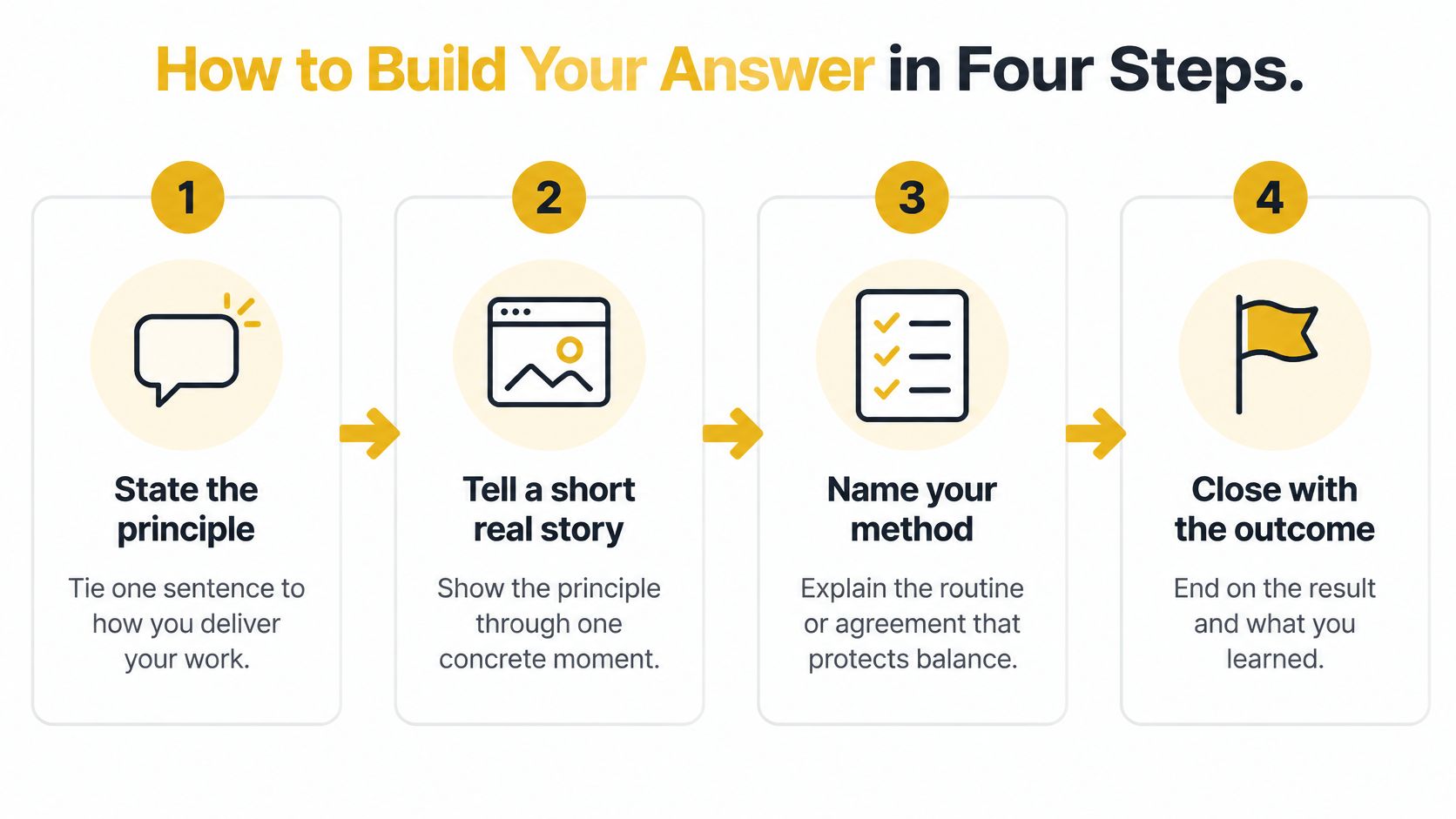
Write it before you say it: draft each of the four steps as a single sentence, then practise until the sentences connect without notes.
- State the principle in one sentence, tied to output. Say something like "I protect two blocks of deep focus a day, because that's what keeps my deadlines honest." That gives the panel a lens for everything that follows. A principle such as "I believe balance matters" gives them nothing, and it's the most common opener in circulation.
- Pick one real situation with a stake. Recent beats impressive. There should be a deliverable on one side and a personal commitment on the other, with a date attached. The usual slip is choosing a story where you refused something, which reads as a boundary boast rather than judgment.
- Explain the rule you used and who you aligned with. State which commitment took priority, why, whether you renegotiated a deadline or escalated, and who you told. This is the part being scored: judgment under load, plus the communication wrapped around it.
- Close with the result and the change you kept. "The deadline held at the same quality." "Overtime went from four evenings a week to one." A result without a baseline is a claim. A result measured against a baseline is evidence.
Four steps won't address a conflict that was stressful rather than merely badly scheduled. If your story is about recovering from a heavy stretch, the managing work stress strategies guide from Therapy with Ben goes further into the recovery side than an interview answer should.
The structure isn't cosmetic. The U.S. Office of Personnel Management's guidance on structured interviews reports that structured interviews built from job analysis and competency-based behavioral or situational questions produce higher validity, rater reliability and rater agreement, while reducing adverse impact. For complex professional and managerial roles, behavioral questions carry particularly strong validity because they test behavior in circumstances resembling the job rather than abstract preferences.
Write the four sentences into a document and cut anything that doesn't attach to a date, a name or a number. What survives is your answer.
Sample Answers You Can Adapt
Four worked answers, each built from the same four steps and each roughly 110 words, which sits comfortably inside the length that keeps an interview answer easy to follow.

Early career, final-year exams. The conflict is a shift swap colliding with a project deadline, and the method is agreeing the plan before the week gets busy.
"My rule is that the week gets planned before it gets busy. During final-year exams I'd already agreed to cover a colleague's Tuesday and Thursday shifts at my campus job. In the first week I told my manager which two project milestones I'd hit early and asked to move the third by four days, which she approved. Both milestones landed, both shifts were covered, and I kept the arrangement for the rest of term because it stopped the last-minute swaps."
It works because every element has a date, a number or a named person who agreed to something.
Mid-level manager, meeting load. Here the trade-off is the team's calendar against the manager's own, and the proof is a measurement.
"I protect the team's calendar before I protect my own, because meetings are where focus goes to die. Two sprints ago our weekly status meeting was consuming about six hours a week across nine people. I replaced it with a written update and a 15-minute exception call, and tracked missed deadlines for six weeks. Nothing slipped, so I kept the format and we recovered the time."
The result is comparable to a baseline, which is what makes it credible rather than promotional.
Parent or caregiver, without disclosing family life. The subject stays on coverage and the work impact.
"I plan around a fixed handover window at 5.30pm and a named backup for anything urgent after that. In my last role I agreed the backup with my lead before my first on-call rotation started and documented it so nobody had to guess. Over fourteen months I was contacted after hours four times, all genuinely urgent. My delivery record was unchanged."
Note what's absent: no family details, no medical information, just a mechanism and its track record.
Remote worker, setting response norms. The move is to convert "flexible" into two numbers the team agreed to.
"When we went hybrid I asked for two things: four core hours when everyone is reachable, and a four-hour response window for anything that isn't urgent. I put both numbers in the team wiki and reviewed them after a month. After-hours messages to me dropped from most evenings to roughly two a week, and the project still shipped on the original date."
A before-and-after figure does more work than any statement about respecting boundaries.
Score Your Answer Before the Interview
Record the answer once, on your phone, with a 90 to 120 second timer running. Most first attempts run to three minutes, all principle and no story. Then score the recording rather than replaying it until it sounds smooth, because fluency is the variable a panel cares about least.
Build a two-column evidence log beside the recording. In the first column, list the conflict, the constraints, the actions and the outcome. In the second, map each element to the competency it demonstrates: prioritization, communication, resilience, judgment, sustainable performance. Anything that maps to no competency gets cut.
Work life balance answer scoring rubric
| Criterion | 0 points | 1 point | 2 points |
|---|---|---|---|
| Specificity of context | Generic claim such as "I manage my time well" | Real situation with a vague timeframe | Dated, specific situation with the stakes stated |
| Explicit prioritization criteria | No decision rule given | Rule named but not applied | Rule stated and applied to the trade-off |
| Stakeholder communication | No mention of other people | Manager informed after the fact | Deadline or scope negotiated with the people affected |
| Boundary-setting | Claims unlimited availability | Describes a limit without an action | Shows a limit that held, with the protected time named |
| Measurable outcome | No result given | Result given without a baseline | Result compared with a baseline, such as a deadline met or overtime reduced |
The benchmark behind this approach is worth knowing. An analysis of structured interview validity places structured interviews at approximately 0.42 validity for predicting job performance, against about 0.19 for unstructured interviews. The gap exists because structured formats compare evidence on consistent criteria instead of rewarding presence.
Hand the recording to a friend, a mentor or a practice partner and ask them to score the five criteria, not to rate how it sounded. Fitting the reps to the format helps: in Interview Pilot's question bank you can search questions by their wording and filter by Question Type, such as Behavioral, Technical or Leadership, so the same four-step answer gets rehearsed in the style the panel will use.
Set a target of 8 out of 10 or better, with no zeros, and confirm the answer contains one concrete trade-off, one named decision rule and one measurable result. If you're below target, pick the two weakest criteria and fix only those before the next rehearsal. Practising in front of a person who scores you beats another online mock interview where nobody writes anything down.
Mistakes and Special Cases That Change Your Answer
The most damaging mistake is claiming perfect equilibrium. It sounds rehearsed, it hides the trade-offs every real role involves, and experienced interviewers hear it as a candidate who hasn't yet managed anything difficult.
Common work life balance answer mistakes and fixes
| Mistake | Why it backfires | Better version |
|---|---|---|
| Claiming perfect equilibrium | Sounds rehearsed and hides real trade-offs | Name one trade-off you still manage and how |
| Presenting balance as lower commitment | Signals you will step back when work peaks | Frame balance as the method that keeps output steady |
| Criticizing a former employer | Reads as a risk in the next hire | Describe the constraint, not the people |
| Overdisclosing family or health details | Shifts focus and invites unfair assumptions | Describe the coverage plan and the work impact |
| Confusing flexibility with unlimited availability | Sets an expectation you cannot keep | State your response window and escalation path |
Where boundary-setting power actually differs
Advice that stops at "turn off notifications" ignores who can safely do that. A 2025 workforce survey reported that 71% of employees work outside scheduled hours at least weekly, while only 41% feel comfortable setting workplace boundaries, with executives substantially more comfortable at 62%, as covered in reporting on overtime becoming normal. The same survey notes that remote and hybrid arrangements can blur when the working day starts and ends.
That reality changes what you should say. During probation, a promotion cycle or an active job search, frame limits as a process that keeps output steady rather than a refusal. Junior staff, contractors, non-native speakers and people in high-availability roles have less room to push back, and an answer that pretends otherwise sounds naive to anyone who has managed a team.
If your schedule involves irregular hours, sleep is the first thing that breaks, and the SleepHabits guidance for restless sleepers from SleepHabits covers the recovery side. In the interview, keep any boundary claim attached to a mechanism.
Make the limit mechanical: a four-hour response window, a meeting-free morning, a named backup for urgent issues. Mechanisms sound credible. Vague preferences sound defensive.
Ask Back and Rehearse Before Your Next Interview
Your answer can only prove how you behave. It can't tell you whether this employer's balance claims will survive contact with a busy quarter. Four questions settle that, and none of them sound like an accusation.
- After-hours messages. Ask what the team's norms are for messages sent outside working hours and who enforces them.
- Meeting-free time. Ask whether any part of the week is protected from meetings, and how often that protection holds.
- How performance is judged. Ask whether success is measured by output or by hours visible online.
- A worked example. Ask for a recent case of someone on the team taking leave without a penalty attached.
Listen for specifics in the reply. "We trust people to manage their time" is a preference. "The on-call rota is published monthly and the backup is named" is a mechanism, and mechanisms are what hold up when the quarter gets busy.
Caregiving raises the stakes even if you never say the word. Recent workforce research found that 48% of employees have caregiving responsibilities, according to the JLL workforce preference barometer, and caregivers report distinct needs, including 42% who want short-notice paid leave and 43% who want greater hybrid flexibility. The same research found that only 49% of workers currently have access to flexible working hours, despite 57% saying flexibility would improve their quality of life. So test the structure rather than the promise: who covers the workload, what the predictable pattern looks like, and whether the manager supports it.
Framing these as operating questions rather than culture questions gets you more honest answers, and the questions worth asking about company culture give you a wider set to draw on. If balance is the deciding factor in your search, the reVIBE Mental Health burnout reading guide covers what sustained overload does and how people recover from it.
Three things before your next interview. Write one four-step answer for the wording you expect, have someone score it against the rubric, and carry these four ask-back questions into the room. Then run the whole thing aloud at least once, because an answer that reads well on paper can still stall on a number or a name you have not rehearsed.
Interview Pilot is built for this kind of preparation. You can rehearse the work life balance question inside a guided mock interview, pull variations from a question bank you can filter by Behavioral, Technical or Leadership type, and rehearse how your answer's evidence reads before your next panel. Visit Interview Pilot to start a practice session.



Topics
work life balance question
interview preparation
behavioral interview
interview answers
job interview tips
Continue reading

Interviews
What Makes You Unique Sample Answers: 8 Proven Examples
8 what makes you unique sample answers for technical, finance, product, and junior roles, with analysis and tips to tailor each one to your interview.
November 4, 2026
17 min read

Interviews
8 Star Method Examples for Behavioral Interviews
Explore 8 star method examples for behavioral interviews, with annotated Situation, Task, Action, Result answers and tips to adapt each story.
September 17, 2026
25 min read
Interviews
Who Are Your Heroes: How to Answer in Any Interview
Learn how to answer "who are your heroes" in interviews with confidence. Get practical examples, a simple structure, and tips to stand out in 2026.
September 6, 2026
12 min read