















AI Tools
7 Product Management Mock Interview Tools for 2026
Compare 7 product management mock interview tools for 2026, from AI voice practice to human coaching. See formats, feedback styles, and how to pick one.
Interview Pilot Editorial Team
Updated November 27, 2026
18 min read
You've read 300 product sense prompts. You can recite CIRCLES, RICE, and a STAR story about an onboarding drop-off. Then the interviewer leans in and asks, "You said activation improves. What happens to retention if you're wrong, and which metric would you trade?" Your answer stalls.
That's not a knowledge gap. It's a rehearsal gap. Reading questions trains recognition; interviews test production, under time pressure, with someone watching and pushing on exactly the part you glossed over.
The seven tools below build that pressure in different ways. Some give you spoken follow-ups from a machine. Some force written structure. One puts a live peer on a video call. Another puts a working PM coach on the other side of the table. Judge each by what it lets you rehearse, then by how much you should trust what it tells you.
Keep a short checklist in mind as you read: does it make you speak out loud, does it follow up on your reasoning, does it score against a stable rubric, can you repeat the same format next week, and does the feedback separate content quality from delivery style? That checklist is the whole comparison.
1. Interview Pilot
Interview Pilot is an AI interview assistant built for candidates who want structured preparation and real-time support during online interviews. Its Interview Copilot generates suggested responses to technical and behavioral questions, using your profile and documents to tailor each answer, and you can adjust tone, depth, and focus for the role in front of you.
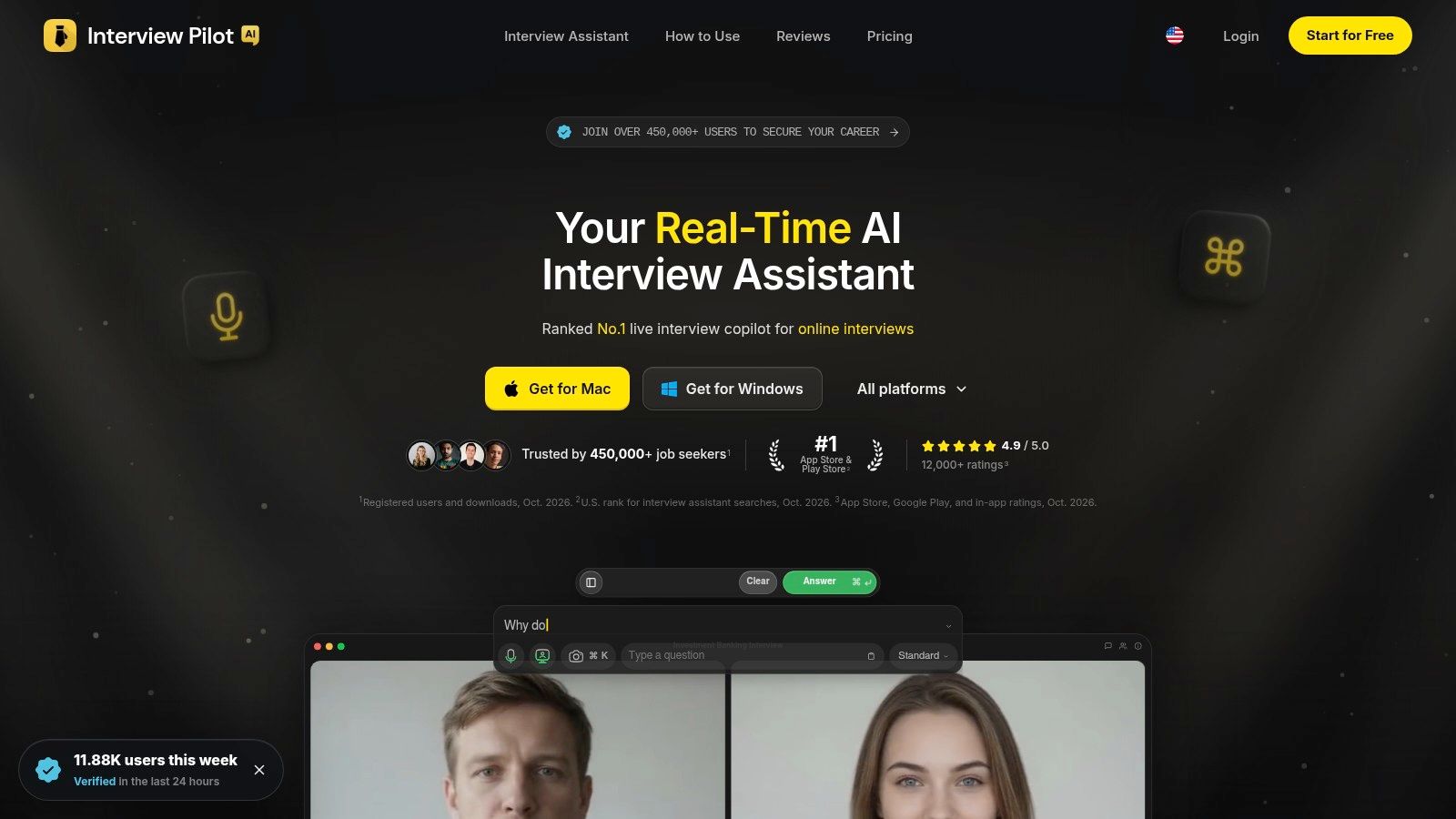
What it lets you rehearse is a full hiring loop rather than a single case format. Mock interviews and the question bank share one profile with the live copilot, so the preparation work and the live support draw on the same background material.
For practice rather than live support, it pairs guided mock interviews with a question bank of roughly 10,000 questions covering product management alongside software engineering, data, finance, consulting, and project management. Sessions run in more than 99 languages and a range of accents, on macOS, Windows, iOS, and Android.
Why the full loop matters more than one case
The same field guide to the PM interview process, built on an analysis of 1,765 product-manager job descriptions, found the median hiring process ran four steps, most commonly three to five, with recruiter screens, product sense cases, hiring-manager rounds, and analytical assessments recurring. Only about 4.5% of postings documented a structured process at all.
That unpredictability is the case for rehearsing the whole sequence rather than one design question. Behavioral screen first, then product sense, then execution and prioritization, then metrics. Each round punishes a different weakness, and a candidate who only drills product design arrives at the analytics round with nothing prepared.
Practical rule: If a tool only lets you practice one round, you're rehearsing the part of the interview you already find easiest.
- Live support: context-aware suggestions keep your train of thought when an interviewer interrupts mid-answer.
- One profile, two uses: mock interviews and a large role-specific bank sit in the same product, so practice and live support share your background and documents.
- Read feedback as coverage, not polish: AI suggestions and model answers are strongest on content structure. They will not catch a flat delivery or an answer that sounds recited, so review your own recordings before trusting the score.
- Check pricing first: plan tiers include Free, Weekly, Monthly, and Yearly options, and I'd compare the paid tiers on the plan page before committing.
- Check the rules: using AI suggestions during a live interview may be restricted by an employer or platform. Confirm what's allowed, and never read out an unverified answer.
The site reports more than 450,000 users across technical and non-technical roles. If you're weighing it against practice-only apps, this roundup where you can find mock interview AI apps covers the category.
Website: interviewpilot.app
2. Soreno
Soreno suits a PM candidate whose answers read well on paper and fall apart under spoken follow-ups. It runs browser-based voice practice for product management interviews, with an AI interviewer that responds to your reasoning instead of marching through a fixed script. That matters because product sense interviews rarely end after the first answer. The interviewer probes trade-offs, metrics, edge cases, and priorities, often before you have settled your own view.
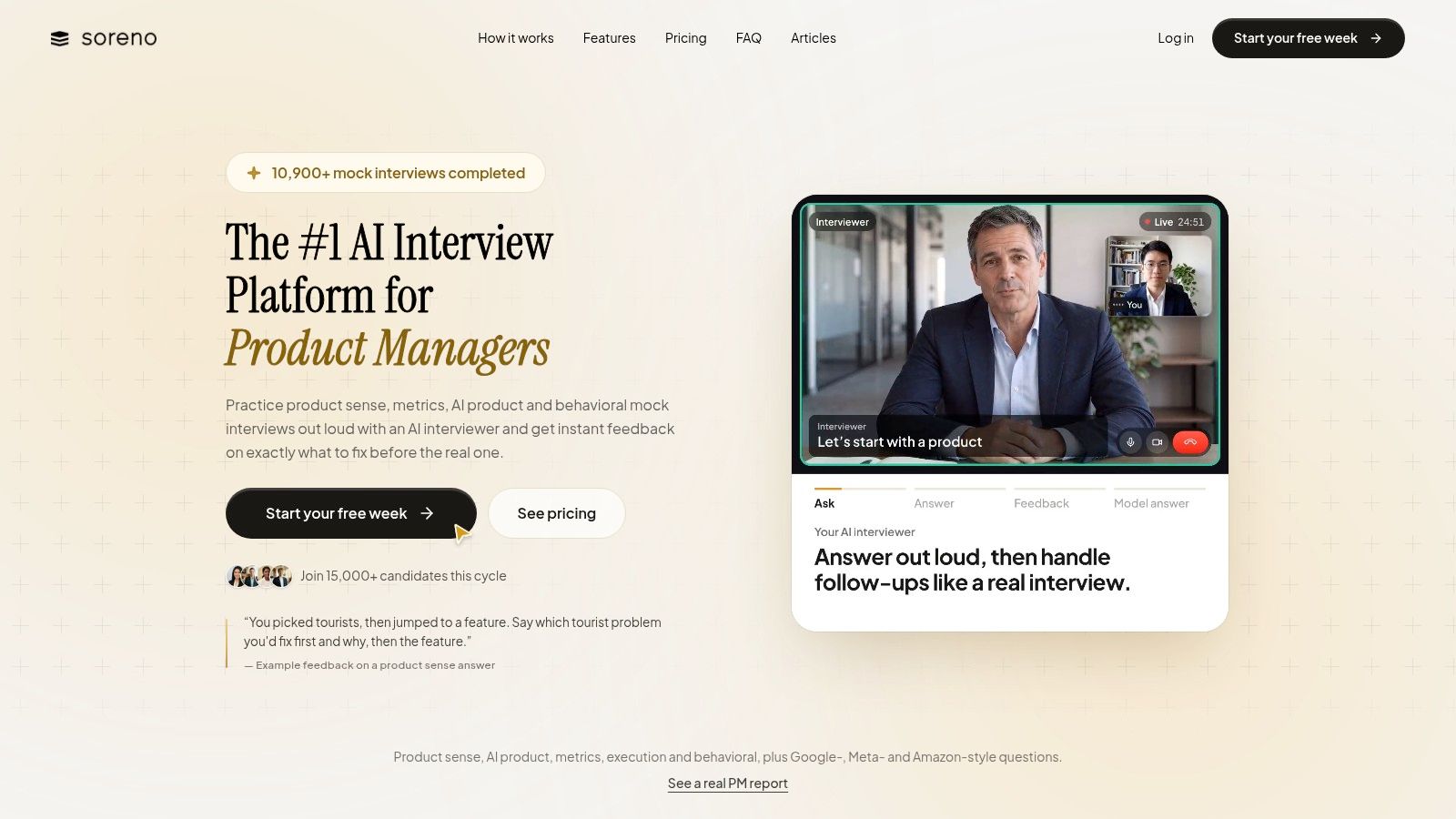
The question library supports general PM practice with model answers near the exercise. Each session returns a score, quoted excerpts from your answer, and suggested improvements. Recordings, transcripts, and reports are saved, so you can hear the same weak transition across sessions instead of guessing at it. I would use that archive as the product's real value. A single score tells you little; three transcripts with the same vague pivot tell you what to fix.
What a follow-up actually trains
A follow-up is where product judgment shows. The first answer is prepared; the second one isn't. Voice practice is the format that reliably reproduces that pressure, because you have to hold structure while someone challenges your assumptions.
The evidence for structured rehearsal is old and consistent. A meta-analysis of interview validity covering 160 studies and 25,244 applicants and employees put overall operational validity at about 0.37 for predicting job performance, rising to 0.44 for structured interviews and falling to 0.33 for unstructured ones.
Practical translation: consistent, job-related criteria beat fresh conversations every time. Soreno's scoring is an attempt at that consistency, which is why you should repeat the same question type instead of sampling randomly. Use one rubric: problem framing, user insight, solution choices, trade-offs, metrics, and a clear close. Then compare transcript excerpts, not moods. If the platform praises a confident answer with weak metrics, discount that feedback. If it flags a transition you also hear, fix that before adding new questions.
- Best for: spoken product sense and AI product rounds where you need to hear your own reasoning out loud.
- Weak spot: a machine score is not an experienced interviewer's judgment. Treat it as a smoke detector, not a verdict.
- Gap: the base flow has no live human coaching, so nobody catches every cue a person would notice.
- How to read feedback: accept comments that point to a specific sentence or pattern. Ignore broad encouragement with no evidence in the transcript.
If you want a question set to feed into voice practice, this set of product sense interview questions is a reasonable starting bank.
Website: Soreno
3. PracticeLoop AI
PracticeLoop AI does one thing narrowly: it puts you in a spoken mock, then writes down what you did. You pick a session type and a length, run product sense, AI product sense, or behavioral scenarios, and get a debrief naming strengths, areas to sharpen, and one next step.
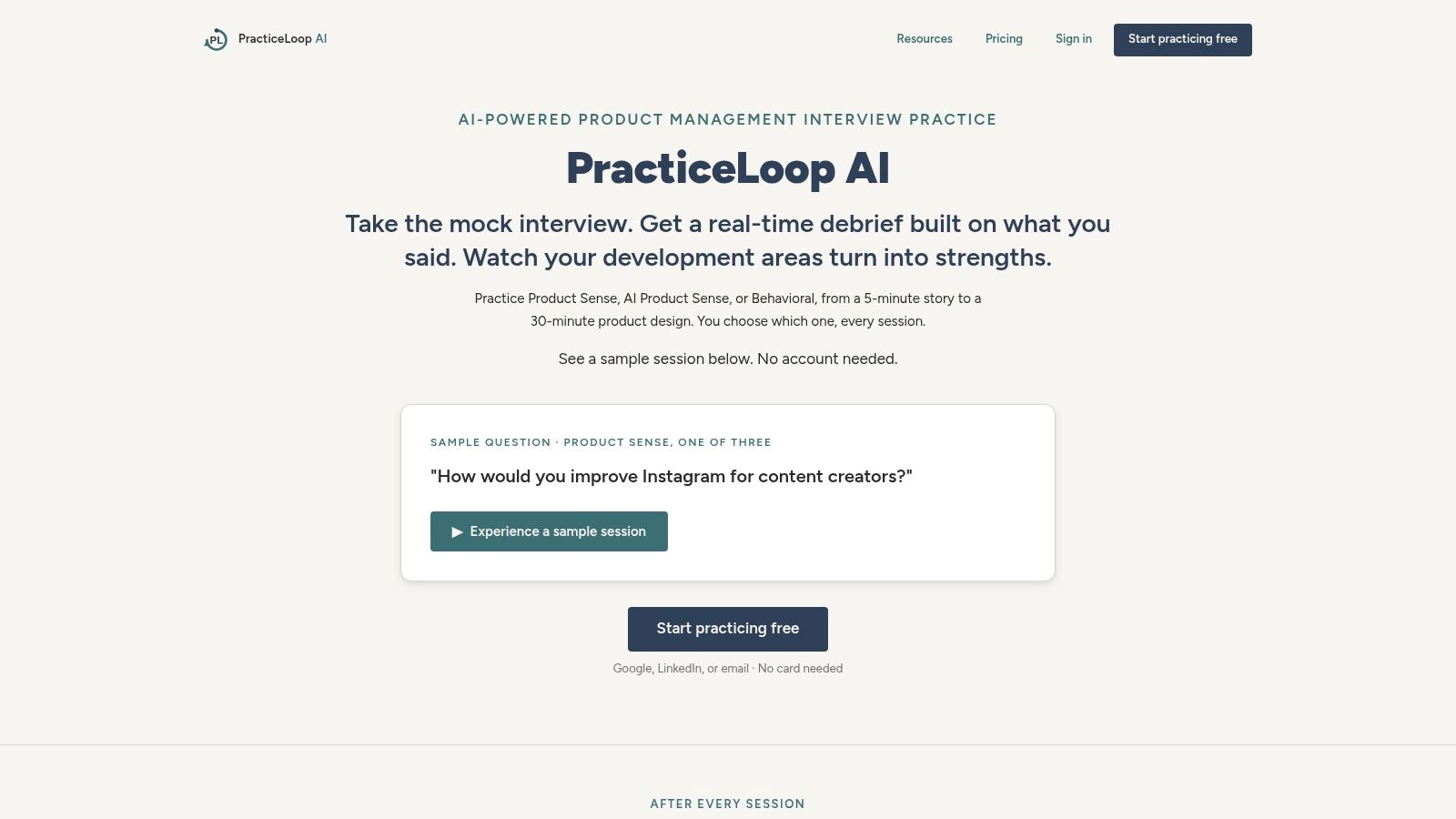
The skill board is the part worth your attention. It tracks development areas across sessions, which turns practice from a string of one-off performances into a trend line you can read.
The case for repeating one format
Candidates ask how to know whether a mock answer was good. The honest answer is that you can't, if every mock is a different conversation scored against different criteria.
A comparison of structured and unstructured interview validity reports roughly .42 for structured interviews against .19 for unstructured ones. Interviewers get more signal from consistency. So do you.
Consistency is what makes this week's score comparable to last week's.
- Free entry point: one complete session without a payment card, which is enough to judge whether the debrief is specific or generic filler.
- Weak spot: the free tier stops at that single session, so a two-week loop means paying.
- Weak spot: AI debriefs can be flat wrong about nuance and say nothing about how you'd perform with a real interviewer in the room.
One note on the scaffolding around your prep: if you're publishing a practice log or a personal site to keep yourself accountable, an AI website and funnel builder handles that side so your notes live somewhere you'll revisit.
For a wider look at app-based formats, this guide to mock interview apps compares them.
Website: PracticeLoop AI
4. Mocked
Mocked leans on volume and breadth. It advertises a provider-described bank of 600+ curated PM questions across product design, strategy, analytics, and behavioral topics, and you answer verbally while AI follow-ups push you deeper into your own reasoning.
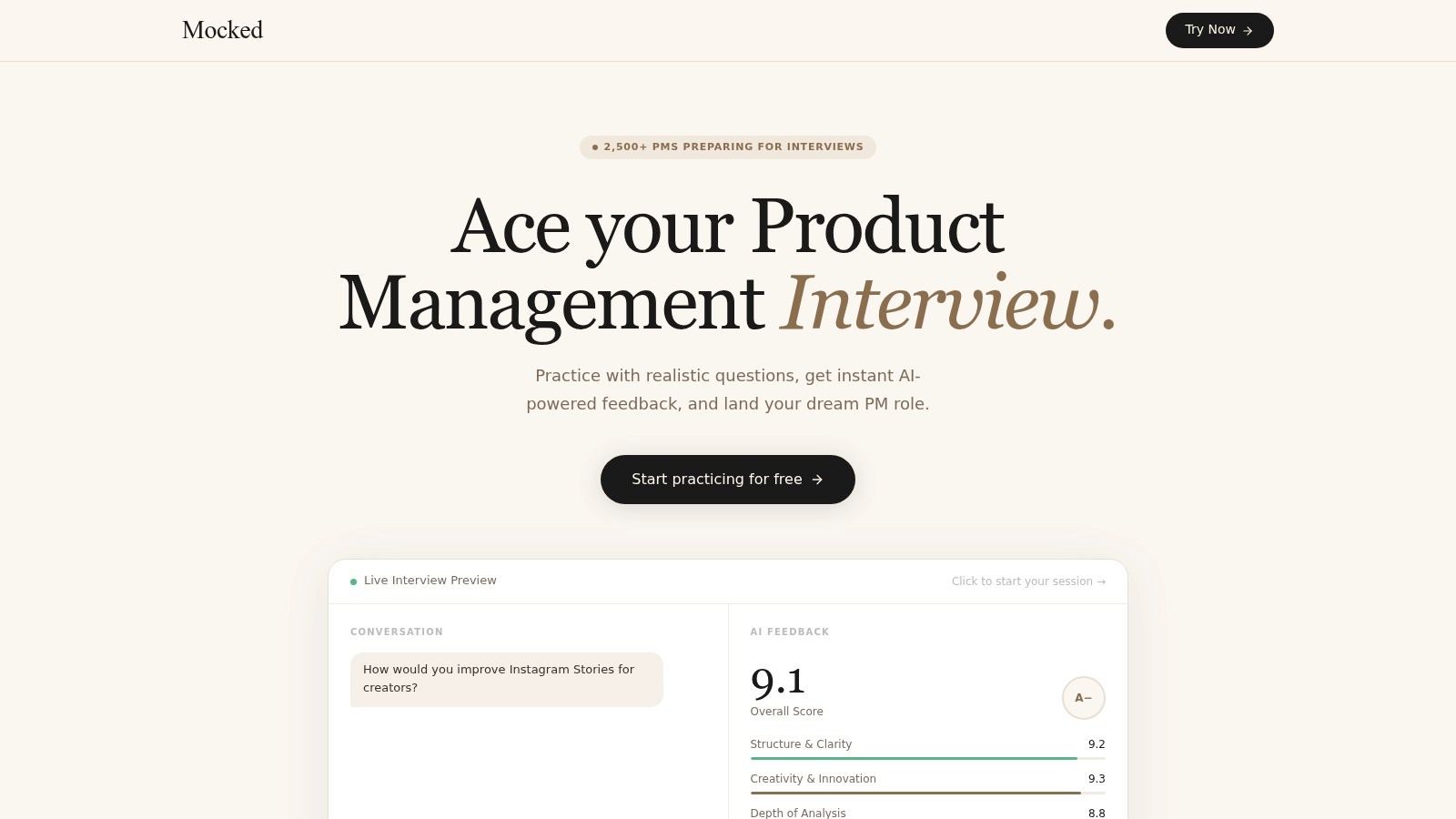
Feedback covers structure, clarity, creativity, and depth. Free practice is advertised, which makes it a low-risk way to find out whether spoken AI practice suits you at all before you spend anything.
Breadth is only useful if the rubric holds still
A large question bank is worthless if the scoring moves under you. What you want is a competency map you score against repeatedly, so a weak answer points at a skill rather than a mood.
Productside's skills assessment reports that more than 4,000 product professionals have completed its Individual Skills Assessment, which benchmarks managers across 15 skill sets including discovery, prioritization, stakeholder communication, and analytics.
You can borrow that structure without touching their product. Score each answer from 1 to 5: 1 for missing or unsupported reasoning, 3 for a coherent answer with thin trade-offs, 5 for explicit assumptions, quantified success metrics, alternatives considered, risks named, and a clear recommendation.
- Best for: candidates who freeze because they haven't said the words out loud enough times.
- Weak spot: current paid-plan pricing isn't clearly shown, so cost comparison is guesswork.
- Weak spot: independent reputation evidence is thin. Treat the scores as practice aids, never as hiring predictions.
Website: Mocked
5. AllthingsPM
AllthingsPM starts from the job description, which is the right starting point for a specific opening and the wrong one for general skill building. Its mock interviews can be built from a real posting, and you answer by typing or speaking, with scored feedback afterward.
The free account includes one mock interview a day, according to its pricing page. That cadence is realistic. Short daily reps beat one three-hour cram session, and the habit is easier to keep when the next rep costs nothing.
The strategy gap most candidates underestimate
Feature creativity gets rehearsed to death. Commercial reasoning doesn't, and that's the mismatch worth fixing.
A cited Productboard chief product officer survey, reported in a product management career guide, found that 59% of product leaders ranked strategy and business acumen as the most important skill for product leaders over the following two to three years.
That's why job-description-based practice helps more than it looks like it should. Postings name the business problem the role owns, and answering against that framing forces you to talk about outcomes instead of feature lists.
- Best for: candidates with a live loop and a specific target role they can paste in.
- Trade-off: the question bank and course content may be more than you need if you only want mocks.
- Weak spot: AI-generated scores aren't an expert coach's evaluation, and independent validation of the catalog claims is limited.
Typed answers are underrated. They expose structural weakness that speaking hides, because you can't smooth over a missing trade-off with confident delivery. If you want human eyes on that structure, product manager interview coaching is the comparison worth reading.
Website: AllthingsPM
6. Aced
Aced is the one on this list that puts another person on the call. It schedules live video mock interviews with other candidates, and the format is reciprocal: you interview them, they interview you, and you both give feedback afterward.
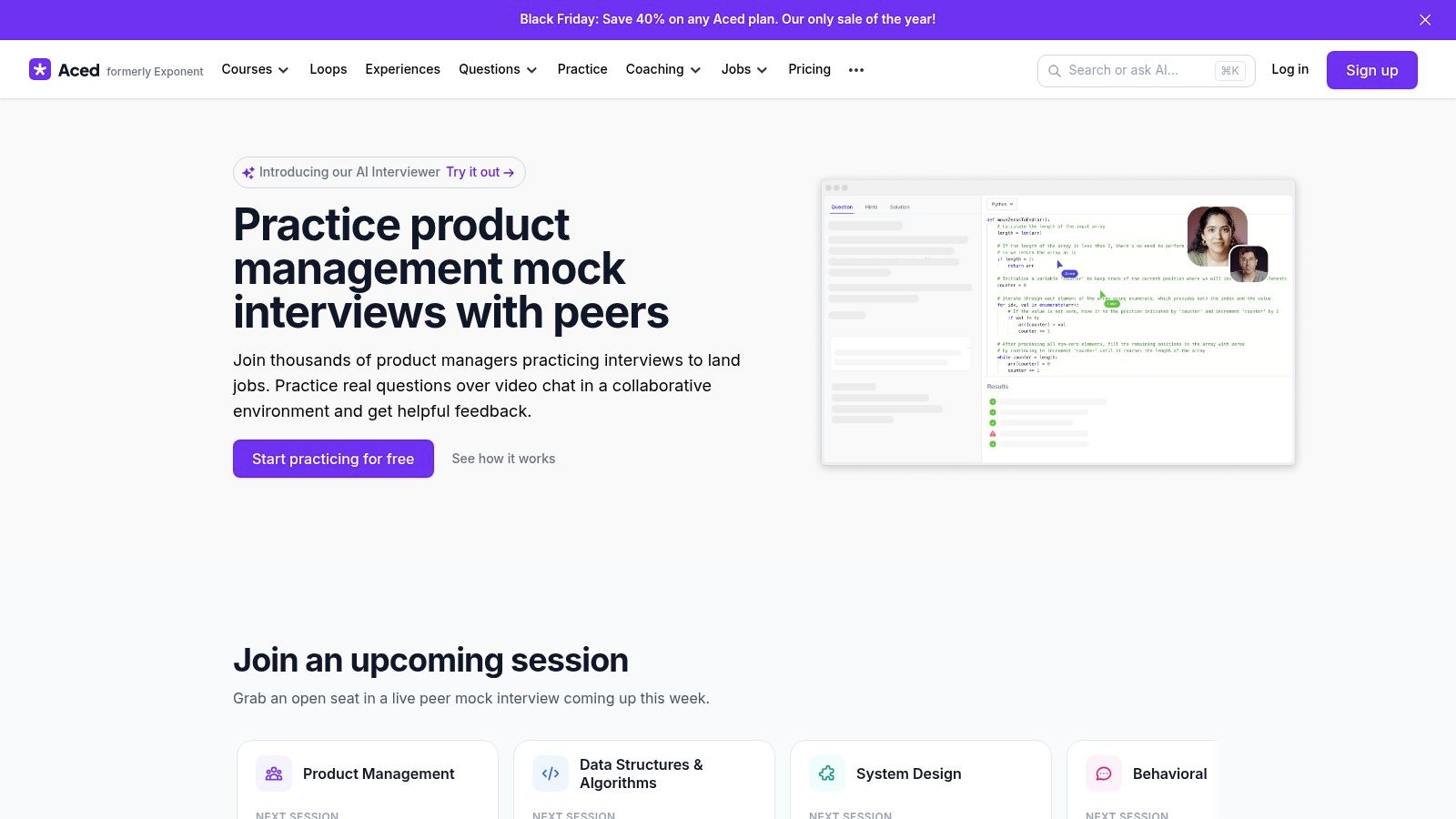
That reciprocity is the feature. Interviewing someone else teaches you what a weak answer sounds like from the outside, which lands faster than being told about your own.
What peer practice buys you
Scripted follow-ups have a tell. A person doesn't. Peer sessions reproduce the interruptions, the odd pivot, and the interviewer who rewards confident storytelling over analytical rigor, which is the exact failure mode a rubric can't warn you about.
Fit gets tested in the room too. In 2024, 68% of product-management hiring managers identified cultural and domain fit as their top hiring signal, according to TalentTuner's summary of Product School's 2024 State of Product Management report.
You can't rehearse fit against a score. You can rehearse it against a human forming an impression of you in real time, including the parts of your manner that a transcript never records.
Book it late: schedule the peer session for the week before a real loop, not six weeks out. The value is in the recency.
- Best for: candidates who've plateaued on AI feedback and need unpredictability.
- Trade-off: peer feedback quality tracks your partner's experience. A polite partner who never pushes is worse than no session at all.
- Trade-off: scheduled sessions are less flexible than on-demand AI, and some transcript and feedback features are members-only.
Website: Aced
7. IGotAnOffer
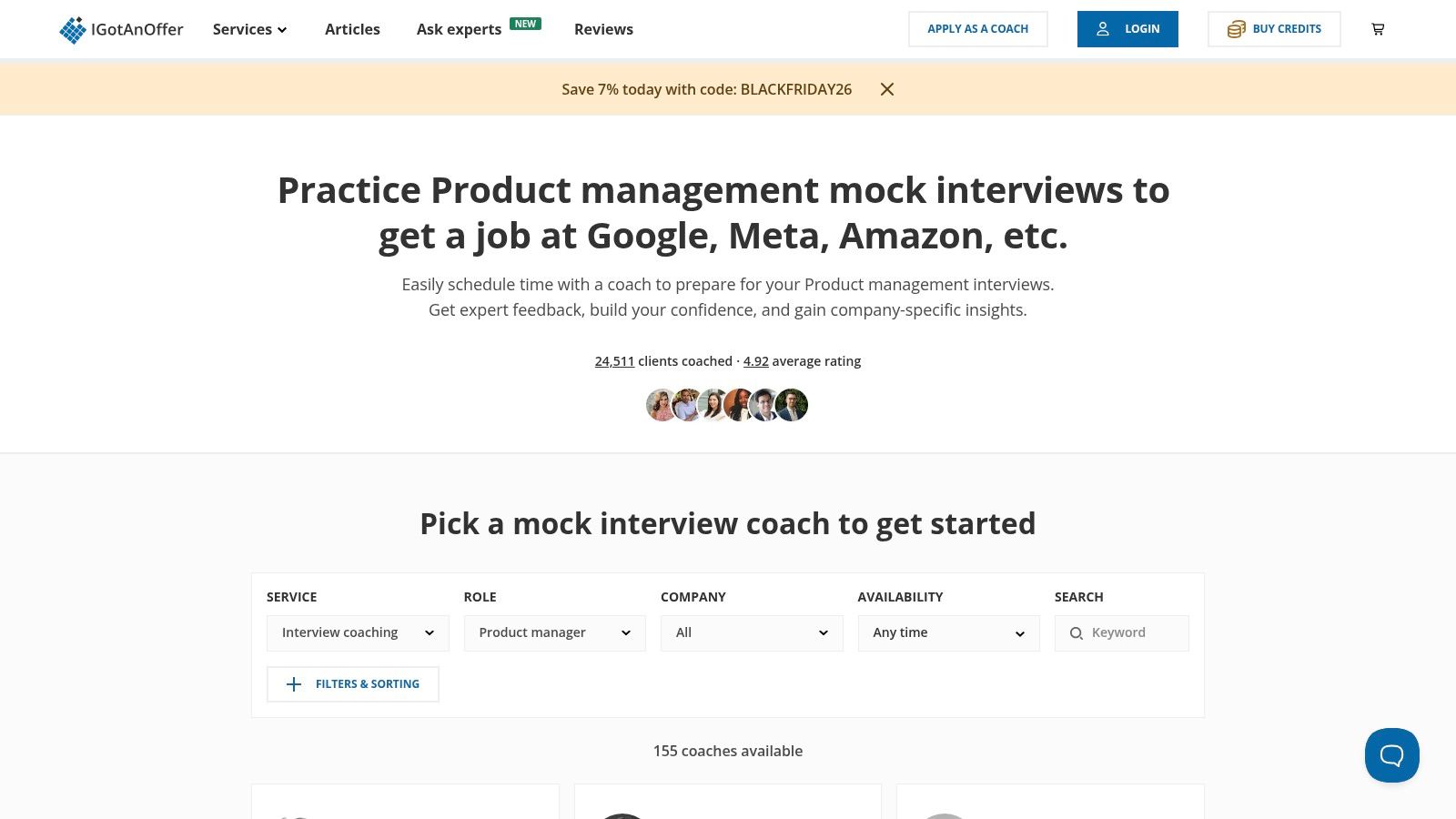
IGotAnOffer sells the expensive, slow, highest-signal option: a one-hour mock with a human product manager, structured as roughly 45 minutes of interviewing and 15 minutes of feedback. You choose the coach from published profiles and backgrounds, so you can aim for someone who has hired for the role or company you're targeting.
Where human judgment earns its price
For AI product interviews, judgment is the whole job. A model that returns a plausible but wrong answer is a product design problem, not a knowledge gap, and the right response depends on latency, inference cost, and user trust trade-offs that no fixed rubric scores well.
The demand is real. A field guide to PM interview trends reports that AI and product-strategy questions tripled since 2023, that AI-related language in PM job postings rose from 8% to 29.5%, and that AI PM roles surged 240% in early 2025.
Generic product-design scripts don't survive those questions. A coach who has shipped a probabilistic feature will catch the moment you say "we'd just add a filter" when the actual problem is evaluation, data quality, or a human-in-the-loop workflow you never mentioned.
- Best for: final-round preparation, career changers, and anyone whose blocker is judgment rather than repetition.
- Trade-off: cost. This is the most expensive format here, and one session gives you limited reps.
- Trade-off: coach availability and quality vary, so read profiles carefully and check the first-session refund conditions before you book.
Website: IGotAnOffer
How the seven product management mock interview tools differ by practice format, feedback type, and free access
The format column matters more than the feature list. A tool that makes you speak under time pressure rehearses a different skill than one that lets you type and edit, and peer feedback carries different weight than a model-generated score. Read the table with that in mind: pick the row whose format matches the skill you're weakest at, then check whether the feedback type is detailed enough to correct it.
| Item | Practice Format | Feedback Type | Free Access | Best For |
|---|---|---|---|---|
| Interview Pilot | Guided mock interviews, question bank, and live interview assistance | AI-generated, profile-tailored answer suggestions | Free plan listed | Multilingual practice and real-time interview support |
| Soreno | Browser-based voice practice with follow-up questions | Scores, quoted excerpts, recordings, and improvement suggestions | No free tier described in this review | Spoken PM practice with progress review |
| PracticeLoop AI | AI-led voice sessions with selectable type and length | Written debrief and skill tracking | One full session | Structured, recurring PM interview practice |
| Mocked | Spoken PM practice with AI follow-ups | Feedback on structure, clarity, creativity, and depth | Free practice advertised | Broad PM question coverage and thinking aloud |
| AllthingsPM | Job-description-based practice with typed or spoken answers | Scored feedback | One mock interview per day with a free account | Role-targeted practice with additional PM resources |
| Aced | Scheduled peer interviews, plus AI practice for selected questions | Peer feedback; some AI feedback features | Limited; some transcript and feedback features are members-only | Live practice with another candidate |
| IGotAnOffer | One-to-one mock interviews with human coaches | Personalized coach debrief | Paid one-to-one sessions | Expert human feedback and tailored coaching |
Three formats rehearse distinct muscles. Voice-first tools (Soreno, PracticeLoop AI, Mocked) train you to think aloud and survive follow-up questions, which is where most written preparation falls apart. AllthingsPM's typed option is useful for tightening written structure before you commit to speaking, and its job-description targeting means the questions track the posting you're applying to. Aced adds something no AI session replicates: another person watching you stumble in real time. IGotAnOffer sits at the top of the cost range because you're paying for a coach's judgment, not for volume of reps.
Weigh the feedback types accordingly. AI-generated feedback is consistent and instant, but it grades against a fixed rubric, so treat scores as directional and pay more attention to quoted excerpts and recordings, which show you what you said. Peer feedback in Aced depends on who you get paired with, so a single session tells you little; patterns across several sessions tell you a lot. A coach debrief is the deepest read you'll get, but one hour is one data point, so arrive with specific questions rather than a general request for impressions.
Whatever platform you end up on, evaluate it with four questions:
- Does it force you to answer aloud, uninterrupted, under time pressure?
- Does it ask follow-ups that react to your answer, or does it read from a fixed script?
- Does the feedback quote or replay your actual words, or only hand you a score?
- Can you compare sessions over time to see whether a specific weakness is closing?
A platform that passes all four is worth paying for. One that fails the first two is a flashcard deck with extra steps.
Build a Two-Week Practice Loop Around the Tool That Fits Your Gap
Diagnose before you buy. If you freeze on follow-ups, choose a tool that makes you speak under pressure. If your answers ramble and never land on a recommendation, choose written structure and a hard rubric. If your content is solid and your presence isn't, put a human on the other side of the call. Candidates often pick the format that feels safest, which can leave the gap untouched.
Run a two-week loop with three timed sessions. Keep the format the same each time, and keep the rubric the same too. Score every answer on problem framing, target user, trade-off logic, metrics, and decisiveness. Write the scores down after each session. The score that repeats is the skill to work on. The score that swings wildly is usually noise from a bad prompt, a hard question, or an off day.
Review recordings for pacing and clarity, not just content. Weak answers often lose the interviewer early, before the analysis gets interesting. Listen for filler, for buried recommendations, and for the moment you stopped qualifying an assumption and started defending it. That last habit matters in product interviews, where the follow-up usually tests whether you can revise your view without sounding unsure.
Treat AI scores as practice signals, never as hiring predictions. A model can tell you that your answer lacked a success metric. It can't tell you whether a hiring manager at a specific company would find your reasoning credible, and it has no idea what that team's current problem is. Use the feedback to choose the next drill, not to decide that you are ready.
Before the interview, put one answer in front of a person. A peer session or a paid coach will surface what automated feedback misses: your pace under interruption, how you handle being wrong, and whether your recommendation sounds like conviction or hedging. Run the loop, check it against human judgment, then walk in with the format already familiar.
Interview Pilot fits candidates who want practice and live support in one place. It includes guided AI mock interviews, a question bank of roughly 10,000 role-specific questions, and Interview Copilot for live online interviews. For this loop, use the guided mock interview and question bank for timed product management practice, then apply the same rubric you would use on any platform. Keep live Copilot use out of the plan unless the employer permits it. You can try Interview Pilot free and see whether the format fits your gap.



Topics
PM mock interview
product management interview
mock interview practice
AI interview practice
PM interview prep
Continue reading
AI Tools
AI Interview Coach: How It Works and How to Choose One
Learn what an AI interview coach does, which features matter, where it falls short, and how to use one ethically before your next job interview.
November 11, 2026
17 min read
AI Tools
Mock Interview App: What to Check in 2026
A mock interview app should offer live help, mocks, and a question bank. See the 2026 feature check and how Interview Pilot compares.
November 1, 2026
15 min read
AI Tools
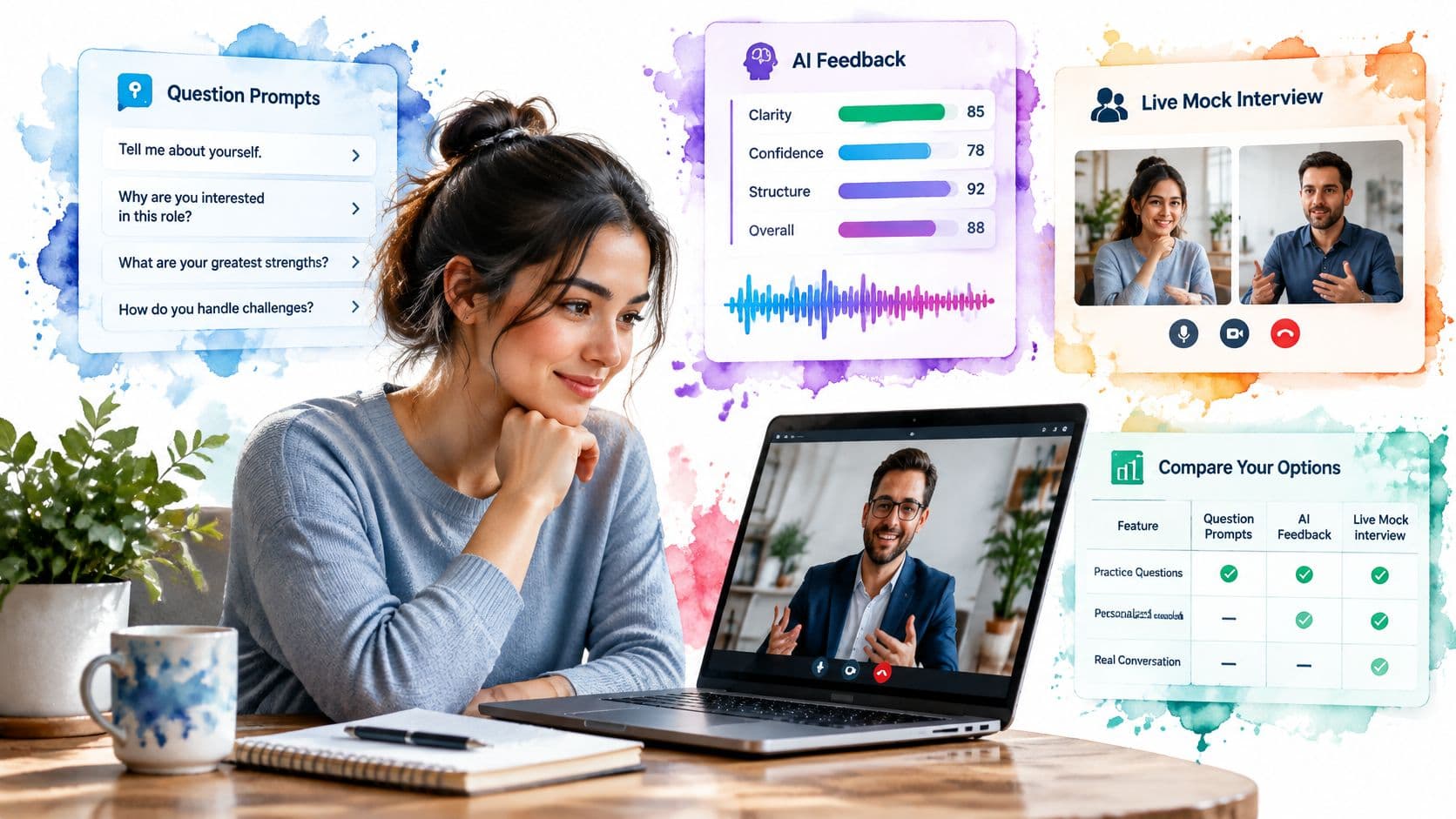
Interview Practice Online: 10 Tools Compared for 2026
Compare 10 interview practice online options, from AI copilots and mock platforms to human coaches, with use cases, limits, and listed prices.
October 24, 2026
17 min read