









AI Tools
Mock Interview App: What to Check in 2026
A mock interview app should offer live help, mocks, and a question bank. See the 2026 feature check and how Interview Pilot compares.
Interview Pilot Editorial Team
Updated November 1, 2026
15 min read
39% of 3,290 job candidates said they'd used AI during the application process, according to Gartner's survey reported in 2025. But using AI to prepare an answer and using it to generate one during an interview are different decisions.
A useful mock interview app helps you practise evidence, judgment, and explanation before someone assesses them. Choose it for what you can learn between attempts, not just how polished its suggested answers sound.
What a Mock Interview App Actually Does
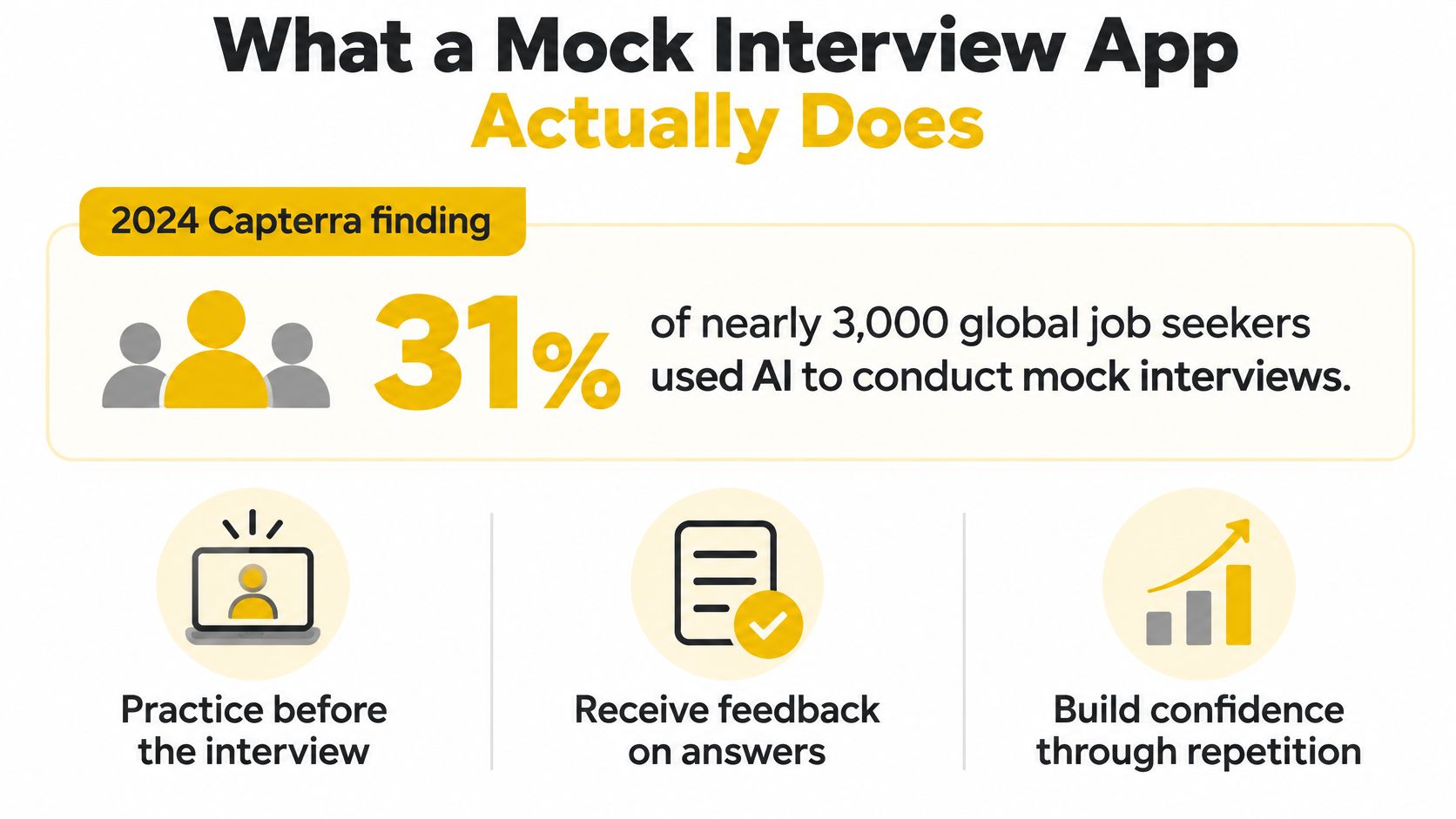
In 2024, 31% of nearly 3,000 global job seekers surveyed by Capterra used AI to conduct mock interviews, according to coverage of Capterra's Job Seeker AI Survey. That makes simulated interviews a familiar preparation method, not merely a novelty.
Think of the software as a flight simulator for interview conversations. You practise handling a situation, receive feedback, and try again without putting a real opportunity at stake. The simulator can expose a weak response, but it can't supply the experience you'll need to explain when an interviewer probes.
The distinction between practising and receiving assistance matters.
A question list isn't a simulated interview
Say you're preparing for a product management interview about prioritising competing requests. Reading a prompt helps you recognise the topic. Answering aloud, being interrupted with a follow-up, and discovering that you never explained your decision criteria is a different exercise.
Tools that appear similar can serve different purposes:
- Question lists expose you to prompts and possible topics.
- Live copilots suggest wording while a real interview is underway.
- Mock sessions ask you to answer, introduce constraints, and evaluate the attempt so you know what to change.
For a video round, rehearse with a camera, a clock, and an unexpected follow-up. A silent written script won't reveal whether you lose your thread when someone asks why you rejected another approach.
Choose by the task you need to rehearse
Start with these checks: live help, guided mock sessions, a role-specific question bank, and language or accent support. Then examine practical constraints such as device compatibility, recording, and review.
Practical rule: A good practice session should leave you with a specific revision, not merely a reassuring score.
Use the comparison table below as a decision tool. Identify the capability you need before deciding whether a product fits your preparation.
Features Worth Comparing Before You Download
Mock interview app capabilities to compare
| Capability | What good looks like | Interview Pilot |
|---|---|---|
| Live help | Instant suggestions shaped by resume, role, job description, and tone, spoken in the candidate's own words | Interview Copilot on Mac, Windows, iPhone, iPad, and Android |
| Guided mock sessions | Timed prompts, follow-ups, and an evaluation of the answer given | AI mock interviews with answer evaluation; audio recorded for the Delivery Score |
| Question bank | Thousands of role-tagged questions, not one generic list | Approximately 10,000 questions, with full access on paid plans |
| Languages and accents | Prompts and answers in the languages the interview actually uses | More than 99 languages and support for diverse accents |
| Devices and review | Practice and live help on desktop and phone, plus a replay | Mac, Windows, iPhone, iPad, Android, and web; one subscription; transcript and Copilot answers saved |
| Privacy and uptime | Stated encryption and a public availability figure | Stated industry-standard encryption; public reporting lists recent 90-day availability at 99.99% |
Match the capability to the interview
Live help is a distinct product choice. Our Interview Copilot generates suggestions customized to your resume, target role, job description, and preferred response style. If you're permitted to use it, treat the suggestion as input you must understand, not a script to recite.
Guided mocks should evaluate the answer you gave. We offer AI mock interviews with answer evaluation, and there's an important recording detail: mock answers are recorded even when Record Interview Audio is off, because the evaluation's Delivery Score is judged from that recording. Know this before practising with sensitive examples.
Question-bank breadth matters only when you can find relevant prompts. Our role-specific question bank covers investment banking, product management, software engineering, data roles, consulting, business analysis, financial analysis, and project management. Browse your target discipline rather than treating the full collection as a completion checklist.
Check the practical fit
Language support should match the conversation you expect to have. Test an answer containing your industry's terminology, your natural pronunciation, and any language switching you anticipate. A supported language doesn't guarantee that every specialist term will be transcribed correctly.
Devices and review affect whether practice fits your routine. One subscription works across our supported platforms, so you don't need separate subscriptions for desktop and mobile use. Check which device you'll use to answer and which you'll use to inspect the session afterward.
Privacy and reliability deserve separate attention. Encryption describes a security measure, not permission to upload an employer's confidential material. Replace customer names, private financial details, and unreleased technical information with safe descriptions.
A historical uptime figure also isn't a guarantee that your connection, microphone, or permissions will work during a particular call. Test those locally.
The purchasing rule is simple: use live help only if the employer allows it; use mock sessions and the question bank for preparation either way.
Structured Practice and the Feedback Loop
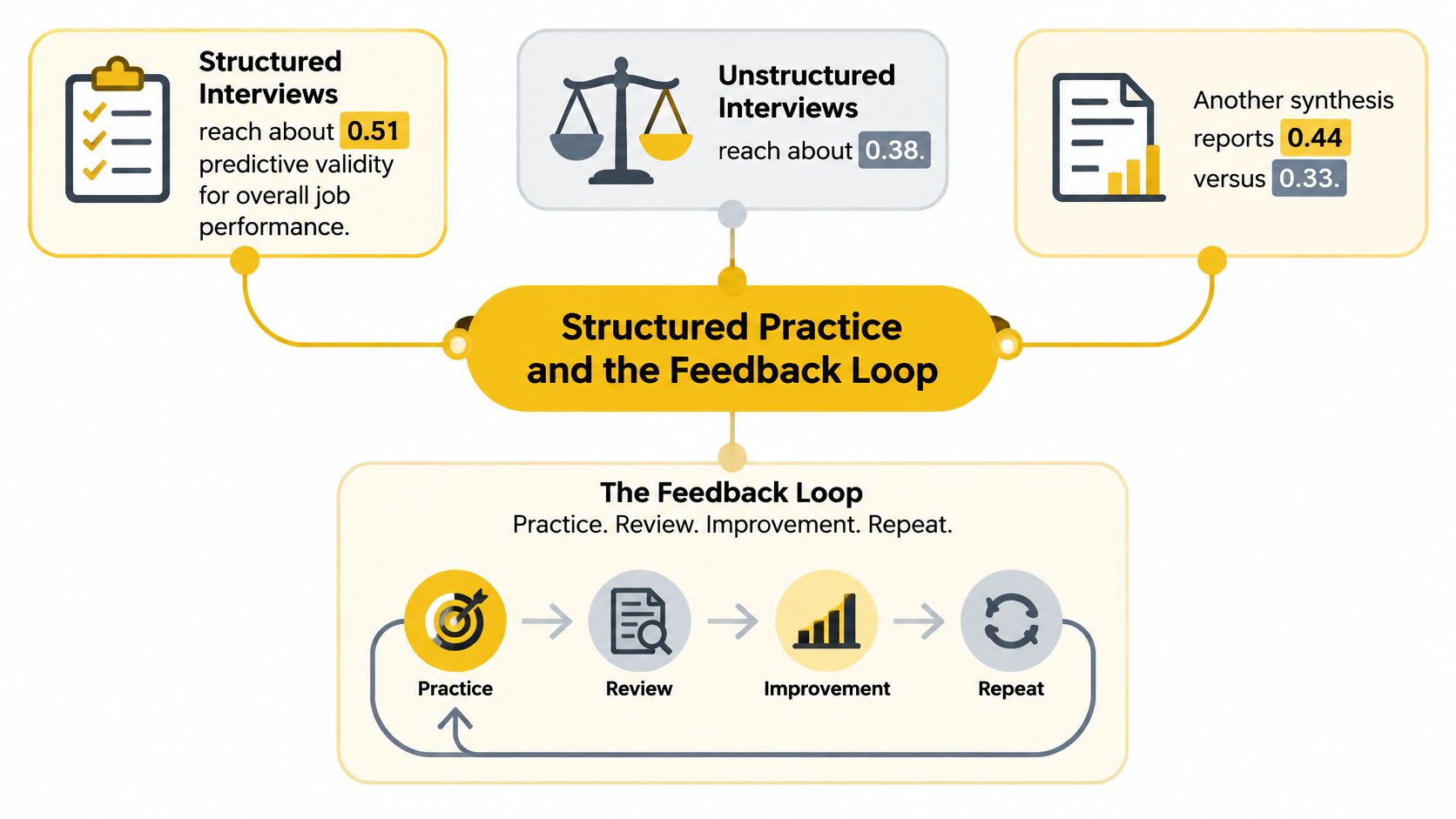
Structured interviews reach approximately 0.51 predictive validity for overall job performance, compared with 0.38 for unstructured interviews, according to a review of employment-interview evidence. Another synthesis covered there reports 0.44 versus 0.33, while a later review's mean near 0.42, with substantial variation, cautions against treating every implementation as equally dependable.
These are validity coefficients, not success percentages. They concern assessment of job performance, not proof that an app will improve your hiring chances. Their practical lesson is narrower: organise practice around relevant competencies and consistent evaluation rather than an improvised conversation.
Build a rubric before chasing a score
A useful mock interview app should keep the target competency and difficulty comparable across attempts. Otherwise, you can't tell whether you improved or received an easier question.
For software and data roles, separate coding or SQL accuracy, system design or experimentation, and communication. For consulting and product roles, distinguish structure, evidence, and judgment. A polished explanation can contain a faulty assumption; a hesitant explanation can contain a sound solution.
A single overall mark hides those differences. Look for feedback on relevance, evidence quality, organisation, technical accuracy, and clarity, and ask what observable part of your answer supports each judgment.
The practice cycle should connect those dimensions rather than reduce everything to one score.
Treat an automated score as a practice signal, not a hiring prediction. Unless the scoring system has been checked against qualified human ratings, a precise-looking number doesn't establish that the judgment is correct.
Run a deliberate practice cycle
Pick one role and one competency. Choose something narrow enough to assess, such as explaining an experiment's limitations or resolving a stakeholder disagreement. A generic goal like improving interviews gives you no clear correction target.
Load the resume and job description. Identify the relevant requirement and the experience you can use to demonstrate it. Remove confidential details and check that the app hasn't inferred responsibilities you never held.
Answer aloud with a timer and a follow-up. Ask the simulated interviewer to challenge a decision rather than request more detail. For example, have it ask why you chose a phased rollout instead of a full launch.
Inspect the evidence. For behavioral answers, check situation, task, action, and result, the STAR framework. For technical answers, inspect assumptions, approach, complexity, trade-offs, and validation. If a result wasn't measured, describe the observable outcome instead of inventing a metric.
Choose feedback you can act on. Missing outcomes, unsupported claims, and unclear requirements are useful correction targets. An instruction to sound more confident isn't enough unless it identifies something specific you can change.
Revise the weakest dimension and try a comparable prompt. If your contribution was unclear, rewrite the action portion rather than polishing the introduction. Then answer a related question so you practise transferring the improvement instead of memorising a paragraph.
Replay and search before creating another story. Our review tools show session insights, each question with its Copilot answer, and the full transcript; you can rename, copy, or share the session. Search covers interview titles, transcripts, questions, and answers, plus practice questions and transcripts, so retrieve an existing example before assuming you need a new one.
Our practice evaluation guide is useful when interpreting the report. Web practice recordings stay with the practice session in your account and can also be played in the Mac and Windows apps.
Make feedback specific enough to transfer
In a university mock-interview assignment, 76% of respondents agreed their interview skills improved and 87% said the exercise helped identify areas for improvement, according to the published assignment evaluation. These are participants' reported outcomes, not evidence that any particular app produces the same result.
Say your answer describes a delayed project but never explains your decision. A useful correction is to name the options you considered, the constraint that mattered, and what happened after you acted. That gives you something concrete to practise.
A better second answer should contain better evidence, not merely more polished wording.
If English phrasing is the obstacle, Englify's English vocabulary for job interviews offers a focused language resource. Use vocabulary work to express your own contribution clearly, not to replace it with rehearsed corporate language.
Finally, test transfer. Change the scenario or ask someone unfamiliar with your story to probe it. Count the practice as useful when the next answer is more specific, better evidenced, or more concise without losing necessary reasoning.
Which Candidates Gain the Most
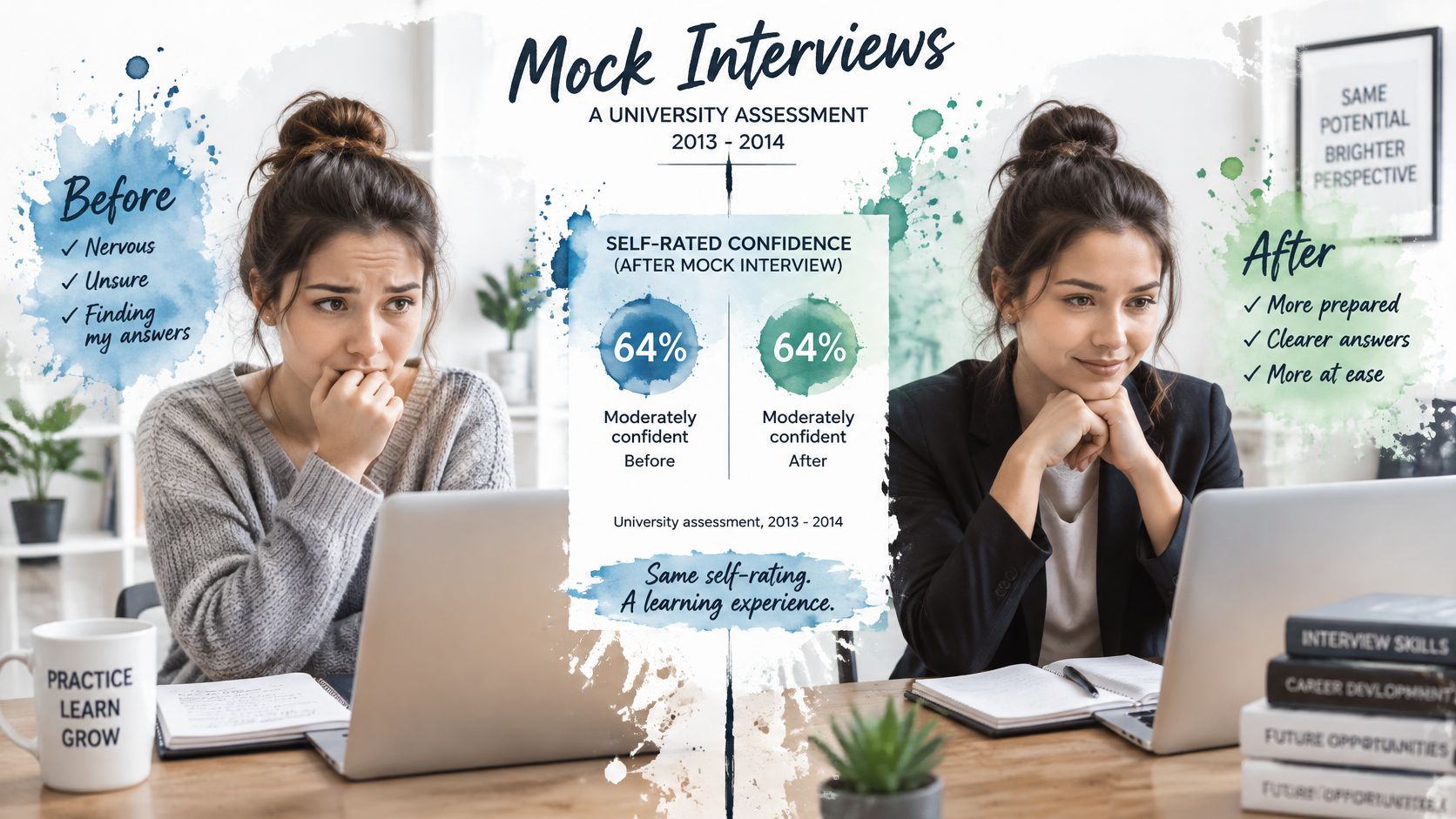
A Northwestern University assessment from the 2013–2014 academic year found that 64% of participants described themselves as moderately confident before the exercise, while 64% reported being confident or very confident afterward. The assessment's confidence and learning results appear below; they're a historical university benchmark, not a promise about an app.
The image illustrates the change candidates hope to achieve, but the useful question is what changed in their answers.
Confidence and learning results from the university benchmark
| Measure | Result |
|---|---|
| Moderately confident before the exercise | 64% |
| Confident or very confident afterward | 64% |
| Average confidence rise | 0.7742 points (median and mode 1.0) |
| Correctly identified STAR method afterward | 100% |
| Three communication techniques from six | 53% |
| Three professional behaviors from six | 77% |
Different candidates need different evidence
Recent graduates can use practice to turn coursework, volunteering, or part-time employment into a clear account of personal contribution. Track confidence alongside STAR completeness, especially whether the action belongs to you rather than an unspecified team.
Software, data, and engineering candidates should track confidence alongside technical accuracy. Practise explaining why a solution works, then verify the code, query, or reasoning independently rather than accepting fluent feedback as technical validation.
Finance and consulting candidates can track recommendation quality. Give a conclusion supported by a calculation or explicit assumption, then name the risk that might change it. Don't add a number just to make the answer sound analytical.
Use a video resource as another rehearsal prompt, then test the advice against your target role.
Accessibility changes what good practice looks like
Non-native speakers can track transcription accuracy and clarity of evidence, not imitation of an ideal accent. Candidates with speech differences or neurodivergent communication styles should also distinguish role requirements from preferences about pauses, gaze, or expression.
A 2025 paper on AI interview accessibility and bias describes concerns about language features, scoring, and perceived fairness. It supports caution about treating communication-style conformity as proof of competence.
Choose adjustable timing, captions, alternative input, and transparent feedback where needed. Across these groups, track confidence plus a relevant rubric dimension, not the number of questions completed.
When Live AI Help Is Allowed
45% of employers hadn't given applicants guidance about appropriate AI use, while 61% identified undisclosed interview AI use as the most common form of misconduct, according to a 2025 employer survey described in written evidence submitted to the UK Parliament. An absent policy isn't permission.
A live suggestion can make an answer smoother while creating a separate problem: the interviewer may believe they're assessing unaided reasoning. Fluency and permission are different tests.
Four lanes for AI help in an interview
| Lane | What it covers | Safe default |
|---|---|---|
| Rehearsal before the call | Mock sessions and question review | Allowed by default, unless instructions restrict preparation |
| Accessibility support | Extra time, captions, or transcription | Request through the employer |
| Ordinary note-taking | Notes used within the employer's rule | Confirm the rule first |
| Real-time answer generation | Suggestions read during the live call | Only with explicit permission |
Ask about the function, not just the tool
An employer may permit captions while prohibiting answer generation. It may allow personal notes but restrict recording or external transcription. Describe the exact function you intend to use, and ask the recruiter to confirm the applicable rule before the interview.
For accessibility support, use the employer's accommodation process rather than assuming the ordinary AI policy answers your needs. Explain the support required without presenting it as interchangeable with generated answers.
You can adapt this disclosure wording:
I used an AI tool for preparation. During the interview, I plan to use captions only, with no generated answers. Please confirm whether that fits your interview rules.
If you intend no live assistance, say that instead. If live generation is permitted, clarify its scope, including whether the permission covers technical assessments or only conversational rounds.
Rehearse the disclosure too
Add a mock follow-up asking whether you're using assistance. Practise answering directly and accurately, without minimising what the tool does. Our live Copilot explanation can help you understand the function before describing it to a recruiter.
You still need to defend your own experience. A generated explanation won't establish why you chose a particular assumption or whether a resume result is accurate.
Prepare with mocks and question review. Use a live copilot only with explicit permission, and keep that permission available in writing.
Set Up Interview Pilot Before the Call
Download our app free for Mac, Windows, iOS, or Android, then set up a practice session before relying on the software during an interview. The help center suggests a five-minute checklist before your first interview. Use it to establish a working setup, not to assume every interview rule has been satisfied.
Prepare the profile and environment
Install the app on the device you'll use for the call. Add your resume and target role, check that the details are current, and select a response tone and depth appropriate to the conversation.
Open a role-specific question set and run a short mock using an example you can discuss without exposing confidential information. Keep your profile factual, because suggestions based on inflated responsibilities won't help you answer a probing follow-up.
- Check permissions. Confirm that the intended microphone and relevant app permissions work.
- Test the visible setup. Run the two-minute test with a second device to see what the interviewer sees, including whether an assistant window appears.
- Write down your decision. Record whether you're using preparation only or employer-approved live suggestions, and retain the approval.
Finish with a usable record
After the mock, inspect the transcript against what you meant to say. Rename the session with the role and competency so you can retrieve it without opening every recording.
If the Delivery Score flags hesitation, inspect the surrounding sentence before trying to remove the pause. You may have needed time to reason, or you may have been searching for an example that wasn't ready. Repeat a comparable question to test the actual issue.
Download, complete the checklist, pass the second-device test, and confirm your permitted setup before the live interview. Don't postpone preparation until the call is about to begin.
Interview Pilot offers guided AI mock interviews, answer evaluation, and role-specific question review to help you practise with a clear feedback loop. Visit Interview Pilot, choose a question for your target role, and use the evaluation to make a specific improvement before your next attempt.
Topics
mock interview app
AI interview practice
interview copilot
question bank
live interview help
Continue reading

AI Tools
What Is Question Bank
What is question bank. Learn what a question bank is, how it is built, and how candidates use one to prepare for technical and behavioral interviews
October 16, 2026
16 min read

AI Tools
5 Best AI Interview Tools for Behavioral Interviews in 2026
Compare five AI tools for behavioral interview stories, STAR structure, roleplay, delivery feedback, and permitted live support in 2026.
October 7, 2026
5 min read

AI Tools
5 Best AI Mock Interview Tools in 2026
Compare five AI mock interview tools for realistic roleplay, custom questions, feedback, repetition, and interview preparation in 2026.
October 6, 2026
5 min read