












Interviews
Interview with Target: A Practical Guide to Getting Hired
Prepare for an interview with Target as a candidate. Learn the hiring process, formats, and targeted strategies to succeed at every stage.
Interview Pilot Editorial Team
Updated October 10, 2026
14 min read

You've applied to Target, checked your email repeatedly, and finally received an interview invitation. Now the résumé that got you noticed can't carry the conversation. You'll need to show how you think, how you work with people, and how your experience matches the role at each stage of the process.
An interview with Target is rarely one isolated conversation. It's a sequence of checkpoints, and each one tests a different kind of evidence. The strongest candidates prepare for the full journey, not just the question, “Tell me about yourself.”
What to Expect During an Interview With Target
You get the interview invite, then the real work starts. Target does not run one generic conversation. It runs a hiring journey, and each step asks for different proof that you can do the job, work well with other people, and handle the pace of the team.
The process changes by role, team, and location. A store role usually centers on availability, customer judgment, reliability, and teamwork. A technology, finance, product, data, or operations role can add assessments, deeper functional questions, and several interviews with different stakeholders.
Your application is only the entry point. A 2024 recruiting-metrics estimate based on more than 10 million job applications reported that roughly 3% of applicants received an interview invitation (recruiting benchmark details). Treat that invite like a narrowed opportunity, not a casual first chat.
The candidate journey
Expect several gates, each with its own standard.
Application review: Recruiters or hiring managers scan for fit against the job requirements. If the role calls for technical, analytical, or operational skill, your résumé needs to show that clearly without extra interpretation.
Initial contact: A recruiter often checks your background, interest in the role, work eligibility, scheduling, location, and compensation alignment. This call also sets expectations for format, timing, and what comes next.
Role evaluation: Weak preparation gets exposed. Depending on the job, you may get technical questions, a work sample, a case discussion, or functional scenarios. Software candidates should expect problem-solving and system design themes. Finance candidates should be ready to explain judgment and trade-offs. Product and operations candidates need crisp examples of prioritization, execution, and decision-making under constraints.
Team interviews: Later rounds usually test collaboration, communication, conflict handling, and reasoning. Interviewers want specifics, not broad claims. They are listening for how you worked through ambiguity, pushed a project forward, and responded when priorities changed.
Final review: Interviewers compare notes before the hiring team decides. Delays can happen, so ask about the timeline and the next checkpoint before the conversation ends.
Hiring funnels are selective. Benchmarks like the one cited earlier show why applying is not enough, and why interview performance decides who reaches the offer stage.
Prepare two evidence sets before the first call. Build behavioral stories that show teamwork, ownership, and judgment. Build role-specific examples that prove you can do the actual work. Then practice both in a structured way, including AI-assisted mock interviews if you need repetition under pressure. Candidates who prepare for each stage separately usually sound sharper, answer faster, and make it easier for Target to say yes.
Understanding the Target Interview Process and Stages
Consider a candidate named Maya applying for a data-focused role. She submits her application, receives a recruiter call, completes a role-related assessment, meets several team members, and waits while the interview panel compares its notes. Her preparation changes at every step because the hiring team is asking a different question each time: Can this person do the work, and will this person work effectively with us?
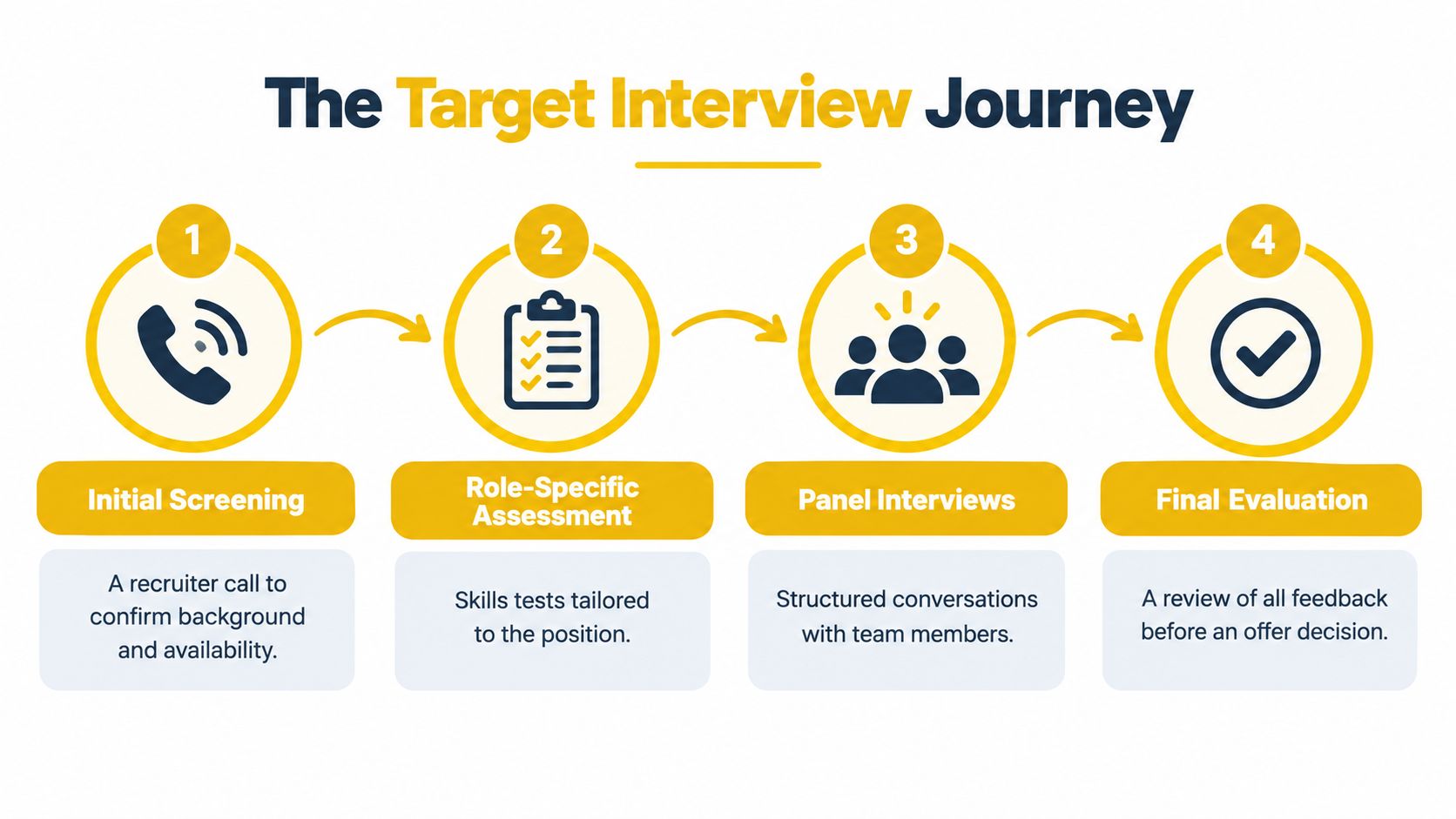
Stage one focuses on alignment
The initial screening usually rewards clarity. Maya doesn't need to recite every job on her résumé. She needs a concise explanation of what she does, why the role fits, and which experience proves she can contribute.
Prepare a short introduction that connects your background to the position. Keep your answer organized around a theme, such as improving operational decisions with data, building dependable software, or coordinating teams through complex launches. Then stop and let the recruiter ask questions.
Stage two tests role capability
A role-specific assessment may look different for a software engineer, financial analyst, product manager, or operations candidate. The format can include technical questions, a case, a work sample, or a discussion of past projects.
Don't memorize polished answers. Practice explaining your assumptions, the options you considered, the action you took, and how you checked the result. Interviewers learn more from your decision process than from a rehearsed conclusion.
Stage three examines collaboration
Panel interviews introduce multiple perspectives. One interviewer may focus on technical depth, another on communication, and another on how you respond to ambiguity. Answer the person who asked the question, but include enough context for everyone else to follow your reasoning.
A structured story works well here: describe the situation, define the task, explain your actions, and finish with the outcome and lesson. Keep the story focused, then invite a follow-up.
Watch this overview of interview preparation before you rehearse your own examples:
Stage four ends with evaluation
The final evaluation isn't another chance to improvise your entire career history. It's a comparison of the evidence gathered across the process. Your best move is consistency. Give different interviewers different examples, but make sure your claims about scope, ownership, and results remain accurate.
Ask each interviewer one useful question about the role, team priorities, or success criteria. Their answers can help you judge the opportunity while showing that you're thinking beyond receiving an offer.
Why Structured Interviews Matter at Target
A structured interview gives every candidate a more comparable evaluation environment. Interviewers use standardized questions, consistent scoring criteria, notes, and similar conditions instead of allowing one conversation to drift into an unplanned discussion.
That matters because structured interviews have a stronger documented relationship with job performance than unstructured conversations. A quantitative review summarizing evidence from 12 meta-analyses found the same repeated conclusion, structured interviews outperform unstructured interviews in reliability and validity (review of structured employment interviews). The historical evidence reaches back at least to the 1988 work of Wiesner and Cronshaw, which found approximately twice the validity for structured interviews compared with unstructured interviews.
What interviewers are actually comparing
A structured process isn't asking whether you sound impressive in the abstract. It's looking for observable evidence tied to competencies.
A large meta-analysis covering 245 validity coefficients and 86,311 individuals reported corrected validity coefficients of approximately 0.63 for structured interviews and 0.20 for unstructured interviews (meta-analysis of interview validity). The practical lesson is direct: don't answer a behavioral question with a personality label such as “I'm analytical” or “I'm a strong collaborator.” Show the decision, behavior, and result that support the claim.
Use this answer pattern:
- Situation: Establish the business or technical context.
- Task: State what you owned and what made the task difficult.
- Action: Explain your choices, trade-offs, and collaboration.
- Result: Describe what changed and what you learned.
For technical questions, add assumptions, complexity, edge cases, testing, and rejected alternatives. For finance or operations questions, explain the information you used, the risk you considered, and how you prioritized. For product questions, connect customer needs to scope and measurement.
You can also use behavioral-based interviewing guidance to turn broad experiences into competency-based stories. The objective isn't to sound scripted. It's to make your evidence easy to evaluate.
Structured interviews can add information beyond cognitive-ability and personality assessments because interview results are only weakly related to those measures. One review found that highly structured interviews contributed approximately 12.3% to 22.2% of unique variance after other predictors were accounted for, while unstructured interviews contributed about 0.9% to 2.2% (review of incremental interview validity). That's why your answers should reveal job-specific judgment, not just general intelligence or enthusiasm.
Practical rule: Treat every answer as evidence against a competency, not as a performance designed to sound polished.
Effective Preparation Strategies for Target Candidates
Preparation should resemble the interview you're likely to face. Reading company information helps, but it won't train you to explain a difficult decision under pressure. Build a rehearsal system that gives you feedback on both content quality and communication quality.

Start with a role evidence map
Read the job description and create a three-column document:
| Role requirement | Evidence from your experience | Likely question |
|---|---|---|
| Technical execution | A project where you designed, built, tested, or improved something | “Walk me through a difficult technical problem.” |
| Collaboration | A conflict, handoff, or cross-functional decision | “Tell me about a disagreement.” |
| Business judgment | A prioritization or resource decision | “How did you decide what to do first?” |
Do this before building a question bank. The job description tells you what the hiring team needs, while your examples prove whether you've done related work.
Rehearse for the role, not the label
Software engineering: Practice data structures, algorithms, debugging, system design, and explaining trade-offs aloud. Don't hide behind code. State assumptions, test edge cases, and explain why your design fits the requirements.
Finance: Prepare examples involving analysis, forecasting, controls, risk, prioritization, and communicating findings to non-specialists. Be ready to explain how you would validate an unexpected result.
Product management: Rehearse customer framing, prioritization, product metrics, experimentation, stakeholder alignment, and handling an unclear request.
Data science and analytics: Practice defining the problem, selecting a method, checking data quality, interpreting uncertainty, and turning findings into a decision.
Operations: Prepare stories about process improvement, customer impact, resource constraints, escalation, and execution across teams.
Use mock interviews to expose weak evidence. A practice partner should interrupt when your answer lacks context, ask what you personally did, and challenge unsupported conclusions. You can also use Interview Pilot for guided mock sessions, role-specific question practice, and responses built from your profile and documents. If nerves affect your delivery, practice methods that build confidence in conversation, especially aloud rather than in private.
Score each answer
After every rehearsal, mark whether you included:
- A clear problem: Could another person understand what was at stake?
- Your ownership: Did you distinguish your actions from the team's work?
- Decision logic: Did you explain why you chose that approach?
- Verification: Did you test, check, measure, or validate the result?
- Impact: Did you show what changed?
- Reflection: Did you explain what you'd repeat or change?
Review Target interview questions and answers for prompts, then rewrite each response in a short version and a deeper version. That flexibility matters when one interviewer wants a direct answer and another asks for technical detail.
Navigating AI-Assisted and Technical Interviews
AI can speed up preparation, but it can also create a dangerous illusion of competence. If a tool generates an elegant answer and you can't defend its assumptions, you aren't prepared for the interview. You're prepared to repeat text.
Technical interviews in 2025 remained concentrated around data structures, algorithms, and system design, while those formats became more demanding. A survey of engineering leaders found that 55% expected candidates to demonstrate greater fluency with AI tools and frameworks, while 54% ranked technical interviews among top readiness signals and 48% ranked behavioral responses nearly as highly (analysis of current technical interview practices). Those findings point to a better standard for AI use: use it to strengthen reasoning, not replace it.
Use AI as a demanding practice partner
Ask an AI tool to generate variations of a problem, challenge your assumptions, or produce a flawed implementation for you to debug. Then explain the answer without looking at the generated response. You should be able to:
- Define requirements before choosing a solution.
- Explain time, space, operational, or financial trade-offs.
- Test the solution against edge cases.
- Identify security, reliability, or data-quality risks.
- Describe why an alternative approach wasn't selected.
- Continue reasoning when the tool gives an incorrect answer.
Timed practice can help you reproduce pressure without turning preparation into passive reading. Resources covering use cases for timed tests can help you design focused drills for coding, analytical reasoning, or structured case responses.
Know the boundary during a live interview
Don't assume that AI assistance is automatically acceptable in a live Target interview. Interview rules vary by employer, role, interviewer, and assessment format. If an interviewer permits tools, clarify what kind of use is allowed. If the instructions prohibit outside assistance, follow them.
The safest principle is ownership. You should be able to explain every line of code, every analytical assumption, and every recommendation independently. A tool may help you prepare, but it can't take responsibility for a decision you can't defend.
For a deeper technical preparation format, use this technical screening interview guide to organize practice around explanation, not only final answers.
A correct answer that you can't explain is weak evidence. A reasoned answer that survives questioning shows how you work.
AI-mediated interviews also create practical concerns around recording, accessibility, and recourse. A 2025 job-seeker survey reported that 33% of respondents had participated in a recorded interview, while 58% trusted HR professionals more than AI to guide them through hiring (job-seeker survey). Before an automated or recorded assessment, ask whether a human alternative exists, how responses are transcribed or analyzed, and how to request an accommodation for speech, hearing, cognitive, or language differences.
Final Steps and Actionable Takeaways for Your Interview
The final preparation window should reduce uncertainty, not create a larger pile of notes. Focus on the role, the evidence, and the mechanics of the conversation.
Use this preparation sequence
Study the role: Identify the capabilities Target is asking for and connect each one to a real example from your background.
Prepare your opening: Write a concise introduction that explains your professional theme and why this role fits it.
Build story coverage: Prepare examples for teamwork, conflict, failure, prioritization, customer impact, technical judgment, and learning.
Practice the technical layer: Solve representative problems aloud. State assumptions and verify your result rather than jumping straight to an answer.
Run a realistic mock interview: Use a timer, camera, or practice partner. Review whether your answers are clear, complete, and concise.
Prepare questions: Ask about the team's priorities, the role's success criteria, current challenges, and the next stage.
Confirm logistics: Check the time zone, meeting link, device, audio, camera, workspace, and any assessment instructions.
Follow up professionally: Send a brief message that references the conversation and reinforces your interest. If the company reaches the offer stage, practical guidance on how to send an offer letter email can help you understand the communication that may follow.
Don't try to sound like a different person. Speak with enough structure that the interviewer can see your judgment, while keeping your language natural. If you lose your place, pause, restate the problem, and continue. A thoughtful recovery often demonstrates more composure than a rushed answer.
The best candidates don't prepare for a mysterious “Target interview.” They prepare for a series of evidence checks. They know which story fits which competency, which technical decisions they can defend, and which questions will reveal whether the role fits them.
Interview Pilot offers guided mock interviews, role-specific question practice, profile-based response tailoring, and live assistance for technical and behavioral conversations across desktop and mobile. Use Interview Pilot to rehearse the exact kind of structured, evidence-based answers you'll need at each stage of your Target interview.
Topics
interview with target
target hiring
retail interview
target job interview
interview preparation
Continue reading

Interviews
How to Answer Behavioral Questions (2026 Guide)
Master how to answer behavioral questions using the STAR method, with role-specific examples and practice exercises for software engineering, product
October 9, 2026
12 min read

Interviews
8 Target Interview Questions and Answers
Prepare for retail and corporate interviews with 8 target interview questions and answers, behavioral examples, model responses, and practical prep tips.
September 27, 2026
22 min read

Interviews
10 Excel Interview Questions by Skill Level
Prepare with 10 Excel interview questions by skill level, including formulas, tasks, pivot table exercises, and practical answer strategies.
September 22, 2026
23 min read