









Interviews
Interview Questions Strengths
Interview questions strengths. Master interview questions on strengths with STAR methods, role-specific examples, and clear strategies
Interview Pilot Editorial Team
Updated October 15, 2026
16 min read

You're halfway through an interview when the hiring manager asks, “What are your strengths?” You know the answer in ordinary life, but under pressure your mind goes blank. You reach for “hardworking” or “a good communicator,” then realize you've offered a label instead of evidence.
Treat the question differently. Your strength is not the main point. The competency behind it, the behavior that proves it, and the result it produced are what the interviewer can evaluate. That shift helps technical and non-technical candidates sound specific without boasting, and it gives candidates with different communication styles a reliable structure instead of forcing them to perform confidence.
Why Hiring Teams Ask About Your Strengths
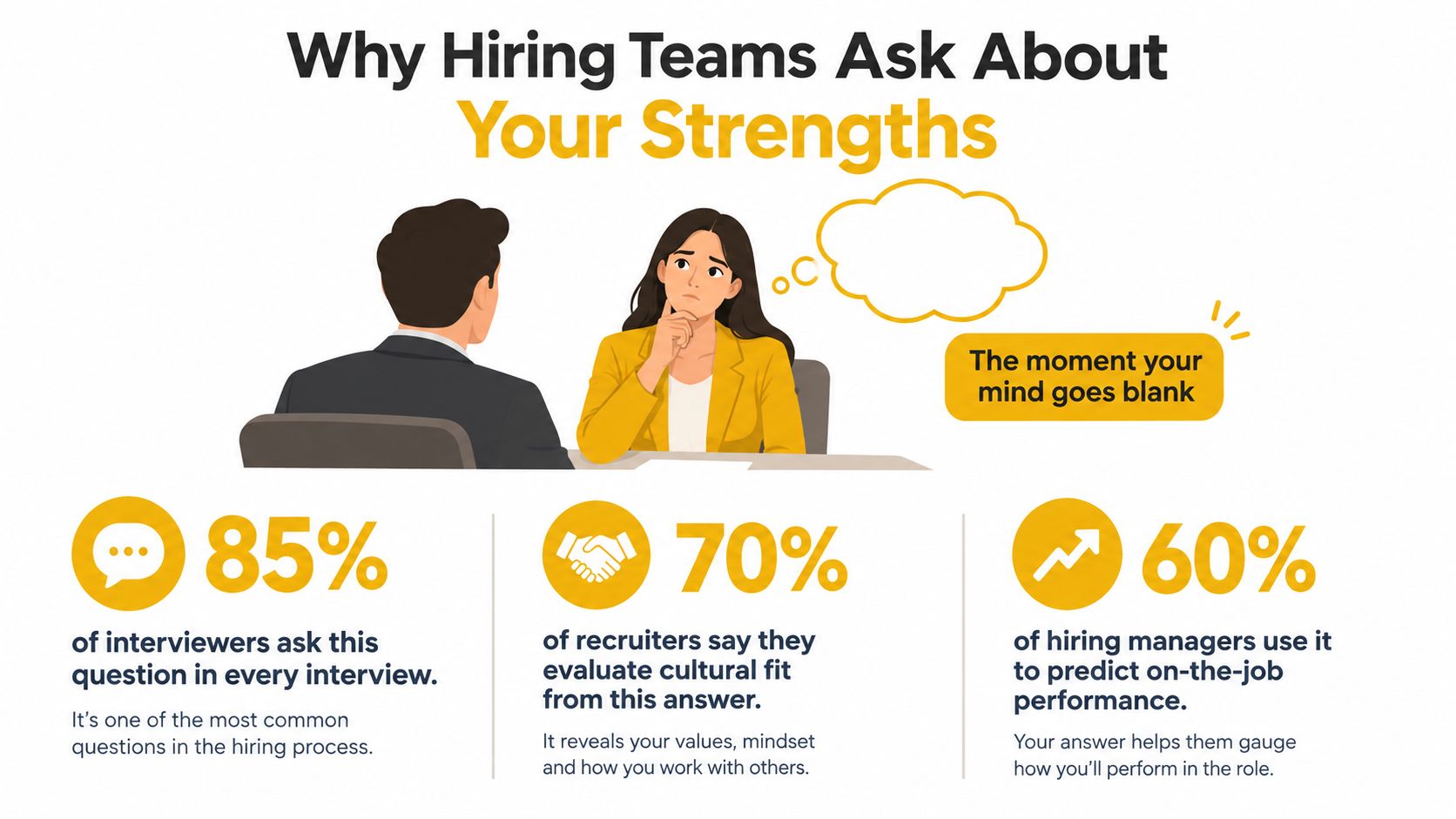
“What are your strengths?” appears so often because it gives an interviewer a fast way to test several things at once. Can you identify a capability that matters for the role? Can you explain it clearly? Can you support it with a real example? Can you connect your contribution to an outcome?
A survey of 503 U.S. recruiters found that 51% of hiring professionals asked, “What are your greatest strengths?” The same survey reported that 60% selected “Tell me about yourself” as their leading question and 57% selected a question about a challenge or workplace conflict (HR Reporter's survey summary). Strengths questions sit inside a broader screening pattern. Recruiters are testing self-presentation, behavioral evidence, and problem-solving, not just collecting personality adjectives.
What the interviewer is actually listening for
A strong answer usually contains four signals:
- Relevance: Your chosen strength matches a competency the position requires.
- Self-awareness: You understand how the capability appears in your work.
- Evidence: You can describe what you personally did, not merely what your team achieved.
- Impact: You can explain the result, ideally with a concrete business, customer, technical, or delivery outcome.
Candidates also prefer this kind of discussion. In a 2024 Yoh survey of 2,084 American adults, 54% said they most wanted to be asked what makes them a good candidate for the job. 46% preferred a question about the soft skills that would make them a good candidate, and 44% wanted to discuss an accomplishment they were proud of (survey details from Revarta). Those preferences make sense. A well-designed strengths question lets you explain your value instead of defending an abstract weakness.
Practical rule: Prepare strengths questions with the same seriousness you give technical problems and behavioral scenarios. They're a mainstream screening tool, not a warm-up exercise.
Your answer should therefore move from strength to competency, competency to behavior, and behavior to result. “I'm organized” is weak because the interviewer must do all the interpretation. “I'm strong at prioritization. On a release with competing defects, I ranked issues by customer impact and dependency risk, then rebuilt the sprint plan with engineering and support” gives the interviewer something assessable.
How to Read the Job Description Like an Interviewer
Most candidates scan a job description for duties. Hiring teams read it for competencies, the repeatable capabilities needed to perform those duties well. Your preparation improves when you read the posting as a scoring guide.
Start by marking every skill, behavior, and outcome that appears more than once. Then separate explicit requirements, such as “write SQL queries” or “manage enterprise accounts,” from coded expectations, such as “works independently,” “influences cross-functional partners,” or “thrives in a fast-paced environment.” Finally, convert each phrase into something an interviewer could observe.
“Strong communicator” might mean writing concise product requirements, presenting a recommendation to executives, explaining a technical issue to customers, or documenting decisions for a distributed team. “Self-starter” might mean identifying an unowned problem, proposing a plan, securing agreement, and delivering without daily instruction.
Translate the language into evidence
Use the table below as a starting point, then adapt it to the actual position.
| Job Description Phrase | Underlying Competency | Evidence to Prepare |
|---|---|---|
| Strong communicator | Clear writing, listening, audience adaptation | A time you changed your explanation for a technical or non-technical audience |
| Self-starter | Initiative and independent judgment | A problem you identified and addressed before someone assigned it |
| Collaborative team player | Coordination, conflict management, shared accountability | A decision involving disagreement, trade-offs, or competing priorities |
| Results-oriented | Execution and outcome ownership | A completed project with a defined business, customer, quality, or delivery result |
| Analytical thinker | Structured investigation and decision quality | A situation where you used data to isolate a cause or choose between options |
| Customer-focused | Empathy, diagnosis, and follow-through | A customer problem you clarified, solved, and prevented from recurring |
| Adaptable | Learning speed and response to change | A shift in tools, scope, process, or priorities and how you responded |
Don't select the strength you're most proud of in the abstract. Select the strength that gives the hiring team the clearest evidence for a requirement they care about.
Build a competency map
Write the role's top requirements in one column and your evidence in another. A software engineer might map “reliable systems” to an incident where they traced a production failure, added monitoring, and improved the recovery process. A customer success candidate might map “retention” to a renewal risk they diagnosed through usage patterns and addressed with a targeted adoption plan.
The U.S. Office of Personnel Management explains that structured interviews become more valid and reliable when questions are tied to job analysis and evaluated against consistent criteria (OPM guidance on structured interviews). That principle helps candidates, too. If you know the competency being assessed, you can choose evidence instead of improvising a personality pitch.
Building Your Answer With the STAR Framework
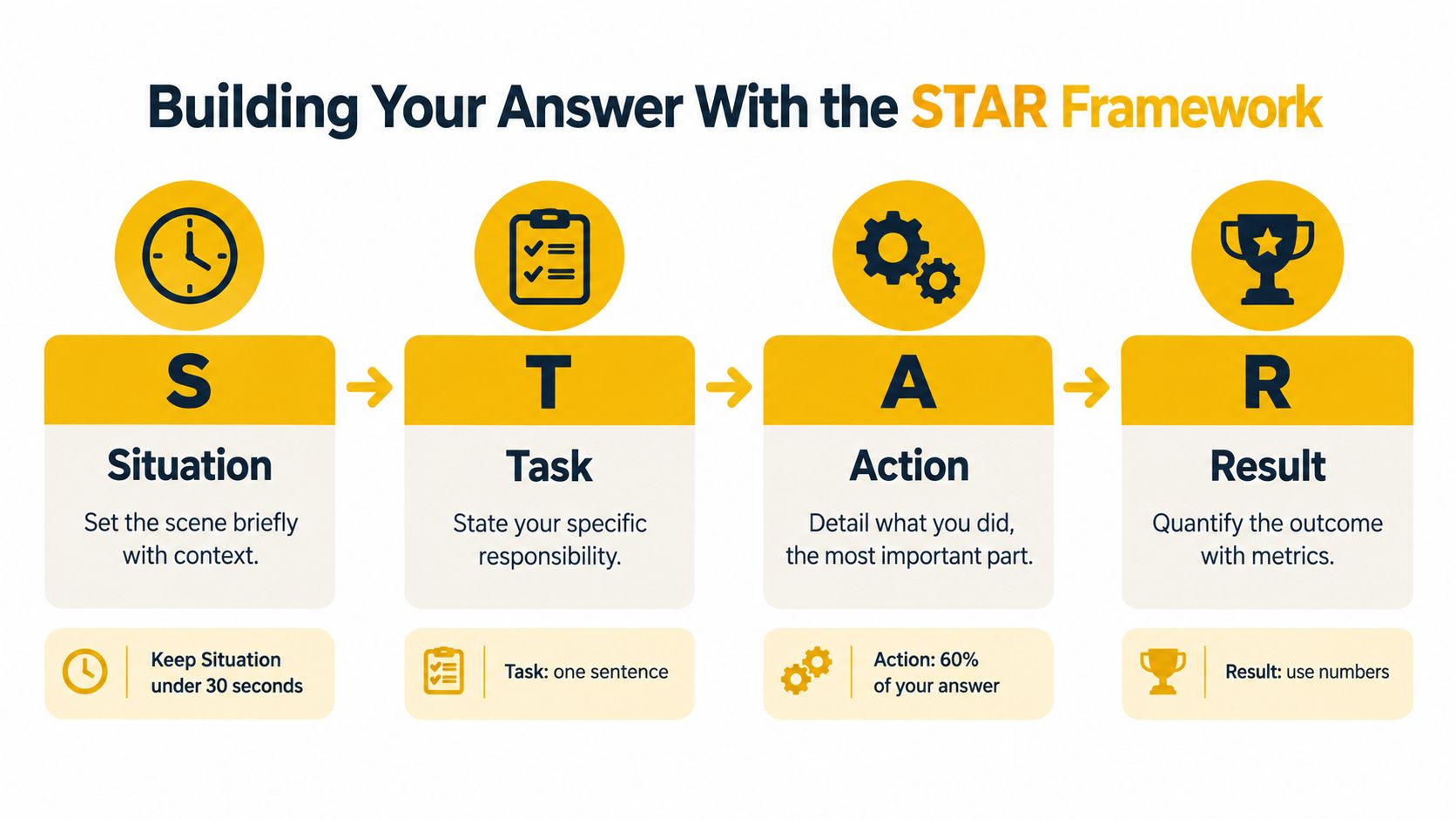
Use STAR, Situation, Task, Action, Result, to keep your answer concrete. The framework isn't a script. It's a control system that stops you from spending a minute describing a vague trait and gives the interviewer a clear path through your example.
Put most of the answer in the action
Situation establishes context. Keep it brief. Name the project, customer, system, or constraint, then move on.
Task defines your responsibility. Don't hide behind “we.” Explain what you owned, what decision you had to make, or what outcome you were expected to produce.
Action deserves the most attention. Explain your reasoning, sequence, tools, communication, and trade-offs. If you say you're strong at prioritization, show the rule you used to prioritize. If you claim analytical thinking, describe the data you examined and how it changed your decision.
Result closes the loop. Use a measurable outcome when you have one, such as reduced cycle time, fewer defects, improved delivery reliability, increased adoption, or stronger customer retention. If the result isn't numerical, describe the concrete change that followed, such as a process becoming standard, a decision being approved, or a recurring issue being eliminated.
A weak response sounds like this:
“One of my strengths is communication. I communicate well with my team, solve problems, and make sure everyone is aligned.”
A stronger version makes the competency visible:
“Clear cross-functional communication is one of my strengths. During a product launch, engineering and support had different assumptions about the rollout scope. I created a decision document with the open questions, confirmed the technical constraints with engineering, and translated the final workflow into customer-facing guidance for support. The teams used the same launch plan, and support had the information needed to handle customer questions from day one.”
The second answer works because it shows a situation, a personal action, and a practical result. Replace the example with your own evidence, but preserve the structure.
Compress the story without flattening it
For a short answer, use one sentence for the strength, one for context, two or three for action, and one for the result. That gives you a focused response without sounding memorized. If the interviewer asks a follow-up, expand the action rather than repeating the opening claim.
The STAR method guide from Interview Pilot can help you rehearse the sequence before you practice aloud. Record yourself once, then remove any sentence that doesn't establish context, clarify your contribution, explain a decision, or show an outcome.
Sample Strengths Answers for Technical and Non-Technical Roles
The same strength can sound impressive in one role and irrelevant in another. A data analyst shouldn't describe curiosity without showing how it changed an analysis. A customer success candidate shouldn't lead with “technical expertise” if the role primarily evaluates trust, diagnosis, and follow-through. Match the story's center of gravity to the work.
Software engineering
Strength: Systematic debugging.
“One of my strengths is turning ambiguous production issues into a sequence of testable hypotheses. During an incident involving intermittent request failures, I isolated the problem by comparing logs across services, reproduced the failure under a specific dependency condition, and worked with the team to add validation and monitoring. The fix addressed the immediate issue and gave the team a clearer signal for similar failures.”
Keep the language precise. Name the part you investigated and the reasoning behind your fix, but don't bury the answer in tool names unless the interviewer asks.
Data analysis
Strength: Translating analysis into decisions.
“I'm strongest when I connect analysis to a decision. For a report with conflicting customer segments, I checked the definitions behind each metric, traced the discrepancy to inconsistent filters, and rebuilt the view with a documented calculation. The stakeholders could use one agreed interpretation for planning instead of debating the numbers.”
Your strength isn't “being good with data.” It's the capability the employer needs, such as data validation, experiment design, forecasting, or communicating uncertainty.
Product management
Strength: Creating alignment under uncertainty.
“A strength I bring to product work is turning competing requests into explicit trade-offs. When sales, support, and engineering proposed different priorities, I grouped the requests by customer problem, mapped dependencies, and brought the decision to the team with options rather than a long feature list. That made the scope discussion more focused and clarified what we would not build.”
For product roles, show judgment and stakeholder management. Don't present yourself as the hero who overruled everyone.
Customer success
Strength: Diagnosing the actual customer problem.
“My strength is asking enough questions to separate a stated request from the underlying risk. When a customer considered reducing usage, I reviewed their workflow, identified a gap in onboarding, and coordinated a targeted enablement session with the right internal team. The customer had a clearer path to using the product, and the account conversation moved from frustration to a specific adoption plan.”
Use customer language, not internal jargon. The interviewer wants to hear how you listen, decide, and follow through.
Recent graduate
Strength: Learning quickly and applying feedback.
“A strength I developed through a group research project is turning feedback into a better process. After our first presentation showed that the audience couldn't follow our methodology, I reorganized the explanation around the decision we were trying to support, assigned clearer speaking roles, and tested the revised structure with a classmate. Our final presentation was easier to follow, and I carried that approach into later project work.”
Students can use coursework, internships, volunteer work, or campus leadership. The evidence doesn't need to come from a full-time job. It needs to show what you did and what changed.
Candidates preparing for clinical training can also compare role-specific prompts with broader behavioral preparation in this resource on common residency interview questions. The same principle applies across fields: choose a competency, describe behavior, and connect it to the demands of the role. For leadership-focused examples, this guide to demonstrating leadership qualities offers another useful way to turn a label into observable action.
Matching Your Strengths to the Conversation in Real Time
Preparation gives you stories. The live interview determines which story deserves airtime.
Suppose you lead with “structured problem-solving” for a data role. The interviewer leans forward and asks, “How did you know the data was reliable?” That's a signal to expand your validation process, not to repeat the result. Explain the checks you performed, the assumptions you challenged, and how you handled conflicting inputs.
A different interviewer might ask, “What happened when a stakeholder disagreed?” Your core strength can remain the same, but the evidence should shift toward communication and influence. Describe how you identified the disagreement, what each person needed, and how you reached a decision. Don't force the original story if it cannot answer the probe credibly.
Use follow-ups to add proof
Follow-up questions often reveal the interviewer's scoring concern:
- “What did you personally do?” Clarify your contribution.
- “How did you handle pushback?” Show judgment, listening, and influence.
- “What would you do differently?” Demonstrate reflection without disowning the result.
- “How did you measure success?” Explain the outcome and its limits.
- “What did you learn?” Connect the experience to future performance.
If you prepared the wrong strength, don't panic. Say, "The example I prepared for this role is slightly different, but a related strength is…" Then choose a story that fits the question. A clean pivot is better than forcing an impressive example that doesn't answer the interviewer's concern.
Read the room without performing
Watch for practical cues. If the interviewer interrupts to ask for detail, answer the detail directly. If they begin taking notes after you mention an outcome, pause and let the result land. If your answer runs long, close with the relevance statement: “That experience is why I'm confident in this role's prioritization work.”
Mock practice helps because it trains adaptation, not just memorization. Use a colleague, a recorded session, or a tool such as Interview Pilot's interview practice features, then review whether your answer still makes sense when the follow-up changes.
When Confidence Looks Different From the Interviewer's Default
Interviewers sometimes mistake a familiar communication style for competence. Fast answers can sound confident. Eye contact can feel reassuring. Extroverted energy can appear engaging. None of those signals proves that a candidate can analyze a problem, write reliable code, support a customer, or lead a decision.
Candidates with accents, non-standard communication styles, disabilities, introversion, or different cultural norms shouldn't respond by masking. Over-rehearsed enthusiasm can make an answer less credible, and overclaiming creates a problem when the interviewer asks for detail. Evidence is more portable than charisma.
A 2024 to 2025 survey of 1,000 working-age adults with disabilities found that 68.4% feared disclosure could affect evaluation and 69.2% feared it could affect hiring chances (Signal49's disability disclosure research). That concern deserves a practical response from candidates and employers alike. Candidates can request an accessible format, ask for clarification, take a moment to organize an answer, or explain the communication method that lets them demonstrate their capability.
Make the evidence do the persuading
Use wording that is confident without pretending to be flawless:
- “I do my best work when I can organize complex information into a clear written plan.”
- “I'm a deliberate listener, so I ask clarifying questions before I recommend a solution.”
- “I communicate most precisely when I can document the decision and the reasoning behind it.”
- “My strength is sustained focus on complex problems. I use checkpoints to keep stakeholders informed.”
These statements don't apologize for a style difference. They connect the style to a job-relevant behavior and give the interviewer a basis for evaluation.
“Culture fit” also needs scrutiny. A hiring team may use it to mean shared working principles, but it can become a preference for people who speak, socialize, or express confidence in familiar ways. Ask yourself whether the interviewer is assessing a real job requirement or reacting to presentation style. Then return to outcomes, decisions, and examples.
If you need an accommodation, you can frame it around performance: “I'd like the questions in writing when possible so I can process them accurately and give you my strongest answer.” Employers should also consider options such as advance questions, multiple assessment formats, breaks, and distraction-free settings, all identified in the cited disability research.
Bringing It All Together Before Your Next Interview
Prepare three strength stories, each tied to a different competency. Audit the job description and mark the requirements your stories support. Rewrite two answers in STAR format, then complete one timed mock in which someone interrupts with follow-up questions.
Fix the three common failure patterns quickly:
- Generic strength: Replace the adjective with a behavior.
- Missing result: State what changed, improved, shipped, resolved, or became possible.
- Mismatched competency: Choose evidence for the role, not your favorite accomplishment.
A strong ending matters too. Practice the principles in this guide to closing statements in an interview, then spend the next 24 hours saying your answers aloud. Your goal isn't to sound flawless. It's to make your capability easy to evaluate.
Interview Pilot provides guided mock interviews, role-specific question practice, and real-time suggested responses during online interviews, so you can rehearse strengths answers and handle follow-up questions with more control. Visit Interview Pilot to turn your competency map into focused interview practice.
Topics
interview questions strengths
strengths interview
STAR method answers
behavioral interview prep
job interview tips
Continue reading

Interviews
Top 8 Behavioral Questions for Consulting Interviews
Explore 8 behavioral questions for consulting interviews with STAR sample answers, interviewer intent, and tips for tailoring responses to consulting cases.
October 9, 2026
20 min read
Interviews
8 Star Method Examples for Behavioral Interviews
Explore 8 star method examples for behavioral interviews, with annotated Situation, Task, Action, Result answers and tips to adapt each story.
September 17, 2026
25 min read
Interviews
Who Are Your Heroes: How to Answer in Any Interview
Learn how to answer "who are your heroes" in interviews with confidence. Get practical examples, a simple structure, and tips to stand out in 2026.
September 6, 2026
12 min read