









Interviews
How to Demonstrate Leadership Qualities in Interviews
Learn how to demonstrate leadership qualities in interviews and resumes. Discover storytelling frameworks, quiet leadership traits, and role-specific framing.
Interview Pilot Editorial Team
Updated October 14, 2026
11 min read

Most interview advice gets leadership wrong. It tells you to sound bigger, louder, and more senior, as if leadership only counts when you've managed a large team or held a formal title. That's lazy guidance. Leadership is observable influence, the way you create clarity, steady other people, and move work forward when the outcome depends on more than your own effort.
If you want to demonstrate leadership qualities, stop hunting for a title-based story and start looking for moments where your actions changed what other people did. That can mean setting a direction, calming disagreement, coaching a peer, or helping a team finish stronger. Gallup's workplace research makes the core point bluntly, managers account for at least 70% of the variance in team-level employee engagement (Gallup), which is exactly why interviewers care about behavior, not self-description.
Redefining Leadership Beyond Formal Authority
Leadership is not the same thing as authority. You can be a student, an individual contributor, or a new hire and still show leadership if other people leave the interaction clearer, calmer, or more capable than they were before. That's the standard that matters in interviews, because it shows how you operate when the org chart doesn't do the work for you.
Gallup's global data also found that only 20% of employees worldwide were engaged at work, while 16% were actively disengaged in 2025 (Gallup). Those numbers matter because they explain why interviewers listen for more than confidence. They're trying to find people who can create trust, inclusion, and accountability in practice, not just talk about ambition.
What Counts as Leadership Evidence
A strong leadership example is usually plain in hindsight. You clarified a goal that was muddy, coordinated people who weren't aligned, or helped a project move after it stalled. That is leadership because it changes the behavior of others.
Practical rule: if your story only proves that you worked hard, it isn't a leadership story yet.
Use everyday situations as evidence. A scheduling conflict, a disagreement between teammates, or a messy handoff can all become strong material if you show how you influenced the result. For candidates who want a useful parallel example of structured thinking and evidence-based skill framing, PlotStudio AI on analyst skills is a relevant reference point, because it shows how employers often judge capability through observable outcomes, not labels.
The point is simple. Don't ask, “Was I senior enough?” Ask, “Did my actions improve how others worked?” That's the lens that makes your experience legible as leadership.
Structuring Your Leadership Stories for Maximum Impact
A weak answer usually tells a task story. A strong answer tells a leadership story. The difference is whether you describe what you had to do, or what you changed in the people, process, or decision-making around you.
Use a Constraint-Alignment-Outcome structure. Start with the friction, then explain how you got people aligned, then end with the result. That sequence forces you to show judgment instead of just activity.
Constraint, Alignment, Outcome
First, name the constraint clearly. Was the goal ambiguous? Were stakeholders disagreeing? Did a deadline, staffing gap, or handoff problem make the work harder? If you skip this, the interviewer can't see why leadership was needed.
Next, show the alignment work. That means the conversations, trade-offs, or decisions you drove to move people in the same direction. Don't hide behind vague phrases like “I helped out.” Say what you did to get agreement, clarify ownership, or remove confusion.
Finally, finish with the result. Gallup notes that strong evidence includes outcomes such as faster delivery, improved quality, reduced errors, higher participation, or successful completion of a difficult project (Gallup). Use that kind of outcome language when you can, because it tells the interviewer your influence had a visible effect.
| Story Element | Weak Approach (Task-Focused) | Strong Approach (Influence-Focused) |
|---|---|---|
| Constraint | “We had a project.” | “The team had conflicting priorities and no clear owner.” |
| Action | “I did my part.” | “I clarified the goal, brought the key people together, and reset responsibilities.” |
| Outcome | “It went well.” | “The team finished on time, with less confusion and fewer follow-up issues.” |
A good story sounds specific without sounding scripted. If you want a familiar framework for comparison, the STAR method is useful, and this guide to interview questions and the STAR method can help you see where the leadership version needs more emphasis on influence and team effect.
Tell the story of the room, not just the task list.
That's the difference between a candidate who participated and a candidate who led.
Highlighting Communal Traits and Quiet Influence
A lot of candidates sabotage themselves by trying to sound more dominant than they really are. That's a mistake. In many interviews, especially for collaborative roles, the interviewer is looking for proof that you can listen, build trust, and lower friction, not dominate the room.
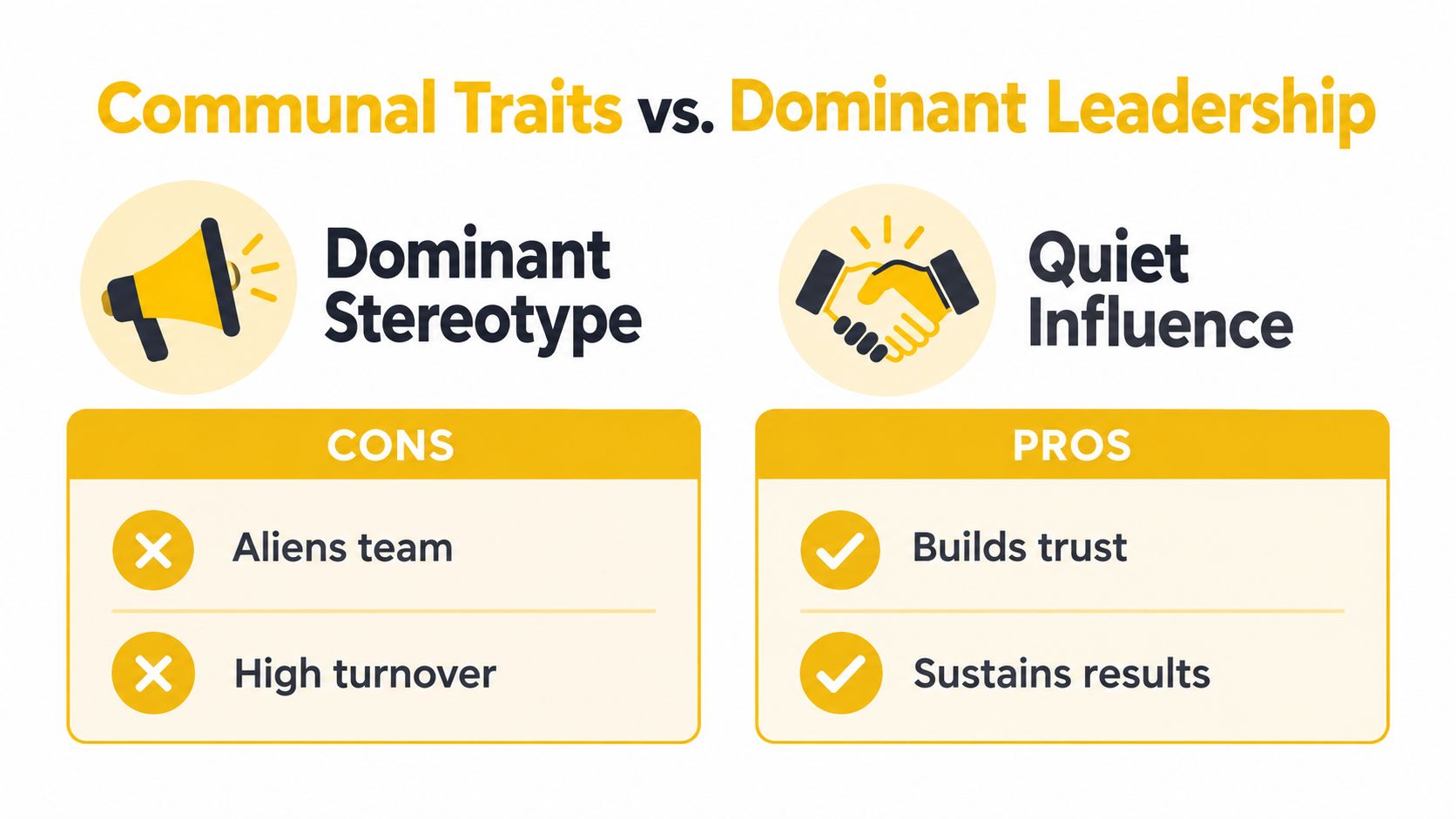
Recent research across eight preregistered studies with more than 3,600 participants found that followers preferred communal leadership traits such as caring, morality, openness, and vulnerability over traditionally agentic traits, with communal traits chosen 66% of the time when people compared the two (Berkeley Haas). That matters because it validates something many candidates already know from real teams, quiet influence often works better than performative force.
Turn “Quiet” Behavior Into Evidence
If you coached a junior colleague, that's leadership. If you stepped back so someone else could present and it improved buy-in, that's leadership too. If you mediated a disagreement before it damaged delivery, that's leadership.
The mistake candidates make is treating those moments as too small. They aren't. Interviewers care about the effect, not how theatrical the action looked from the outside.
For a character-focused lens that helps you translate those qualities into answer material, this character interview guide is a useful companion because it keeps the focus on judgment, reliability, and interpersonal behavior.
Use language that makes your contribution visible. Say you “created space for quieter voices,” “reduced tension between two teammates,” or “helped the group reach a decision faster.” Those are all leadership verbs in disguise.
Navigating Situational Constraints and Limited Resources
The best leadership stories usually happen under pressure, not comfort. If you had every resource, every permission, and a supportive manager, the story is less interesting. Real leadership shows up when the conditions are messy and you still make progress.
That's why it helps to acknowledge constraints directly without sounding defensive. Don't apologize for lacking authority, mentoring, or visibility. State the facts, then move immediately to what you controlled.
Lead With the Constraint, Then Own the Levers
Start with the situation in one sentence. Maybe you were new to the team, or you didn't own the final decision, or the project lacked support. Then shift to the levers you did have, like communication, prioritization, relationship-building, or follow-through.
Many candidates get it wrong here. They either over-explain the constraint and sound trapped, or they skip the constraint and make the story feel unrealistic. The better answer shows both truth and agency.
UNSW BusinessThink summarized evidence indicating that about 83% of the difference between great and average leadership was explained by situational factors, while even intelligence accounted for only 4% of variation in leadership success (UNSW BusinessThink). That doesn't excuse weak leadership. It does mean your story should show how you adapted to the conditions you had, not pretend the conditions didn't matter.
A Mature Way to Frame Hard Conditions
Use this pattern:
- Name the limit: short staffing, unclear ownership, weak buy-in, or limited access to senior help.
- State your control: what you could influence directly, such as the sequence of work, how decisions were communicated, or how disagreements were handled.
- Show adaptation: the specific adjustment you made so the team could keep moving.
- Acknowledge others: make it clear you weren't the only person who made the outcome happen.
The strongest answers sound grounded. They don't dramatize hardship, and they don't flatten context. They show that you can lead responsibly even when your range of motion is smaller than you'd like.
Tailoring Leadership Examples to Your Target Role
Leadership is not one-size-fits-all. The story that works in a software interview won't always land in consulting, finance, or product, because each panel is scoring different signals. If you reuse the same example everywhere, you'll sound generic.

Match the Story to the Scorecard
Technical teams usually want to hear how you unblocked work, settled on a direction, or helped people agree on a technical path. Finance and consulting panels often care more about client handling, delegation, crisp communication, and staying composed under pressure. Product teams usually want cross-functional coordination and the ability to align engineering, design, and business priorities.
Take one core example, like a delayed project. In a data science interview, you might emphasize how you clarified assumptions, got alignment on the problem definition, and kept the analysis moving. In a consulting interview, you'd focus on how you reset expectations with stakeholders and kept the team coordinated under time pressure. In product management, the same story should highlight how you aligned functions with competing priorities and protected delivery without losing the broader goal.
That's also where question banks help. A structured repository like the Interview Pilot question bank gives you a practical way to practice role-specific phrasing, especially when you need to translate one experience into multiple interview contexts.
Use Role Language, Not Generic Leadership Language
Don't say “I showed leadership” and stop there. Say what leadership looked like in that role. For an engineer, it may mean making a trade-off visible. For a consultant, it may mean steering the client conversation. For a product candidate, it may mean keeping multiple functions aligned long enough to ship.
The same event can prove different things. Your job is to make the relevant proof obvious. If the panel can't see why your example matches their scorecard, the story won't help you, no matter how strong it felt to you.
Embedding Leadership Evidence in Resumes and Prep Tools
Strong interview answers start before the interview. If your resume only lists tasks, you make the interviewer infer the leadership. Do the opposite. Make leadership visible on the page, then rehearse the same evidence until it sounds natural out loud.
Use verbs that signal influence and outcomes, not just motion. A resume builder tool can help you reshape experience into clearer, impact-led bullets before you practice them. For specific templates on leadership bullets, see our guide to resume bullet examples.
Tighten the Evidence Before the Interview
Start each bullet with the action and end with the effect. Words like “coordinated,” “aligned,” “resolved,” “coached,” and “reduced” work because they point to what changed for the team, project, or customer. If a bullet only describes a task, cut it or move it lower on the page.
Then test the same story in live practice. Leadership stories should sound like you, not like a script you memorized. Tools such as Interview Pilot help you drill the wording until it holds up under pressure.
A few rules keep the prep sharp:
- Lead with the result: name what changed for the team, customer, or process.
- Use verbs that show influence: coordinated, coached, reset, de-escalated, clarified.
- Trim the solo-hero language: leadership usually means moving people, not rescuing everything yourself.
- Practice out loud: the story has to survive pressure, not just look good on paper.
Strong preparation makes interviews easier because you are not inventing leadership on the spot. You are pulling it from stories you have already sharpened. That is the difference between hoping you sound convincing and sounding convincing.
Topics
demonstrate leadership qualities
interview leadership examples
behavioral interview tips
resume leadership skills
interview pilot
Continue reading

Interviews
Top 8 Behavioral Questions for Consulting Interviews
Explore 8 behavioral questions for consulting interviews with STAR sample answers, interviewer intent, and tips for tailoring responses to consulting cases.
October 9, 2026
20 min read

Interviews
10 Behavioral Interview Questions Software Engineer
Prepare for behavioral interview questions software engineer candidates face with 10 examples, answer frameworks, and technical-role framing tips.
October 7, 2026
26 min read

Interviews
Behavioral Interview Questions and Answers: 10 STAR Examples
Master behavioral interview questions and answers with 10 STAR examples, role-specific tailoring tips, and practice prompts for confident responses.
September 9, 2026
26 min read