












Interviews
Closing Statements in an Interview: Leave a Mark
Master closing statements in an interview to leave a lasting impression. Learn key phrases and strategies for a confident, memorable finish.
Interview Pilot Editorial Team
Updated October 5, 2026
14 min read

You've prepared for the difficult questions. You've rehearsed your examples, researched the company, and answered the final question well. Then the interviewer says, “That's everything from me,” and the conversation drifts toward an awkward goodbye. Those last moments often receive less preparation than the opening, yet they're your final chance to shape what the interviewer remembers.
A strong closing statement in an interview isn't a theatrical sales pitch. It's a concise summary of your fit, a clear signal of interest, and a diagnostic opportunity to uncover anything that could stop the process. Used properly, it turns an ordinary goodbye into a deliberate final contribution.
The Strategic Value of the Interview Closing
Most candidates treat the closing as a formality. They thank the interviewer, say they're interested, and wait for the call to end. That approach wastes a valuable decision-making moment.
Career guidance consistently recommends using the close to restate your strengths, express interest, and invite the interviewer to raise concerns. The Indeed guidance on ending an interview also emphasizes practical actions such as thanking the interviewer, asking about next steps, and offering additional information. These actions give the conversation a clear finish instead of leaving the interviewer to decide how to end it.
Why the last exchange carries weight
Structured hiring processes often involve several stages, multiple interviewers, and competing candidates. The final exchange gives you a chance to clarify fit, reinforce the role's importance to you, and address uncertainty while the conversation is still active.
That's particularly important in competitive white-collar hiring, where an interviewer may already believe you're capable but still wonder about motivation, communication style, or readiness. A generic “I really want this job” doesn't resolve those doubts. A precise closing can.
Practical rule: Don't use the final minute to introduce a new achievement. Use it to make the evidence you've already shared easier to remember.
The closing also creates structure. Thanking the interviewer shows professionalism, summarizing your fit creates a final value statement, and asking about concerns or next steps gives both sides a clear handoff. A useful executive preparation resource is the Carlos Alba Media senior interview playbook, especially for candidates preparing for high-stakes conversations where the final impression needs to match the level of the role.
The right closing doesn't rescue a poor interview. It can, however, sharpen a strong one, expose a hidden objection, and leave the interviewer with a clearer answer to the question, “Why should we move this candidate forward?”
How to Structure Your Closing Statement
A reliable closing statement has three parts. Keep the whole delivery to about 20–30 seconds, as recommended by MetaIntro's guidance on closing statements. That length is long enough to reinforce your value and short enough to avoid sounding like you're starting another interview.
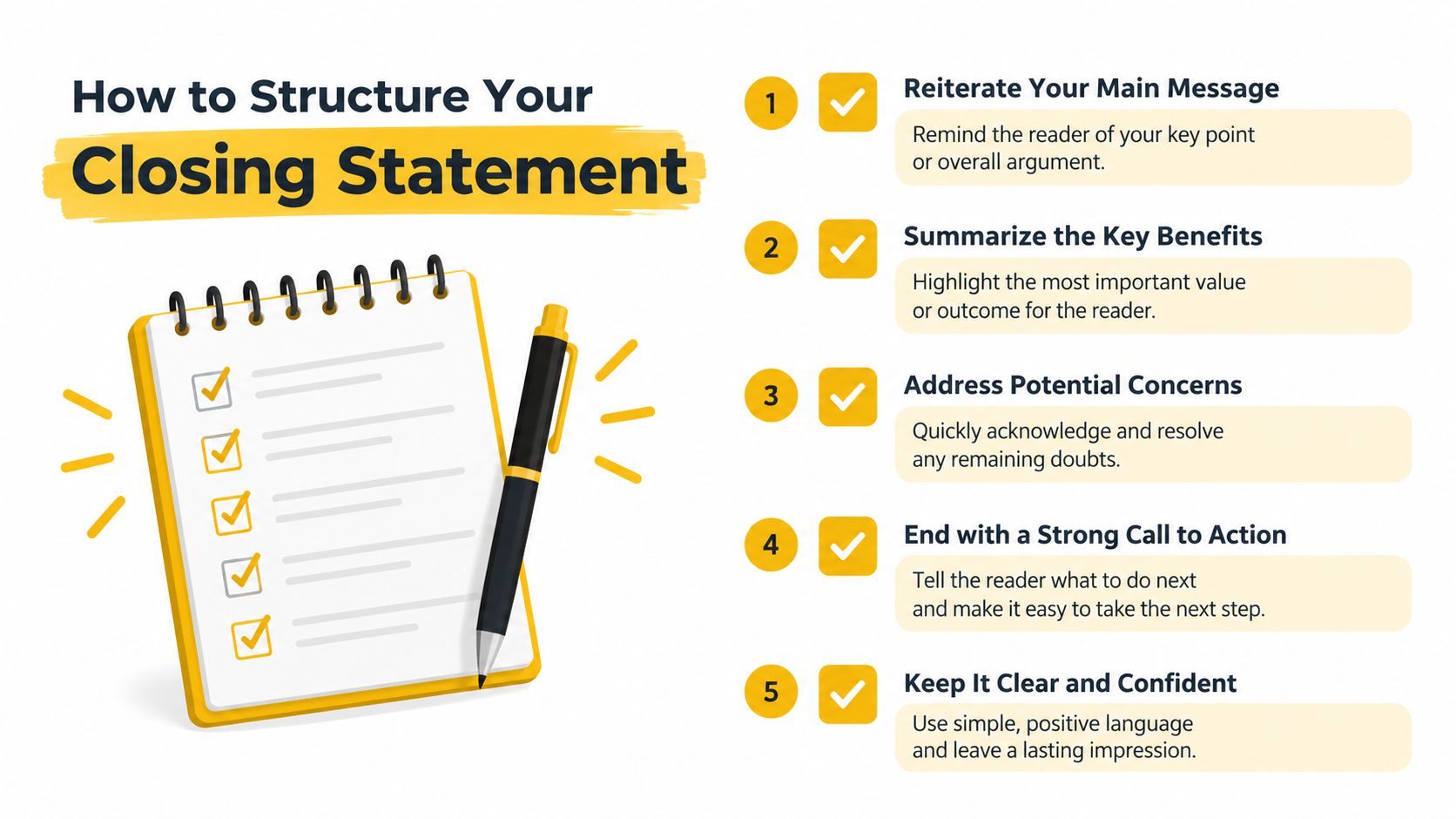
Start with a fit recap
Open with one sentence connecting your background to the role's central need. Don't repeat your résumé. Choose the capability that came up most clearly during the conversation.
“Based on our discussion, my experience improving reporting workflows and partnering with cross-functional teams fits the operational focus of this position.”
That sentence works because it links your experience to the employer's context. It doesn't ask the interviewer to remember every answer you gave. It tells them what conclusion to draw from those answers.
Add one specific reason the role matters
Your second part should explain why this particular role interests you. Avoid broad praise such as “your company is amazing” or “this sounds like a great opportunity.” Mention a challenge, product, customer group, or responsibility discussed during the interview.
“I'm especially interested in the opportunity to help simplify the customer onboarding process because that's where my experience is most relevant.”
Specificity makes the statement sound observed rather than memorized. It also proves you listened.
Finish with a direct question
Close with a question that creates forward movement. “What are the next steps in your hiring process?” is clear and appropriate. If you sense hesitation, ask whether the interviewer has any concerns about your background that you can clarify.
A useful template is:
“Thank you for your time today. Based on our conversation, my experience in [relevant capability] would allow me to contribute to [role-specific priority]. I'm particularly interested in [specific responsibility or challenge]. Is there anything in my background you'd like me to clarify, and what are the next steps?”
Practice the structure, not every syllable. A memorized speech becomes brittle when the conversation takes an unexpected turn. Your aim is to sound prepared, not recited.
Diagnostic Questions Versus Generic Enthusiasm
“I'm very interested in the role” is harmless, but it's weak on its own. The interviewer already knows you're interested because you applied, attended the interview, and stayed until the end. Repeating enthusiasm gives them little new information.
A diagnostic closing question does more. It asks the interviewer to reveal the concern that may be sitting between you and a positive decision.
The weaker approach
Generic enthusiasm usually sounds like this:
“Thank you for your time. I really enjoyed learning about the company, and I'm very excited about the opportunity. I hope to hear from you soon.”
This is polite, but passive. It doesn't reinforce a specific qualification, connect you to a business need, or create an opening to repair an answer that landed poorly.
The stronger approach
A diagnostic close sounds like this:
“Our discussion reinforced my interest in the role, particularly the team's focus on improving delivery reliability. Before we finish, is there anything in my experience that gives you pause or that you'd like me to address?”
That question requires confidence. It also gives you one final opportunity to correct a misunderstanding, explain a career transition, or add context to an answer that felt incomplete.
Employers often use the end of an interview to assess more than interest. They're also watching for clarity, confidence, self-awareness, and coachability. A candidate who can invite constructive concern without becoming defensive demonstrates useful judgment.
When to use each style
Use a straightforward next-step question when the interview has been smooth and the interviewer has already shown strong engagement. Use a diagnostic question when you sensed uncertainty, struggled with an answer, lack direct experience in a key area, or want to address a potential objection openly.
Keep the tone curious, not anxious. Don't say, “Did I do okay?” That transfers responsibility to the interviewer and sounds like a request for reassurance.
For more ideas on making the final exchange useful, review these questions to ask at the end of an interview. Choose one question that fits the conversation rather than firing off a list just to appear prepared.
Adapting for Modern Interview Formats
A closing statement has to survive the format in which you deliver it. In a room, the interviewer can read your posture and natural eye contact. On video, sound quality, framing, timing, and interruptions can affect how your words land. In multilingual interviews, clear phrasing matters more than clever phrasing.

Remote and hybrid interviews
On a video call, slow down slightly and look at the camera while delivering your core sentence. Don't continue speaking while the interviewer is reaching for the controls or another panelist is trying to join. Pause, confirm they can hear you, and deliver the close with steady volume.
A remote interview may end abruptly because of a connection issue or platform timing. Have a short version ready:
“Thank you for the conversation. My experience with stakeholder coordination and process improvement aligns closely with this role, and I'm very interested. Could you share the next step in the process?”
The virtual interview tips from Interview Pilot provide additional guidance for managing the practical demands of online conversations.
AI-filtered and multilingual contexts
Automated systems and international hiring teams reward clarity. Use the employer's terminology naturally when it accurately describes your experience, but don't cram keywords into a speech. Say “forecasting,” “technical documentation,” or “customer retention” only when those concepts genuinely match the role and your background.
If English isn't your first language, choose short sentences and avoid idioms. A direct statement is easier to understand across accents and audio conditions than a polished phrase full of nuance.
For asynchronous interviews, finish with a complete thought rather than a casual “That's all.” State your fit, your interest, and the question or next action clearly because the closing may be the final portion reviewed.
Role-Specific Examples and Templates
The best template reflects the job's actual decision criteria. A software engineer should point to technical contribution and collaboration. A finance candidate should connect analytical discipline to the team's priorities. A product manager should show judgment about users, trade-offs, and execution.
Closing statement templates by role
| Role | Closing Statement Template | Key Focus |
|---|---|---|
| Software engineer | “Thank you for the discussion. My experience building reliable services and working closely with product teams fits the engineering challenges you described. I'm especially interested in improving the platform's performance. Is there any technical area you'd like me to clarify, and what comes next?” | Technical fit and collaboration |
| Finance professional | “I appreciate your time today. My background in financial analysis, attention to detail, and experience communicating recommendations would support this team's decision-making work. The role's focus on evaluating business performance is particularly appealing to me. What are the next steps?” | Analytical value and judgment |
| Product manager | “Thank you for explaining the product goals. My experience prioritizing customer needs, aligning stakeholders, and taking initiatives from discovery through delivery matches what this role requires. I'm interested in the problem your team is solving. Is there any part of my product experience you'd like me to expand on?” | Customer insight and execution |
| Recent graduate | “Thank you for the conversation. My project experience, willingness to learn, and ability to organize complex work would help me contribute to the team while developing quickly. I'm particularly interested in the opportunity to support [specific responsibility]. What would the next stage involve?” | Transferable skills and readiness |
Don't copy these lines word for word. Replace the bracketed material with something the interviewer discussed. A hiring manager can spot a generic script quickly, especially when the candidate uses the same wording for every company.
Match the seniority
Early-career candidates should emphasize preparation, learning speed, and transferable evidence. Experienced candidates should be more specific about the business problem they can own. Executives should focus on priorities, decision quality, and the outcomes they expect to influence.
A strong close also respects the interview stage. In an initial screen, keep the statement concise and curiosity-led. In a final interview, address fit more directly and invite discussion of any remaining gap.
Psychology and Best Practices
The peak-end effect offers a useful reason to take the final exchange seriously. People often remember an experience through its most notable moments and its ending, so a concise close can shape the interviewer's lasting impression and reduce ambiguity about your fit. Aspect's discussion of the peak-end rule in interviews applies this principle directly to interview decisions.
That doesn't mean you can compensate for weak evidence with a polished final sentence. It means the final sentence should accurately organize the evidence you've already provided.
What effective delivery looks like
- Use a calm pace: Speak clearly enough for the interviewer to follow every part, especially on video.
- Keep your posture open: Sit upright, maintain natural eye contact, and avoid looking down at a script.
- Name the role's priority: Refer to a responsibility or challenge raised during the conversation.
- Ask one useful question: Choose next steps or a diagnostic question, not a collection of low-value questions.
- End decisively: Thank the interviewer, answer any final response, and stop talking.
Do not lead with salary, holiday entitlement, or remote-work logistics in an early interview unless the interviewer raises them. Those topics may matter, but they rarely make the strongest final impression at that stage. Use the closing to establish contribution and alignment first.
The best ending sounds like a professional decision, not a plea for approval.
Your voice matters more than theatrical confidence. If nerves make you rush, practice aloud and record yourself. The guidance on calming interview nerves can help you build a steadier delivery before the actual conversation.
If you follow up by email, preserve the same tone. Advice on timing and tone in business thank-you notes is useful when you want the written message to reinforce, rather than contradict, the impression you created in the interview.
Putting It All Together
Prepare your closing before the interview, but customize it during the conversation. Write down the role's central challenge, one qualification that matches it, and one question you want answered. By the time the interview ends, you'll have the raw material for a close that sounds specific and natural.
Use this final checklist:
- Recap fit: Name the capability that best matches the role.
- Show informed interest: Refer to a real responsibility, challenge, or project from the discussion.
- Invite clarification: Ask whether anything in your background gives the interviewer pause when that question is appropriate.
- Confirm the process: Ask what happens next.
- Stop cleanly: Don't dilute a strong ending with unnecessary extra explanation.
Avoid four common mistakes. Don't recite your entire career history. Don't introduce an unrelated achievement. Don't ask several questions after the interviewer has clearly signaled the meeting is over. Don't use enthusiasm as a substitute for evidence.
Before your next interview, write one version for a first-round conversation and another for a final-round conversation.
Practice until the structure feels automatic, then leave room to adapt. A first-round close might emphasize curiosity and relevant experience. A final-round close should be more direct about contribution, remaining concerns, and alignment with the team's needs.
After the interview, write down the details you want to remember while they're fresh. Then send a focused follow-up that reinforces the conversation rather than repeating your closing statement. This practical guide to nailing your post-interview email can help you carry the same clarity into the next stage.
A closing statement in an interview won't manufacture fit where none exists. It will make your fit easier to recognize, give the interviewer a chance to surface doubts, and leave the process with a clear next action. That's enough reason to stop treating the final minute as an afterthought.
Interview Pilot offers guided mock interviews, a searchable question bank, and real-time suggested answers for online interviews across technical and non-technical roles. Use Interview Pilot to rehearse your closing statement, adapt it to the role, and practice delivering it naturally before your next interview.
Topics
closing statements in an interview
interview tips
job interview
interview closing
interview questions
Continue reading

Interviews
Behavioral Interview Questions to Ask Candidates
Use behavioral interview questions to ask candidates with competency-based scoring guidance, ideal answer indicators, and practical follow-up tactics.
October 1, 2026
22 min read

Interviews
10 Questions for Property Manager Interview
Prepare for a property management role with 10 questions for property manager interview, model answer angles, and practical scenario tips.
September 26, 2026
22 min read

Interviews
How to Answer Tell Me About Yourself Interview
Learn how to answer tell me about yourself interview questions with a clear formula, real scripts by role, and timing tips that help you stand out fast.
September 16, 2026
15 min read