













Interviews
API Testing Interview Questions: 10 Answers for 2026
Prepare for API testing interview questions with 10 answers covering HTTP methods, status codes, authentication, contract testing, and automation.
Interview Pilot Editorial Team
Updated November 19, 2026
18 min read
You've built the collection. You can fire a request, read the status line, and explain what a bearer token does. Then the interviewer asks how you'd test a payment endpoint that returns 200 OK with "insufficient funds" in the body, and the room goes quiet for a beat too long.
That beat costs offers. API rounds aren't vocabulary tests. The panel is checking whether you see an API as a contract with failure modes, identities, retries, and state that has to land somewhere consistent. A candidate who checks the status code and stops sounds like someone who'll sign off a release that breaks checkout on a Friday.
Question volume doesn't fix it. Zoho QEngine's 2024 guide runs to more than 25 API testing interview questions, AdaFace published 98 in 2024, and Vskills published 100 in 2025. None of that helps if you can recite an answer and can't defend it once the follow-up lands.
Each question below takes the same shape: the answer I'd give, a test case that makes it concrete, and the follow-up you should expect next. Rehearse the reasoning rather than the script. The wording changes in every interview; the logic doesn't.
1. What is API testing, and how does it differ from UI testing?
The answer: API testing sends requests straight to an endpoint and validates what comes back, including status code, headers, payload, and latency, with no browser in the path. UI testing drives the screens a user clicks. API checks sit at the service layer of the testing pyramid: faster, more deterministic, and much closer to the business rules where defects start.
The test case: POST an order to the payment service, assert a 201 with a well-formed body, then confirm the matching row exists in the ledger table. No checkout page involved. If the order-to-payment join is broken, the API test catches it in milliseconds while a UI test catches it after eight seconds of clicking through a cart.

The follow-up: "So would you drop UI tests?" No. UI tests answer a question APIs can't: can a human finish this journey, and does the page survive a layout change? The answer that lands is the one that says the two layers catch different defects. If the fundamentals round follows, this collection of software tester interview questions covers the ground.
What's really being tested: whether you understand cost. API tests are cheap to run and cheap to maintain; UI tests are neither, so you spend them where they earn their keep.
2. What are the main HTTP methods, and how do you test each one?
The answer: GET reads, POST creates, PUT replaces, PATCH partially updates, DELETE removes. Test each method twice, once for the documented outcome and once for what it must never do. GET must not change state. A PUT sent twice must leave the resource identical. A DELETE on something already gone returns 404 or 204, depending on what the API documents, and your test should pin that choice down rather than accept either.
The test case: create a user with POST, read it back with GET, change the email with PATCH, delete it with DELETE, then GET again and expect 404. Check the database between calls, not just the response bodies. A DELETE that returns 204 while leaving the row in place is a defect no assertion on the response will ever find.
The follow-up: "Which methods are idempotent?" GET, PUT, DELETE and HEAD are, by definition; POST isn't. If they push, explain why it matters. A retry layer that repeats a POST on a timeout creates duplicate orders, and that's the bug that pages someone at 2am.
REST still dominates what teams build, which is why this comes up in nearly every loop. Postman's 2021 State of the API report, from a survey of more than 28,000 developers and API professionals, found REST in use by 94% of respondents, making HTTP semantics a baseline topic rather than a specialist one. When you need to see how a real API documents its verbs and resources, these endpoint contracts for headless DXP are a useful reference.
3. Which HTTP status codes should you validate in API tests?
The answer: the 2xx family for success (200, 201, 204), 4xx for client mistakes (400, 401, 403, 404, 409, 422, 429), and 5xx for server faults (500, 503). For every code the API documents, write one test that produces it. For codes it should return but doesn't document, that's a finding before it's a test.
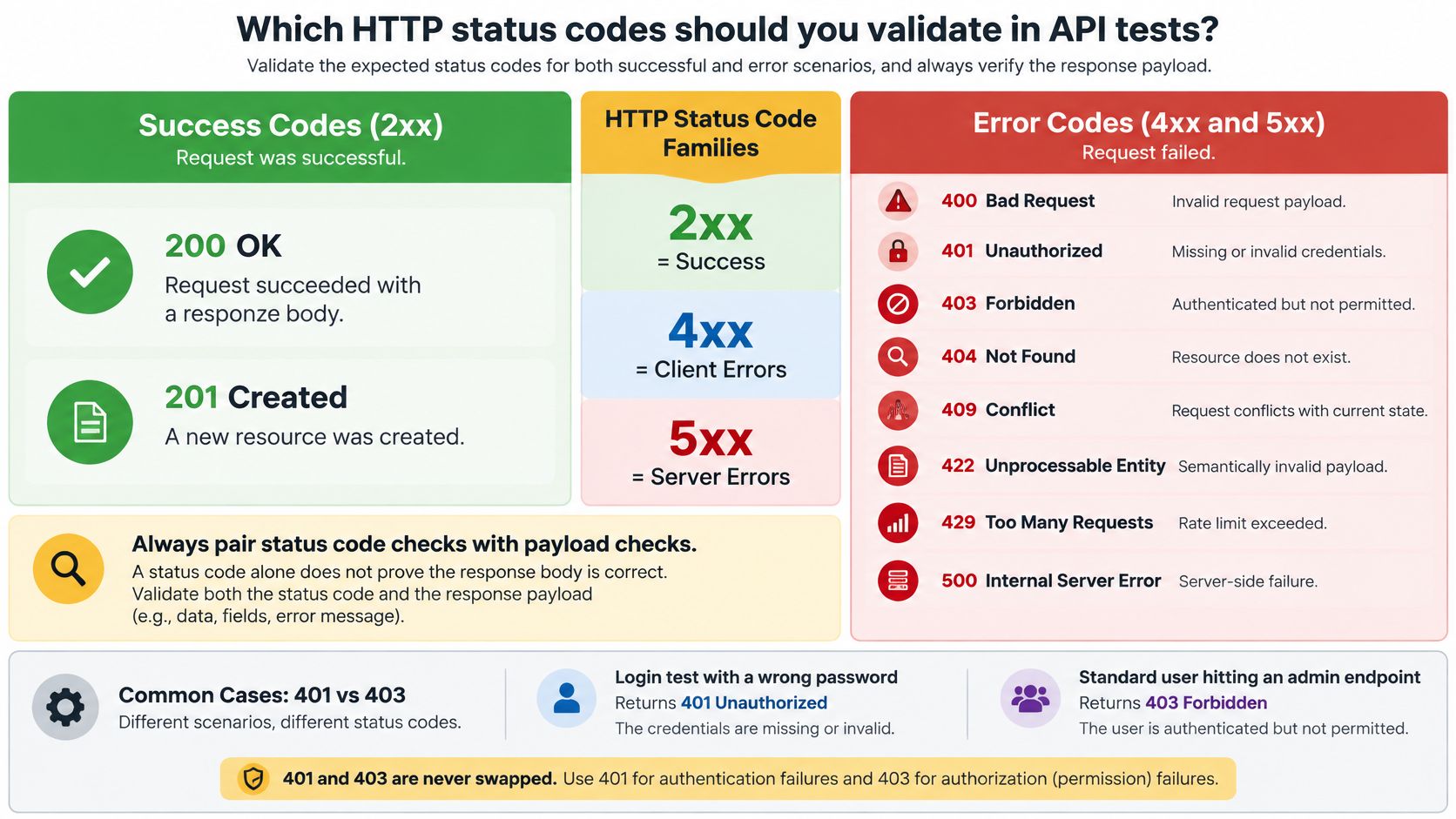
The test case: a login with a wrong password returns 401, not a 200 carrying {"success": false}. A standard user calling an admin endpoint gets 403, not a 404 and definitely not a 200. A duplicate email at registration gets 409 rather than a 500 from a unique constraint crash.
The follow-up: "What's the difference between 401 and 403?" 401 means the identity isn't established: no token, expired token, bad signature. 403 means the identity is valid and the permission isn't there. APIs swap the two constantly, and a suite that only asserts "request blocked" never notices. If you want to see how an error taxonomy looks on a real public API, these documented real estate API error codes are worth a read.
The trap: an interviewer who asks about status codes is usually checking whether you read them as a contract. A 200 with an error body breaks retries, monitoring, and every client that trusts the status line.
4. How do you test authentication and authorization in an API?
The answer: these are two questions, not one. Authentication asks who you are; authorization asks what this identity may touch on this specific object. Test them separately, with real tokens for at least two roles.
The test case: log in as user A, take an order ID that belongs to user B, and request it with A's token. Expect 403, or 404 if the API hides existence, and check the body for leaked partial data. Repeat with an expired token (401), a token you edited and re-encoded without a valid signature (401), and an admin identity (200). Four requests, and every one of them covers something a "login works" test doesn't.

The follow-up: "How does that run continuously instead of once a quarter?" A good answer becomes a process answer at that point. Akamai's 2026 API Security Impact Study reports that API-related incidents affected 87% of organizations, that only 23% knew which APIs returned sensitive data, and that only 16% had fully integrated API security testing into development pipelines. Object-level authorization checks belong in CI, failing the pull request, not in a pen test that finds last quarter's problems.
5. What is idempotency, and how do you test it?
The answer: an operation is idempotent when repeating it leaves the system in the same state as running it once. GET, PUT and DELETE are defined that way. POST isn't, which is why payment APIs accept an Idempotency-Key header: the second call returns the first result instead of charging the customer again.
The test case: send the same POST /payments twice with an identical key, then open the ledger. One charge, same payment ID in both bodies. Resend with a different key and confirm a second charge appears, because an API that swallows legitimate repeat payments is a different, quieter bug.
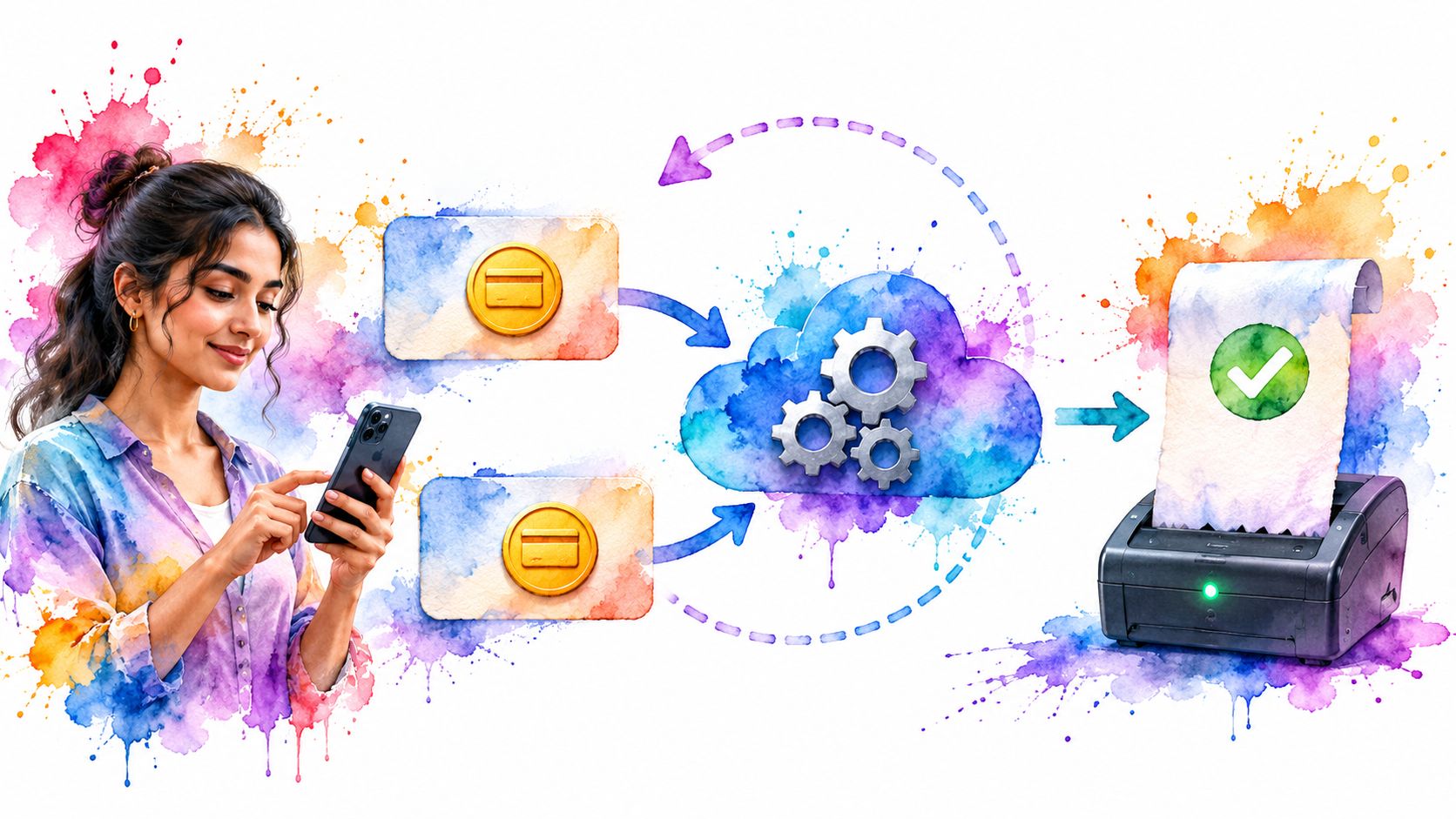
The follow-up: "What if the same key arrives while the first request is still running?" That's a concurrency case, and the honest answer is that the second request should block, return the in-progress result, or fail with a conflict, depending on the design. Say which you'd expect and how you'd force the race with two parallel clients.
The deeper point is that a 200 and one field is a weak oracle, as Qable's API testing interview questions guide notes. Assert duplicate-submission behavior, downstream effects, and ordering. If you're still deciding how to design these tests, this explanation of which HTTP methods need idempotency keys covers the mechanics.
6. How do you validate API responses against a schema?
The answer: pull the response schema from the OpenAPI document, or a standalone JSON Schema, and validate the whole body against it on every call. Required fields present, types correct, enums respected, formats enforced for email and ISO 8601 date-times, and additional properties handled the way the spec says.
The test case: a user object must always carry id as an integer, email as a string in email format, and createdAt as an ISO 8601 timestamp. Three hand-written assertions on those fields pass forever while someone renames createdAt to created_at, because none of your assertions read the field that moved. Schema validation fails the moment the shape drifts.
Structure Is Not Meaning
Say plainly what a schema check can't do. A field that stays a string but switches from cents to dollars passes validation and breaks billing. If an interviewer asks whether adding a field is safe, the accurate answer is that additive changes usually are, while removing, renaming, or retyping a field breaks consumers, and your suite should fail on all three.
Worth saying out loud: functional tests check values, schema tests check shape. A suite with only the first will pass a release that breaks every client at once.
7. What types of API tests do you perform, and how do they differ?
The answer: functional tests check whether one endpoint honors its rules. Integration tests check whether services agree with each other. Regression tests check whether a change broke something that used to work. Contract tests check whether consumer and provider share an interface. Performance tests check behavior under traffic, and security tests check who can reach what. Different questions, different cadences, different failure signals.
How they fit a pipeline:
- Functional tests run on every commit, in seconds, against a fixed spec.
- Integration tests run on merge, against real databases, queues, and downstream services.
- Contract tests run in both the consumer's and the provider's own pipelines, before either deploys.
- Performance tests run nightly with production-like volume, not on a laptop.
- Security tests run per pull request for authorization and per quarter for deeper exploitation work.
The follow-up: "Which do you prioritize when time is short?" A current stat helps here. Postman's 2023 State of the API Report, built on a survey of 40,261 developers and API professionals, found 67% used functional testing and 64% used integration testing, with performance, security, and contract testing behind them, and roughly 1 in 25 respondents saying their teams didn't test APIs at all. Start where the defects land, then argue for the gaps.
8. What is contract testing, and why is it useful for microservices?
The answer: contract testing verifies that a provider's responses still satisfy what its consumers expect, without standing both services up together. In the consumer-driven form, the consumer publishes its expectations as a contract, and the provider verifies them in CI before every deploy. Tools such as Pact do the publishing; a schema-diff tool or a spec-driven runner covers the other direction.
The test case: a frontend needs id, email, and plan from the user service, and its contract names those fields. The user service renames plan to tier, and its build fails at the contract gate before merge, rather than three days later in staging when checkout breaks for everyone.
The follow-up: "Why not just run integration tests?" Integration tests tell you two deployed services work together today, in one environment, with one dataset. Contract tests tell you they'll work tomorrow after either team ships. Both matter; only one scales to a dozen consumers across teams.
The gap between that argument and common practice is wide. Postman's 2025 State of the API Report found 82% of organizations had adopted some level of API-first development, with 25% fully API-first, yet contract testing sat at 17% while functional and integration testing each reached 67%. If you want the service-design side of this conversation nailed too, these interview questions on microservices are good practice.
9. How do you handle test data, dependencies, and mocking in API testing?
The answer: mock what you don't control and can't afford to break (payment gateways, SMS providers, third-party identity), and call the actual service on the paths where the integration itself is under test. Every test creates its own data with a unique identifier and tears it down, so the suite runs in any order and in parallel.
The test case: point WireMock at the payment gateway and have it return a 504 after six seconds. Now you can assert the retry policy, the timeout, the message the user sees, and the fact that no duplicate charge was created. You can't produce that on demand against the live gateway without breaking something.
The follow-up: "Where does mocking go wrong?" When the mock becomes the specification. A stubbed response stays green for a year while the actual provider changes its shape. Pair every mock with a thin, scheduled contract check against the live service so a breaking change fails somewhere.
The mechanics of chaining requests, extracting a value, and asserting on a body are worth seeing once in motion before you describe them under pressure.
10. Which tools do you use for API testing, and how do you choose between them?
The answer: Postman for exploration and shared collections, Newman or the Postman CLI to run those collections in CI, REST Assured when the team lives in Java, Karate when you want tests and mocks in one DSL, SoapUI or ReadyAPI where SOAP contracts still matter, and k6 for load. Choose on four things: who writes the tests, which protocols you need, how the runner reports into CI, and how the suite will look in two years.
The test case: design collections in Postman for a new service, keep them in Git, and run them with Newman in GitHub Actions on every pull request, publishing a JUnit report so failures show in the pipeline UI. When the suite passes a few hundred requests, the maintenance bill for hand-written assertions arrives, and that's the moment a code-based framework starts earning its place.
The follow-up: "Why not use Postman for everything?" Because GUI-authored suites drift from the spec and don't tell you which endpoints have no test at all. A good answer names the limitation you hit, not just the feature list. If you're preparing for a loop that mixes API and QA fundamentals, working through these software testing interview questions alongside is time well spent.
How the core API testing topics compare at a glance
| Item | Main Focus | Standards or Tools Referenced | Key Limitation |
|---|---|---|---|
| What is API testing, and how does it differ from UI testing? | Testing service-layer behavior and comparing it with UI testing | HTTP, REST, GraphQL, SOAP, gRPC; Postman; SoapUI; ReadyAPI; testing pyramid | Does not verify visual or usability aspects |
| What are the main HTTP methods, and how do you test each one? | Testing method behavior, responses, and side effects | HTTP; REST; IETF RFC 9110 | Expected behavior depends on the API specification |
| Which HTTP status codes should you validate in API tests? | Checking success and error outcomes for requests | IANA HTTP Status Code Registry; IETF RFC 9110 | Status codes alone do not validate response bodies |
| How do you test authentication and authorization in an API? | Verifying identity, permissions, and access controls | API keys; Basic authentication; JWT; OAuth 2.0; OWASP API Security Top 10; RFC 6749 | Requires role-specific test accounts and can involve time-consuming token tests |
| What is idempotency, and how do you test it? | Confirming repeated requests do not cause unintended state changes | HTTP; RFC 9110; Idempotency-Key header | Requires checking underlying state, not just responses |
| How do you validate API responses against a schema? | Checking response structure, types, and constraints against a contract | JSON Schema; OpenAPI; Swagger | Schemas can drift or be overly strict |
| What types of API tests do you perform, and how do they differ? | Comparing functional, integration, regression, performance, security, and contract testing | Apache JMeter; Grafana k6; OWASP ZAP; CI/CD | Comprehensive coverage can be costly and require specialized expertise |
| What is contract testing, and why is it useful for microservices? | Verifying consumer-provider agreement without running services together | Pact; consumer-driven contracts | Does not validate business logic or end-to-end workflows |
| How do you handle test data, dependencies, and mocking in API testing? | Isolating dependencies and managing repeatable test data | WireMock; Mockoon; Postman mock servers | Mocks can diverge from real behavior and hide integration defects |
| Which tools do you use for API testing, and how do you choose between them? | Selecting tools based on team skills, protocols, and delivery needs | Postman; REST Assured; Karate DSL; SoapUI; ReadyAPI; Newman; Jenkins; GitHub Actions; GitLab CI | Tool sprawl and commercial licensing can add overhead |
Turning Your Answers Into a Confident Interview Performance
Say each answer out loud before you read it again. Reading builds recognition; speaking builds recall, and the interview only measures the second one.
Then run a short scenario against a real public API so the steps come from memory rather than from a page. Pick a sandbox with authentication, create a resource, read it back, break the payload on purpose, and watch which status code comes back. Do it once with an expired token. You'll describe the flow far more convincingly after that than after another hour of reading.
Treat these ten as patterns, not scripts. Interviewers reword them constantly, and the wording is the least important part. What they're scoring is whether you reach for boundary cases before happy paths, whether you separate authentication from authorization without being prompted, and whether you know the difference between a test that passes and a test that would catch the bug.
Expect the two rounds candidates prepare for least: debugging and CI/CD. A question about a suite that's green while production is broken is really asking whether you understand coverage. A question about where tests run is asking whether you've owned a pipeline rather than just used one.
One honest note on preparation resources. Interview Pilot's question bank contains roughly 10,000 questions, with full access on paid plans, and the question-set content is generalized from public materials and interview patterns rather than confirmed to be asked by any specific company. Use it as volume for rehearsal, and use the reasoning above as the thing you're rehearsing.
Finally, keep one war story ready. A defect you caught at the API layer, what it would have cost in production, and how the test now prevents it. That story does more work in a final round than any definition you can recite.
Interview Pilot pairs a real-time AI interview assistant with guided mock sessions and role-specific question sets, which is useful when you want to rehearse answers like these under time pressure rather than alone in a text editor. If you're prepping for API and SDET loops, you can practice explaining idempotency, authorization testing, and contract drift out loud and get feedback on where the answer thins out. Start with the free plan at Interview Pilot and work up to the paid tiers when you want the full question bank.


Topics
API testing
interview questions
HTTP status codes
API automation
QA interview prep
Continue reading

Interviews
What Are Your Expectations? Sample Answers That Work
Answering 'what are your expectations' in an interview? Get sample responses for salary, role and culture, plus follow-ups and questions to ask back.
November 6, 2026
16 min read

Interviews
Question to Ask Hiring Manager: 10 Smart Picks
Find the best question to ask hiring manager at every stage, with practical follow-ups, role-specific adaptations, and real examples.
October 18, 2026
19 min read

Interviews
10 Assistant Manager Job Interview Questions and Answers
Prepare for Assistant Manager Job Interview Questions with 10 sample answers, competency mapping, and quick prep tips for leadership and delegation.
October 12, 2026
23 min read