
















Interviews
What Are Your Expectations? Sample Answers That Work
Answering 'what are your expectations' in an interview? Get sample responses for salary, role and culture, plus follow-ups and questions to ask back.
Interview Pilot Editorial Team
Updated November 6, 2026
16 min read

You're 20 minutes into a good interview. The questions have been fair, your examples are landing, and then the hiring manager leans back and asks, "What are your expectations?" It sounds open ended, but it's scored. Interviewers use it to check whether you understand the role, whether you'll be easy to manage, and whether you'll stay. A vague answer like "growth and a good culture" gives them nothing to score. A specific answer, followed by a smart question back, gives you credit and tells you whether this employer can describe success at all.
Sample Answers for Each Version of the Question
Start with the plain version, because it's the one you'll hear most. Use a three-part frame that covers what you want from this role, what you bring to it, and how you want to grow. That order matters. It puts the job first, proves fit second, and shows ambition without making the role sound like a stepping stone.
I would keep the whole answer to one clear pass. Name something concrete from the posting, not a preference that could apply anywhere.
Sample Openings for Each Version of the Question
| Version of the question | What the interviewer wants to learn | Sample opening | Pitfall to avoid |
|---|---|---|---|
| Plain 'What are your expectations?' | Fit between you and the role and team | I'm looking for a role with clear ownership and a team that gives regular feedback, which is where I do my best work | Listing only pay, perks or time off |
| Expectations of the role | How clearly you understand scope | From the posting, I expect to own the weekly reporting and then take on forecasting once the pipeline is stable | Describing duties with no sense of priority |
| Expectations of the manager | Management style and what you need to perform | I do well with a manager who sets priorities in writing and checks in every two weeks | Sounding dependent or criticising past managers |
| Expectations of the culture | Pace, collaboration and working norms | I'm looking for a team that reviews work openly and makes decisions with the people who will live with them | Vague praise like 'a good culture' with no example |
| Salary expectations | Budget check and seniority alignment | Based on the scope we've discussed, I'm targeting a range in line with the market for this level | Naming a single exact figure before knowing the scope |
| Growth expectations | Retention risk and development plans | Within a year I'd like to lead a metric review, and I'd value a path toward that in this role | Implying you will leave once you have learned the job |
One Complete Sample Answer
Say you're a mid-level product analyst. You might answer like this:
"I'm looking for clear ownership of a reporting pipeline I can improve end to end, which is the work I've done best in my last two roles. I work well with a manager who gives feedback every two weeks and sets priorities in writing. Within a year, I'd like to lead a regular metric review, and I'd value a path toward that here."
That's about 60 words. It names a specific expectation, a working norm, and a growth path, and every claim connects to the job.
Practical rule: Aim for 45 to 60 seconds and end on the role, not on pay or perks, unless the interviewer has asked directly about pay.
Ending on the role keeps the last impression on contribution. If you end on flexibility, time off, or money, that's what the panel writes down, even if the rest of your answer was strong.
Check Whether AI Is Part of the Evaluation
Clarity matters here because trust is low. In 2025, Gartner found only 26% of job candidates trusted that artificial intelligence would evaluate them fairly, while 52% believed AI screened their application information. If you don't know who's scoring you, you can't structure an answer properly.
The setup below is now common in first-round screens.

Ask the recruiter one direct question before the interview: "Will my answers be reviewed by AI, a person, or both?" You can also ask whether a human reviews the result and what the system scores. That isn't adversarial. It's how you decide how to answer and whether the process gives you a fair route to be understood.
How the Answer Changes Your Delivery
- AI review: Use the role's keywords from the posting in clear, complete sentences. Systems built for matching candidates with AI reward direct evidence tied to stated competencies.
- Human review: Use a conversational story with a result, because a person can follow context and ask a follow-up.
Separate preparation from live help. Rehearsing answers, using practice tools, and reviewing the job posting are legitimate. Using real-time assistance during a live interview is only acceptable if the employer allows it, so check the rules first. If you're unsure how detection works, read up on whether employers can detect AI during interviews before you decide anything.
This short walkthrough shows what an AI-led screen can look like from the candidate side.
If the policy is vague, answer as yourself and ask for clarification in writing. If the employer offers a human alternative, you can say, "Thank you, I'd prefer to speak with someone on the team, so I'm glad that option is available." You've set a boundary without attacking the process.
Build and Rehearse Your Own Answer
A panel scores what it can place. "Growth and collaboration" could mean anything, so it earns nothing. Name what you would own, how you work, and why this posting fits you.
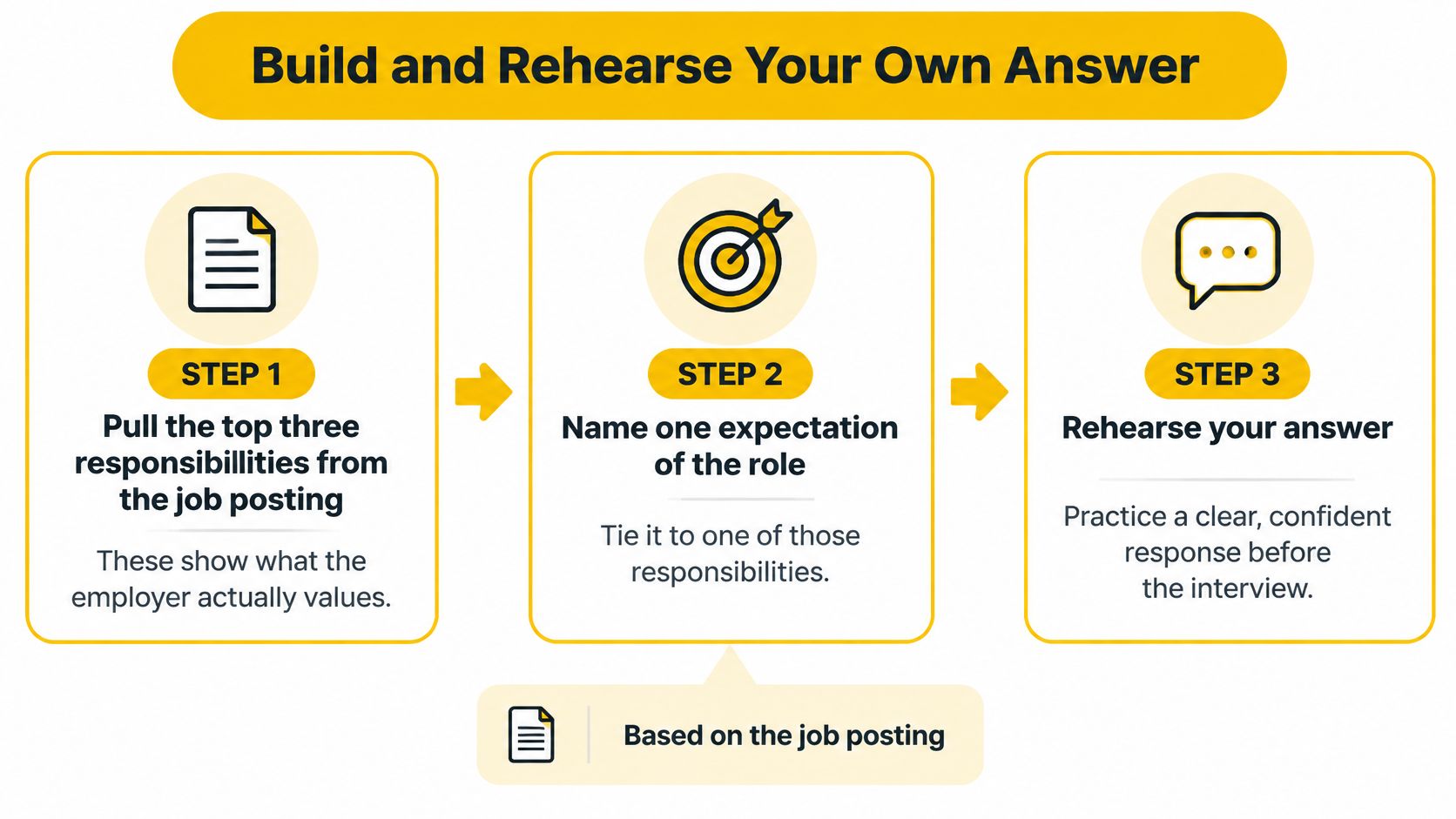
Build It in Five Steps
- Pull the top three responsibilities from the job posting. The posting shows what the employer will measure, not what the careers page celebrates.
- Name one expectation of the role tied to one responsibility. Say clear ownership of a dashboard or a defined scope for the first quarter, not "meaningful work."
- Add one expectation of the environment. Pick a feedback cadence, a team size, or how decisions get made. Interviewers use this to judge management fit.
- Connect each expectation to evidence. Use one result with a number, such as cutting report preparation from two days to three hours in a hypothetical example you adapt to your own record.
- Close with a question back about how success is measured. You are checking alignment, and you are also testing whether they can describe success clearly.
Evidence carries weight because hiring still runs on it. The World Economic Forum's Future of Jobs Report 2025 found 81% of businesses expect to continue using work experience as a hiring assessment method through 2030. That is why a real result beats a polished generic line. The same report expects 39% of workers' core skills to change by 2030, so show reasoning and adaptability, not just a credential.
Rehearse Until It Sounds Like You
Write the full answer on one page first. Check that every expectation maps to a responsibility in the posting. If a sentence could fit any employer, cut it or name the tool, team, or metric that makes it true here.
Then record a 45 to 60 second version on your phone. Listen for filler words, vague nouns like "stuff" or "opportunities," and any claim you cannot back up with an example. Fix one problem per take, not all of them at once. I recommend one clean recording over ten rushed ones.
Next, practise with a mock interview that gives feedback on your answer. We offer AI mock interviews with an evaluation of your answers, and our interview questions library has question sets for 10 roles, including product manager, software engineer, data analyst, data scientist, and project manager. Use the set for your role so the follow-ups sound like a real panel.
Repeat the answer three times aloud, changing one sentence each time. Stop once it sounds like you talking rather than reading.
Over-rehearsal is a real trade-off. A flawless script collapses the moment an interviewer interrupts.
Commit before the interview to one opening, one environmental expectation, and one question to ask back, and use that same version for every interview for the role.
Consistency protects you. Panels compare notes, and a new answer in each round looks like indecision.
Adjust the Answer for Career Changers and Entry-Level Roles
If you have little experience in the role, don't claim seniority you can't back up. Don't apologise for it either. Apologies invite the panel to score the gap instead of what you bring.
Name expectations you can justify without a long track record. A structured first 90 days, a named mentor, clear tasks you can ship, and a path toward more ownership over the year all sound reasonable because they help the employer plan your onboarding.
An entry-level candidate might say: "I'm looking for a structured first three months with a named mentor and tasks I can ship, and I want to grow into analysis work within a year." That's specific, modest, and easy for a manager to say yes to.
Career Changers Should Lead With Transferable Evidence
Use the same structure, but replace the role-specific result with one result from your earlier career, such as a process you owned end to end. Then state your expectation for the new role in terms of the skill you want to use more. A former operations lead moving into support, for example, can point to handover discipline. The same logic applies when firms hire legal receptionists, where intake accuracy and calm client handling transfer from many front-desk roles. For more phrasing, see these career change interview answers.
Avoid three slips:
- Senior pay for a junior scope: It signals you haven't read the level.
- Listing what you lack: Name what you bring and how you'll close one gap.
- Calling the old career a mistake: It makes interviewers wonder if you'll say the same about this one.
If a follow-up asks why you're changing, answer with the expectation that drew you to the new field, not a complaint about the old one.
How to Handle Salary Expectations
Do the market check before the call. Look up the rate for the role, seniority, and city using at least two salary sources, such as a salary guide and live postings with ranges. You need your floor settled in advance, because deciding it live under pressure is how people undersell themselves.
Defer in the First Screen
In a first screen, you usually don't know the full scope yet. Ask the recruiter for the budgeted range before you name yours. Say, "I'd like to understand the scope first, then I can be specific." That's not evasive. Scope changes price. A role with on-call duties, direct reports, or revenue ownership isn't the same job as the title alone.
I would avoid quoting your current salary as a baseline unless it's directly asked and legally required where you live. Your current pay reflects your old scope and old employer, not this role's market value.
Give a Range When You Must Answer
Give a range, not a single figure. Set the bottom at the market rate for the role and the top at what you'd accept for the full scope as described. A single exact number leaves you nowhere to go if the scope expands during the process.
Watch for two common slips:
- Naming a number far below market because you're nervous: Recruiters read it as a seniority signal, and you can't easily renegotiate upward later.
- Naming a number so high the recruiter stops listening: You lose the chance to be scored on fit at all.
Calm pivot: "Based on the responsibilities you described, that range fits, and I'm most interested in the ownership of the forecast."
That closing line does real work. It confirms alignment, then moves the conversation back to the role, where you can earn credit. Don't keep negotiating after you've stated a range. Say it once, clearly, and let the recruiter respond.
Ask Two-Way Questions Back to the Employer
Most candidates treat What are your expectations as a one-way test. It isn't. After you state yours, test whether the employer can describe its own. If it can't, you've learned something important about how you'll be managed.
The feedback gap makes this step necessary. A 2025 interview-feedback report from Textio found 84% of rejected candidates had never received interview feedback. If you wait until after a rejection to learn the criteria, you'll probably never learn them. Ask while you're still in the room.
Four Questions Worth Asking
- "What does success look like in the first 30, 60 and 90 days?"
- "Which competencies are you scoring in this interview?"
- "What does the team most need from this role in the first six months?"
- "When will I hear about the next step?"
Frame each one as fit checking, not cross-examination. "I want to make sure my expectations match how you'd measure the role" works well. You're inviting clarity. For more options, browse good interview questions to ask the employer and pick ones you can ask naturally.
How to Read the Response
A clear answer names metrics, owners, and dates. "Own the weekly pipeline by day 60, and we'll decide on next steps by Friday" tells you the process is structured and the manager has thought about the hire. That kind of answer is rare, which makes it valuable.
A vague answer is also information. If nobody can explain evaluation criteria, feedback practices, or role priorities, that's evidence about management quality and process transparency. It should inform your decision, not only your next answer. You may still take the job, but take it knowing you'll have to create your own structure.
State reasonable expectations, then check whether the company can describe them concretely. If it can't, that gap is part of the offer.
Ask collaborative questions, listen carefully, and write down any dates you're given. Following up exactly when they said they'd decide shows you're organized, and their reply shows whether they are.
Answer Follow-Up Questions Without Stalling
The follow-up lands seconds after you finish your opening. The panel is checking whether your expectations hold when pushed, so prepare the replies that keep you consistent instead of inventing new priorities on the spot.
Common Follow-Up Questions and Suggested Replies
| Follow-up question | What it checks | Suggested reply |
|---|---|---|
| Is that salary negotiable? | Flexibility and how firm your number is | It depends on the full scope, so I'd like to understand the responsibilities before we talk numbers |
| What if we can't meet your expectations? | Whether you negotiate or walk away | If the scope is as we discussed, I'm open to talking about the package; I'd want to know where the flexibility is |
| Where do you see yourself in five years? | Commitment and growth fit | I'd like to be leading the forecasting work here and mentoring newer analysts |
| Why are you leaving your current role? | Motivation and whether the reason is stable | I've learned what I can in this role, and I want more ownership of decisions |
| What would make you turn down an offer? | Deal-breakers and priorities | Unclear scope, no path to growth, or a manager who can't give feedback would be the main concerns |
Notice what each reply protects. The salary answers keep scope in the frame. The five-year answer grows inside this company instead of beyond it. The leaving answer moves toward ownership rather than away from a bad manager. The deal-breaker answer repeats the same priorities you opened with, so the panel hears one coherent person.
Treat that coherence as due diligence in both directions. A consistent candidate makes it easier for a strong manager to answer clearly, and a vague or shifting response from the panel tells you something about how decisions get made there.
Three Rules for Any Follow-Up
- Pause for two seconds first: A short pause reads as thought, not hesitation. Rushing reads as a rehearsed deflection.
- Name what you'd need to know: If you can't answer, say so plainly and offer to follow up in writing. That is stronger than inventing a figure.
- Restate scope when pushed: On salary or expectations, repeat the responsibilities and ask what the employer has budgeted for them.
I recommend one standard: keep the same set of expectations from opening answer through final follow-up. Interviewers score consistency. A rehearsed reply that contradicts your first minute damages credibility, and credibility is hard to rebuild in the same meeting.
Rehearse your answer to "What are your expectations?" before a panel tests it, using AI mock interviews with an evaluation of your answers and role-specific question sets. Practise until your opening, evidence, and question back sound natural under pressure, then visit Interview Pilot to run your next rehearsal today.
Topics
interview expectations
interview questions
interview answers
salary expectations
Continue reading

Interviews
What Makes You Unique Sample Answers: 8 Proven Examples
8 what makes you unique sample answers for technical, finance, product, and junior roles, with analysis and tips to tailor each one to your interview.
November 4, 2026
17 min read

Interviews
How to Ace Behavioral Interview with STAR
See how to ace behavioral interview rounds with 6-8 scored stories, a timed STAR answer, follow-up practice, and a rehearsal that stays credible.
October 31, 2026
16 min read

Interviews
Question to Ask Hiring Manager: 10 Smart Picks
Find the best question to ask hiring manager at every stage, with practical follow-ups, role-specific adaptations, and real examples.
October 18, 2026
19 min read