









Career
40 Dollars an Hour Jobs: 7 Careers Worth Pursuing in 2026
Discover 40 Dollars an Hour Jobs in healthcare, finance, and analytics, with BLS pay medians, required credentials, and clear steps to get started.
Interview Pilot Editorial Team
Updated October 31, 2026
14 min read

$40 an hour equals about $83,200 a year at 40 hours a week for 52 weeks. The typical U.S. hourly wage is far below that benchmark, so reaching it usually requires a specific degree, license, or certification. Pay also varies by region, employer, and specialty.
The seven roles below offer distinct paths to the target, each with entry requirements you can check before investing in training. For context on management pay, see median pay for US managers. Each profile covers the work, qualifications, trade-offs, and a field-specific interview preparation step.
1. Accountant and Auditor
Start with the image below for a quick view of how pay and schooling line up for this role.
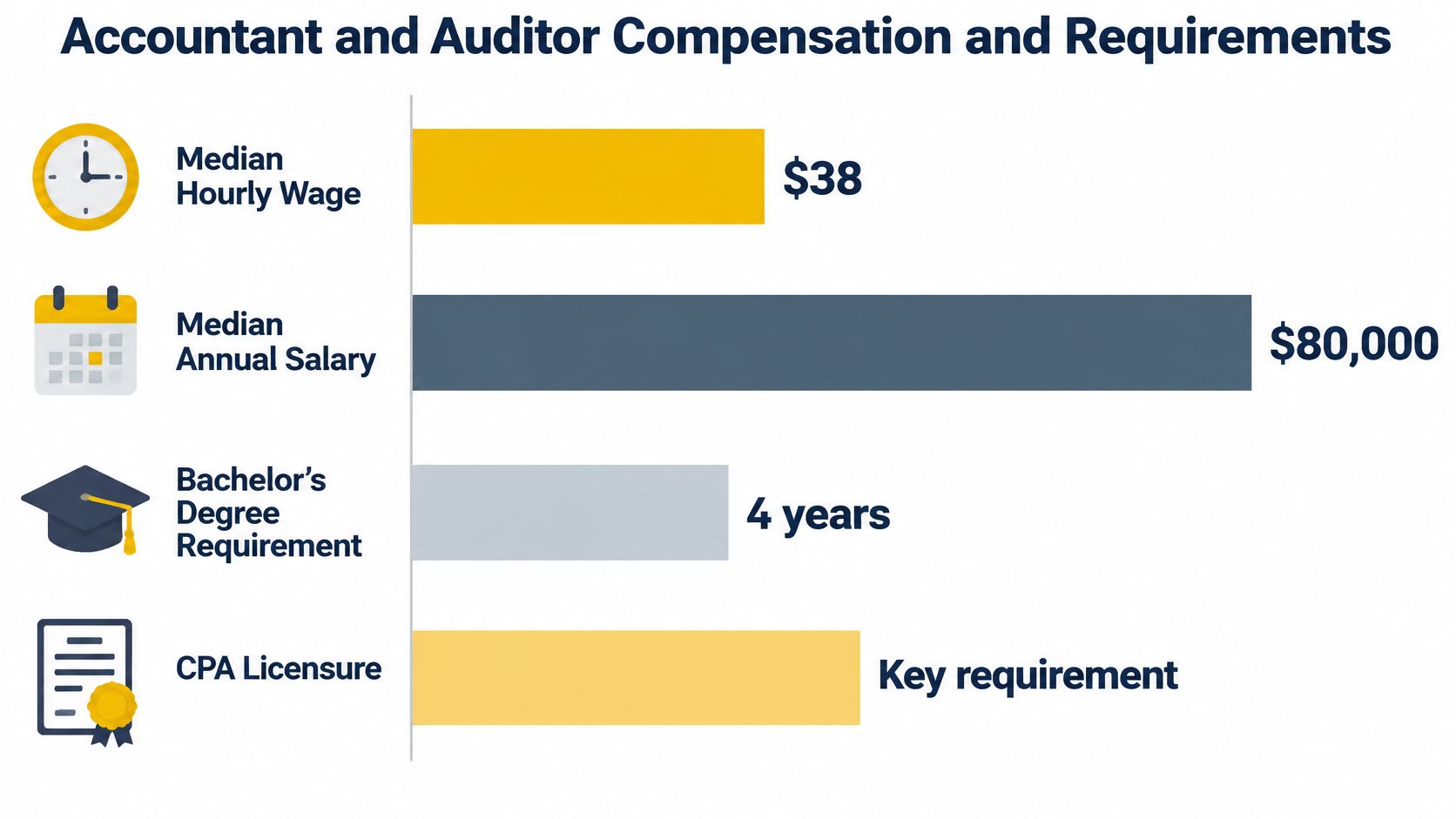
Accountants organize financial records, prepare statements, and handle tax filings. Auditors independently check those records for errors, fraud, and compliance failures. The work is foundational because every lender, regulator, and board relies on those numbers being right. The Bureau of Labor Statistics May 2025 wage tables show multiple business and financial occupations with median hourly wages around or above this benchmark, including reported medians of $40.15, $44.06, and $48.49 for specific occupations in the category.
Entry Path and Trade Offs
You'll typically need a bachelor's degree in accounting or a related field. The CPA license is what separates candidates who stall below the target from those who clear it, especially for audit and public accounting. Deloitte, PwC, EY, and KPMG hire large entry level audit cohorts each year, while a corporate controller at a mid size company runs month end close and internal controls. The upside is stability and portability across industries. The downside is deadline pressure around close, quarter end, and tax season, plus continuing education to keep a license active.
Practical rule: Don't interview on personality alone. Bring one error you caught and explain what it would've cost if you'd missed it.
Interview Step
Prepare a STAR example on error detection or a process you improved, and be ready to explain GAAP versus IFRS, revenue recognition, and internal controls out loud. Work through these accountant interview questions and technical topics until you can answer without freezing when an interviewer changes the numbers mid question.
2. Budget Analyst
A hospital system asks you to explain why a department overspent while patient volume fell. That's the job in miniature. Budget analysts review spending requests, forecast costs, track actual spending against plan, and recommend cuts or reallocations. State and local governments use them to build annual operating budgets, and hospital systems use them to allocate departmental budgets and track cost per patient.
The image below captures the dashboard heavy, spreadsheet driven nature of the work.

Most roles ask for a bachelor's degree in finance, accounting, economics, or a related field, and government postings often layer on specific coursework or experience rules. What pushes pay toward the benchmark isn't the degree title. It's Excel modeling, forecast accuracy, and the ability to tell a non finance manager what a variance means for staffing or services next month. Analysts who only report numbers get replaced by software. Analysts who explain trade offs get promoted.
What Helps and What Hurts
- Pros: Predictable employers in government, universities, and hospitals, plus skills that transfer to financial analysis.
- Cons: Budget cycles create intense peak periods, and you'll often deliver unwelcome news to department heads.
- Reality check: A posting that says analyst but mostly means data entry won't reach this pay level.
Interview Step
Quantify a result before you walk in, such as costs you reduced or a forecast you made more accurate, and practice a two minute explanation of a budget variance for a non finance manager. Review technical finance interview questions on forecasting and modeling so a live Excel or methods question doesn't derail you.
3. Insurance Underwriter
Underwriters decide whether an insurer should accept a risk, and at what price. They review applications, financial data, claims history, and medical or property information against company guidelines. A commercial underwriter might evaluate a small manufacturer for property and liability coverage. A life underwriter assesses medical history to decide eligibility and premium class. Get the decision wrong in either direction and the carrier loses money or loses the account.
Most employers want a bachelor's degree, and many train new hires internally because each carrier has its own appetite for risk. Professional designations such as the CPCU for property and casualty work signal that you understand coverage forms and risk selection beyond your first desk. That credential plus a profitable book of business is usually how underwriters move toward and past the benchmark, not time served alone.
Where Candidates Misjudge This Role
Automation handles straightforward personal lines applications faster every year. The durable work sits in commercial, specialty, and complex cases where judgment matters and documentation has to hold up. That's also where pay holds up. On the plus side, hours are often steadier than in claims or sales. On the minus side, you'll decline business that agents worked hard to bring in, and you'll need to explain why without burning the relationship.
Interview Step
Prepare one specific example of balancing risk against growth. Say you approved a borderline account with exclusions and a higher deductible instead of declining it outright, then explain the evidence you used. Practice describing how you'd handle incomplete or conflicting information, and research the carrier's product lines so you can connect your answer to the risks it wants. Vague talk about being detail oriented won't carry this interview.
4. Operations Research Analyst
Airlines use optimization models to schedule crews and aircraft while meeting rest rules. Hospitals model patient flow to reduce emergency department wait times. Operations research analysts build models like these to improve decisions about routing, staffing, pricing, and resource allocation.
In May 2025, the mean hourly wage across all U.S. occupations was $33.54, according to the Bureau of Labor Statistics occupational wage release. That figure provides a useful benchmark, but it is not this job's pay rate. Reaching $40 an hour usually calls for strong quantitative skills and relevant experience. Employers typically expect a bachelor's degree in operations research, mathematics, statistics, engineering, or computer science. Some prefer a master's degree for work that requires deeper modeling expertise.
Trade Offs to Weigh
The role overlaps with data analysis and data science, so interviews may include SQL and coding screens as well as case questions. The work can be intellectually demanding and remote-friendly. Its main frustration is that a sound model may still go unused if decision-makers distrust its assumptions or the input data is unreliable.
Interview Step
Choose one modeling project and explain it in sequence: the decision it addressed, the assumptions and constraints, and the model's limitations. Be ready to describe where the model could fail. Start with a plain-language explanation, then add the technical detail when asked.
5. Dental Hygienist
Licensed clinicians, not dental assistants with a different title. Hygienists clean teeth, screen for oral disease, take X rays, apply preventive treatments, and teach patients how to maintain oral health between visits. Private practices rely on them for routine cleanings and periodontal care, while public health programs send them into schools and community clinics for preventive work.
The License Is the Gate
You'll need an accredited dental hygiene program, usually at the associate degree level, followed by state licensure with clinical and written exams. That license is why the pay works. A practice can't hand your duties to an unlicensed hire when schedules get tight. It also means your earning ceiling depends partly on state scope of practice rules and whether you're full time with benefits or filling part time shifts across offices.
- Pros: Strong hourly pay relative to training length, patient facing work, and flexible schedules.
- Cons: Physical strain from posture and repetitive hand work, exposure management, and production pressure in some corporate practices.
- Watch out for: A high hourly rate attached to too few guaranteed hours to match full time income.
Anxious patients remember how you explained the procedure more than how fast you finished it. Interviewers know that, and they'll test it.
Interview Step
Prepare a clear example of educating a patient who was anxious or resistant, and be specific about your infection control procedures and clinical experience. Use these healthcare interview questions and situational prompts to rehearse difficult patient scenarios out loud, because calm, concrete answers beat general claims about loving patient care.
6. Speech-Language Pathologist
Speech language pathologists assess and treat communication and swallowing disorders. In a school district, that means supporting students with articulation and language disorders so they can participate in class. In a stroke rehabilitation unit, it means treating swallowing safety and language impairment so a patient can eat and communicate again. The settings differ, but the core work stays the same. Evaluate, build an individualized plan, measure progress, and adjust.
This is a master's degree profession. You'll complete graduate training in speech language pathology, supervised clinical hours, and state licensure, and many employers also expect the ASHA Certificate of Clinical Competence. That long runway is the honest trade off. Training costs more and takes longer than several other roles on this list, so you should want the clinical work itself, not only the hourly rate.
Setting Changes Everything
Schools offer predictable calendars but heavy caseloads and paperwork. Hospitals and rehab settings bring medically complex cases and interdisciplinary teams. Private practice can raise earnings while adding scheduling, billing, and unpaid documentation time. Ask any employer how productivity is counted. A rate that looks strong on paper shrinks fast if you're expected to document, call families, and coordinate with teachers off the clock.
Interview Step
Bring one concrete case where you adapted therapy for a child or adult with limited motivation, and explain how you measured whether the change worked. Practice describing how you collaborate with parents, teachers, and physicians when goals conflict. Name the evidence based approach you chose and why it fit that person. Panels hire clinicians who can justify decisions, not clinicians who list techniques.
7. Diagnostic Medical Sonographer
Sonographers use ultrasound equipment to capture images of organs, tissues, and blood flow for physicians to interpret. Their work varies by specialty: obstetric sonographers perform prenatal scans, while cardiac sonographers capture images used to assess heart function. Clear communication matters throughout the scan, especially when patients are anxious or the examination is sensitive.

The typical entry path is an accredited associate or bachelor's program that includes clinical rotations. Specialty credentials, such as those offered through ARDMS, can support work in a specific area. Check job postings for the credentials employers require; training and certification take time, and specialty choice can affect both schedule and duties. Cardiac and vascular roles may involve on-call work, while outpatient obstetric roles may offer steadier hours.
The video below covers sonography training and daily scanning work. Use it to compare the demands of the job with what a program teaches.
Interview Step
Describe how you would adjust scanning technique when anatomy is difficult to image. Explain how you would communicate calmly if a finding concerns you, while leaving diagnosis to the physician. Be precise about the ARDMS credentials and specialty certifications you hold or are pursuing.
Median hourly pay, entry requirements, and best-fit profile for each role
Use the hourly figures as a benchmark, not a guaranteed starting wage. The table summarizes the roles' typical entry routes and the preparation each calls for.
| Role | Median hourly pay | Typical entry education | Credential or license | Best fit |
|---|---|---|---|---|
| Accountant and Auditor | About $38/hour | Bachelor's degree in accounting or a related field | CPA license can support advancement and is often needed for advanced roles | Detail-oriented people interested in financial reporting |
| Budget Analyst | About $41/hour | Bachelor's degree in finance, economics, accounting, or public administration | No license typically required | People skilled in forecasting and resource planning |
| Insurance Underwriter | About $38–$40/hour | Bachelor's degree in finance, business, or a related field | CPCU or ARM designations can help | Analytical people interested in evaluating risk |
| Operations Research Analyst | About $40/hour | Bachelor's degree in math, statistics, engineering, or economics | No license typically required | Quantitative problem-solvers interested in optimization |
| Dental Hygienist | About $42/hour | Associate or bachelor's degree from an accredited program | State license and required exams | People seeking hands-on patient care and preventive health work |
| Speech-Language Pathologist | About $43/hour | Master's degree in speech-language pathology | State license; clinical fellowship and CCC-SLP are standard | People interested in helping clients improve communication and swallowing |
| Diagnostic Medical Sonographer | About $40/hour | Associate or bachelor's degree in diagnostic medical sonography | ARDMS certification is widely required or preferred | People interested in technical, patient-facing imaging work |
A degree is the usual entry point for the analyst and finance roles. Clinical careers add accredited training and licensing requirements, so their path includes more formal gates before you can practice. Prepare accordingly: accountants should be ready to discuss financial reporting, budget analysts to explain a forecast, and underwriters to show how they assess risk. For operations research, practice describing how you would use quantitative analysis to improve a decision.
Your Next Step Toward $40 an Hour
A $40 hourly target narrows the field: wages vary widely across occupations, as the Bureau of Labor Statistics percentile table shows. Choose one of the seven roles and check its entry requirements before spending money on a degree, license, or certification.
The paths differ. Accounting, budgeting, underwriting, and operations research involve analytical work; dental hygiene, speech-language pathology, and sonography involve clinical training and patient contact. Consider the day-to-day work as well as the pay target.
Check state licensing rules, local employer expectations, and whether a training program is accredited. Then compare job offers by total compensation. A contractor's hourly rate may not account for unpaid gaps, health insurance, or retirement contributions, so compare those costs with a salaried offer.
Prepare for interviews while you train. Build a specific example for a skill the role requires: a forecast you improved, a model you validated, or a patient interaction you handled well. Practise explaining your example clearly under time pressure. For roles with patient contact, prepare to discuss communication and care; for analytical roles, explain your reasoning and the result.
Treat interview preparation as part of the path to the target rate. Your degree or license may meet an entry requirement, while clear, relevant answers help employers assess your fit. Choose a role, confirm its requirements, and rehearse questions tied to its work.
Interview Pilot offers real-time suggested answers during live online interviews, guided mock practice, and a searchable bank of role-specific questions. Use its questions to practise explaining your experience for the role you want.
Topics
40 dollars an hour jobs
high paying jobs
$40 hourly pay
career guide
hourly salary jobs
Continue reading

Career
How to Build a Resume with Publications Listed
Format a resume with publications listed: where it belongs, status labels, citation order, how many to keep, and when a full CV is better.
October 28, 2026
15 min read

Career
Other Words for Teamwork: 10 Terms to Use in 2026
Looking for other words for teamwork? Compare 10 terms like collaboration and synergy, with resume, interview, and job description examples you can use.
October 25, 2026
16 min read

Career
Strategic Partnerships Manager Career Guide
Explore the strategic partnerships manager role, core skills, KPIs, interview answers, resume examples, salary expectations, and career paths.
October 22, 2026
20 min read