









Career
Strategic Partnerships Manager Career Guide
Explore the strategic partnerships manager role, core skills, KPIs, interview answers, resume examples, salary expectations, and career paths.
Interview Pilot Editorial Team
Updated October 22, 2026
20 min read

You're in the final round, describing a partner everyone loves. The meetings run well, the executives get along, and the launch shipped on time. Then the hiring manager asks what revenue the partnership sourced, what it cost to support, and whether you'd renew it on the same terms. If you can't answer, you've described a good relationship, not a strategic partnerships manager track record. That distinction now decides who gets hired.
Why the Role Matters Now
The candidate in that interview isn't inexperienced. She's run partner calls for years, kept a difficult sponsor engaged, and coordinated a product launch across two companies. Her problem is translation. She talks about activity while the panel evaluates commercial outcomes, operating quality, and risk.
That gap is common because partnerships are easy to describe warmly and hard to prove. You can count meetings, logos signed, and introductions made without showing activation, pipeline, margin, or retention. A hiring manager hears effort. She doesn't hear whether the partnership deserved scarce product, legal, and sales time.
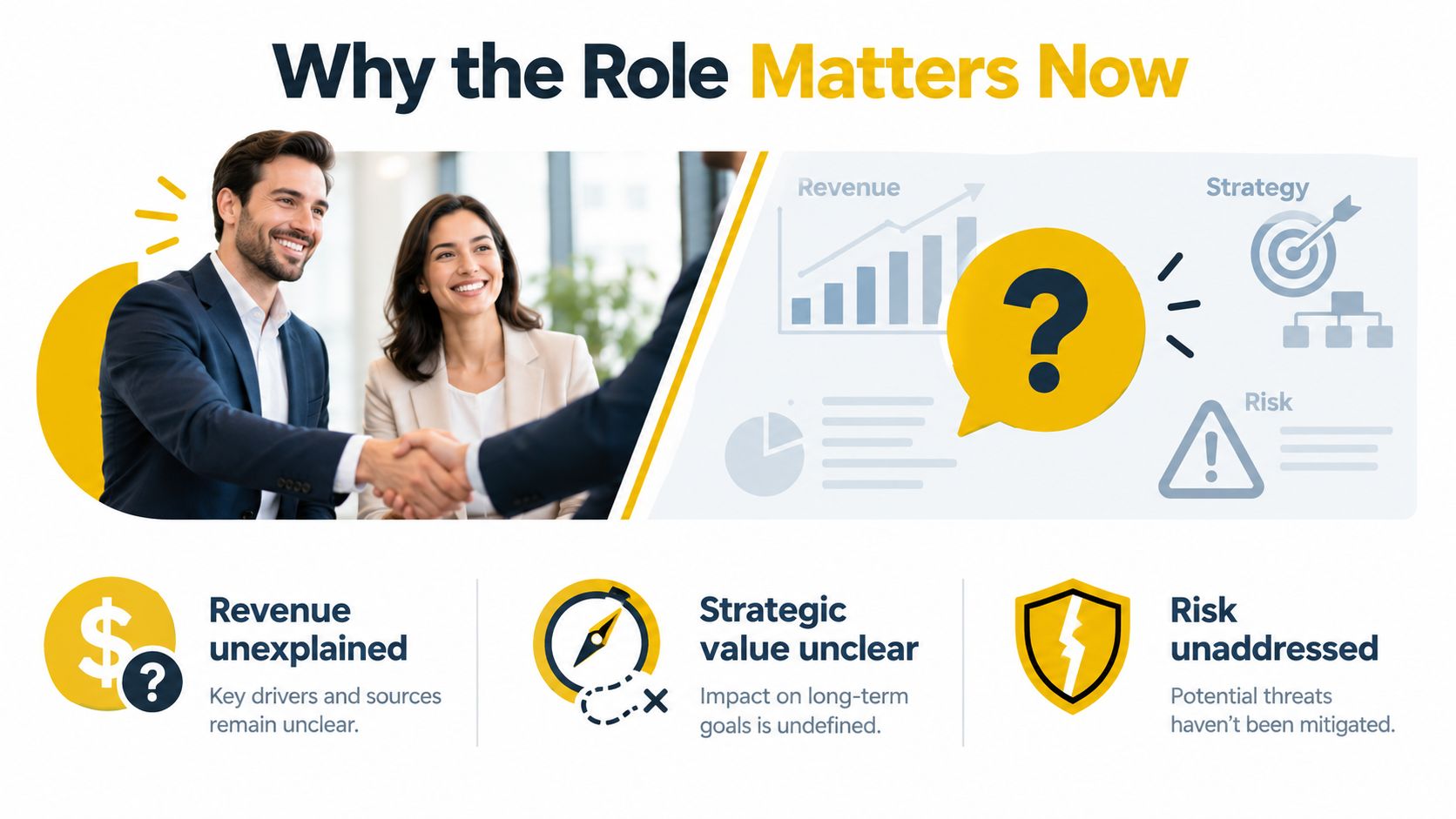
The economics explain why panels push harder. In a partnership-industry study, 52% of surveyed companies generated over 20% of revenue through partnership channels, and partners contributed an average of 23% of overall company revenue, the partnership industry study on revenue contribution reports. Those aren't side-channel numbers. They put the role next to sales and marketing in growth accountability.
Maturity Separates Activity From Value
The same study shows what's at stake in portfolio quality. Companies with highly developed partnership programs obtained an average of 28% of revenue from partnerships, compared with approximately 18% for less mature programs. At that study's average annual income of $1.55 billion, the 10-percentage-point gap represented an estimated $162 million in annual revenue.
You don't need to memorize that figure for an interview. You need its lesson. Mature programs select partners for economic complementarity, structure incentives carefully, track attribution, and intervene when activation stalls. Immature programs collect signed agreements and hope goodwill turns into pipeline.
Trust gets a partnership launched. Governance, measurement, and honest trade-offs determine whether it earns renewal.
That's the lens this career path rewards. You'll be judged on partner selection, business-case quality, launch discipline, risk calls, and your ability to expand what works or exit what doesn't. Relationship skill still matters, but it isn't the job. It's one input into a commercial system you own across organizations.
Understanding the Strategic Partnerships Manager Role
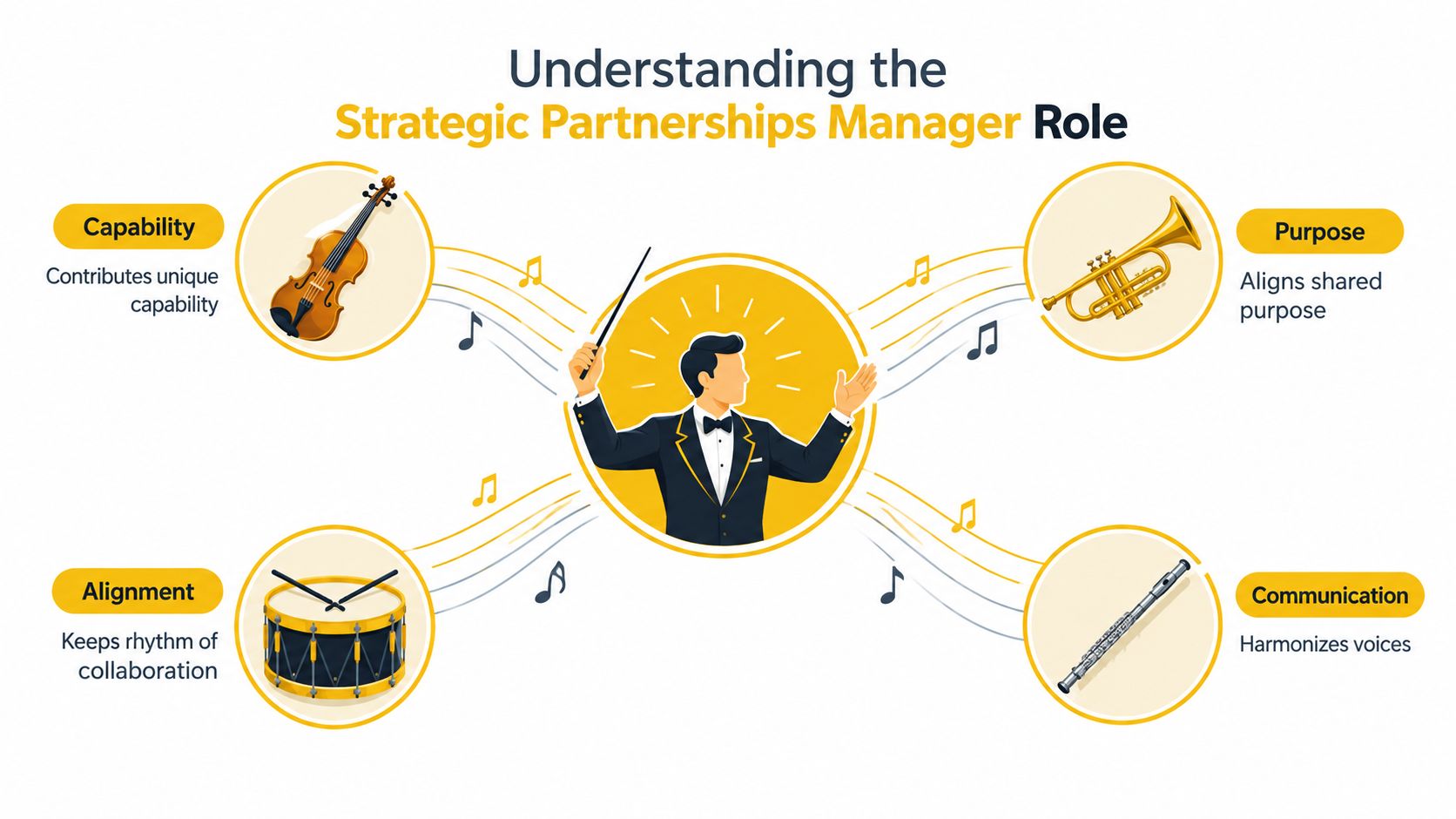
Think of a strategic partnerships manager as an orchestra conductor rather than a single performer. Each partner brings a different capability, audience, or distribution route. Internal teams bring product, pricing, legal terms, and delivery capacity. Your work aligns purpose, economics, timing, and operating rules so those parts produce one coherent result.
The role didn't always carry this scope. Strategic partnerships management developed into a distinct business discipline during the 1980s and 1990s as companies used alliances instead of relying exclusively on mergers, acquisitions, or vertical integration to obtain technology, capabilities, and market access, the alliance management history covering that evolution explains. Among the 1,000 largest U.S. public companies, the share of revenue attributed to strategic alliances reportedly rose from approximately 3-6% during the 1990s to about 40% by 2010.
The Work From Fit to Expansion
The job moves as a chain. First comes partner identification and due diligence. You're testing strategic fit, overlapping customers, complementary capabilities, reputation, and whether the partner can deliver users, product value, or market access.
Next comes value-proposition design and negotiation. Both sides need a reason to invest beyond a press release. You define what each company contributes, what each receives, how revenue or costs are shared, and which commitments are contractual rather than aspirational.
After signature, the harder work starts. You coordinate launch plans, enablement, integrations, co-marketing, and sales handoffs. Then you run governance, monitor performance, resolve blockers, and decide whether to expand, redesign, or end the relationship.
That operating view helps explain measurement. If you're building dashboards beyond signed logos, a practical starting point is reviewing common partner management KPIs and adapting them to your motion, whether that's referrals, integrations, marketplaces, or co-selling.
What the Role Is Not
Strategic partnerships isn't vendor procurement, where the primary goal is buying a defined service at acceptable cost and risk. It isn't pure channel sales, where quota through resellers dominates. It also isn't general business development if that term means opening doors without owning post-signature performance.
The distinction is accountability after agreement. Procurement can succeed when a vendor performs to contract. A partnerships manager succeeds when two independent organizations create value neither would produce as efficiently alone.
You'll work with legal, finance, product, marketing, sales, data, and operations, but they don't report to you. Influence comes from a credible business case, clear decision rights, and evidence about what's working. When priorities conflict, you can't escalate every disagreement. You have to show the customer, revenue, cost, and risk consequences of each option.
This short video is useful for hearing how practitioners frame partner strategy in plain commercial terms before you map it to your own experience.
Watch for the underlying pattern. Strong partnership work connects a strategic gap to a partner's asset, then turns that connection into governed execution. Weak work starts with an available partner and searches for a justification afterward.
Responsibilities and Performance Dimensions
Responsibilities become credible when you turn them into an operating cadence. Partner selection, negotiation, and launch work matter, but hiring managers also want to know what you review weekly, what triggers intervention, and how you decide whether a partner stays in the portfolio.
Start before signature. Build a mutual business case with the target customer, expected motion, resource commitments, and success thresholds. Agree on commercial terms, data handling, support obligations, and exit conditions while goodwill is high. It's much harder to invent those rules after a missed launch.
The Cadence After Launch
A workable cadence has layers. Weekly or biweekly working sessions handle blockers, lead flow, integration issues, and campaign execution. Monthly reviews examine pipeline, activation, and leading indicators. Quarterly business reviews test the original thesis against results and reset priorities with executives.
Don't let those meetings become status theater. Each one should answer three questions. What changed, what decision is needed, and who owns the next action by when? If a partner is underperforming, the review should distinguish weak demand from poor enablement, slow handoffs, product friction, or fading sponsor commitment.
Teams sometimes treat partners like outbound channel, which is a useful corrective to passive account management. Partners need targeting, messaging, enablement, and follow-up discipline, just as direct prospects do. The difference is you're motivating an independent organization, not controlling its staff.
Four Dimensions of Performance
McKinsey identifies four alliance performance dimensions, financial, strategic, operational, and relationship, in McKinsey guidance on measuring alliance performance. That same source notes fewer than one in four alliances reportedly have adequate performance metrics, while one cited study found 51% had no metrics and only 11% had sufficient measurement coverage.
Use the four dimensions as a diagnostic chain, not four unrelated scorecards. Enablement completion affects activation. Activation affects qualified pipeline. Pipeline quality affects revenue, retention, and whether executives keep investing attention.
| Performance dimension | Illustrative measures | Decision supported |
|---|---|---|
| Financial | Partner-sourced revenue, influenced pipeline, gross margin, return on partnership investment | Invest, expand, reprice, or exit |
| Strategic | Market access, capability acquisition, product adoption, geographic expansion | Continue thesis or revise partner strategy |
| Operational | Lead-routing speed, integration reliability, enablement completion, issue-resolution time | Fix handoffs, staffing, or product blockers |
| Relationship | Executive engagement, joint-planning cadence, trust, conflict escalation | Reset governance or sponsor involvement |
Strategic Partnerships Manager KPI Framework
Attribution Needs Explicit Rules
Partner-sourced, partner-influenced, indirectly transacted, and marketplace revenue aren't interchangeable. Define the numerator, denominator, attribution window, partner role, and deduplication rule before setting targets. A sourced opportunity might require a partner-originated referral recorded in your CRM. An influenced opportunity might require documented co-selling after lead creation.
Don't count the same deal as both sourced and influenced unless you deliberately present mutually exclusive and inclusive views. Industry commentary warns there's no universal percentage of B2B revenue to apply across companies because benchmarks vary by partner type, attribution method, population, and period, a point made in the discussion of why partnership benchmarks vary by attribution method.
- Sourced pipeline: Shows whether partners originate demand you would not otherwise see.
- Influenced pipeline: Shows whether partners improve progression or win rates on existing demand.
- Activation and adoption: Reveal whether signed partners and end users use the joint offer.
- Retention and margin: Test whether partner revenue is durable and worth its support cost.
- Cost per partner-sourced dollar: Makes partnership efficiency comparable with other acquisition routes.
That discipline protects your credibility. Inflated attribution may win one internal review, but finance and sales leadership will eventually discount every number you bring them.
Evaluating Risk Before Growth
Saying yes quickly feels like momentum. In partnerships, it often just moves cost and risk into legal, product, security, and support teams. A strategic partnerships manager earns trust by knowing when growth should be approved, redesigned, paused, or rejected.
Consider a hypothetical integration partner with a large, relevant user base. Early calls go well and both teams see referral potential. Then diligence surfaces problems. The partner wants broader user data than the integration needs, its retention practices differ from yours, and customers sit in jurisdictions with different transfer requirements.
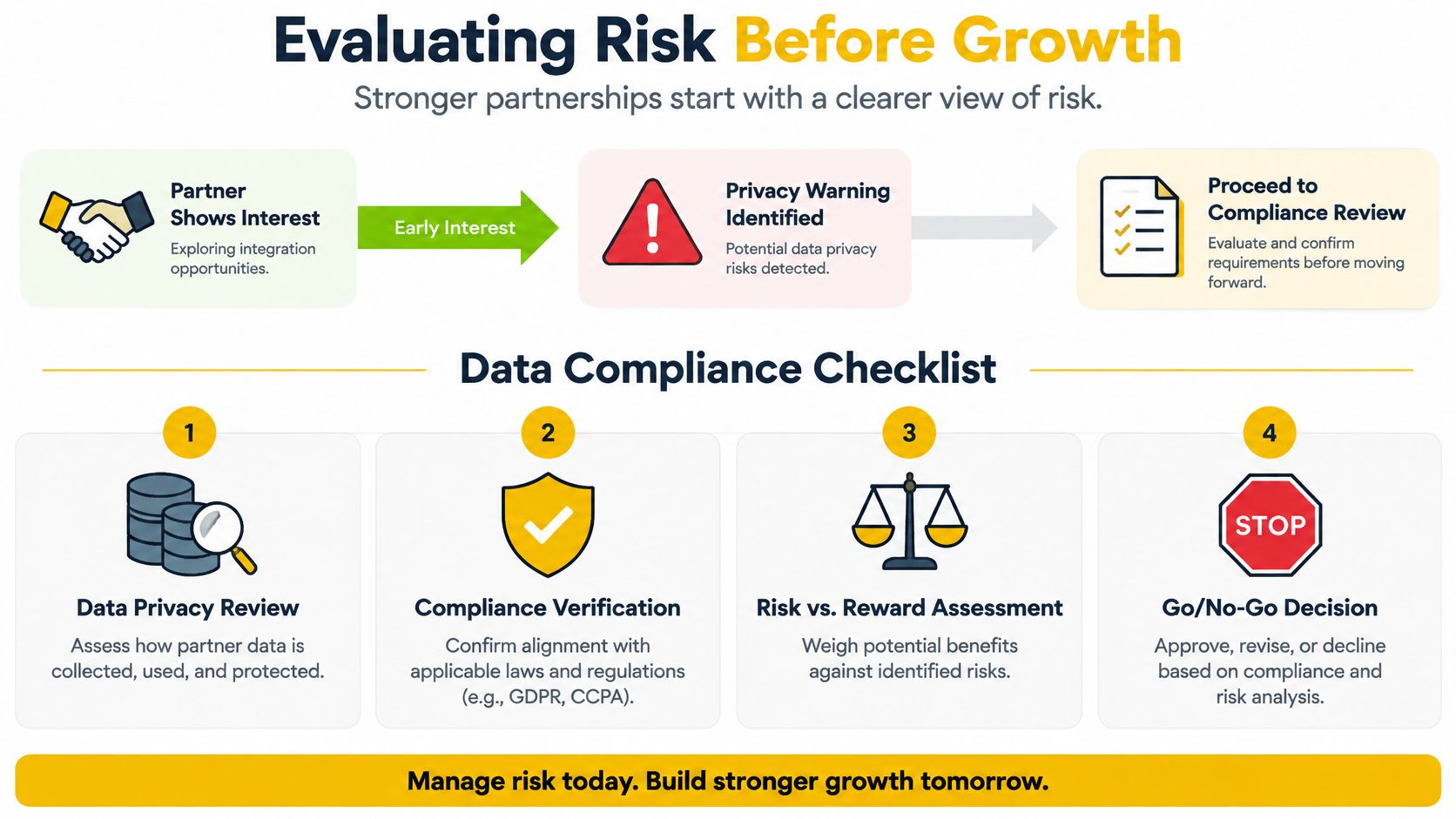
The commercial upside hasn't disappeared, but the decision has changed. You now need to price in security review time, contractual liability, implementation effort, support exposure, and the chance that the partner's roadmap moves into your core market. A warm sponsor relationship doesn't offset unowned risk.
A Reusable Risk Decision Framework
- Strategic fit: Does the partner provide distribution, capability, data, or workflow access you can't build efficiently?
- Data access: What's the minimum data required, who controls it, and how is deletion handled?
- Security and compliance: Which reviews, audits, and regulatory obligations apply in each market?
- Commercial liability: Who bears cost for downtime, misuse, failed referrals, or customer harm?
- Implementation effort: What product and support work is required before any upside appears?
- Measurable upside: Which leading indicators will prove value before revenue arrives?
- Exit conditions: What triggers pause, termination, data return, or customer transition?
A structured template for scoring inbound partners can help you apply consistent criteria before enthusiasm hardens into commitment. Score the deal while alternatives are still real. Once executives announce intent internally, objective diligence gets harder.
This governance scope is increasingly visible in job descriptions. A recent Experian role combines partner growth with contract lifecycle management, data-protection compliance, regulatory alignment, and audit support, as shown in the Experian strategic partnerships manager role description. That's business-risk ownership, not networking with a revenue target attached.
Decision rule: If you can't name the data, liability, cost, and exit terms, you don't yet have a partnership. You have an introduction.
Your options aren't only yes or no. You can narrow data scope, pilot in one segment, delay launch until controls pass, change liability terms, or replace exclusivity with performance thresholds. Rejection is right when residual risk, opportunity cost, or strategic overlap outweighs credible upside even after redesign.
That judgment is exactly what the tough interview question tests. Asked to describe a partnership you rejected, paused, or redesigned, walk through criteria, evidence, stakeholders consulted, trade-off, and outcome. Don't present caution as virtue by itself. Show how you protected growth capacity for a better use.
Answering Partner-Focused Interview Questions
Interviewers aren't collecting partnership stories. They're testing whether you make defensible decisions when incentives conflict, attribution is messy, and another company's priorities shift. Your answers need situation, decision, trade-off, action, and measurable result, without inventing precision you can't support.
How Would You Select a Partner
A weak answer lists brand reputation, audience size, and personal rapport. A stronger answer starts with the strategic gap, then scores fit, customer overlap, capability, economics, implementation effort, and risk. You'd validate assumptions with product, sales, legal, and finance before proposing terms.
Close with what would disqualify the partner. Selection criteria mean little if every plausible logo passes. Interviewers listen for prioritization because portfolio capacity is finite.
How Would You Activate an Underperforming Partnership
Don't start with more meetings. Diagnose first. Low referrals could reflect weak seller awareness, poor lead quality, slow routing, unclear incentives, product friction, or no executive sponsor. Each cause needs a different intervention.
A credible answer sets a baseline, picks one or two leading indicators, and assigns owners on both sides. You might rebuild enablement, simplify referral submission, add co-selling rules, or narrow the target segment. Then you'd set a review date and an exit threshold if activation doesn't improve.
Tell Us About a Conflict With a Partner
Weak answers make the partner unreasonable and you patient. Stronger answers separate interests from positions. Explain what each side needed, which contract or operating rule applied, what data you brought, and where you conceded or held firm.
Interviewers also watch escalation judgment. Bringing executives in too early signals you can't operate independently. Waiting too long while customers suffer signals poor risk awareness. Name the trigger that justified escalation.
How Do You Measure Your Impact
Lead with your attribution definitions. Distinguish sourced from influenced results, identify the CRM evidence required, and explain how duplicates were removed. Then connect your specific actions to outcomes the broader team delivered. Shared results are normal in partnerships. Claiming all partner revenue as personal production isn't credible.
If you're preparing for broader leadership screens, review these management interview questions and what strong answers demonstrate and map each one back to partner decisions you've owned. The partnership context changes, but panels still probe prioritization, conflict, and accountability.
How Would You Evaluate an AI Partnership
AI deals add delayed attribution, rapid product change, and possible competitive overlap. KPMG reported 69% of surveyed organizations expected partnerships to be a priority for expanding AI use cases over the following one to three years, while 59% considered AI capability a top partner attribute, in KPMG research on partner ecosystems and AI. Separate reporting on the same research found more than three-quarters of large U.S. organizations had increased ecosystem partnerships over the prior three years and 83% planned to expand them during the next three years.
Don't answer that trend with enthusiasm for signing more partners. Ask whether the AI partner creates defensible distribution, proprietary data or workflow advantage, or merely adds a vendor dependency. Define leading indicators such as activation, integration adoption, qualified pipeline, time-to-value, retention, and compliance readiness. Add review points for model, pricing, or roadmap changes, plus exit criteria if the partner becomes a direct competitor.
That answer shows portfolio judgment. You're not buying novelty. You're underwriting strategic value under uncertainty, with evidence thresholds that tell you when to scale or stop.
Preparing for a Partner-Focused Interview
Preparation starts with the hiring company's ecosystem, not generic question lists. Study its products, users, pricing model, likely distribution routes, integration surface, and visible partners. Form hypotheses about where partnerships could create value, but label them as hypotheses. Don't present public speculation as insider knowledge.
Map likely stakeholders too. A product-led company may care about integration adoption and activation. A sales-led company may prioritize sourced pipeline and co-selling. A regulated business will probe data access, audit readiness, and contract discipline earlier.

Build a Story Bank
Prepare six to eight stories you can adapt without forcing them. Cover partner discovery, value-proposition design, negotiation, launch coordination, activation, a difficult stakeholder, underperformance, and an ethical or regulatory trade-off. Each story needs the business context, your decision rights, the trade-off, actions you took, and the result with its measurement method.
Trim background ruthlessly. Interviewers don't need every meeting. They need the moment where judgment mattered. Practice saying what you decided and why before you describe what happened next.
- Discovery story: Show criteria, diligence, and why you rejected plausible alternatives.
- Negotiation story: Show interests, concessions, and how terms protected execution.
- Activation story: Show diagnosis, intervention, and leading indicators.
- Risk story: Show evidence, stakeholder input, and a pause, redesign, or rejection.
- Conflict story: Show escalation timing and a durable operating fix.
Rehearse Follow-Up Pressure
Read answers aloud and time them. Most partnership stories sprawl because candidates narrate relationships chronologically. Aim for a clear opening answer, then let follow-ups pull detail. Practice follow-ups on attribution, your personal contribution, what failed, and what you'd change.
Mock practice helps expose vague claims before a panel does. Interview Pilot supports more than 99 languages, offers guided mock interviews and a searchable question bank, and provides native apps for macOS, Windows, iOS, and Android. Used well, that kind of rehearsal tests structure, evidence, and clarity rather than helping you memorize scripts.
Finish by preparing questions that reveal how the company operates. Ask how partner attribution is defined, who owns pricing exceptions, what kills partnerships internally, and how product capacity gets allocated. Those questions signal you've lived with post-signature reality, not just deal announcements.
Showcasing Your Impact on a Resume
A partnership resume fails when every bullet starts with managed, supported, or collaborated. Those verbs hide scope and decision ownership. Stronger bullets follow a simple anatomy. Business context, partnership action, scope, result, and measurement method.
Don't fabricate precision to fill that structure. Use placeholders while drafting, then replace them only with numbers you can defend from CRM records, finance reports, contracts, or launch documentation. If you can't verify revenue, quantify scope through partner count, segment, cycle time, markets, or internal teams coordinated.
Adaptable Bullet Patterns
- Partner acquisition: Built scoring model for [number] inbound partners across [segments], advancing [number] to signed agreements based on customer overlap, economics, and implementation risk.
- Revenue influence: Drove partner-sourced pipeline of [$ amount] and influenced revenue of [$ amount] using CRM referral and co-selling definitions agreed with sales operations.
- Launch coordination: Led cross-functional launch with product, legal, marketing, and support for [partner type], reducing time from signature to activation from [baseline] to [result].
- Portfolio expansion: Expanded [number] partners into [new segment or market] after quarterly reviews showed adoption and retention above agreed thresholds.
- Risk reduction: Paused or redesigned [number] proposed partnerships after diligence on data access, liability, and implementation cost, redirecting capacity to [higher-fit motion].
- Operational improvement: Cut partner lead-routing time from [baseline] to [result] by defining ownership, response standards, and escalation rules.
For more phrasing patterns, compare your drafts with these resume bullet examples for outcome-focused experience, then rewrite in your own operational language. Borrow structure, not another candidate's claims.
Before and After
Weak version: Managed strategic partners and worked with internal teams to drive revenue growth. It says nothing about which partners, what decisions you made, or how revenue was counted.
Stronger version: Managed [number] integration partners, introduced sourced versus influenced CRM tagging with revenue operations, and led quarterly portfolio reviews that expanded [number] partners while exiting [number] below activation thresholds. The action, governance, and measurement discipline are visible even before results are added.
If a bullet could describe anyone who attended partner meetings, it doesn't yet describe your contribution.
Tailor emphasis by seniority. Earlier-career candidates should show launch execution, enablement, and problem diagnosis. Senior candidates need portfolio choices, commercial terms, executive governance, and exit decisions. At every level, separate team outcomes from your role in producing them.
Comparing Career Paths and Salary Expectations
Career progression in partnerships follows scope and complexity, not just title inflation. A partnerships coordinator may support launches, reporting, and partner communications. A manager owns a defined portfolio, business cases, and quarterly outcomes. A senior individual contributor handles larger or more ambiguous partners where product, regulatory, or competitive trade-offs are harder.
From there, paths split. A strategic portfolio lead may own a partner category and its investment thesis. A head of partnerships adds hiring, budget, portfolio strategy, and executive decision-making. Others move into general management, corporate development, product partnerships, or ecosystem strategy because the role builds cross-functional commercial judgment.
Evidence Changes as You Advance
Early promotion cases rely on reliable execution and activation. Senior cases need partner selection quality, negotiated economics, risk judgment, and proof you can stop weak work. Leadership cases require a portfolio system other people can run, not personal heroics across every account.
Don't chase titles without checking decision rights. One company's senior manager may own pricing input and executive sponsors. Another may coordinate referrals with little authority. Ask who approves terms, product commitments, attribution rules, and exits.
Salary Research Without Invented Ranges
No universal salary range is credible for this role. Compare current market data for roles matched by location, company stage, industry, revenue responsibility, partner complexity, management scope, and incentive structure. Separate base salary from commission, bonus, equity, and the likelihood of earning variable pay.
Use a structured method to compare job offers across pay, scope, and growth potential before negotiating. A higher title with weak product support and impossible attribution targets may be worth less than a manager role with real portfolio authority.
Durable credibility comes from the same combination at every level. Select partners for defensible value, measure with care, govern risk early, and be candid about trade-offs. That record travels across industries because executives can verify how you think, not just whom you know.
Preparing for a strategic partnerships manager interview means rehearsing partner selection, risk rejection, attribution, and AI ecosystem questions until your evidence sounds clear under pressure. Interview Pilot offers guided mock interviews and a searchable question bank so you can practice those answers aloud and tighten them before your final panel. Visit the site, build your story bank, and run a focused mock session on the toughest partnership trade-offs you'd rather not improvise.
Topics
strategic partnerships manager
partnerships career
partnership manager interview
partnership management skills
partnership manager salary
Continue reading

Career
8 Interview Questions Testing: Answers and Scenarios
Master interview questions testing with practical answers, scenarios, expert tips, and proven frameworks for QA, automation, performance, and strategy roles.
October 21, 2026
17 min read

Career
How to Find Jobs at Startups
Build a startup job shortlist around the work, company stage, and available support, then verify openings and ask useful questions before joining.
October 20, 2026
3 min read

Career
How to Network for a Job Without Asking Everyone for a Favor
Build a focused job-search network through useful conversations, specific questions, and respectful follow-through rather than mass referral requests.
October 20, 2026
3 min read