









Career
How to Build a Resume with Publications Listed
Format a resume with publications listed: where it belongs, status labels, citation order, how many to keep, and when a full CV is better.
Interview Pilot Editorial Team
Updated October 28, 2026
15 min read
You've pasted your bibliography into your industry resume, and the experience that matches the job posting has slipped onto the next page. The papers are legitimate. The layout is tidy. But the hiring manager now has to search past academic titles to find evidence that you can do the job.
A strong resume with publications listed starts with an editorial decision, not a citation style. Each paper needs the right treatment: keep it as a citation, place it under the job that produced it, or turn it into a bullet about a skill or outcome.
Where Publications Belong and How Many to Keep
Choose the document before choosing the papers
A CV records your scholarly history. A resume makes a selective case for a particular job. Treating them as interchangeable usually produces an industry resume that's too dense or an academic CV that leaves out expected evidence.
The American Psychological Association's CV guidance describes a resume as a concise one- or two-page summary, while a CV has no fixed page limit and includes education, research, publications, presentations, grants, clinical work, and professional memberships. For academic applications, publication detail belongs in that broader record. For nonacademic employers, the useful evidence may instead be the researching, writing, editing, or peer-review skills behind the work.
Faculty and academic research readers expect to evaluate scholarly output. Scientific, medical, policy-research, and specialist employers may also need a dedicated Publications heading, particularly when producing or assessing research is part of the job. Don't remove the bibliography merely because the employer isn't a university.
For other readers, start with the following defaults. A policy research fellowship belongs closer to the research rows than to a generalist policy-administration job.
Where publications go by reader
| Reader | Document | Heading | Citation depth | Overflow home |
|---|---|---|---|---|
| Faculty or academic research | CV | Publications | Full discipline citation | Still on the CV, grouped by type |
| Industry research or R&D | Resume plus a CV | Selected Publications | Authors, title, venue, year, DOI | Full list on the CV or ORCID |
| Software, data, or technical role | One- or two-page resume | Under the job that produced the work | Title, venue, year, and methods used | Portfolio or Google Scholar |
| Business, policy, or generalist role | Resume | No standalone section | One impact sentence tied to the posting | Link only if the employer asks |
| Only one publication | Resume | Inside a research-experience bullet | Short citation, not its own heading | None unless a portfolio already exists |
| Preprint or non-English work | Match the target market | Labeled line, not mixed in unlabeled | Language and status visible | ORCID for the canonical record |
The choice also changes with seniority. A graduate whose strongest evidence comes from research can give it more prominence than an experienced analyst with directly relevant delivery results. Don't make an employer infer your current professional identity from your oldest credential.
Set a space budget
When the publication record is extensive, about three to five relevant entries is a practical conventional-resume target; the University of Colorado Boulder CV guide also supports grouping an unwieldy record by publication type and identifying each item's publication stage. Treat that range as a ceiling to consider, not a quota to fill. Weakly related papers don't become useful because there's room left.
Use these editorial choices:
- A short, relevant record: Use Publications when a dedicated section truly helps the reader evaluate your qualifications.
- A longer record: Use Selected Publications so omissions look intentional rather than accidental.
- A detailed CV: Separate journal articles, books or chapters, conference papers, and abstracts when a combined list becomes difficult to browse.
- Collaborative work: Retain every author in the original order and make your own name easy to find.
Within each publication category, put the newest published work first. Keep status labels visible rather than making readers investigate which entries have appeared.
Say you're applying for product analytics with a hypothetical bibliography of twelve mixed papers. You retain three about experimentation, retention, and measurement, then direct readers to your ORCID record for the rest. The recovered space goes to an experience bullet explaining how you evaluated an onboarding change and informed a launch decision.
That's a better exchange than squeezing every citation into smaller type. If you have a measured result from that work, put your verified metric in the experience bullet rather than adding a journal's prestige indicator.
Space rule: Stop adding citations when the next entry would remove evidence of a result the posting explicitly asks for.
Resolve your resume page-length decision before adjusting margins or font size. Page space is an allocation decision, not a typography problem.
How to Format and Label Each Entry
An entry must answer two different questions: what is this work, and what is its actual publication status? Attractive formatting won't rescue an ambiguous answer.
Use the workflow below to separate those decisions before you polish punctuation.
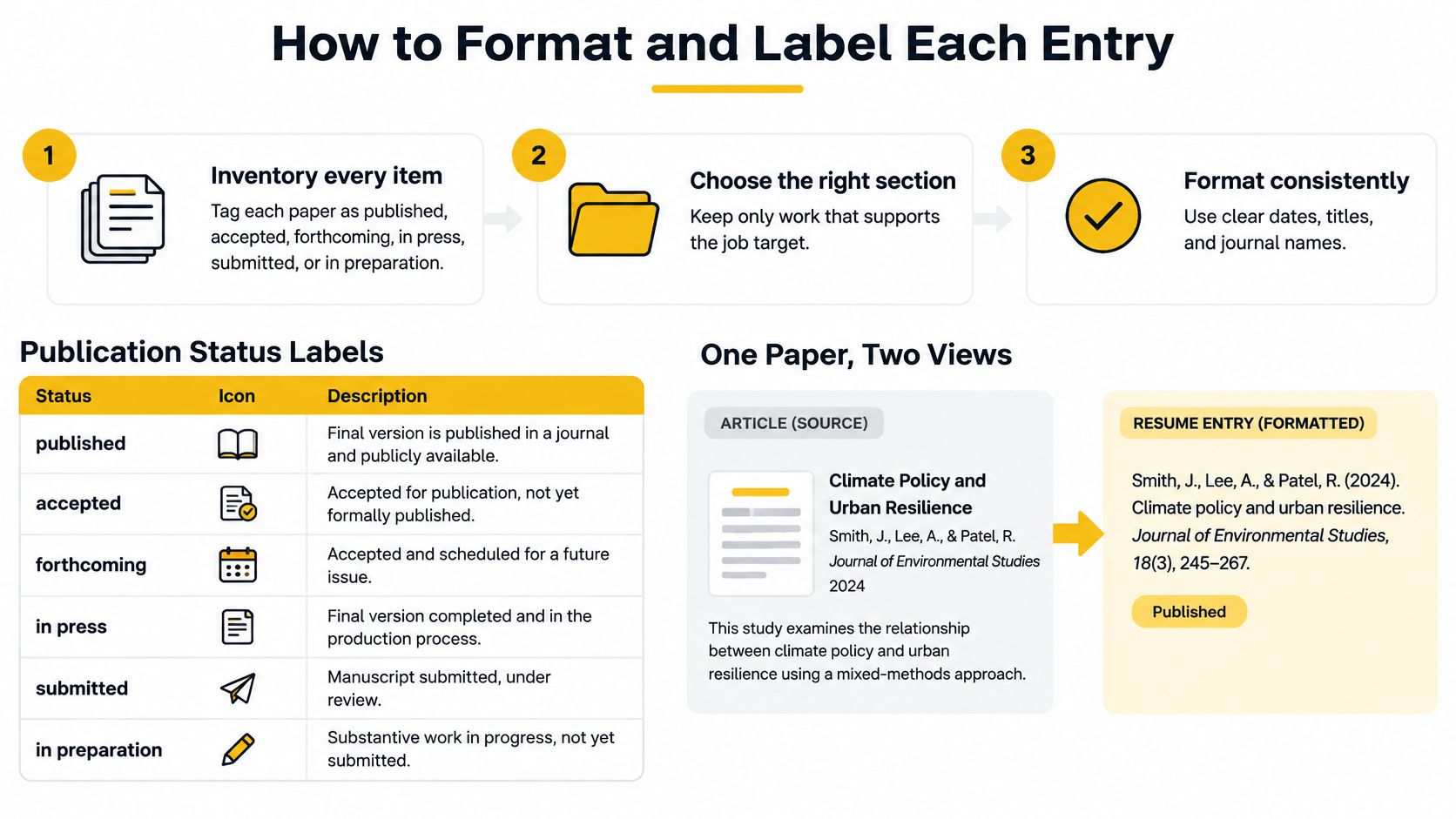
Build from the publication record
- Inventory every item. Tag each work as published, accepted, forthcoming, in press, submitted, or in preparation. Record the venue and identifier separately so you don't confuse a manuscript's destination with an actual publication.
- Filter against the posting. Keep the work that supports the employer's subject matter, methods, or communication needs. Don't format the entire archive before making these cuts.
- Choose the citation depth. Follow your discipline's citation style for academic applications. For industry readers, use a compact title, outlet, date, and identifier line when detailed bibliography information adds little.
- Copy bibliographic details accurately. Include authors, year or status, article or chapter title, journal or book title, volume, issue, pages, and DOI where those details exist.
- Order the published work. Use reverse chronological order within each category. Don't give an undated accepted manuscript a guessed year merely to force it into that sequence.
- Make authorship visible. Bold your name in place. Never move yourself earlier in the author list.
Oxford's CV guidance recommends full citation details, consistent styling, and selected publications when particular works deserve emphasis. Consistency means using the same pattern for comparable entries, not forcing posters, book chapters, and journal articles into identical bibliographic structures.
For a chapter, the book and publisher matter. For a journal article, the journal and article identifier matter. Copy from the publisher's record or a checked reference-manager export, then inspect the result rather than trusting the export blindly.
Label status before styling
The APA's CV-writing tips distinguish peer-reviewed publications from other work and recommend removing under-review or in-preparation citations from the publication list. Submission isn't acceptance, and public availability isn't automatically peer review.
What each publication status may say
| Status | Label to print | Keep in Publications | Still include |
|---|---|---|---|
| Published | Calendar year | Yes | Authors, title, venue, volume, pages, DOI |
| Accepted, no year yet | accepted, forthcoming, or in press | Yes | Full citation without an invented year |
| Forthcoming | forthcoming | Yes | Venue and DOI or publisher link if assigned |
| Under review | Do not label it published | No | Methods only, under Research, if relevant |
| In preparation | Omit | No | Nothing in the publication list |
| Conference poster or talk | Poster or presentation, own heading | Only in that category | Event, date, and title |
Use the status that accurately matches the publisher's communication. Don't call something in press just because you expect acceptance, and don't use forthcoming to soften a rejection or an unresolved submission.
A submitted manuscript with a publication year is a misleading entry. Remove it from Publications. If the underlying project demonstrates relevant experimental design or analysis, describe that work under Research Experience without suggesting that a journal has published it.
Posters and talks need their own headings, such as Conference Posters and Presentations. A conference presentation and a peer-reviewed proceedings paper aren't interchangeable credentials.
Show the same work at different depths
Consider a fictional article about onboarding measurement, with the candidate as the middle author. The full academic version would retain the authors in order, the publication year, the article title, the italicized journal title, volume, issue, pages, and the assigned DOI.
The industry version would compress that same record to:
Cohort-based evaluation of product onboarding. Example Journal of Product Analytics. Publication year. Assigned DOI.
This is an illustrative pattern, not a real publication to claim. Use the exact year, pagination, and DOI from your own publisher record; don't invent plausible bibliographic details to make an example look complete.
The difference is depth, not truthfulness. The short version still needs to identify the same paper reliably, while the fuller version lets an academic reviewer inspect authorship and venue details immediately.
If you're applying for research-led content work, distinguish the original publication from adaptations. A resource for creating carousel content for B2B marketers from ViralBrain can help you plan a portfolio adaptation, but that adaptation belongs under content projects, not peer-reviewed scholarship.
Finish with a mechanical check:
- Author order: Match the published record exactly.
- Dates and status: Use a consistent presentation without manufacturing missing information.
- Venue styling: Apply journal italics consistently in the formatted document.
- Identifiers: Keep the same DOI presentation pattern throughout.
- Candidate visibility: Make your name easy to locate without depending on color.
Tips for Turning Papers into Job Evidence
Skills-based screening makes the choice of presentation more important than decorative formatting. In NACE's employer update, published by the University of Wyoming career service, almost two-thirds of employers reported using skills-based hiring in 2025.
Think of the transition as moving from a scholarly artifact to evidence a hiring manager can question.
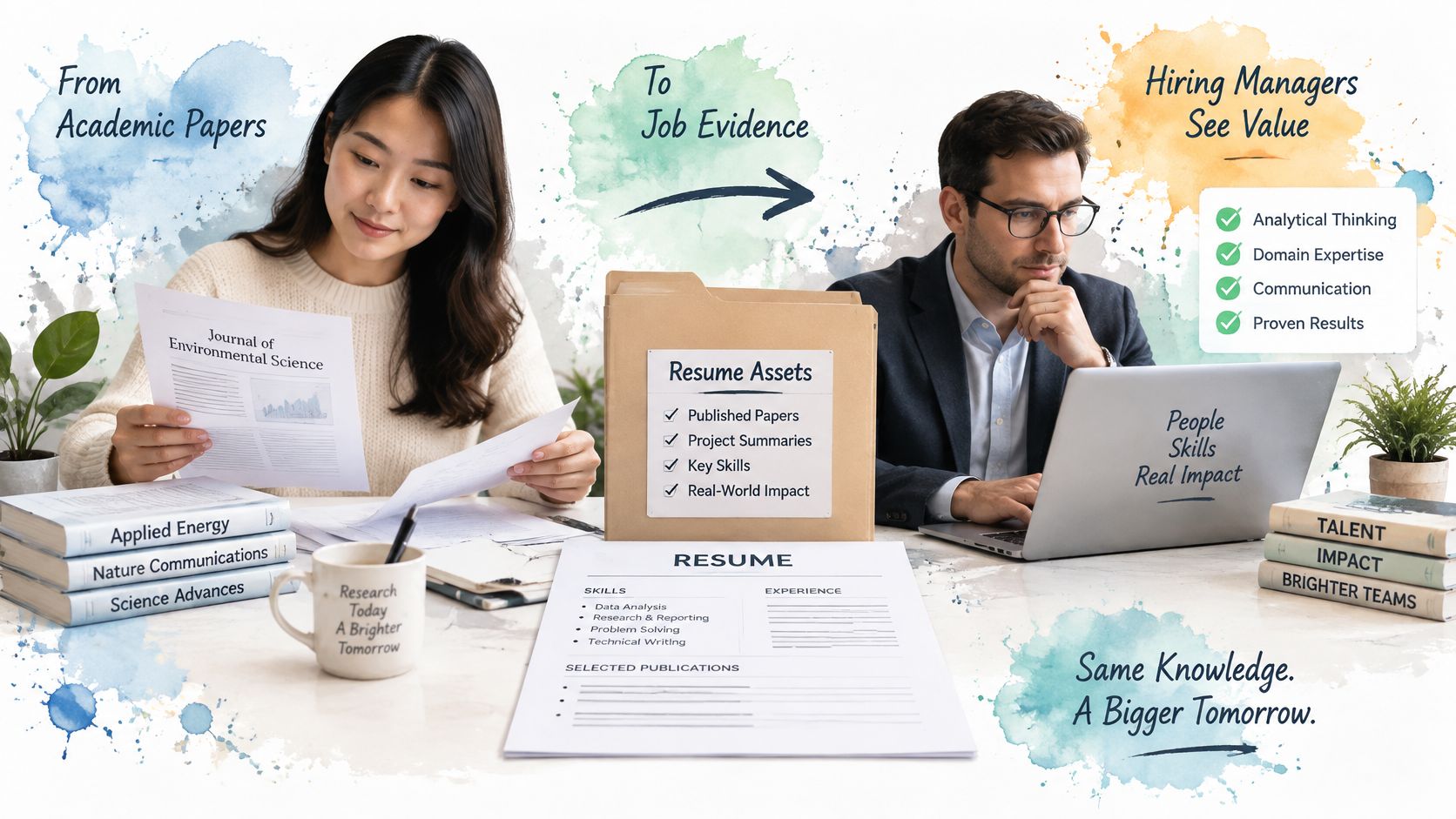
Rewrite for the decision-maker
A title exposes the topic. It may hide the Python pipeline, cohort definition, sensitivity analysis, stakeholder discussion, and recommendation that made the work valuable.
For a research-heavy position, retain the citation because the employer needs to assess scholarly contribution. For a technical position, attach the relevant method to a shortened reference. For an operations position, lead with the implemented outcome if you can substantiate it.
Say the onboarding paper came from a project where you built the analysis and helped an operations team change its review process. These are alternative treatments, not lines to stack together:
- Research reader: Retain the full citation to the onboarding study, with authorship and venue details.
- Data-science reader: Built a Python cohort-analysis pipeline to evaluate onboarding completion and check whether findings held across acquisition channels; published in Example Journal of Product Analytics.
- Operations reader: Used onboarding research to redesign the team's review process and clarify intervention priorities; findings published in Example Journal of Product Analytics.
Add a measured outcome to the operations version only when your records support it. Don't turn an association reported in the paper into a business improvement you personally delivered.
A publication deserves resume space when you can explain what you did, how you know it worked, and why that matters to this employer.
Use resume bullet examples to sharpen the action and result, not to borrow impressive metrics. For writing-heavy applications, writing portfolio advice from Maxijournal can help you present the surviving work with enough context for an editor to assess it.
Use a practice prompt to test whether your rewritten line sounds like work you can explain.
Before keeping the line, ask:
- Topic fit: Does the posting ask for this subject or capability?
- Method ownership: Can you defend the method out loud?
- Useful evidence: Does the line name a tool or result, rather than only a journal?
Keep the complete bibliography on ORCID, Google Scholar, or your portfolio when it would otherwise crowd out stronger evidence.
A Copy Block You Can Paste
Keep the structure and replace the illustrative record
The following fictional record demonstrates the academic and industry treatments without inventing a working DOI or a public profile address. Replace its bibliographic content with your actual publisher record before submitting an application.
Academic CV treatment
Publications
Rivera, A., Morgan, J., & Shah, P. (Publication year). Cohort-based evaluation of product onboarding. Example Journal of Product Analytics, volume(issue), page range. Assigned DOI.
Industry treatment of the same paper
Cohort-based evaluation of product onboarding. Example Journal of Product Analytics. Publication year. Assigned DOI.
The academic treatment preserves the candidate's middle-author position. The industry treatment removes bibliography detail that a nonresearch reader may not need, while keeping the work identifiable.
Selected Publications
- Onboarding study: Cohort-based evaluation of product onboarding. Example Journal of Product Analytics. Publication year. Assigned DOI.
- Retention study: Evaluating retention across acquisition cohorts. Example Journal of Product Analytics. Publication year. Assigned DOI.
- Measurement study: Interpreting product experiment outcomes. Example Journal of Product Analytics. Publication year. Assigned DOI.
For your actual resume, order the completed entries newest first and add a single descriptive hyperlink to your own ORCID or Google Scholar record. Don't link a generic profile homepage or leave an example identifier in the finished document.
Keep special cases visibly separate
These additional patterns belong only where they're relevant to the application:
- Preprints: Author names. Article title. arXiv preprint. Posting date. Canonical record.
- Non-English publication: Author names. Original-language title, followed by an English translation if useful. Venue. Publication year. Language identified explicitly. Canonical record.
A preprint label describes publication status; a language label describes accessibility. A non-English peer-reviewed article remains a peer-reviewed article, so don't automatically downgrade it into a miscellaneous category.
Use ordinary selectable text rather than an image of the block. A University of Washington report stated that an estimated 99% of Fortune 500 companies used some form of automated hiring process, including resume screening, in 2024; that doesn't establish that any particular punctuation breaks a parser.
Paste the appropriate treatment into your document, remove unused headings, and test the exported file by copying its text into a plain-text editor. If you also maintain an author page, the BarkerBooks guide to author bios can help you write the short introduction that accompanies the work without repeating the bibliography.
Check the List Then Practice the Story
The final pass isn't another opportunity to add papers. It's a check that the application tells a coherent story about the work you're ready to do.
Read the resume against the posting, not against your master bibliography. Confirm that the heading suits the reader, that no unfinished manuscript looks like a completed publication, and that your strongest relevant experience remains easy to find.
Verify what the reader will infer
- Professional identity: Does the opening page present you as the researcher, analyst, engineer, or operator this employer needs?
- Personal contribution: Can a reader distinguish your work from the broader team's output?
- Verification: Do the publication details match the public record?
- Priority: Have citations displaced any requested tool, method, or delivery result?
Then select the paper most likely to prompt a follow-up question. Write a short spoken explanation covering the question, method, your contribution, and the result, with the journal name last.
A useful answer starts with the problem in plain English. Explain the methodological choice, identify what you personally owned, and state what the findings did and didn't establish. Don't imply that coauthorship means you performed every stage of the project.
Rehearse the claim behind the citation
Practice answering a skeptical follow-up: why did you choose that comparison group, what alternative explanation did you test, or what would you change with better data? These questions reveal whether the resume line reflects working knowledge or merely familiarity with the abstract.
Use storytelling in interviews to organize the explanation without turning it into a memorized speech. Keep technical detail available for follow-ups rather than forcing every caveat into your opening answer.
In Interview Pilot, you can create a profile by importing a resume or job posting and attach documents to that profile. The app also includes interview guides, resume templates, and email templates, plus mock interviews with answer evaluation.
Freeze the publication list once you can defend every surviving entry. Then rehearse the paper you'd least want to blank on, using the same contribution language you put on the resume.
Interview Pilot offers resume-based profiles and mock interview practice so you can prepare around the publication claims an interviewer will see. Visit Interview Pilot to import your cleaned resume, attach relevant materials, and practice explaining your strongest paper.
Topics
resume with publications listed
CV publications
citation format
selected publications
academic resume
Continue reading

Career
Other Words for Teamwork: 10 Terms to Use in 2026
Looking for other words for teamwork? Compare 10 terms like collaboration and synergy, with resume, interview, and job description examples you can use.
October 25, 2026
16 min read

Career
Strategic Partnerships Manager Career Guide
Explore the strategic partnerships manager role, core skills, KPIs, interview answers, resume examples, salary expectations, and career paths.
October 22, 2026
20 min read

Career
8 Interview Questions Testing: Answers and Scenarios
Master interview questions testing with practical answers, scenarios, expert tips, and proven frameworks for QA, automation, performance, and strategy roles.
October 21, 2026
17 min read