
















Interviews
What Happens at Second Interview and What Comes Next
What happens at second interview: formats, goals, and next steps. Learn how to prepare, read the signals, and follow up after round two.
Interview Pilot Editorial Team
Updated November 22, 2026
15 min read
A 2025 TechNeeds summary of what happens at a second interview reports that only 10 to 20 percent of initial applicants progress after the second interview. Read that as a description of the room you're walking into. Everyone there has already been judged competent, and most of them will still be turned down.
The usual preparation misses that shift. Candidates rehearse harder answers to the same questions, then meet a panel, a case exercise, or a half-day of technical interviews they never asked about. Or they leave a good conversation, hear nothing for nine days, and conclude they've been rejected while the hiring manager is still ranking two finalists.
Treat round two as a diagnostic round. Work out which decision this specific employer is making, build evidence for that decision, and read the silence afterward for what it is.
Second Interview Formats at a Glance
The question candidates carry into round two is which format they'll face. The honest answer depends on the employer, the role, and how much the hiring manager still needs to learn. The invitation usually carries the answer if you read it closely.
| Format | Who you meet | What it tests | How to prepare |
|---|---|---|---|
| Hiring manager deep dive | Hiring manager, sometimes a peer | Role fit, motivation and depth of past work | Three measurable stories tied to the job description |
| Panel interview | 3 to 5 interviewers from different teams | Consistency across perspectives and collaboration | Map each interviewer's likely concern before arriving |
| Presentation | Hiring team, possibly leadership | Communication, structure and judgment | Build a 10-minute talk ending in one clear recommendation |
| Case exercise | Hiring manager or senior peer | Problem solving, trade-offs and numbers | Practice structuring out loud for 20 minutes |
| Work sample | Team members | Execution on a real or realistic task | Ask in advance for scope, tools and time limit |
| Technical or half-day round | Engineers, team leads and sometimes cross-functional staff | Hands-on skill and team fit across a full day | Confirm the schedule, breaks and materials allowed |
A presentation or a case exercise is a timed task with defined materials, so practice under the same constraints. Ten minutes of speaking with a clock running teaches you more than a deck you polished for a week. A manager conversation sits at the other end of the scale, mostly evaluative in tone, with the weight on your examples rather than your slides.
Reading the Invitation for Clues
Three details give away more than the job ad does.
- Names on the invite. One name points to a manager conversation. Three to five point to a panel, and a long distribution list with engineers or analysts points to a technical round.
- Attachments and tasks. A data set, an attached file, or a line about bringing a laptop means a work sample or live exercise. Ask for the scope, the tools, and the time limit before you agree to anything.
- Stated length. An hour is usually one conversation. Two hours or a half-day means several sessions, so ask for the running order and where the breaks fall.
Write the format at the top of your preparation page before you do anything else. Every choice after that, the stories you pick, the slides you build, the questions you draft, follows from it.
Why Employers Hold a Second Interview
Round one exists to remove people. Round two exists to pick one.
Think of a callback after an audition. The first round proved you can play the part. The second decides who fits this production, with this director, on this schedule.
Employers use the round to validate what they heard the first time, compare a short list, and test job-specific capability, team fit, motivation, and practical availability in more depth. Indeed reports that employers may invite around 3 to 6 candidates to a second, often in-person, interview, and occasionally just one if the hiring manager already sees a strong match (Indeed's guide to how many candidates reach the final interview). The same guide cites Zippia's figures, which put an average of 3 candidates at the final interview within a typical range of 2 to 10, and note that 40% of employers expect candidates to complete at least two rounds.
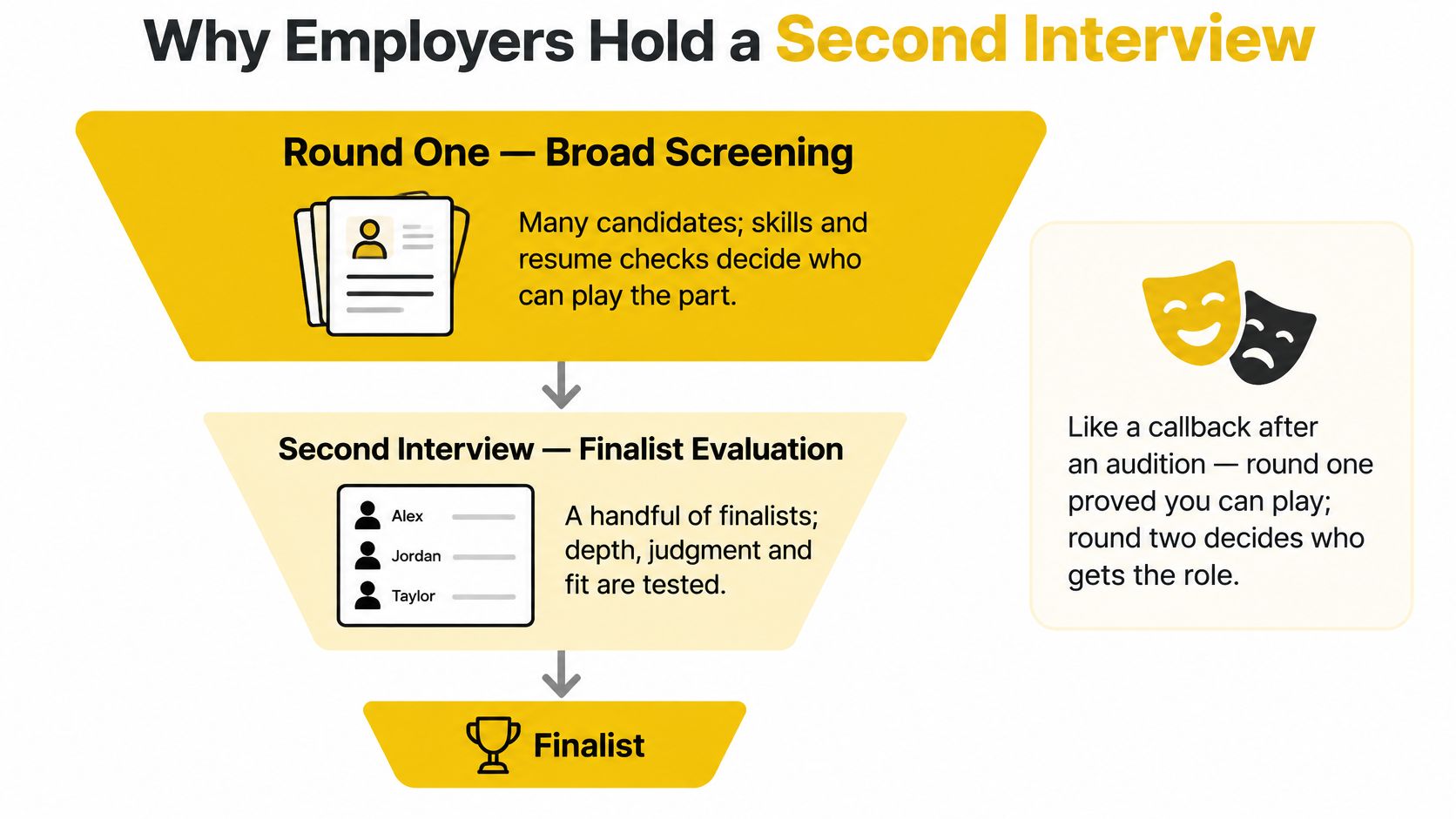
What changes between rounds is the machinery. Additional interviewers join, a presentation or work sample appears, and earlier answers get probed for consistency. The employer is gathering evidence now, not screening.
That shift should change how you prepare. Background questions give way to role-specific examples, measurable accomplishments, and questions about the work itself. A candidate who arrives with a polished career story and no numbers is answering the round-one question in a round-two room.
A second interview is a real milestone and a poor finish line. It's often followed by a panel, reference checks, compensation discussions, or a final executive conversation. The decision is closer than it was. It isn't made.
Working Out What the Round Is Testing
Most guides describe round two as the first interview with harder questions. Employers don't run it that way. A second round can be a manager conversation, a panel, a presentation, a case, a work sample, or a half-day process for technical and senior roles, and each format tests something different (Cohesyve's breakdown of second interview questions). Walk into a live case carrying a bag of behavioral stories and you'll struggle. Treat an informal stakeholder chat as the final verdict and you'll misread it.
Diagnosis comes before preparation. Five questions to the recruiter settle it.
- Who will I be meeting, and what are their roles?
- Is there a timed task or presentation, and how long does it run?
- What materials or tools am I allowed to use?
- How will performance be assessed in this round?
- Is this round evaluative, or mainly an introduction to stakeholders?
The answers change what you do with your evenings. A timed task means practicing out loud against a clock, not reading. A stakeholder introduction means sharper questions about the team's priorities and a clearer view of what they need in the first quarter.
One thing the round reliably tests is consistency. Interviewers compare what you say now with what you said in round one, and they look for evidence of execution, judgment, collaboration, and trade-offs rather than adjectives. If the answers point to a behavior-based format, work through how to ace behavioral interview questions before you build anything else.
Copy this into an email today: "Thanks for confirming the next round. So I can prepare properly, could you tell me who I'll be meeting, whether there's a timed task or presentation, what materials are allowed, and whether the session is primarily evaluative?"
A second interview signals shortlist status. It doesn't promise an offer, and it doesn't always end the process. Asking these questions early costs nothing and removes the guesswork.
Preparing Evidence and Questions to Ask
Evidence beats enthusiasm in round two. Numbers do work that adjectives can't, and the interviewer is scanning for claims that survive a follow-up question.
Build the Evidence File First
Pick three to five accomplishments and attach a measure to each one: revenue moved, hours saved per week, error rate reduced, team size led, budget managed. Then tie each of them to a line in the job description, because an unlinked achievement is just a story. If the posting asks for cross-functional influence, your example should name the teams and say what you changed about how they worked together.
Reread your notes from round one and list every claim you made. For each one, prepare the measurement method, the constraint you worked inside, and the trade-off you chose. That's the consistency check most candidates lose points on, and it's the easiest to rehearse. If you're shaping those stories from scratch, the HiredBySkill guide to competency-based interview questions sets out the structure interviewers expect and, more usefully, the reasoning behind each choice inside the answer.
Then Choose Questions That Do Work
Four questions carry more weight than a page of them.
- What does success look like in the first 90 days? The answer tells you what the team measures and who else is affected by the hire.
- What's the biggest challenge the team faces right now? You'll hear the actual problem, not the recruiting pitch.
- How do decisions get made here? This separates teams where one person decides from teams where consensus is slow and deliberate.
- What will the next round test? It signals you're planning, and it tells you exactly what to prepare.
More options sit in this guide to questions to ask on a second interview, including the ones that open up reporting lines and salary bands without awkwardness.
Bring a short written list of your questions and a one-page summary of your achievements if the format allows handouts. Both say the same thing: you came prepared to talk about the work.
How the Round Usually Unfolds Step by Step
Formats change the order and the weight of things, but most rounds follow the same skeleton. Treat it as a default, not a promise.
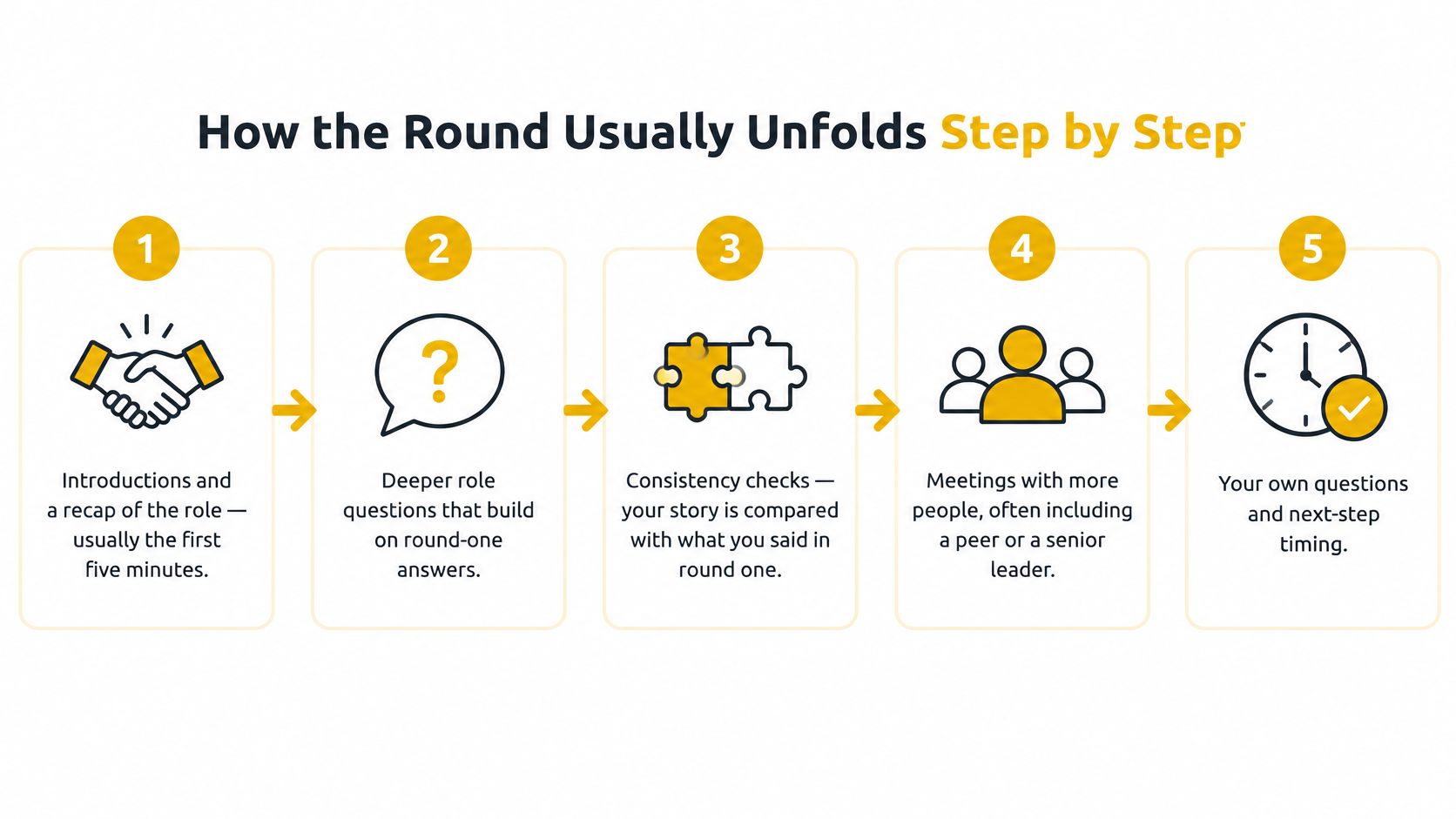
- Introductions and a recap of the role. The first five minutes usually cover who's in the room and what the job involves. It settles nerves and lets the interviewer frame what follows. The common slip is treating it as small talk and switching off.
- Deeper role questions. These build on what you said in round one rather than restarting your résumé. The employer wants detail it couldn't get in thirty minutes. Repeating the same story word for word wastes the slot.
- Consistency probes. Someone asks how a result was measured, who else was involved, or what you'd do differently. They're checking that the claim survives a second telling. Improvising numbers you can't defend is where candidates come unstuck.
- The task, presentation, or case. Only when the format includes one, usually with a time limit and stated materials. The employer is watching judgment under realistic pressure. Spending the whole slot on analysis and closing without a recommendation undoes the work.
- Your questions. Fifteen minutes at the end, and often the part that separates finalists. It shows what you'd be like to work with. Asking nothing, or asking only about leave policy, wastes it.
- The close. You should leave with named next steps, a date, and a contact. That's how the process keeps moving. Walking out without asking when to expect news is the most common miss of the day.
Expect questions that test execution rather than attitude: walk through a result you mentioned last time and explain how it was measured, describe a trade-off on a comparable project, say what you'd tackle in your first month, and name where you'd need support. A strong answer adds a number or a constraint. The weak version repeats the résumé.
Strong exit: one sentence on why the role fits, one on what you'd do first, and one asking when the decision lands.
Timelines and Outcomes After Round Two
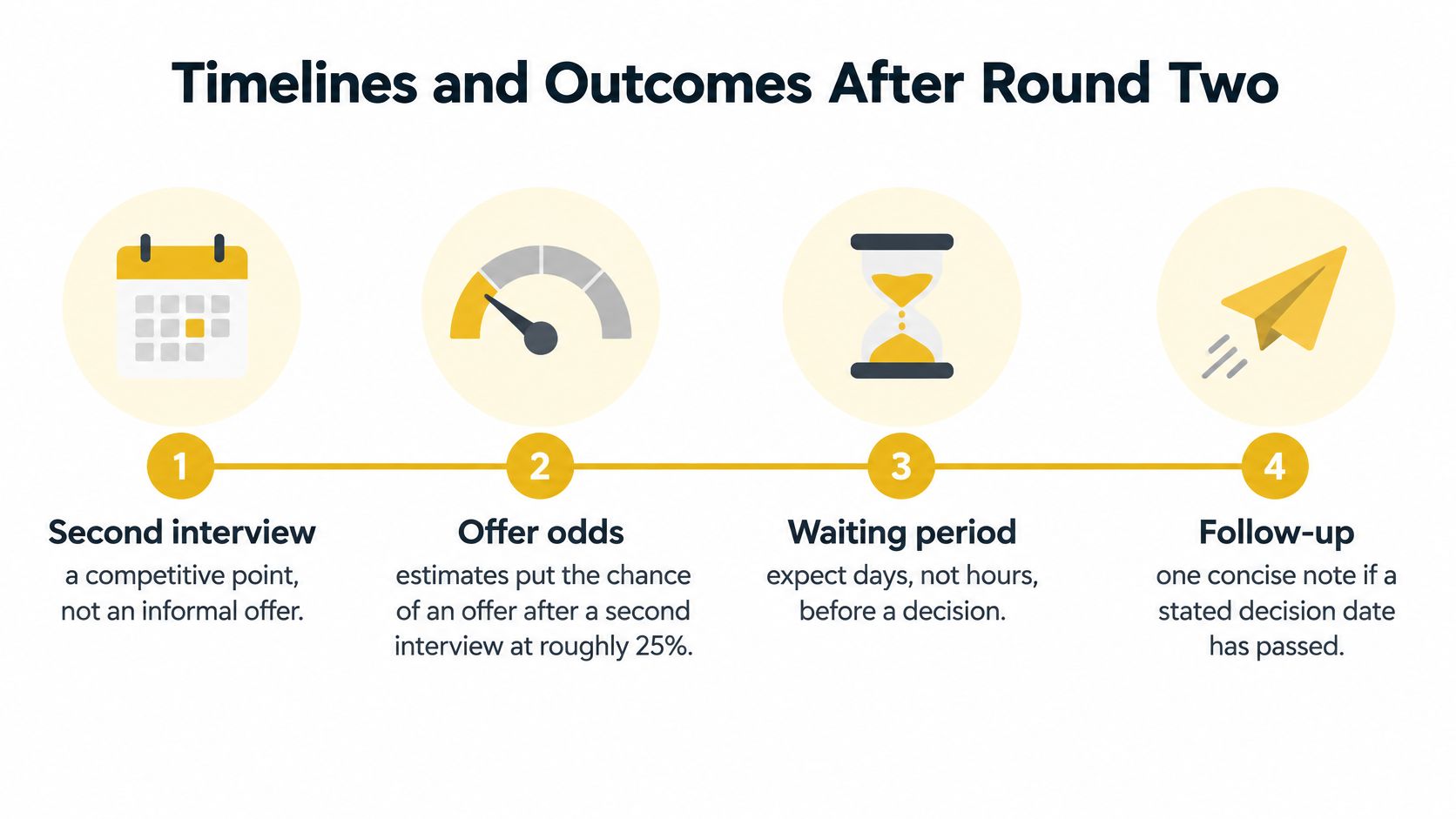
The second interview improves your position and still leaves a genuine contest. Estimates place the chance of an offer after a second interview at roughly 25% to 50%, and another estimate puts the typical outcome nearer 20% to 33%, about 1 in 5 to 1 in 3 candidates (Work Insiders on how many interviews to expect before a job offer). Those ranges move with the number of rounds, the shortlist size, and each company's decision rules, so treat them as a realistic band rather than a rate you're owed.
Timing runs slower than nerves prefer. A 2025 PitchHired summary of NACE's 2025 Recruiting Benchmarks reports an average of 27.3 days from first interview to an offer or rejection, from a benchmark survey covering 197 NACE member organizations and 15 nonmember companies.
| Outcome | What it usually means | Best next move |
|---|---|---|
| Offer | Compensation and headcount are approved | Review the terms and ask about the start date |
| Final round | The employer is still comparing finalists | Prepare for a conversation with a senior leader |
| Reference or work sample request | Verification before a decision | Line up references and deliver on time |
| Rejection | Another finalist was chosen | Ask for brief feedback and keep the relationship open |
| Silence past the stated date | Feedback consolidation is still underway | Send one check-in message |
Behind most of those outcomes sits work you never see. Interviewers' notes get consolidated, finalists get ranked, references and employment details get checked, and compensation and headcount get signed off. None of it produces a same-day answer.
When the gap between the promised date and the actual one stretches, one clear message beats three nervous ones. How to ask for an interview update covers the wording, and the principle behind it is simple: a single well-timed note reads as professional, while a stream of them reads as pressure.
Deciding Your Next Move After Round Two
The next step depends on what the employer told you. A missed deadline calls for one check-in; a request for references or extra work calls for a prompt reply. Treating every pause the same can lead to unnecessary follow-ups.

Unclear next steps are a common source of frustration for candidates. The 2025 CandE research collected more than 66,000 completed candidate surveys, with recurring complaints about unclear expectations, unknown interviewers, and vague process updates (Qualaroo's summary of candidate experience survey findings).
When a Stated Date Has Passed
Wait two business days past the date, then send one message. Confirm that you remain interested, ask whether the timeline has changed, and offer anything the team may still need, such as an updated reference list or clarification about your availability. Asking whether a decision has been made puts the recruiter on the spot without helping them move the process along.
When No Deadline Was Given
Wait about a week after the interview, then ask once for a rough decision date and the preferred communication channel. After that, give the team time to compare finalists. Several check-ins within a few days can feel like pressure rather than interest.
When They Ask for References or Extra Work
Reply the same day if you can. Confirm the task's scope, deadline, and format, then deliver on time and send a brief note confirming it is complete. A reference or work-sample request means the employer needs more information before deciding; it does not guarantee an offer.
Sample message after a missed date: "Thank you for the conversation on 12 March. I understood a decision was expected by the 20th, so I wanted to check whether the timeline has shifted. I'm still very interested in the role and happy to send anything else that would help, including updated references. Could you let me know the new expected date?"
Before leaving the interview, note five details: the decision-maker's name, the remaining stages, the expected date, anything you owe the team, and the channel they prefer. These notes give you a clear reference point if the process goes quiet.
A delayed reply can reflect a process still in motion, not a decision about you. Follow up once if a stated date passes, then keep pursuing other opportunities while you wait.
Round two rewards rehearsal, and Interview Pilot is free to get: it runs AI mock interviews that evaluate your answers, and it keeps a large bank of behavioral and role-specific questions you can work through until your evidence stories sound natural out loud. Use it to practice the consistency probes, the trade-off questions, and the closing line that names your next step. Visit Interview Pilot to start, and treat the scores as practice feedback rather than a forecast, since no tool can guarantee an offer or a recruiter's response.


Topics
second interview
second round interview
second interview format
after second interview
interview follow up
Continue reading
Interviews
10 Questions to Ask on 2nd Interview: Smart Picks for 2026
Learn the best questions to ask on 2nd interview, from 90-day goals to team challenges, with tactics that show fit and strengthen your offer.
November 10, 2026
17 min read
Interviews
Co Pilot or Copilot: Which Spelling Is Correct in 2026
Co pilot or copilot? Learn which spelling is correct, when to use co-pilot or copilot, and how each form is used in aviation and AI, with examples.
November 22, 2026
13 min read

Interviews
Copilot AI Cost: Plans, Prices and Hidden Fees
Compare Copilot AI cost across Microsoft 365, GitHub and consumer plans, with per-seat math, hidden expenses and a simple way to estimate your budget.
November 22, 2026
17 min read