
















Interviews
Co Pilot or Copilot: Which Spelling Is Correct in 2026
Co pilot or copilot? Learn which spelling is correct, when to use co-pilot or copilot, and how each form is used in aviation and AI, with examples.
Interview Pilot Editorial Team
Updated November 22, 2026
13 min read
Copilot, written as one unhyphenated word, is the standard default; co-pilot is the older, hyphenated form retained in aviation and some style guides, while co pilot as two words is nonstandard. If both accepted spellings describe the same helper, why can an editor change one but leave the other untouched?
The answer is context, not pronunciation. A dictionary establishes accepted spellings, a publication chooses its house style, and a product owner determines its brand name. Knowing which authority governs your sentence is more useful than memorizing a rule that treats every document alike.
The Short Answer on Copilot Spelling
Use copilot unless your document has a specific reason to use co-pilot. The closed form works for a generic software assistant, an ordinary reference to someone assisting a pilot, and business prose without a conflicting house rule. Don't insert a space because you can recognize the parts co- and pilot.
The three spellings at a glance
| Spelling | Status | Where readers still see it | Verdict |
|---|---|---|---|
| Copilot | Standard, one word | AI assistants, software, current dictionary entries | Use this by default |
| Co-pilot | Hyphenated, older form | Aviation manuals, older print, some style guides | Keep when the governing style requires it |
| Co pilot | Two words, nonstandard | Typing slips and informal drafts | Avoid in published writing |
The capital letter in the table identifies the spelling, not a requirement to capitalize the common noun. In an ordinary sentence, write a copilot just as you'd write a pilot.
Accepted spelling versus preferred spelling
An accepted variant isn't automatically the best choice for your document. A publisher can prefer the hyphenated form without declaring the closed form incorrect, just as a software company can use a capitalized product name without changing the spelling of the common noun.
That distinction matters when you're editing someone else's writing. Changing co-pilot to copilot may be a style edit, rather than the correction of a spelling mistake. Changing co pilot to an accepted form is a correction.
Practical rule: Choose a default for ordinary prose, preserve required terminology, and don't alternate spellings merely for variety.
If you searched for co pilot or copilot, the space is the part to remove first. The remaining decision is whether your intended context calls for a hyphen.
Check the Dictionary and the Style Guide
Start with the reference your organization uses, rather than whichever search result appears first. A dictionary lookup and a style-guide lookup answer different questions: Is this spelling accepted? and Which spelling should this document use?
Run the lookup in order
- Inspect the dictionary entry. Search for copilot and co-pilot. Note the headword, any listed variant, and any regional or usage label. An entry that redirects to another form isn't necessarily treating both forms as equally preferred.
- Search the governing style guide. Check the house style sheet, client instructions, or publication manual for the word itself. If there's no entry, look for guidance on compounds beginning with co-.
- Separate names from common nouns. Copy a named product's spelling and capitalization from its official materials. A generic hyphenation rule shouldn't rewrite a proper name.
- Record the decision. When house style differs from the dictionary's preferred form, follow house style for that assignment and add a brief editorial note.
For a thesis or other formal submission, make terminology review part of the final manuscript check. The Thesis Book Project submission checklist is a useful companion when organizing that broader review.
Make the exception easy to find
Put the choice in an editorial comment or shared style sheet, not in the published introduction. A useful note is: Use copilot for common-noun references; retain official names and original quotations.
For applications, cover letters, and interview follow-up emails, check terminology alongside tone and clarity. A professional communication guide can support that wider editing pass without replacing the spelling authority for your document.
If neither your dictionary nor your house guide resolves the choice, use the closed form. Don't treat a stray two-word occurrence in an informal draft as evidence of another accepted variant.
How Each Spelling Fits Different Fields
The reader's task helps determine the appropriate form. Someone studying a flight manual needs terminology that matches that manual. Someone following software instructions needs wording that matches the interface.
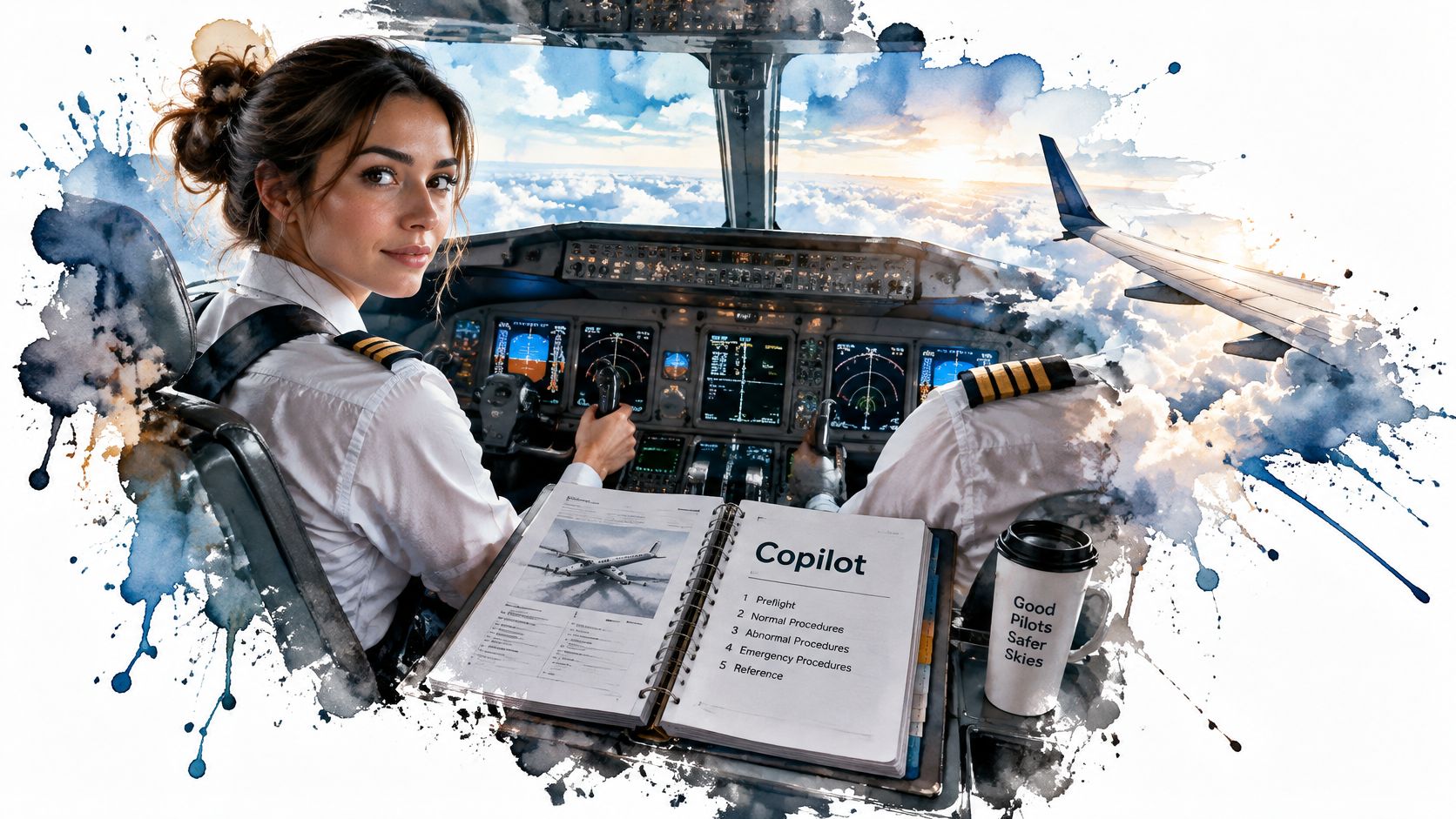
Which spelling each field uses
| Field | Spelling | Capitalization | Deciding source |
|---|---|---|---|
| Aviation crew role | co-pilot when prescribed | Lowercase, unless the manual specifies title styling | Operator manual or training material |
| Generic software and AI helper | copilot | Lowercase | Generic tool terminology |
| Microsoft product | Copilot | Microsoft Copilot | Official product materials |
| GitHub product | Copilot | GitHub Copilot | The product's own spelling |
| Interview product | Copilot | Interview Copilot | The product's own spelling |
| General business prose | copilot | Lowercase | Document-wide editorial choice |
| Academic, legal, or publishing copy | copilot or co-pilot | As the guide prints it | House style guide |
Aviation and software use different reference points
In aviation, consult the operator's manual or training material before standardizing terminology. The word names a crew role, so readers may need to match it to checklists, course materials, or quoted instructions. A hyphenated spelling can be appropriate without being compulsory in every aviation document.
In software and AI, distinguish the category from the named tool. Write an AI copilot when describing a type of assistant, but preserve the capitalization of a particular product. If you're documenting a button or menu label, reproduce the displayed wording so users can recognize it.
In general business writing, lowercase suits an unnamed assistant or metaphorical helper. For example, a proposal might describe an analyst as a project's copilot without suggesting that Copilot is the analyst's official title.
In academic, legal, and publishing work, the governing guide matters more than a neighboring industry's preference. Preserve exact wording in quotations, and don't modernize a hyphen in material presented as verbatim.
Choose for the document's purpose
Use these criteria before applying a field default:
- Audience: Will readers compare the wording with a manual, interface, or formal source?
- Meaning: Does the word identify a crew member, a generic assistant, or a named product?
- Authority: Does an editor, client, or institution specify the form?
- Document type: Are you writing explanatory prose or reproducing a brand asset?
For teams preparing AI-assisted drafts, include terminology decisions in the workflow review. SleekPost's best practices for AI content workflows can sit alongside your organization's own naming and editing checklist.
In aviation, a hyphen can reflect a manual's treatment of a crew role. In software, a closed word commonly identifies a tool. Neither convention makes the other spelling universally wrong.
The closed form can be correct in both fields. Context determines preference, not an absolute division between people and technology.
Example Sentences With the Right Spelling
| Sentence | Correct form | Why it works |
|---|---|---|
| The co-pilot checked the fuel load before takeoff. | co-pilot | Appropriate when following hyphenated aviation terminology |
| Our team uses an AI copilot to draft weekly reports. | copilot | Generic AI assistant, one word and lowercase |
| Microsoft Copilot can summarize long email threads. | Copilot | Capitalized product name |
| Two co-pilots shared the long-haul shift. | co-pilots | The plural retains the chosen hyphen |
| The co pilot feature was missing from the menu. → The copilot feature was missing from the menu. | copilot feature | Corrects the nonstandard two-word spelling |
Test the meaning before changing the letters
The aviation example assumes that the document follows a hyphenated convention. In a publication that prefers closed compounds, The copilot checked the fuel load before takeoff is also a suitable sentence. The job hasn't changed, only the editorial treatment has.
The AI example doesn't identify a particular product. That's why copilot stays lowercase even though the assistant may perform complex tasks. Capitalization signals a name, not importance or technical capability.
The product example works differently. Keep the complete name on first mention when readers need to know which tool you mean. Don't turn a generic reference into a product reference merely by adding a capital letter.
A useful editing test is to replace the word with assistant. If the sentence still describes a category rather than a particular named tool, lowercase is probably appropriate.
For job seekers, the same distinction applies when describing experience. Write used an AI copilot to organize practice notes if you mean a category, and use the product name if the particular tool matters. Consult an interview vocabulary list when checking other role-specific terms, but keep your wording faithful to what you did.
Check a fresh sentence yourself
- Find the referent. Identify the person, tool, or product the word points to. Don't decide from the word's position in the sentence alone.
- Match the governing convention. Apply the manual, house style, or official name appropriate to that referent.
- Read the surrounding passage. Check that neighboring references use the same treatment for the same meaning.
Consistency doesn't mean forcing every occurrence into identical typography. A paragraph can correctly contain a lowercase common noun and a capitalized product name.
Where the Three Spellings Came From
The aviation meaning explains the metaphor. A copilot, also called a first officer, supports the captain by sharing aircraft operation, monitoring systems, and cross-checking actions. The role involves active responsibility, not sitting nearby.
The prefix co- expresses a shared relationship. Writers can see the components clearly in co-pilot, while the closed spelling treats the established compound as a single word. The spaced version may look like another stage in that progression, but it isn't an equivalent standard choice.
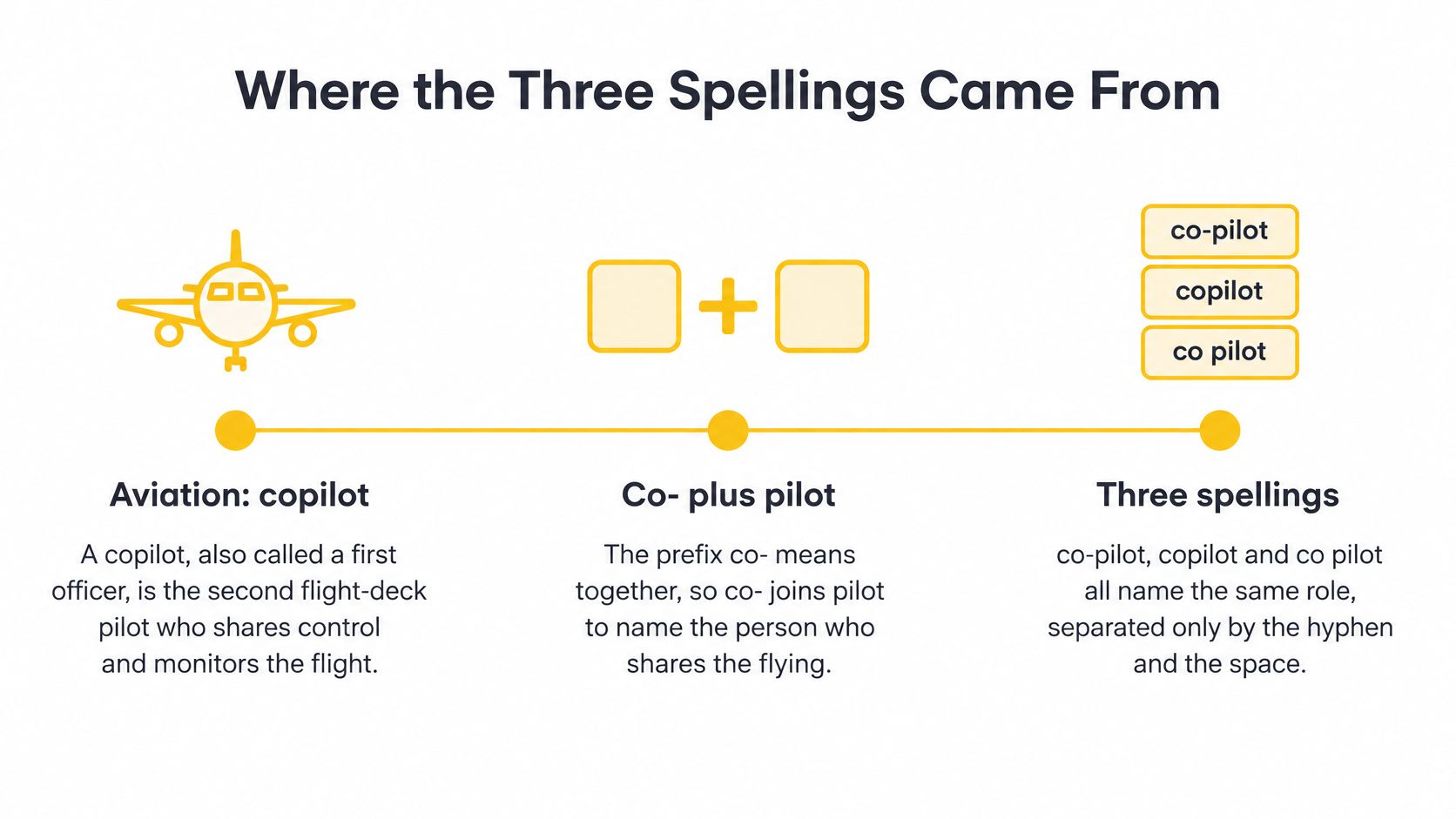
From flight deck to software interface
- Aviation roots: The term identifies a qualified flight-deck colleague who shares workload and checks the captain's actions. Older print and aviation materials help explain why readers still recognize the hyphenated form.
- The jet era: More complex aircraft and operating procedures made clearly divided flying and monitoring duties especially important. That working relationship gives the later software metaphor its meaning.
- The software transition: Bing Chat launched on February 7, 2023, and was renamed Microsoft Copilot on November 15, 2023, according to Taskade's history of Microsoft Copilot.
- Everyday tool language: As writers encounter the closed form in interfaces and product names, they have a ready model for describing generic AI assistance.
The software metaphor borrows the idea of help within an existing task. A person asks for a draft, a summary, or a recommendation while remaining responsible for evaluating the result.
History explains variation, not permission
It's tempting to read the illustration's spellings as interchangeable alternatives. Editorially, they aren't: recognizable meaning doesn't make every arrangement of spaces and hyphens standard.
Nor did a software brand invent the underlying word. Product naming reinforced a visible closed spelling in a new context. For the writer, the useful historical lesson is that established usage and local convention can coexist, which is why older hyphenated text doesn't automatically need correction.
Fix Spelling Mistakes and Lock One Form
A reliable final pass checks spacing, meaning, capitalization, and inflection separately. A blanket replacement can fix one error while damaging a quotation or changing a product name.
Run a controlled editing pass
Search every form. In Word, Google Docs, or your publishing editor, search separately for copilot, co-pilot, and co pilot. Review each result rather than selecting Replace All immediately. Correct the spaced form in your own prose, but inspect quotations and reproduced interface text before changing them.
Resolve unexplained alternation. If adjacent paragraphs describe the same generic assistant with different spellings, normalize them. Keep a different treatment only when there's a reason, such as an official name or a verbatim quotation.
Check capitals in sentence context. Lowercase the common noun inside a sentence. Retain a capital at the beginning of a sentence and in proper names. Don't assume that every search result beginning with Copilot is a branding reference.
Protect official wording. Compare names and interface labels with the materials you're documenting. In marketing copy, a creative spelling such as Co-Pilot can misidentify the product even though a reader understands the intended word.
Inspect endings and apostrophes. Use copilots for the closed plural and the copilot's checks for the singular possessive. Under a hyphenated convention, use co-pilots and the co-pilot's checks. For a plural possessive, the apostrophe follows the plural ending: the copilots' schedules.
Leave collaborators a usable decision
A style note should specify scope, not just announce a favorite spelling. For example: Generic references use copilot; quoted aviation terminology retains its original spelling; named tools retain official capitalization. Put that note in the shared editorial file so another reviewer doesn't undo a deliberate choice.
For searchable titles and headings, use the wording that accurately describes the page. Mention alternatives where readers need clarification, rather than scattering misspellings through the text to capture searches.
Your final check should include captions, tables, navigation labels, and image descriptions. These elements are easy to miss when you review only the main paragraphs.
The lasting rule is simple: default to copilot, preserve justified exceptions, and remove accidental variation. A clean document reflects a consistent decision about meaning, not merely a successful spell-check.
We offer live answer suggestions through Interview Copilot, alongside mock interviews and structured practice questions. Visit Interview Pilot, which is free to get, to explore the tools and practice explaining your experience clearly. Before using live assistance in an assessment, check the employer's rules and disclose its use when required.


Topics
co pilot or copilot
copilot spelling
co-pilot vs copilot
copilot meaning
copilot usage
Continue reading

Interviews
What Happens at Second Interview and What Comes Next
What happens at second interview: formats, goals, and next steps. Learn how to prepare, read the signals, and follow up after round two.
November 22, 2026
15 min read

Interviews
Copilot AI Cost: Plans, Prices and Hidden Fees
Compare Copilot AI cost across Microsoft 365, GitHub and consumer plans, with per-seat math, hidden expenses and a simple way to estimate your budget.
November 22, 2026
17 min read

Interviews
Product Manager Interview Answers That Hold Up
Sample product manager interview answers for behavioral, product design, metrics and prioritization questions, with the structure interviewers score and how to deliver it live.
November 22, 2026