
















Interviews
What Are Informal Interviews? Meaning, Format and Tips
What are informal interviews? Learn how they differ from formal interviews, what to expect in a casual conversation and how to prepare.
Interview Pilot Editorial Team
Updated November 9, 2026
15 min read
An informal interview is a loosely structured conversation with no fixed sequence of identical questions and no standardized scoring, used in hiring, networking and research. But if nobody calls the conversation an assessment, how do you know whether you're being evaluated?
That's the gap behind the question, what are informal interviews? A friendly invitation can mean a hiring screen, a career-learning conversation, or a researcher asking about your experiences. The tone alone won't tell you which.
For job seekers, the important skill isn't becoming more casual. It's recognizing the purpose of the conversation and giving useful, specific answers without needing a predictable question list.
What an Informal Interview Actually Is
An informal interview is a guided conversation rather than a scripted assessment. The interviewer has something they want to learn, but they can change direction as you speak.
Think of a structured interview as an exam with common questions and marking criteria. An informal interview is closer to a guided chat: your answer helps determine what the interviewer asks next. That doesn't mean the conversation has no purpose, only that its route isn't fixed.
A methodological review in the International Journal of Qualitative Methods describes informal conversations as flexible ways to explore people's experiences, interpretations and knowledge through broad prompts and follow-up questions. Participants can explain things in their own terms, although the interviewer gathers less consistent information across conversations.
The setting can look ordinary even when the conversation has a professional purpose.

What makes the conversation unstructured
In employment settings, you'll also encounter the term unstructured interview. Its defining features are about how questions and judgments are handled, not whether you're sitting in a café or wearing a suit.
- Broad prompts replace a script. The interviewer might invite you to describe your recent work instead of asking a tightly specified competency question.
- Follow-ups develop from your answers. A passing reference to a difficult handover could become the main topic.
- Personal judgment replaces a fixed rubric. The interviewer may form an overall impression rather than score each answer against predetermined evidence.
Say you mention helping a colleague finish a delayed project. The hiring manager becomes interested in how you divided the work, then asks how you handled disagreements. You didn't prepare for that exact sequence, but you can still explain what happened and what you contributed.
Flexible doesn't mean purposeless
In research, an informal conversation may develop naturally during fieldwork. Responsible researchers still need a clear objective, appropriate consent, confidentiality and careful documentation. A conversational method doesn't remove those responsibilities.
For a candidate, an invitation to have a chat is therefore a cue to prepare adaptable examples, not memorize a speech. Expect the interviewer to follow interesting details, and make sure the details you introduce are ones you can explain.
Three Situations Called Informal Interviews and How to Tell Them Apart
| Situation | Who starts it | Main purpose | Assessed? |
|---|---|---|---|
| Casual screening conversation | Employer | Decide whether to advance a candidate | Yes |
| Informational interview | You or a professional contact | Learn about a career path and build a connection | No, and it is not a job interview |
| Unstructured research interview | Researcher | Generate ideas before a survey or structured interview | No, your views are the data |
| Coffee chat, networking meal or office tour | Either party | Build rapport and gather context | Often yes, employers may still evaluate |
The most easily confused terms are informal interview and informational interview. An informational interview is a learning conversation, not an application stage or an implied offer. The University of Nebraska–Lincoln Business Career Center's interviewing resources distinguish career-learning conversations from employment interviews and explain why candidates should take employer interactions seriously even outside a conventional interview room.
For example, you might contact a project manager to learn how they entered the profession. You'd ask about responsibilities, career transitions and useful experience, rather than expect them to assess you for a vacancy.
By contrast, a recruiter who invites you to meet the team after discussing an advertised role may be gathering evidence for a hiring decision. Coffee doesn't change that purpose.
Work out what the invitation means
Use these questions together rather than treating any single answer as conclusive:
- Who initiated it? Employer contact can signal screening, while your request for career advice points toward an informational conversation.
- Is there an open role? A named vacancy, job description or application discussion makes employment assessment more likely.
- Will someone assess your suitability? Ask whether the conversation contributes to shortlisting or another hiring decision.
An open interview is a different label again. It concerns how candidates access the hiring process, not necessarily how structured the questions are. Our guide to the meaning of an open interview can help you distinguish the invitation format from the conversation itself.
Match your preparation to the purpose
For screening, prepare evidence that connects your experience to the work. For an informational conversation, bring thoughtful questions and a brief explanation of your career interests, without turning the meeting into an unsolicited application.
For research, describe your experiences clearly and ask how your information will be used. You can decline topics you're uncomfortable discussing.
When the invitation is ambiguous, ask whether the meeting is intended as a screening conversation, career-information discussion or job interview. That's a practical clarification, not a sign that you can't handle an informal setting.
Practical rule: Identify the purpose from the invitation, not the atmosphere when you arrive.
If you discover that you're preparing for an assessment, our AI mock interviews include an evaluation of your answers. Use that feedback to check whether you're providing evidence, rather than sounding agreeable.
How an Informal Interview Unfolds, Step by Step
An employment conversation can change direction, so treat this sequence as a useful model rather than a guaranteed agenda. The opening usually gives you clues about how much detail the interviewer wants.
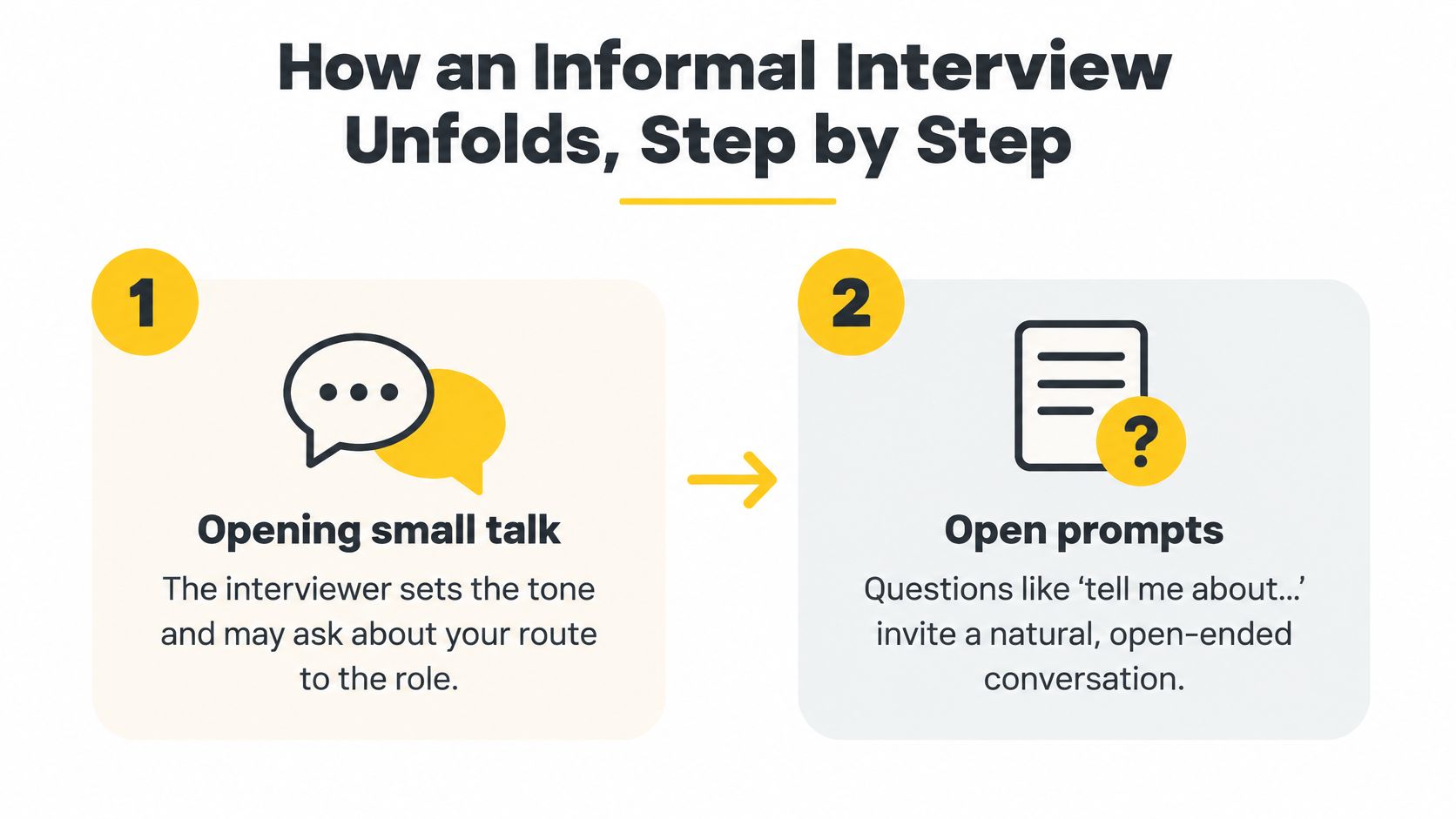
This visual highlights the opening stages, where the interviewer establishes the tone and invites you to talk.
Follow the conversation without losing your point
Opening small talk. The interviewer may ask how you found the opportunity or what interested you about the team, partly to establish an easy conversational rhythm. Respond warmly, then connect your interest to something concrete about the work.
Open prompts. A request to describe your recent work gives you room to choose what's relevant, but it isn't an invitation to recite your entire résumé. Start with your current responsibilities and a useful example, then leave space for a follow-up.
Follow-up exploration. The interviewer picks up a detail, perhaps asking how you persuaded a stakeholder or solved a delivery problem. Explain your own actions clearly, separating what you did from what the wider team achieved.
Topic drift. Discussion may move toward motivation, preferred working arrangements or a shared professional interest. Engage naturally, but use a relevant connection to return to the role if the conversation becomes detached from why you're meeting.
Informal wrap-up. A question about your availability, a summary of the discussion or an invitation for your questions may signal the close. Ask about any unresolved practical issue and confirm what happens next.
An interviewer might make brief notes during the meeting or record impressions afterward. Don't assume that only direct questions about qualifications contribute to their decision.
Make the ending useful
The closing is also your opportunity to assess the employer. Ask how the team defines successful work, what problem the new hire needs to solve, or how responsibilities are shared.
Choose questions that help you make a decision rather than questions designed only to sound impressive. Our guide to questions to ask a hiring manager offers prompts you can adapt to the conversation.
For another preparation resource, you can watch the video below.
Before leaving, check who will contact whom and whether another assessment is planned. A pleasant goodbye isn't a clear next step, so don't leave yourself guessing about what to do afterward.
Informal vs Formal Interviews Compared
| Feature | Informal interview | Formal interview |
|---|---|---|
| Question order | Changes by candidate and follows the conversation | Same core questions in the same order when structured |
| Scoring | Personal judgment, no fixed rubric | Predetermined criteria and scoring scale when structured |
| Average validity for job performance | 0.38 for unstructured interviews, compared with the structured estimate in the Merit Systems Protection Board report | 0.51 for structured interviews |
| Meta-analytic criterion-related validity | 0.19 for unstructured interviews, compared with the structured estimate reported in the Human Resource Management review | 0.42 for structured interviews |
| Consistency across candidates | Low when questions and judgments aren't standardized | High when the same assessment procedure is followed |
| Reliability | Weaker without shared questions and scoring rules | Supported by common prompts, scoring anchors and independent ratings |
Formal and structured aren't perfect synonyms. A panel in a boardroom can still ask improvised questions and judge candidates subjectively. A friendly video conversation can include common prompts and a carefully defined scoring process.
The comparison therefore concerns assessment structure, not how serious the room looks. Question order controls what candidates are asked, while scoring criteria control how interviewers interpret their answers.
What the validity figures actually mean
Validity here concerns how well interview assessments predict later job performance. The reported estimates aren't percentages of candidates who succeed, and they don't guarantee that a particular interviewer will make the right decision.
The estimates come from different evidence summaries, so they shouldn't be treated as interchangeable measurements. Their useful shared message is that structured interviewing provides stronger prediction than unrestricted conversation.
That doesn't make informal interviewing useless. A flexible discussion can reveal how someone explains their experience, what motivates them and which parts of a role interest them. It doesn't establish, by itself, that the person can perform every relevant task.
Why the distinction extends beyond hiring
The conversational approach isn't a recent recruitment invention. A methodological review of informal conversations traces its roots to ethnography and fieldwork more than a century ago, and distinguishes spontaneous field conversations from unstructured interviews arranged in advance.
That distinction helps explain why the same terminology appears in anthropology, journalism and recruitment. Researchers may want rich accounts of experience; employers need defensible comparisons between applicants. Those aren't identical objectives.
For a role with compliance responsibilities, candidates can also examine how the employer handles hiring safeguards. Advisor Momentum's financial advisor hiring compliance guide is a role-specific resource for exploring that context.
A relaxed delivery can coexist with rigorous assessment. What matters is whether the employer evaluates relevant evidence consistently.
Prepare as though your answers need to stand on their own merits, not as though being liked will substitute for demonstrating competence.
Why Employers Use Them and Where They Fall Short
In 2024, 22% of surveyed employers used only an informal chat and/or interview, according to Jobs and Skills Australia, assessing a jobseeker without the usual application process. That's an Australian finding, not a universal measure of how employers recruit.
There are understandable reasons to choose this approach. A manager can establish mutual interest, explore a résumé detail and explain an immediate staffing need without organizing a full assessment first.
For a small team, a direct conversation also offers room to discuss practical working relationships. An interviewer can ask how you communicate delays or seek help, then follow the example wherever clarification is needed.
Where convenience becomes a weakness
The problem begins when an employer treats an easy conversation as sufficient proof of suitability. An interviewer may mistake shared interests for compatible working habits, or confident delivery for sound technical judgment.
- Similarity can influence impressions. If a manager focuses on a shared background, redirect toward an example that demonstrates relevant work.
- Vague fit judgments are hard to interpret. Ask which working behaviors matter, such as documenting decisions or handling competing requests.
- Different questions create uneven opportunities. If an important skill hasn't come up, offer a concise example before the conversation ends.
- Strong claims may go untested. Ask whether the process includes a work sample, technical exercise or another opportunity to demonstrate capability.
These are limitations of the assessment method, not reasons to distrust every friendly interviewer. A manager can be welcoming and conscientious while still needing a more consistent way to compare candidates.
What a stronger hiring process looks like
Employers can preserve room for conversation while using job-based competencies, common core prompts and behaviorally anchored scoring. Instead of marking someone as a good communicator, they can define the evidence they need, such as explaining a technical issue clearly to a nontechnical colleague.
Independent ratings and a documented decision rule also help prevent a persuasive first impression from becoming the entire hiring case. For technical recruitment, erecruit's discussion of assessing skills for government ICT roles offers a relevant skills-based hiring perspective.
As a candidate, you don't need to audit the employer's process. You do need enough clarity to understand what you're being asked to demonstrate.
Ask which capabilities carry the most weight in the decision and whether you'll have a chance to demonstrate them directly. If the chat is moving toward a hiring decision, confirm the criteria and next stage before assuming that rapport means progress.
How to Succeed in a Casual Interview Conversation
Prepare useful material, not a rigid performance. You want examples you can shorten, expand or adapt as the interviewer changes direction.
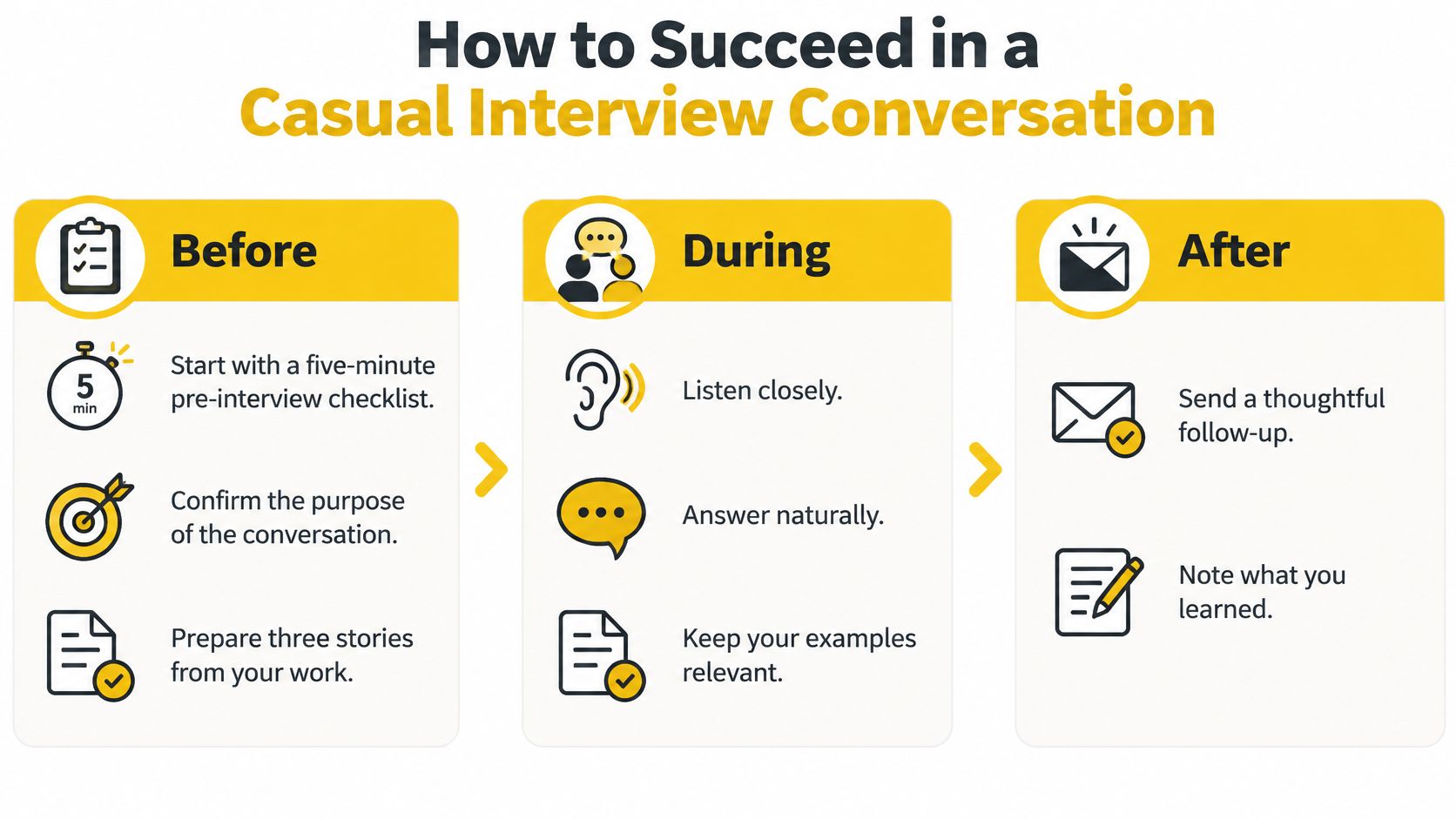
The checklist below organizes that preparation around what you can control.
Before the conversation
Our help center suggests a 5-minute checklist before a first interview. Use that final check to confirm your setup and materials, not as a replacement for learning about the opportunity.
- Confirm the purpose. Check whether you're discussing an application, exploring a career or participating in research so you prepare for the right task.
- Build a small story bank. Choose examples of solving a problem, working with others and learning from a setback, with a clear outcome for each.
- Read for relevance. Review the role description and the team's work, then connect their needs to specific parts of your experience.
- Prepare your questions. Write down what you need to know about responsibilities, support and expectations so you aren't improvising everything.
- Check the setting. For online meetings, test your microphone, camera and connection; for clothing decisions, use our business casual interview guide as a starting point.
During the discussion
Keep the first version of each answer brief. You can expand when the interviewer asks for more, which is easier than recovering their attention after an unfocused explanation.
- Use situation, action and result. Give enough context to understand the problem, explain your contribution and finish with what changed.
- Replace adjectives with evidence. Rather than describe yourself as organized, explain how you tracked dependencies and kept colleagues informed.
- Pause for unexpected questions. Take a breath, identify what the interviewer wants to know and answer in plain language.
- Listen for the underlying concern. A question about a difficult colleague may be testing conflict handling, not inviting criticism of a former coworker.
- Protect confidential details. Explain your reasoning without revealing customer information, private documents or sensitive commercial details.
For example, describe how you clarified ownership during a delayed handover, not merely that you're good at teamwork. If you don't have a directly matching example, explain the closest relevant experience and be clear about its limits.
After the conversation
- Send a thoughtful thank-you. Mention a specific point you discussed and briefly reinforce a relevant contribution you could make.
- Record your learning. Note unexpected questions, unclear answers and anything you still need to ask.
- Follow the agreed next step. Send requested materials and use the stated timeline rather than reading meaning into the interviewer's friendliness.
Remember: Informal means flexible, not unimportant. A relaxed setting isn't permission to ramble, exaggerate or leave your contribution unclear.
We offer guided mock interview practice and preparation resources to help you rehearse clear, relevant answers. Visit Interview Pilot to practice explaining your work aloud before your next casual hiring conversation.
Topics
informal interviews
informal interview tips
interview preparation
casual job interview
formal vs informal
Continue reading

Interviews
What Makes You Unique Sample Answers: 8 Proven Examples
8 what makes you unique sample answers for technical, finance, product, and junior roles, with analysis and tips to tailor each one to your interview.
November 4, 2026
17 min read
Interviews
Interview Question to Ask: 10 Questions by Stage and Role
Use the best interview question to ask at every stage, from screening to final rounds, and see why each matters for engineering, product, and finance roles.
November 4, 2026
19 min read
Interviews
10 Tax Interview Questions You Should Prepare For
Master the 10 most common tax interview questions with sample answers, key topics to review, and tips for entry-level to senior tax roles.
October 31, 2026
17 min read