









Research
Open Interview Definition for Hiring and Research
Open interview definition splits a research conversation from a walk-in hiring event, with validity numbers and preparation tips.
Interview Pilot Editorial Team
Updated October 29, 2026
15 min read
An open interview is a flexible qualitative interview with no fixed question list, where a participant explains experiences in their own words. In hiring advertisements, an open interview can instead mean a walk-in event where applicants attend without an appointment.
If an interview feels like a natural conversation, does that make it a better way to choose an employee? Not necessarily. Understanding the term requires separating how people enter an interview from how an interviewer asks questions and evaluates answers.
Two Meanings of an Open Interview
The open interview definition changes with context. A researcher uses the term to describe a way of exploring experience. An employer advertising an open interview may be telling applicants they don't need to book a slot.
There's also an overlapping hiring use: a scheduled interview that follows no consistent question list. You can have an appointment and still take part in an unstructured conversation. Conversely, you can walk into a hiring event without an appointment and answer carefully standardized questions.
That distinction matters because attendance arrangements tell you little about assessment quality. Look for separate clues about access, question format, and evaluation.
Three things people mean by open interview
| Meaning | Also called | Fixed in advance | Person's role | Typical purpose |
|---|---|---|---|---|
| Qualitative open interview | Unstructured, nondirective, or open-ended | Broad topics only, not a script or answer codes | Describes experience in their own words | Themes and narratives for research |
| Walk-in hiring event | Open interview or open hiring session | Time, place, and often a short screen | Arrives without an appointment and queues | Same-day screen, callback, or next step |
| Scheduled unstructured job interview | Unstructured selection interview | Little beyond the role and application; questions can change by candidate | Answers whatever the interviewer pursues | A hiring impression that is hard to compare |
Suppose a supermarket advertises open interviews at its store. That wording usually describes the entry arrangement, not a promise that the manager will let you direct the discussion. You might complete an application, wait with other applicants, and answer the same screening prompts as everyone else.
A university invitation to discuss your experience of caregiving means something different. The researcher wants an account they can interpret, rather than an application they can accept or reject. The conversation can still involve formal consent, recording, and rules about handling personal information.
Open doesn't mean casual or fair
The SolarH explanation of open selection interviews identifies inconsistent coverage, interviewer dependence, and conversational drift as weaknesses. A friendly tone doesn't remove those problems, and an informal setting doesn't make a consequential decision low-pressure.
Walk-in access can remove the appointment barrier while leaving other barriers intact. Location, event timing, language, disability accommodation, and the ability to rearrange care or shifts all affect who can attend. An applicant who can't reach the venue hasn't gained meaningful access because registration isn't required.
Before preparing: Match your invitation to the appropriate row, then confirm anything the wording leaves unclear.
Ask the organizer whether you need an appointment and whether the meeting is for research, an initial job screen, or a selection decision. Those answers are more useful than the word open alone.
How an Open Interview Conversation Works
A researcher studying night-shift nursing begins with a broad invitation: Tell me about a shift that stayed with you. The nurse describes trying to arrange childcare after an unexpected schedule change.
The researcher doesn't immediately switch to a prepared question about hospital equipment. Instead, they ask the nurse to explain what happened when the childcare arrangement fell through. The follow-up comes from the participant's account, not from the next box on a questionnaire.
Follow the meaning without supplying it
If the nurse had begun with staffing levels, the conversation could have followed staffing instead. The interviewer still has a purpose, but the participant helps determine which experiences matter and how to describe them.
The University of Texas guide to unstructured interviews describes the absence of predetermined questions and answer categories as a defining feature. That doesn't mean arriving unprepared. The interviewer prepares topics, understands the study's purpose, and listens for details worth exploring.
The process follows a broad direction without requiring an identical route.
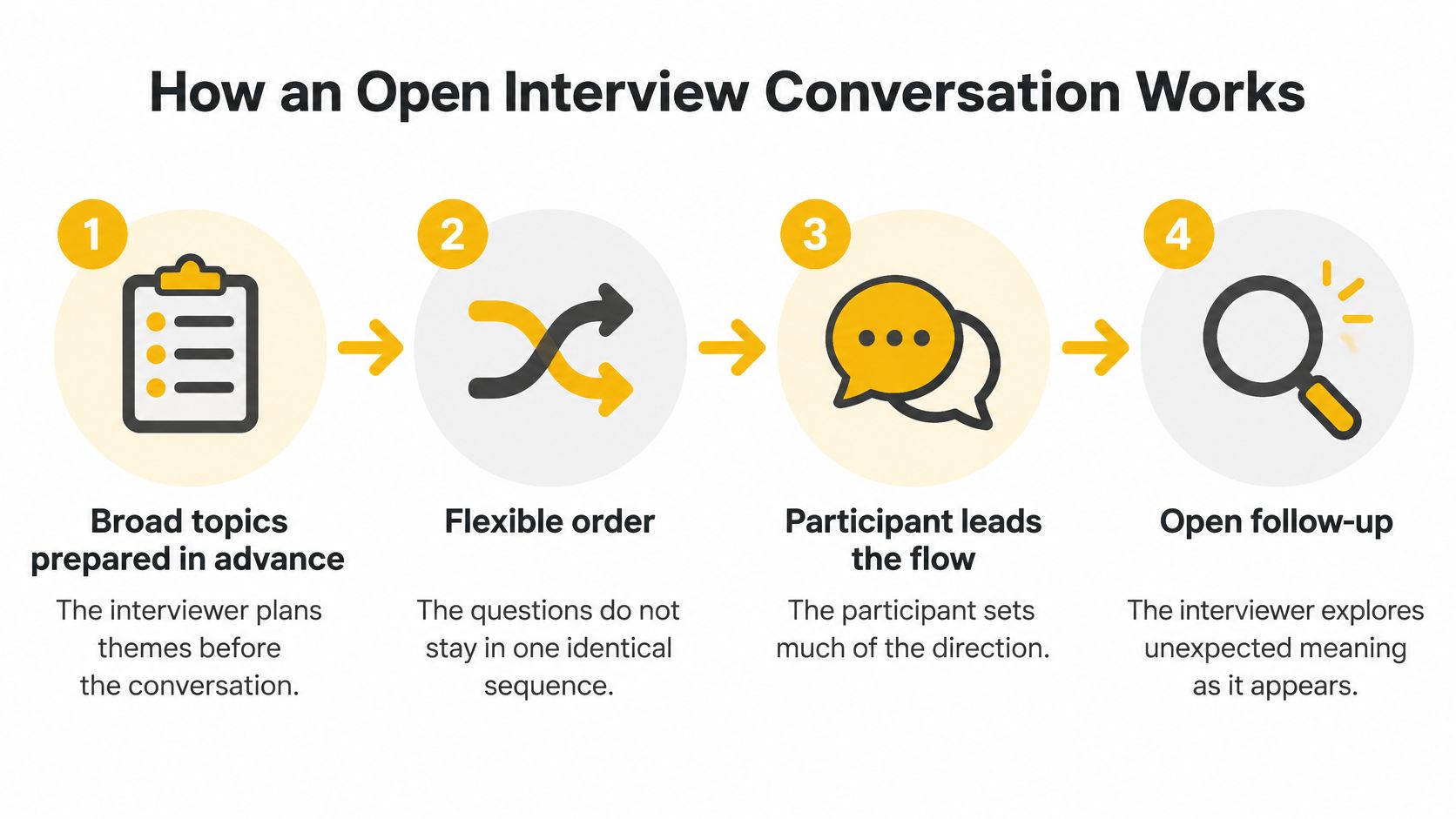
A useful analogy is a guided walk with a destination, not a checklist of checkpoints. The researcher can pause over an unexpected detail while keeping the discussion connected to the subject.
Good probes invite explanation without suggesting the answer:
- Follow an event: Ask the participant to describe what happened next.
- Clarify a term: Ask what they mean by a phrase such as support from management.
- Explore a decision: Ask how they chose what to do.
- Check understanding: Restate the meaning tentatively and invite correction.
Asking whether poor management caused the childcare problem would introduce an explanation the nurse hasn't necessarily offered. Asking how the schedule change affected their arrangements leaves room for a different account.
Open questions aren't the same as an open format
A structured interview uses standardized questions and response options. A semi-structured interview retains a prepared guide while allowing follow-up. An open interview gives the interviewer greater freedom to change the wording, sequence, and direction.
A single open-ended question doesn't establish the format. An interviewer can ask every participant to describe an experience using exactly the same prompt and evaluate each response against the same criteria.
That distinction also matters in professional interviewing. A hiring manager looking to evaluate SDR pipeline skills can use role-specific prompts to keep the subject focused without limiting candidates to yes-or-no answers.
For exploratory research, the benefit is different: participants can describe motives and connections the researcher didn't know to ask about. Their language helps the researcher discover possible response categories rather than forcing the account into categories chosen beforehand.
Open Interviews in Research and Walk-In Hiring
The setting often gives the clearest clue to what an organizer means. Consider these situations, each with a different purpose and a different role for the person answering.
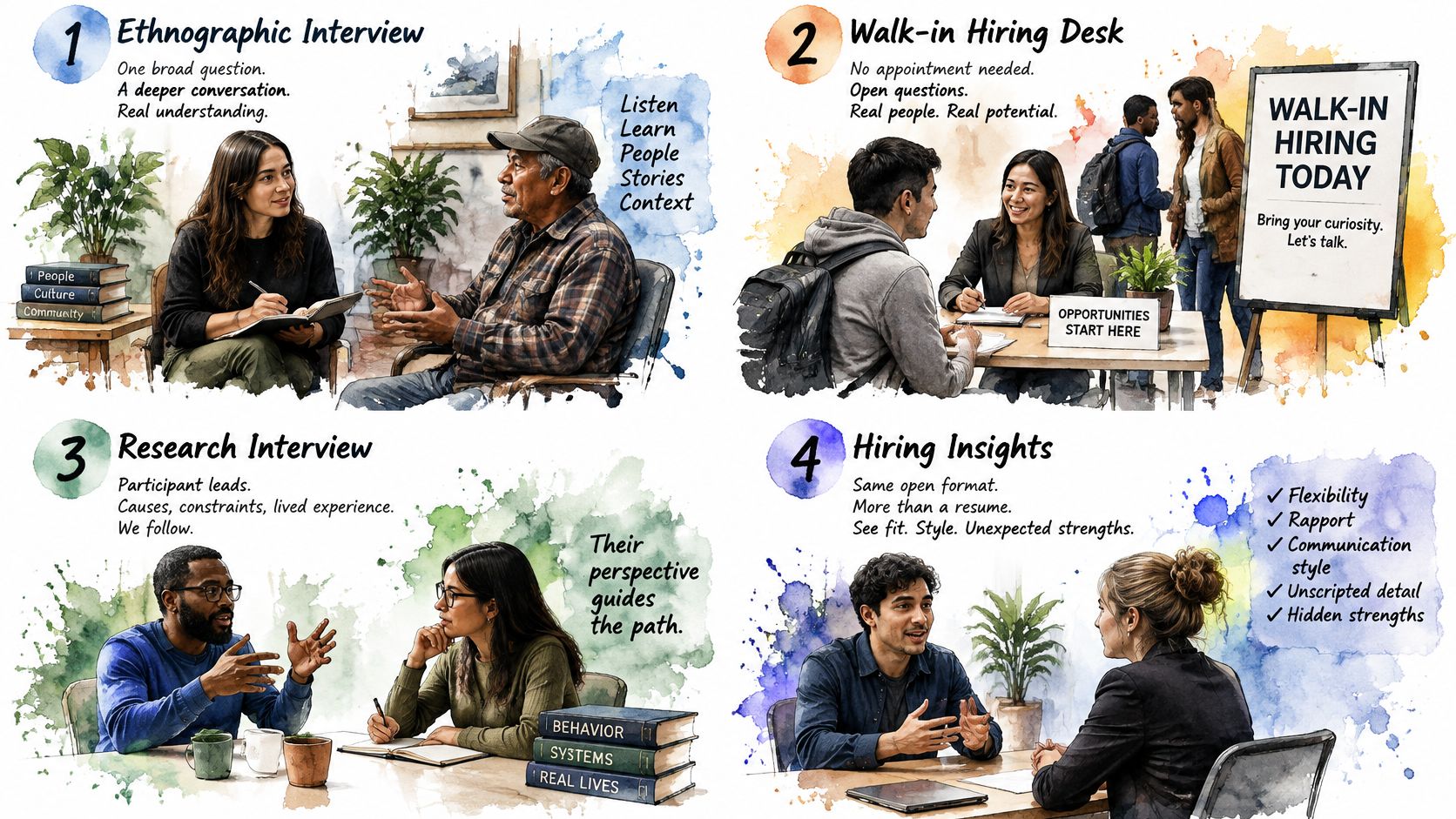
This visual places research conversations alongside hiring encounters.
Research conversations that uncover context
An ethnographic conversation. A researcher meets a community informant and asks them to describe a typical family week. When the informant uses a local term for shared caregiving, the researcher asks what that arrangement involves rather than replacing it with a familiar label.
Notice whose language organizes the discussion. The interviewer is trying to understand the informant's world, not test whether the informant knows the researcher's terminology. Does that match the invitation you received?
An exploratory academic interview. A researcher wants to understand why students stop attending an optional course. Before writing a survey, they invite former attendees to explain their decisions.
Participants might discuss transport, embarrassment about falling behind, or uncertainty about the course's purpose. The researcher listens for explanations that a prematurely designed checklist could miss. Does your invitation ask for experiences rather than correct answers?
Hiring conversations with different entry arrangements
A scheduled job conversation. A manager starts with your résumé, then follows an interesting project into a discussion of team conflict. Another applicant's meeting may focus on technical interests instead.
The important clue is the absence of a stable discussion guide. A semi-structured interview sample offers a useful contrast: prepared subjects remain visible even when follow-ups change. Does your invitation describe a planned assessment or a conversation with the manager?
The video below offers another interview reference point.
A walk-in hiring event. Say a warehouse invites applicants to attend an open session. At the entrance, an employee directs arrivals to an application desk, then to a waiting area.
A recruiter may speak with applicants individually, or staff may address the group before beginning short screens. Other applicants or observers may be nearby, so the encounter may offer less privacy than a scheduled meeting.
The outcome isn't necessarily an offer. You might receive a callback, an invitation to another assessment, or no immediate decision. Watch for an explanation of what happens after the conversation rather than assuming that attendance guarantees an interview with the final decision-maker.
Does your invitation name a venue and attendance window but no personal appointment? That most closely matches the walk-in meaning.
Why Open Hiring Interviews Predict Less
For employment selection, a meta-analytic estimate cited in a Human Resource Management article places corrected criterion-related validity at approximately 0.19 for unstructured interviews versus 0.42 for structured interviews, a difference of about 0.23 correlation units. In plain language, the structured format has a stronger relationship with later job performance.
These are correlations, not percentages of successful hires. They don't mean an employer will choose the right person at those rates, and they don't guarantee an outcome for an individual candidate.
How well each hiring format predicts performance
The estimates above describe the structured and unstructured formats. No separate estimate for the proposed hybrid is established here.
| Format | Validity (rho) | What stays the same | Plain-language meaning |
|---|---|---|---|
| Structured interview | 0.42 | Questions and scoring anchors | Stronger link to later job performance |
| Unstructured open interview | 0.19 | Often only the role or the résumé | Weaker and harder-to-compare evidence |
| Hybrid with open probes | Not established for this design | Core prompts, then probes, plus a rubric | Keeps conversation while restoring comparability |
An unstructured interviewer may hear valuable information about an unusual career path or a difficult technical choice. The problem arises when another applicant never gets a comparable opportunity to demonstrate the same competency.
Say a manager asks one applicant about resolving customer complaints but spends another applicant's meeting discussing shared interests. The manager now has different kinds of evidence. Being impressed by both conversations doesn't make the evidence equivalent.
Keep the conversation, structure the judgment
A practical hybrid starts with a shared competency framework. For a customer-support role, that might include diagnosing problems, explaining decisions, and handling disagreement.
Every candidate receives the same core prompts. The interviewer then uses open probes to clarify personal contributions, reasoning, and outcomes, while keeping those probes relevant to the competency.
Scoring anchors describe observable evidence rather than personality preferences. For example, a strong problem-diagnosis answer might show that the candidate checked assumptions, gathered relevant information, and tested an explanation before acting.
Notes should separate the candidate's evidence from the interviewer's reaction. Explained how they isolated the cause is useful evidence; seemed like someone I'd enjoy working with is an impression.
A conversational delivery can coexist with a disciplined assessment. The interviewer doesn't have to sound mechanical to apply consistent standards.
Workflow changes need the same discipline. Employers exploring using AI to reduce recruiter workload should define the evidence and scoring rules before deciding which administrative tasks to automate.
Questions candidates can ask
You don't need to interrogate the recruiter. Ask concise questions that clarify what the meeting will accomplish:
- Decision stage: Is this an initial screen or the interview used for the hiring decision?
- Assessment focus: Which competencies will you evaluate?
- Scoring method: Will interviewers use a scoring rubric?
- Next step: What happens after today's conversation?
A fast offer isn't proof of accurate assessment. Employers still need a fair opportunity to gather relevant evidence, including when applicants have different language backgrounds or accommodation needs.
Tradeoffs That Should Change Your Format
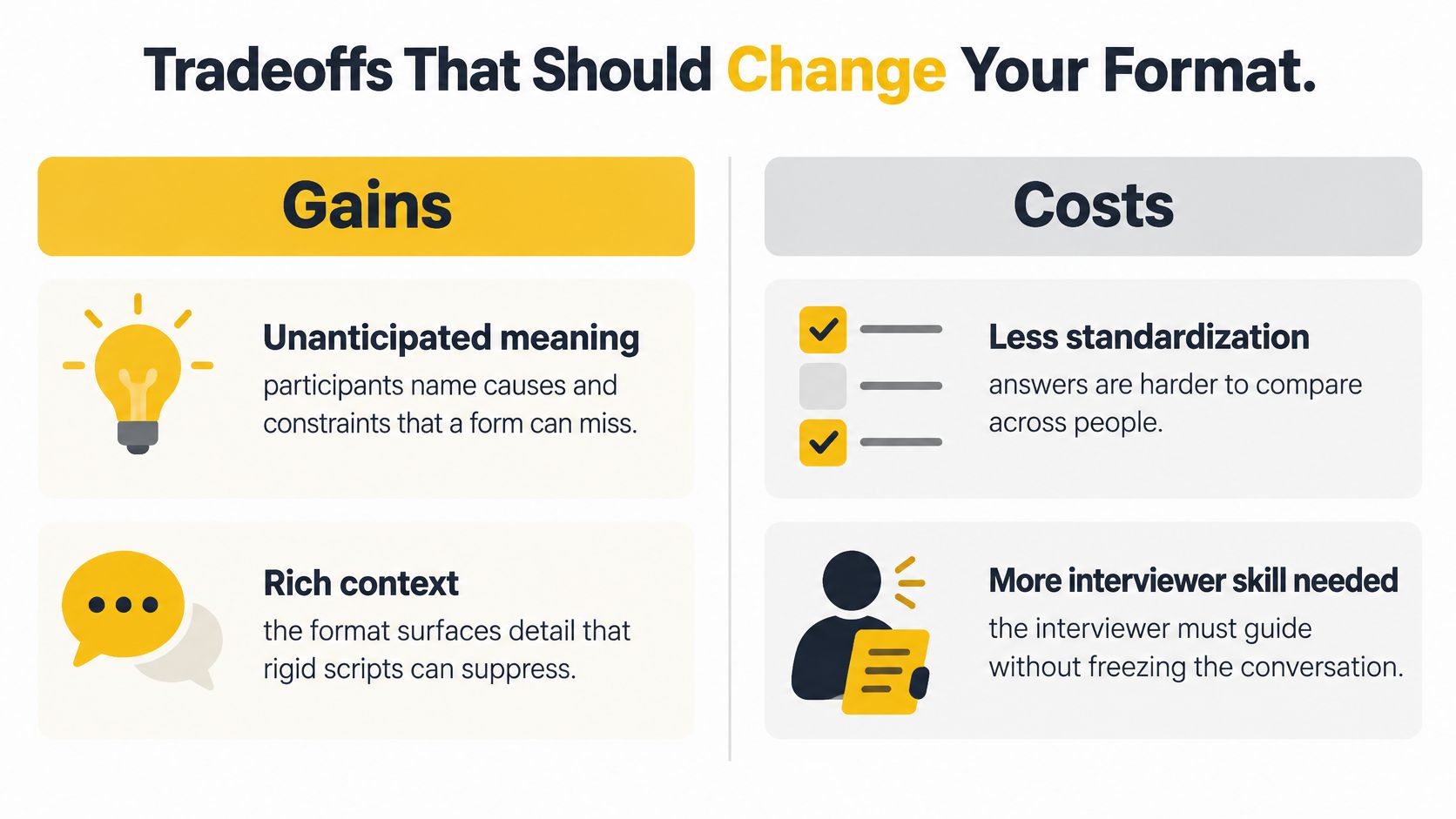
Researchers gain access to unanticipated meaning when participants can explain events in their own terms. They also take on a heavier interpretation task: a collection of rich conversations isn't yet a defensible account of recurring themes.
The Sustainability Methods guide to open interviews connects this flexibility with the need for transparent transcription, codebooks, analytic memos, and, when possible, comparison between coders. Those practices help a team distinguish what participants consistently describe from what an interviewer happens to notice.
Research depth requires an analysis plan
A transcript preserves the account. A codebook explains how passages receive labels, while an analytic memo records why the researcher interprets a passage in a particular way.
Suppose participants discuss feeling unsupported. A researcher shouldn't automatically group inadequate training, unpredictable scheduling, and dismissive supervision under a single explanation. They need to examine what each participant means and document the decision to combine or separate those accounts.
Question design matters too:
- Keep the purpose visible: Follow relevant surprises without treating every interesting story as part of the study.
- Avoid suggested causes: Ask how an event affected someone before proposing why it happened.
- Preserve disagreement: Keep accounts that challenge the emerging interpretation, not just those that fit it.
The gains and costs belong together when choosing a format.
Candidate freedom brings different risks
In a free-form job conversation, a candidate can explain why a career change makes sense or why a project required an unconventional approach. That freedom is useful when a résumé leaves out important context.
But an interviewer can mistake fluent storytelling for stronger capability. A quieter applicant may have excellent evidence yet receive less credit because they don't turn every answer into an engaging narrative.
At a walk-in event, the trade-off is more operational. You can seek contact without a calendar appointment, but you may have limited time to explain a complex background and receive little written feedback afterward.
A broader guide to interview formats can help organizers choose a format based on the decision they need to make, rather than the atmosphere they prefer.
Decision rule: Use a fully open conversation to understand experience. When the output is a ranked list of applicants, preserve common prompts and explicit scoring.
The central question isn't whether flexibility is good. It's whether the organizer needs to discover meanings or compare people against the same requirements.
Prepare for the Open Interview You Have
Prepare for the task, not the label. Research participants need access to their memories; job candidates need clear evidence of relevant work; walk-in applicants also need a workable attendance plan.
If you're a research participant
- Recall concrete episodes: Jot down experiences related to the study topic, including what happened, who was involved, and what mattered to you.
- Use your own language: You don't need academic terms or a polished explanation. Mention uncertainty when your memory is incomplete.
- Clarify participation terms: Read the consent information and ask about recording, privacy, and any questions you'd rather not answer.
Expect the interviewer to follow a detail you mention. You aren't failing to stay on script, because reproducing a script isn't your task.
If it's an unstructured job interview
- Prepare a career narrative: Connect your background, your current direction, and the role you're seeking without reciting your entire résumé.
- Build evidence stories: Choose examples of delivery, judgment, and difficulty. Explain your own actions and finish with a measurable result when you have one.
- Practice changing prompts: Rehearse describing a project you're proud of, explaining a difficult choice, and discussing an improvement your manager would recommend.
- Bring process questions: Write down what you need to clarify about the assessment stage, competencies, scoring, and next step.
For delivery habits such as pausing, keeping answers relevant, and asking for clarification, use these job interview tips and tricks alongside your role preparation.
If it's a walk-in event
- Pack what the posting requests: Bring résumé copies, identification, and any specifically named work-eligibility documents. Don't assume every event requires the same paperwork.
- Plan the journey: Check the attendance window, entrance, transport, and accessibility arrangements. Allow time for registration and waiting.
- Rehearse a compact introduction: State the role you want, the experience that fits it, and your availability clearly enough for a busy room.
- Record the outcome: Afterward, note the recruiter's instructions, any requested documents, and how the employer says it will contact you.
Practice aloud rather than memorizing exact sentences. Our AI mock interviews at Interview Pilot include an evaluation of your answers, and you can use the Start for Free button to begin on a free plan that requires no payment. Check the employer's rules before using any live assistance tool during an online interview.
Confirm which open interview you face, then prepare only for that row.
Interview Pilot offers mock interviews, structured question sets, and role-specific guides to help you prepare evidence without memorizing a rigid script. Visit Interview Pilot to rehearse answering unfamiliar prompts and review your answers before your next hiring conversation.
Topics
open interview definition
unstructured interview
walk-in hiring
interview validity
candidate preparation
Continue reading

Research
8 Data Science Intern Interview Questions to Practice
Prepare for the 8 most common data science intern interview questions with concise model answers, coding practice, statistics, ML, and portfolio tips.
October 22, 2026
19 min read

Research
10 AI Tools for Students: A Practical Guide
Explore 10 AI tools for students for studying, research, writing, coding, organization, and interview preparation, with practical limits.
October 19, 2026
18 min read

Research
Storytelling in Interviews: Build 8 to 15 STAR Stories That Stick
Build an 8 to 15 story bank, choose STAR, CAR, or PAR, then rehearse concise, truthful answers using research on how stories hold attention longer.
October 12, 2026