









Interviews
7 Semi Structured Interview Sample Guides
Explore 7 semi structured interview sample guides for research and hiring, with question sets, probes, timing, recording tips, and practical analysis.
Interview Pilot Editorial Team
Updated September 12, 2026
17 min read
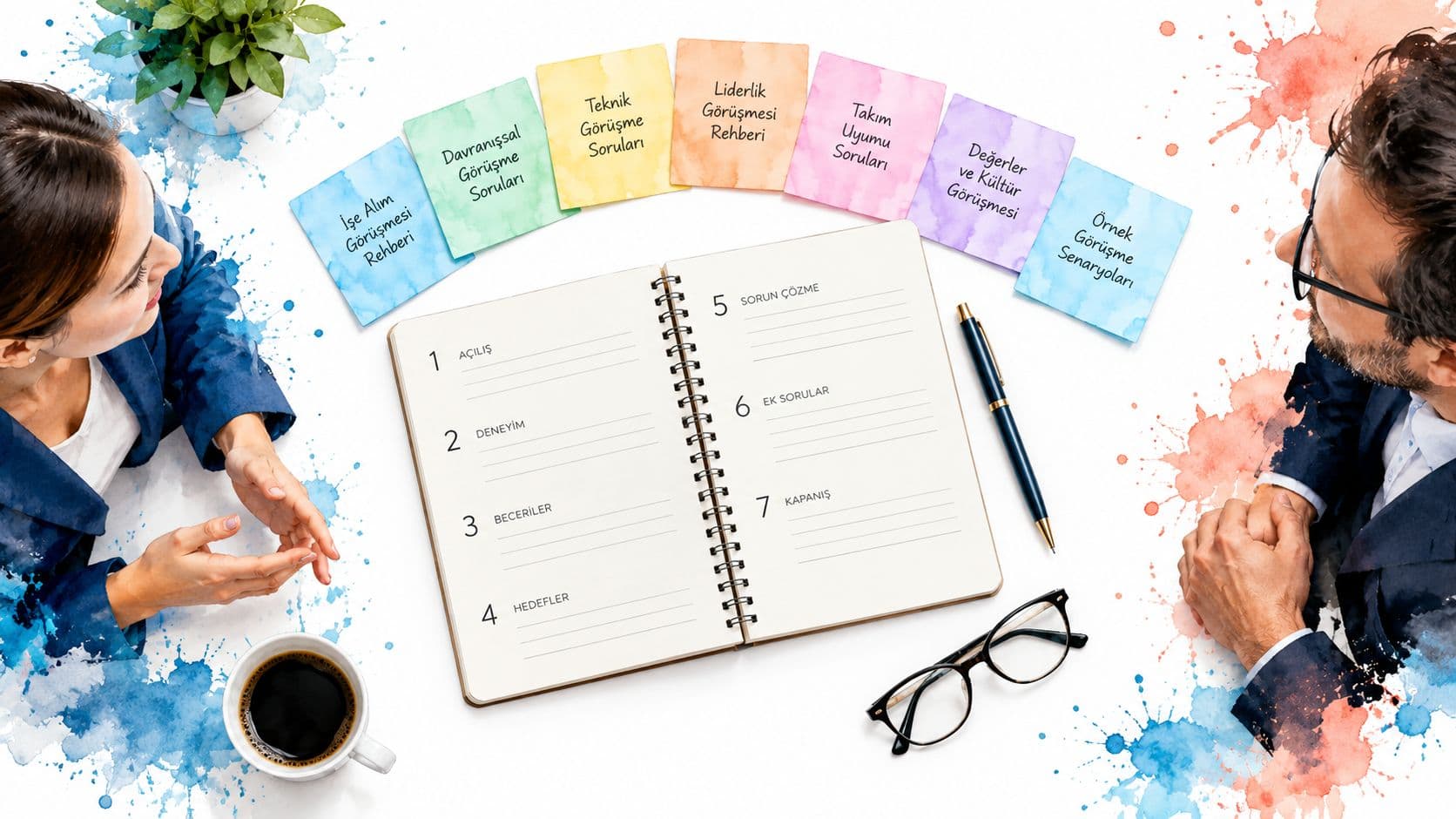
You've got a topic list, a deadline, and a half-finished interview guide that feels too loose to trust. One person on your team keeps asking different follow-up questions, another forgets to ask for consent before recording, and the notes from each interview look impossible to compare. A strong semi structured interview sample fixes that by pairing a clear objective with a short set of open core questions, optional probes, a realistic pace, consent-based recording, and a simple way to capture evidence you can compare later. The best examples aren't just question lists, they translate purpose into sequencing, timing, and note-taking discipline.
That's why the seven guides below use one reusable lens, research objective, core questions, probes, pacing, recording, and post-interview analysis. You'll see how the same structure adapts to behavioral, technical, case, finance, product, data, and leadership interviews. Interview Pilot fits here as a preparation tool for mock practice and ethical rehearsal, not for undisclosed assistance during a live interview.
1. Behavioral Interview Guide for Competency Stories
A behavioral interview works best when the candidate stops improvising and starts organizing experience. The STAR framework gives you that structure, Situation, Task, Action, Result. It helps turn a vague prompt like “Tell me about a time you handled conflict” into a clear narrative that shows judgment, ownership, and follow-through. For role searches in product management, consulting, and business analysis, this kind of sample keeps the story focused without making it sound scripted.
The strongest version starts with a small pool of examples, not a huge memory dump. Before the interview, map each story to a competency such as leadership, collaboration, analytical thinking, or resilience. If you want a behavioral question bank, the behavioral interview questions and answers guide can help you organize prompts by theme, then shape your responses with the same structure every time.
Practical rule: keep each story flexible enough to answer both broad and narrow prompts. A single example can work for “leadership,” “conflict,” or “pressure” if you know how to adjust the depth.
A useful practice routine looks like this:
- Prepare 5 to 7 examples: Choose stories that show different strengths, so you're not forced to reuse one achievement for every question.
- Write the action first: Candidates often over-explain the setup. The interviewer usually cares most about what you did and why.
- Record a mock run: Listening back helps you catch mechanical phrasing, weak transitions, and filler words.
- Vary the depth: A short prompt needs a tight answer. A follow-up needs more detail, not a new story.
- Match the role: A consultant interviewer may want structured thinking, while a product manager interviewer may want cross-functional judgment and tradeoffs.
A good behavioral sample also respects pacing. Start with a warm-up question, move into the main prompt, then close with a brief reflection on what you learned. That keeps the conversation human and gives the interviewer enough material for comparison without losing natural flow.
2. Technical Interview Guide for Coding and System Design
Technical interviews usually fail for one simple reason, the candidate jumps into code before they've explained the problem. A better semi structured interview sample forces a pause for requirements, constraints, and strategy before implementation starts. That's useful in live coding rounds, system design discussions, and technical problem-solving interviews where the interviewer wants to hear reasoning, not just syntax.
For software engineering roles, the interview guide should separate the big picture from the details. First, define the objective, solve the algorithm, design the service, or debug the edge case. Then build the core questions around that objective. For technical prep support, the technical interview preparation guide is relevant because it helps candidates rehearse the format before they walk into a live assessment.
A disciplined technical sample usually includes three layers. The opening question checks understanding of the problem, the middle probes test tradeoffs, and the closing asks the candidate to summarize complexity or implementation risks. That structure matters because it prevents the interview from turning into a race through half-finished code.
A clean pacing pattern is easy to follow:
- Clarify the problem: Restate inputs, outputs, and constraints.
- Explain the approach: Describe the algorithm or architecture before coding.
- Validate edge cases: Talk through failure points, scaling issues, or assumptions.
- Close with tradeoffs: Summarize what you'd change if latency, memory, or maintainability became the priority.
Practical rule: don't let the candidate code silently for too long. Ask for a verbal plan first, then let the implementation follow that plan.
Recording also matters here. In a mock session, keep audio or screen notes so you can review whether the candidate explained tradeoffs clearly or rushed into a weak path. For analysis, separate “correct answer,” “good reasoning,” and “clear communication.” Those are related, but they're not the same thing. If you're using assistance tools for practice, make sure they stay inside rehearsal and don't replace your own reasoning during a live interview.

3. Case Interview Guide for Structured Problem Solving
Case interviews reward candidates who can build order out of ambiguity. A strong sample starts with the business problem, not with a memorized framework. Whether the prompt is about market entry, pricing, profitability, or growth strategy, the guide should help the candidate define the objective, state assumptions, and test logic step by step.
That makes the core questions different from a behavioral interview. Instead of asking for past experience, the interviewer asks how the candidate would approach an unknown problem. The sample should include prompts for market sizing, competitive dynamics, cost structure, and strategic tradeoffs, but it shouldn't force every case into the same mold. The candidate needs room to think aloud, ask clarifying questions, and narrow the problem before diving into math or structure.
The most useful case sample also builds in pacing. A rushed candidate often starts calculating too early and misses the business logic. A more reliable flow is, clarify the goal, outline the framework, test the biggest driver, then summarize the recommendation. That structure keeps the discussion comparable across candidates while still allowing different styles of reasoning.
A practical preparation habit is to build a personal casebook, then review it after each mock session. Use it to note where you lost the thread, where your logic sounded thin, and where you skipped a probe that would've improved the answer. If you want a starting point for scenario-based practice, the problem-solving scenarios guide fits naturally into this kind of rehearsal.
A strong analysis format looks like this:
- Restate the issue: Make the problem explicit before solving it.
- Choose a structure: Use a simple framework that fits the case, not one that just sounds familiar.
- Probe for constraints: Ask about geography, customer segment, margins, or timing.
- Summarize the recommendation: Give a clear answer and name the main risk.
The interviewer can only evaluate your thinking if your steps are visible.
Recording mock cases is useful because it shows whether your reasoning stayed coherent or wandered after the first branch of the framework. During review, focus on whether your structure supported the answer or buried it under jargon.

4. Investment Banking and Finance Interview Guide
Finance interviews often mix technical knowledge with judgment under time pressure. A good sample has to cover valuation methods, financial modeling, market awareness, and deal thinking without turning into a memorization test. The objective is simple, can the candidate explain what a company is worth, how a transaction changes outcomes, or why a market move matters?
The core questions should move from fundamentals to application. Start with valuation logic, then ask about assumptions, then check whether the candidate can connect the answer to a live market or transaction context. In finance interviews, vague language creates problems fast, so the sample needs prompts that push precision. If a candidate says a method is “better,” the interviewer should probe why, for what business model, and under what constraints.
Pacing matters even more in this setting because short, confident answers often carry more weight than long explanations. A solid guide uses a quick opening question to settle the candidate, then a targeted technical probe, then a closing prompt on deal relevance or market awareness. That rhythm helps interviewers compare candidates fairly while still testing depth.
Recording mock sessions is useful for a different reason here, it shows whether the candidate can explain assumptions without sounding defensive. Finance answers often fail when the explanation becomes too abstract or too fast. A clean analysis note should capture what model the candidate used, how they defended assumptions, and whether they linked the answer back to the business outcome.
Practical preparation usually includes:
- Finance background inputs: Add coursework, projects, and prior deal exposure to your prep profile.
- Assumption checks: Explain why a valuation input is reasonable, not just what number you chose.
- Market awareness: Keep up with recent transactions and sector movement before the interview.
- Speed practice: Work through calculations under time pressure so the math doesn't eat the conversation.
- Firm style fit: Different firms emphasize different levels of technical rigor and communication style.
A semi structured sample in finance should also protect authenticity. If you're getting help from a prep tool, use it to rehearse explanations and spot gaps, not to invent expertise you don't have. The interviewer will notice the difference.
5. Product Management Interview Guide
A product interview sample works best when it follows the same path a product manager uses on the job. Start with the user problem, then move to metrics, tradeoffs, and the business result. That sequence helps the interviewer see how the candidate turns a broad goal into a decision, not just a feature idea.
Product questions should invite reasoning. “How would you improve this feature?” and “What would you build first, and why?” work well because they show how the candidate thinks about users, constraints, and priorities. Strong probes then check whether the answer rests on product sense, metric judgment, and clear communication. If the candidate can name a feature but cannot explain why it matters, the sample has not done its job.
Timing should match the task. A short opening question can establish the user pain, a follow-up can test metrics or tradeoffs, and a closing prompt can ask for expected impact. That rhythm keeps the conversation anchored in product judgment instead of drifting into a loose brainstorming session. For product management interview scenario prompts that fit this structure, use the product management blog resources as a practice set for scenario-based thinking.
A helpful prep structure for product candidates includes:
- Three to five product case studies: Choose products you have studied or worked on, then note what changed, why it mattered, and what you would do differently.
- Why-focused practice: Explain the user pain and the business reason behind each recommendation.
- Metrics language: Use plain language for activation, retention, conversion, or engagement.
- Communication review: Record mock answers and listen for clutter, over-explaining, or confidence that is not backed by evidence.
- Company fit: Adapt the guide to the company's product culture and stage.
Post-interview analysis should separate instinct from evidence. A candidate may have a strong idea but weak support, or a clear metric view but little user insight. A useful sample makes those gaps visible so the next rehearsal can address them.

6. Data Science and Analytics Interview Guide
Data interviews work best when the sample makes room for both explanation and verification. A data scientist, analyst, or data engineer usually needs to show statistical thinking, SQL fluency, Python comfort, and business judgment. That means the interview guide should not just ask for the answer, it should show how the candidate approaches the problem, checks the result, and explains the business meaning.
The objective changes the exact questions. For an analytics role, the interviewer may care more about metrics interpretation and experiment thinking. For a data engineering role, the focus may shift toward pipelines, reliability, and data quality. For a machine learning role, the conversation may go deeper into model choice, validation, and error analysis. A semi structured sample works well because it keeps the same broad areas in view while letting the probes change by role.
A good pacing pattern starts with a straightforward technical prompt, then adds a follow-up on assumptions or tradeoffs, then ends with a short explanation of impact. Many candidates can solve the technical part but struggle to explain it in business language. The interviewer needs both.
The best prep notes are concrete:
- Separate SQL and Python drills: Practice them on their own before combining them in a live scenario.
- Document projects: Tie every answer back to a real project, dataset, or analysis when possible.
- Explain clearly: Practice turning complex statistics into plain language that a hiring manager can follow.
- Emphasize impact: A correct method is good, but it's stronger when you can say what decision it supported.
- Match the role: Scientist, engineer, and analyst roles don't ask for the same depth in the same areas.
Recording mock interviews helps more than people expect. It lets you see whether your explanation was crisp or whether you buried the answer inside too much technical detail. For analysis, write down the question, the method, the result, and the business takeaway as separate notes. That structure makes later review faster and much more honest.
7. Cross Functional and Leadership Competency Interview Guide
Leadership interviews test how a person works through other people, not just how they perform alone. The sample should focus on influence, conflict resolution, strategic thinking, and emotional intelligence. In mid-level and senior roles, interviewers want evidence that the candidate can operate across functions, make judgment calls, and explain a decision without hiding behind team jargon.
A strong guide begins with a broad question about leadership style, then moves into a situation that required alignment or repair. The probes should explore what the candidate noticed, how they handled disagreement, and what changed after the conversation. That kind of structure helps the interviewer compare people who have led teams, influenced peers, or coordinated across departments.
This sample benefits from a more reflective pacing. Open with a lower-stakes question that helps the candidate settle in, then move toward conflict, failure, or organizational change. The closing question should ask what the candidate learned and how they would apply it again. That gives the interviewer evidence of maturity, not just accomplishment.
A solid preparation set usually includes:
- Leadership moments: Write down situations where you influenced a decision, repaired a relationship, or moved a team forward.
- Cross-functional examples: Choose stories that show collaboration with product, engineering, sales, finance, or operations.
- Failure reflection: Practice explaining mistakes without sounding vague or defensive.
- Tone control: Adjust your language to match the seniority and culture of the organization.
- Impact framing: Focus on team outcomes, not only individual wins.
If the answer only describes personal effort, the interviewer still doesn't know how you led.
Recording and review are especially useful here because tone matters as much as content. A candidate can sound confident but rigid, or humble but unclear. Good post-interview analysis separates those dimensions. Look at what the person said, how they said it, and whether the story showed influence, judgment, and accountability in a believable way.
Comparison of 7 Semi-Structured Interview Samples
| Guide | Implementation Complexity 🔄 | Resource Requirements ⚡ | Expected Outcomes ⭐📊 | Ideal Use Cases 💡 | Key Advantages ⭐ |
|---|---|---|---|---|---|
| Behavioral Interview Guide (STAR Method) | Low–Medium, repeatable four-step narrative; 🔄 | Low, time to prepare 5–7 real examples and practice; ⚡ | Clear, structured answers showing competencies and measurable impact; ⭐📊 | Non‑technical roles, culture‑fit, PM/consulting/business analyst behavioral rounds; 💡 | Predictable interviewer‑friendly format; reduces rambling; multilingual support; ⭐ |
| Technical Interview Guide (Coding & System Design) | High, algorithms + system design depth; complex problem workflows; 🔄 | High, extensive coding practice, mock interviews, platform tools; ⚡ | Demonstrable coding proficiency, design thinking, and optimization skills; ⭐📊 | Software engineers, ML/data engineers, live coding and system design rounds; 💡 | Directly maps to technical assessments; Copilot offers real‑time code/debug hints; ⭐ |
| Case Interview Guide (Consulting & Strategy) | High, structured frameworks (MECE, issue trees) and analytical rigor; 🔄 | Medium–High, casebook practice, market/financial prep, timed mocks; ⚡ | Structured problem solving, strategic recommendations, market/financial analysis; ⭐📊 | Consulting firms, strategy PM roles, investment banking case assessments; 💡 | Transferable frameworks across industries; builds structured business judgment; ⭐ |
| Investment Banking & Finance Guide | High, quantitative modeling and valuation complexity; 🔄 | High, financial modeling practice, up‑to‑date market knowledge; ⚡ | Accurate valuation, modeling speed, and market/deal insight; ⭐📊 | Investment banking, equity research, corporate finance roles; 💡 | Deeply specialized finance content; Copilot assists complex calculations; ⭐ |
| Product Management Guide | Medium–High, strategy, metrics, UX, and cross‑functional scenarios; 🔄 | Medium, product case studies, metrics practice, stakeholder scenarios; ⚡ | Clear product strategy, prioritization rationale, metric‑driven proposals; ⭐📊 | PM interviews (APM → Director), product strategy and prioritization rounds; 💡 | Balances user, business, and technical considerations; Copilot suggests strategic angles; ⭐ |
| Data Science & Analytics Guide | High, statistics, ML, SQL/Python, and pipelines; 🔄 | High, coding/ML practice, datasets, experimentation design; ⚡ | Robust data modeling, reproducible analysis, and business impact communication; ⭐📊 | Data scientist/engineer/analyst technical rounds, ML system interviews; 💡 | Broad technical + business focus; real‑time code and query generation; ⭐ |
| Cross‑Functional & Leadership Competency Guide | Medium, nuanced behavioral and leadership narratives; 🔄 | Medium, documented leadership examples, mock feedback, reflection; ⚡ | Demonstrated leadership presence, influence, conflict resolution, EI; ⭐📊 | Mid‑level to senior leadership interviews, cross‑functional roles; 💡 | Applicable across industries; Copilot adapts tone to leadership level; ⭐ |
Turn Any Sample Into a Repeatable Interview Plan
A semi structured interview sample becomes useful when it's treated as a repeatable plan, not a static list of questions. Start with the interview objective, then choose open core questions, add role-specific probes, assign realistic timing, obtain permission before recording, and separate observation notes from interpretation. That process works for research interviews, hiring interviews, and practice sessions because it protects both consistency and depth.
The best next step is to adapt one guide to your own context instead of memorizing every possible prompt. A behavioral sample can become a template for consulting prep, a technical guide can become a model for system design rehearsal, and a leadership guide can become a framework for promotion interviews. In practice, the same disciplined structure helps you compare answers more fairly and review them more objectively.
If you're using AI during prep, keep it inside rehearsal. Interview Pilot's AI Mock Interview sessions, question bank, and profile inputs can help you rehearse role-specific prompts, but you should still follow each employer's rules on live AI assistance. For a wider view of candidate experience and hiring measurement, RedactAI insights on hiring metrics offers a useful adjacent perspective on how structured hiring affects the process.
When you're ready, build one interview guide, test it in a mock session, and refine the probes after each run. Then use the same structure again for the next interview, so every conversation produces clearer evidence and better decisions.
If you want a structured way to rehearse behavioral, technical, case, product, data, finance, or leadership interviews, Interview Pilot gives you mock practice, a question bank, and role-specific preparation tools. Use it to build your guide, test your timing, and review how your answers sound before the interview.
Topics
semi structured interview sample
interview guides
qualitative research
interview questions
hiring interviews
Continue reading

Interviews
Question to Ask Hiring Manager: 10 Smart Picks
Find the best question to ask hiring manager at every stage, with practical follow-ups, role-specific adaptations, and real examples.
October 18, 2026
19 min read

Interviews
10 Assistant Manager Job Interview Questions and Answers
Prepare for Assistant Manager Job Interview Questions with 10 sample answers, competency mapping, and quick prep tips for leadership and delegation.
October 12, 2026
23 min read

Interviews
Closing Statements in an Interview: Leave a Mark
Master closing statements in an interview to leave a lasting impression. Learn key phrases and strategies for a confident, memorable finish.
October 5, 2026
14 min read