
















Interviews
Synonyms of Housewife: Terms That Fit Every Context
Synonyms of housewife explained: neutral, formal and informal options, when to use each, and inclusive alternatives for résumés and everyday talk.
Interview Pilot Editorial Team
Updated November 6, 2026
15 min read
Does replacing housewife with a more modern word tell readers what someone does? Not always. A person managing household finances, a parent caring for children, and someone supporting an older relative may all need different labels.
The most useful synonyms of housewife describe the work accurately without adding assumptions about marriage, gender, or paid employment. Homemaker is usually the best general alternative, but the right choice changes with the audience and purpose.
Synonyms of Housewife by Register, Use and Status
| Term | Register | Best Used For | Status |
|---|---|---|---|
| Homemaker | Neutral | General conversation, biographies, surveys | Current |
| Stay-at-home parent | Neutral, descriptive | A parent who mainly cares for children | Current |
| Stay-at-home mother | Descriptive, gendered | Mothers who care for children full time | Current |
| Stay-at-home dad | Descriptive, gendered | Fathers who care for children full time | Current |
| Full-time parent | Neutral | Parents whose main role is childcare | Current |
| Unpaid caregiver | Formal, neutral | Care for illness, disability or older age | Current in policy writing |
| Household manager | Neutral, practical | Budgeting, planning and household logistics | Current |
| Homemaker and primary caregiver | Formal, compound | Résumés, forms and surveys | Current |
| Househusband | Gendered | A man who runs the home | Current, less common |
| Domestic engineer | Informal, humorous | Light conversation | Dated |
| Lady of the house | Formal, dated | Older formal writing | Dated |
| Keeper of the home | Literary | Fiction and historical writing | Archaic |
| Hausfrau | Borrowed German term | Quoted or historical use | Stereotyped, avoid in new writing |
Match the term to your audience before choosing the most impressive-sounding option. Check the status column, because dated or archaic language can distract from an otherwise straightforward description. Neutral terms are generally the safest starting point, while formal language needs an appropriate setting and gendered terms need a reason to specify gender.
Read the Register Before Replacing the Word
Register means the level and style of language appropriate to a situation. You might describe yourself as a homemaker at a community event, but use homemaker and primary caregiver when explaining a career break on a résumé. Neither is more respectful by nature, they serve different purposes.
A synonym also needs to fit the sentence grammatically. Homemaker names a person, while unpaid domestic and care work names an activity. Replacing a person-label with an activity-label requires rewriting the sentence, not just swapping words.
Choose Accuracy Over a Grand Title
Say someone plans meals, handles repairs, tracks spending, and coordinates family appointments. Household manager puts the organizational responsibilities in the foreground; homemaker gives a broader picture without suggesting a formal position.
By contrast, domestic engineer can sound like a joke or an attempt to inflate a title. It may work in a playful personal introduction, but it gives an employer less information than a direct description of responsibilities.
The same principle applies when choosing a synonym for cashier: a replacement should clarify the role rather than make it sound more prestigious.
Practical rule: Choose a label the reader can understand immediately, then describe the responsibilities that the label leaves out.
A current term isn't automatically the correct term. Stay-at-home parent won't fit someone without children, and unpaid caregiver won't fully describe a role centered on budgeting and home administration. Treat the table as a set of context-specific choices, not a list of interchangeable titles.
Why Housewife Has So Many Alternatives
Why does one role need so many labels? Each term preserves a different part of the job and a different social setting. The word's history explains why its alternatives emphasize different responsibilities, and the timeline places those changes in sequence.
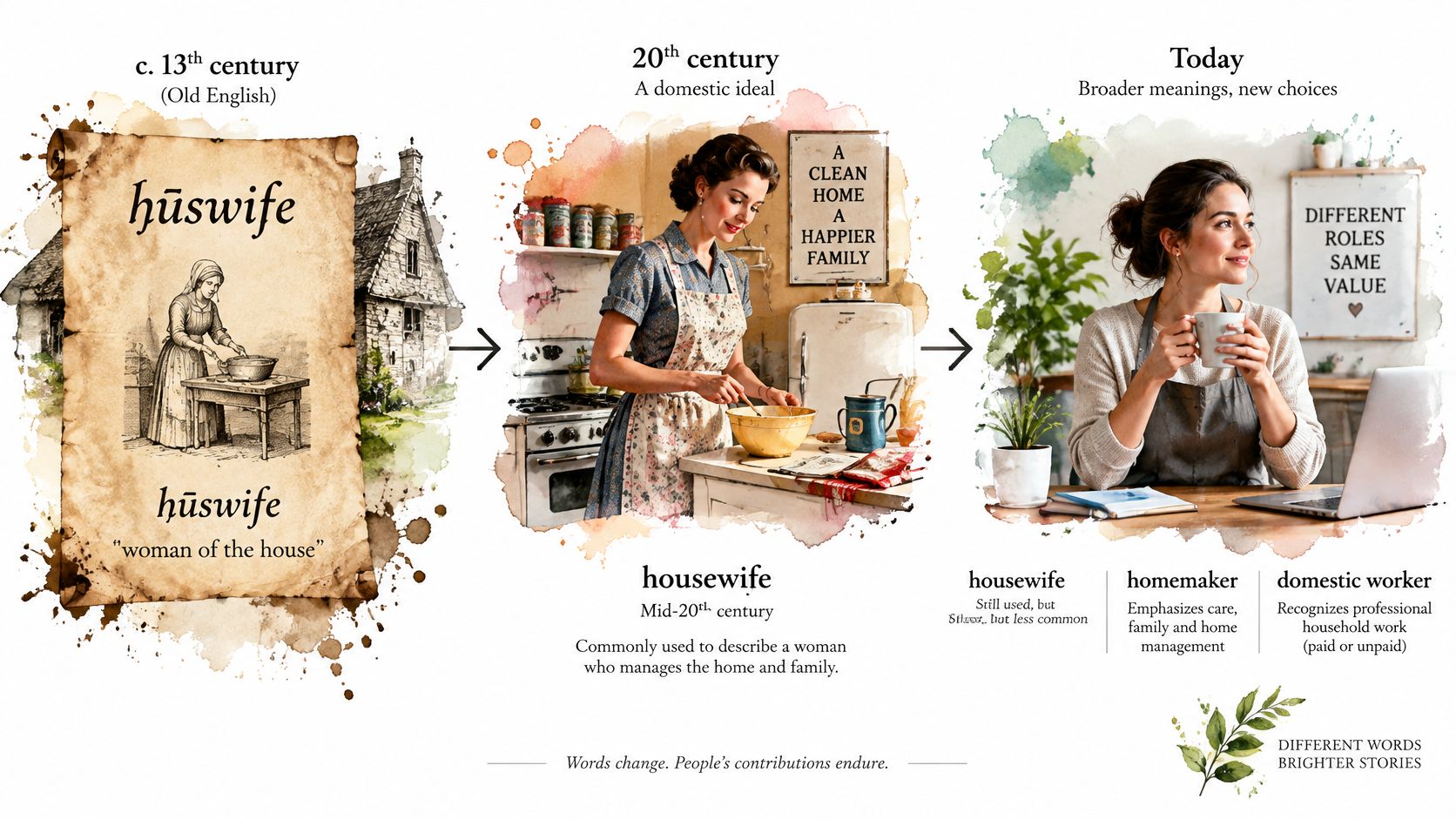
Oxford English Dictionary evidence traces the written form husewif to 1225 and dates homemaker to the period 1885 to 1890. The earlier word described a woman responsible for managing a household, rather than exclusively the modern category of a married woman outside paid employment.
In the United States, home-economics education and domestic advice literature helped present homemaking as skilled work. Writers discussed household management, child development, and emotional care alongside cooking and cleaning. Homemaker therefore offered a way to emphasize capability rather than marital position.
Different Words, Different Emphases
Consider a family biography. Calling someone a housewife may preserve the traditional language of her social setting; calling her a homemaker directs attention toward the home she managed. Calling her a stay-at-home mother highlights a particular arrangement around childcare and employment.
Each choice tells the reader which part of a person's life the writer considers relevant, while leaving other responsibilities less visible. A synonym here works like a label on a map: one label marks marital status, another marks the work of running a home, and another marks the care arrangement. The label does not change the territory, but it changes what the reader notices first.
The conclusion is historical as well as practical: newer words do not erase older ones. They layer on new emphases, and the writer decides which emphasis the reader should see.
Role-Based Terms for Management and Care
Domestic work splits into two broad layers: household management and caregiving. Household management works like the operations side of a small organization, covering budgets, schedules, supplies, maintenance, and appointments. Caregiving covers the personal and relational work of looking after children or dependent adults. Separating the two layers shows what a broad label can hide.
A homemaker may run a household without being a parent. A stay-at-home parent centers the role on children. An unpaid caregiver may support someone with illness, disability, or age-related needs. Household manager stresses planning, budgeting, administration, and logistics. The term can describe unpaid family work, and it can also appear as a paid job title, so the surrounding sentence needs to make the arrangement clear.
Compare the Work, Not Just the Titles
| Main responsibility | Most useful starting term | Detail worth adding |
|---|---|---|
| Running the home overall | Homemaker | Meals, maintenance, supplies |
| Organizing household operations | Household manager | Budgets, appointments, contractors |
| Taking primary responsibility for children | Stay-at-home parent | School routines and daily care |
| Supporting a dependent adult | Unpaid caregiver | Appointments and personal assistance |
The ILO's care-work guidance distinguishes direct care, meaning personal and relational activities, from indirect care, such as cooking and cleaning. One person can prepare meals, manage bills, and help a relative get dressed in the same day. A title that names only caregiving can leave the management tasks invisible, just as a title that names only homemaking can leave personal care invisible.
If you need a comparison with paid household support, a guide to personal assistants for home management describes paid household-management services. Use that comparison to separate paid assistant duties from unpaid family responsibilities. The distinction matters because the same tasks can carry different labels depending on whether money changes hands.
Make the Responsibilities Visible
Precise role descriptions help employers, service providers, and families read a work history accurately. On a job application, identify the relevant transferable skills, such as scheduling, purchasing, and prioritizing competing responsibilities. Describe what you handled: the number of people you coordinated, the budgets you tracked, the appointments you arranged.
Pick the term that matches the work being described. If the role includes both management and care, name both. If it centers on one area, choose the narrower term and add the detail that keeps the rest of the work visible.
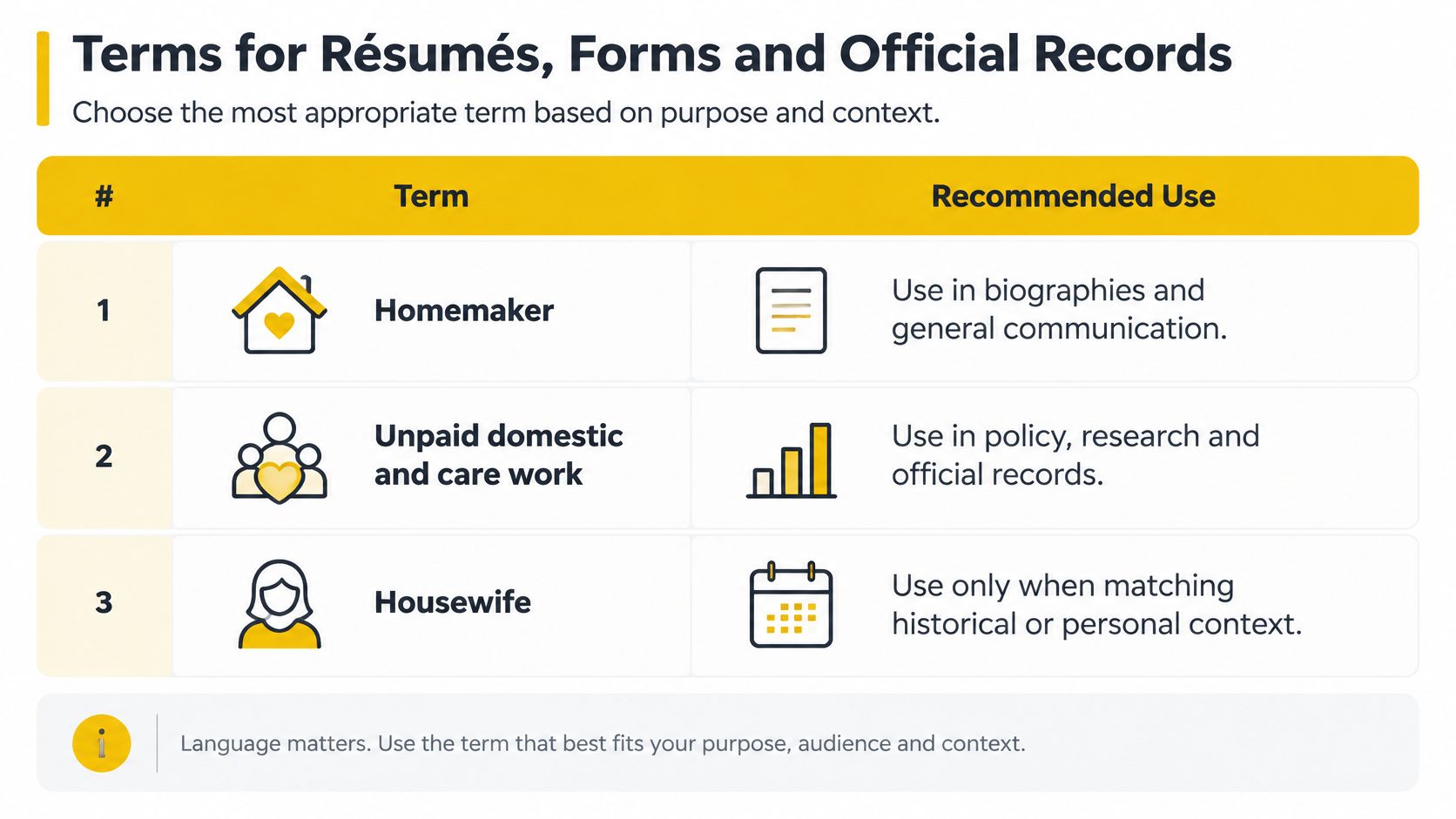
Terms for Résumés, Forms and Official Records
| Setting | Label to use | Add next |
|---|---|---|
| Biography or general communication | Homemaker | A sentence on the role |
| Résumé, survey or form | Homemaker and primary caregiver | Budgeting, scheduling, eldercare, school coordination |
| Policy or equity research | Unpaid domestic and care worker | Hours and tasks performed each week |
| Statistical or labor-market analysis | Person engaged in own-use provision of services | Cooking, cleaning, shopping, care for children or dependent adults |
| Paid work inside a household | Domestic worker | Employer and employment terms |
Follow the document's definitions first. An official form may provide fixed categories or specific instructions, so a preferred personal label shouldn't override the category the form requests.
Distinguish Work From Employment
The International Labour Organization's statistical guidance classifies unpaid household services as own-use provision of services, including cooking, cleaning, shopping, household management, and care without an expectation of remuneration. It distinguishes this from domestic work performed within an employment relationship.
That distinction matters on a résumé. You can describe substantial unpaid responsibilities without presenting a family member as an employer or inventing a salaried job.
The visual guide summarizes the main context choices.
Add Evidence Beneath the Label
A résumé entry could use Career break for household management and family caregiving, followed by responsibilities that are relevant to the target role:
- Scheduling: Coordinated medical appointments, school commitments, and household maintenance.
- Budget administration: Tracked expenses, compared supplier prices, and managed recurring payments.
- Care coordination: Organized transport and communicated with care providers.
For an office role, examples of administrative experience can help you recognize relevant tasks without overstating your professional background.
A precise task description tells an employer more than an elaborate replacement for housewife.
If a compound label doesn't fit your circumstances, change it. Someone without caregiving responsibilities can use homemaker or household management without adding primary caregiver.
Gendered Pairs and Inclusive Alternatives
The role doesn't belong exclusively to married women. Househusband is a gender-specific counterpart to housewife, while stay-at-home dad corresponds more closely to stay-at-home mother.
These distinctions matter because marital status and parenthood aren't the same thing. A househusband needn't have children, and a stay-at-home dad needn't be married.
The ILO's report on equality in the workforce states that 708 million women and 40 million men were outside the labor force because of care responsibilities in 2023. The imbalance is substantial, but the figures also make clear that caregiving isn't an exclusively female role.
Include the Relevant Identity, Not an Assumption
- For a personal profile: Stay-at-home dad may be appropriate when a father's experience is central to the story.
- For a service questionnaire: Stay-at-home parent avoids making unnecessary assumptions about gender or partnership.
- For an individual biography: Use the person's preferred description, provided it accurately communicates their situation.
Homemaker, unpaid caregiver, household manager, and full-time parent can accommodate different family structures when they match the responsibilities involved. That includes unmarried partners, single parents, grandparents, and same-sex couples, without requiring writers to build marriage into the label.
Don't replace a person's chosen identity merely to make every sentence sound neutral. Default to inclusive wording when gender is irrelevant, but ask the person what they prefer when describing them individually.
When Housewife Still Fits and What to Avoid
Housewife still works in historical writing, period fiction, direct quotations, and commentary that deliberately adopts a traditional voice. It also fits when a person uses the word for herself.
As a default label, though, it can carry assumptions the writer has not checked. Over the twentieth century, paid employment became more common for women, while unpaid household work remained a real economic contribution. That split means writers need to separate family role, employment status, and caregiving instead of folding all three into one old title.
Retire the Unhelpful Shortcuts
- Lady of the house and little woman: These sound dated or condescending in present-day descriptions. Use them only inside quotation marks or in a period voice.
- Domestic engineer: Treat it as a joke or light aside. In a résumé line or an official form, it reads as evasion.
- Labels implying dependence: A term should not define a person's worth through marriage or financial reliance. Describe the work instead.
- Hausfrau: Avoid presenting it as a colorful substitute. In English, it can summon a stock image rather than a neutral description.
Historical accuracy does not require the narrator to adopt an old label. You can preserve a quoted term and still describe the person's responsibilities in plain language nearby.
Audience test: If a label could confuse or exclude your reader, replace it with an accurate description of the work.
For example, manages the household budget and provides daily childcare states what the person does. It lets the reader understand the role without having to decode a traditional title.
Related Terms That Are Not Synonyms
Housekeeper and domestic help often appear in searches for synonyms of housewife, but they usually refer to service roles. If you're describing unpaid management of someone's own home, homemaker is generally the clearer choice.
For a concrete contrast, someone looking to find Bay Minette maid services through Sweet Home Cleaning Service is seeking cleaning assistance, not a label for a family role.
Check What the Term Actually Names
| Confusing term | Where the confusion happens | Better choice |
|---|---|---|
| Domestic worker | Household tasks are mistaken for an employment relationship | Homemaker for unpaid home management |
| Nanny | Any person caring for children is given a paid childcare title | Stay-at-home parent for a parent's own caregiving role |
| Tradwife | A lifestyle identity is treated as a general domestic role | Homemaker unless the specific identity matters |
| Full-time parent | Emphasis on childcare is confused with employment status | Choose according to the arrangement being described |
Tradwife is a social-media lifestyle label, not a neutral synonym for everyone who runs a home. Likewise, full-time parent emphasizes parenting as a main role, whereas stay-at-home parent foregrounds the household's work-and-care arrangement.
Neither expression means employed parents stop parenting when they go to work. Avoid wording that implies otherwise.
Choose the Right Term for Your Situation
Choosing a label affects how employers, survey designers, and other readers understand unpaid responsibilities. The ILO's publication on decent work and the care economy treats unpaid care as a substantive labor-market issue, not merely a matter of personal vocabulary.
Use this visual as a quick decision aid.
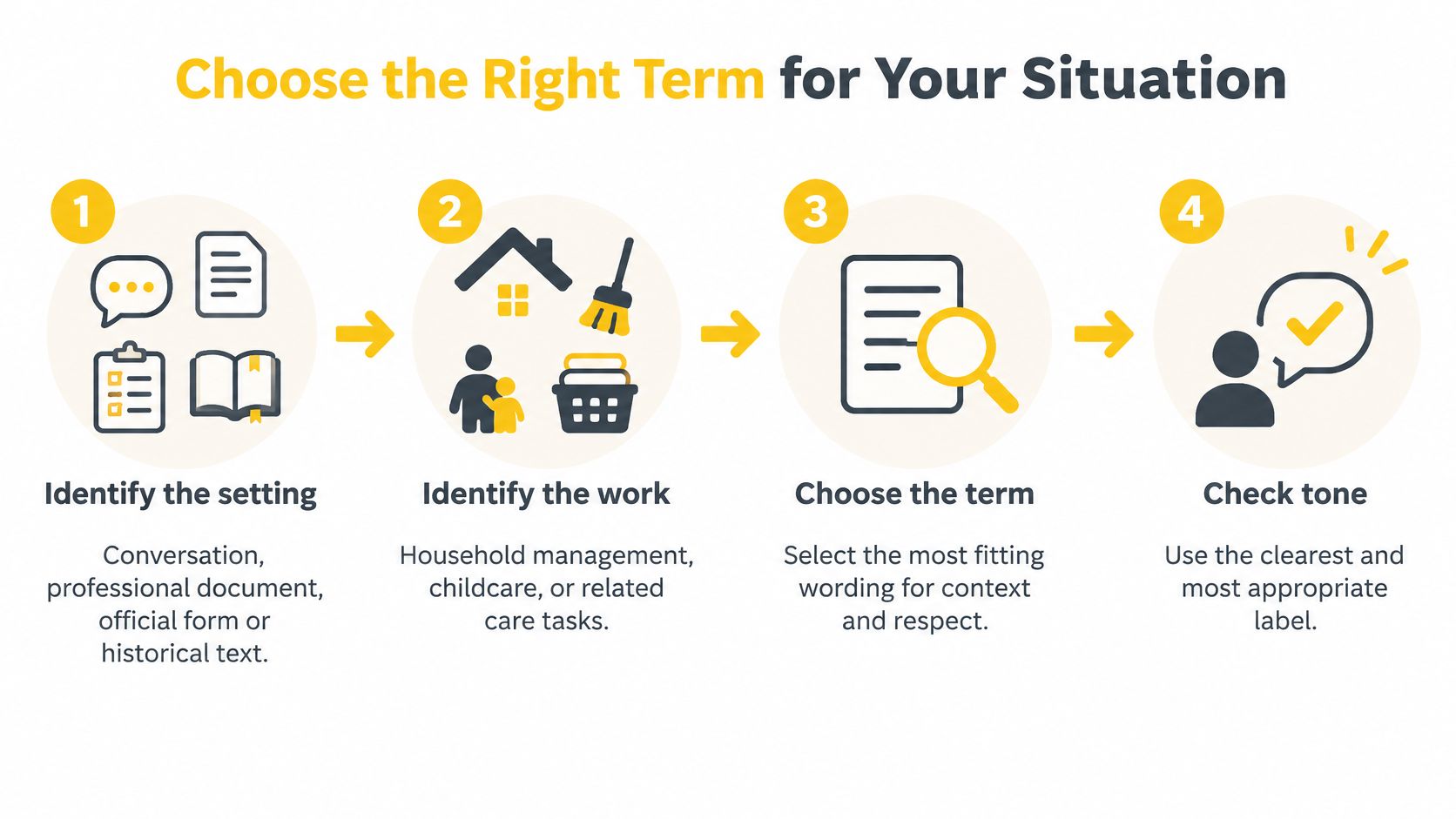
- Identify the setting. A conversation, professional document, official form, and historical text each require a different level of precision.
- Name the main work. Decide whether you're describing household management, childcare, adult care, or a combination.
- Check relevance. Include gender or marital status only when it contributes necessary information.
- Select the closest label. Use a neutral term or an accurate compound rather than forcing every responsibility into a single word.
- Describe the tasks. Add concrete activities so the reader doesn't have to infer what the title means.
- Confirm personal preference. Ask the person described whether they're comfortable with the wording.
Turn the Choice Into an Interview Answer
For a career break, connect the description to the period away from paid employment and your present goal. A possible answer is: During my career break, I managed household finances and coordinated care for a relative. I'm now ready to return to paid work and apply my organizational skills in an administrative role.
Keep the explanation truthful and proportionate. Draft your own version, remove any responsibility you didn't perform, and rehearse it aloud until it sounds natural.
Interview Pilot offers guided mock interview practice and a searchable question bank to help you prepare clear answers about your background. Visit Interview Pilot to practice explaining a caregiving or homemaking career break and connecting your actual responsibilities to the role you're pursuing.
Topics
synonyms of housewife
housewife synonyms
homemaker
inclusive language
stay-at-home parent
Continue reading

Interviews
Post-Interview Follow-Up: When to Send It and What to Say
Send a thank-you within 24 hours, then check in after the date they gave you. Get the timing, the wording and ready-to-edit email templates.
November 8, 2026
Interviews
8 Verbal Reasoning Test Examples with Worked Answers
Explore 8 verbal reasoning test examples with worked answers and tips for synonyms, analogies, syllogisms, and critical reasoning items.
November 7, 2026
18 min read

Interviews
7 Women's Interview Attire Ideas for Every Industry
Discover 7 women's interview attire options for corporate, creative, tech and finance roles, with dos, don'ts and seasonal tips for dressing with confidence.
November 7, 2026
14 min read