












Career
8 Administrative Experience Example Templates
Use these administrative experience example templates for resumes and interviews, with metrics, bullet points, analysis, and practical tips.
Interview Pilot Editorial Team
Updated September 28, 2026
20 min read

Administrative work isn't “just support.” That advice hides the evidence employers need. A strong administrative experience example connects an action to its scope, the method you used, a measurable result, and the reason that result matters in the target role. Scheduling can demonstrate resource planning. Document control can demonstrate information architecture. Vendor coordination can demonstrate commercial judgment. Process automation can demonstrate technical problem-solving.
The eight templates below translate administrative responsibilities into evidence for technical, business, data, product, and operations roles. Each example shows how to shape a resume bullet and deliver the same story in an interview using STAR, with practical trade-offs around tools, adoption, accuracy, and ownership. Replace every placeholder such as X, Y, and $X with a truthful metric from your own work. Never borrow a result just because it sounds persuasive.
Administrative professionals have long handled coordination, communication, and office systems, not only typing or filing, as the history of the profession shows in this overview of administrative support's evolution. If recurring coordination prevents you from focusing on higher-value work, some teams choose to reclaim time with dedicated support. You can rehearse role-specific explanations with Interview Pilot's AI Mock Interview sessions or question bank, but practice should sharpen genuine experience, not turn invented results into facts.
1. Led Cross-Functional Scheduling and Calendar Management for 50+ Team Members
Scheduling becomes compelling evidence when you show the operating problem behind the calendar. Coordinating 50+ team members, several departments, interviews, or on-call coverage requires prioritization, dependency management, and a reliable system for resolving conflicts. Those skills transfer directly to operations, business analysis, product management, and technical program work.
A useful resume structure is:
Coordinated schedules for [scope] across [teams, locations, or time zones] using [tools], reducing [conflicts, delays, or manual effort] by [truthful result].
For example, a candidate who coordinated interviews during a peak hiring period might write: “Coordinated interview scheduling for a high-volume recruitment cycle across hiring managers and candidates, maintained interviewer availability in Calendly, and escalated conflicts early to protect hiring timelines.” Add a number only if you can defend it, such as the number of candidates, interviewers, or hours saved.
Show the system, not just the calendar
Name the tools and the decisions behind them. Calendly may handle availability, Excel may support capacity tracking, and Asana may record dependencies. The strongest answer explains why you combined those tools rather than listing software as decoration.
For an engineering role, emphasize time zones, on-call coverage, and escalation rules. For product management, discuss protecting focus time and aligning meetings with delivery milestones. For operations, focus on resource allocation and service continuity.
The trade-off is flexibility versus control. A highly standardized scheduling process reduces errors but can frustrate stakeholders when urgent exceptions arise. Explain how you preserved a clear default process while creating an escalation path for genuine exceptions. Practice the concise version with resume bullet examples, then rehearse the longer version with Interview Pilot's mock interview feature.

2. Streamlined Document Management and Created a Searchable Knowledge Base
A shared folder isn't automatically a knowledge system. Your example becomes stronger when you identify what people couldn't find, why the existing structure failed, and how your replacement improved retrieval without creating a new maintenance burden.
A practical story might involve consolidating scattered procedures in Confluence, SharePoint, Notion, or Google Drive. You could describe naming conventions, ownership fields, version control, permissions, templates, and a review process. If you reduced lookup time, record the before-and-after figures. If you can't verify them, describe the improvement without inventing a measurement.
Connect information architecture to another role
For a technical audience, frame the work as documentation governance. Explain how you organized API references, runbooks, or troubleshooting instructions so engineers could locate current information and identify owners. For a business analyst, emphasize consistent definitions and traceable source documents. For operations, focus on reducing duplicate questions and making procedures usable across teams.
A resume bullet might read: “Built a searchable knowledge base in Confluence by consolidating operational procedures, applying standardized templates, and assigning document owners, improving access to current guidance across multiple teams.” The result should be specific to your evidence, such as fewer repeated requests, faster onboarding, or higher usage.
The central trade-off is completeness versus usability. Migrating everything creates a larger archive, but users may struggle to distinguish active guidance from historical material. A smaller, curated library with clear ownership often serves people better. That principle also appears in discussions of finance automation and office workflows, where the value comes from connecting information to repeatable work rather than merely storing files.

To rehearse a technical explanation, use Interview Pilot's question bank and practice answering three questions: what was broken, how did you design the structure, and how did you know people adopted it?
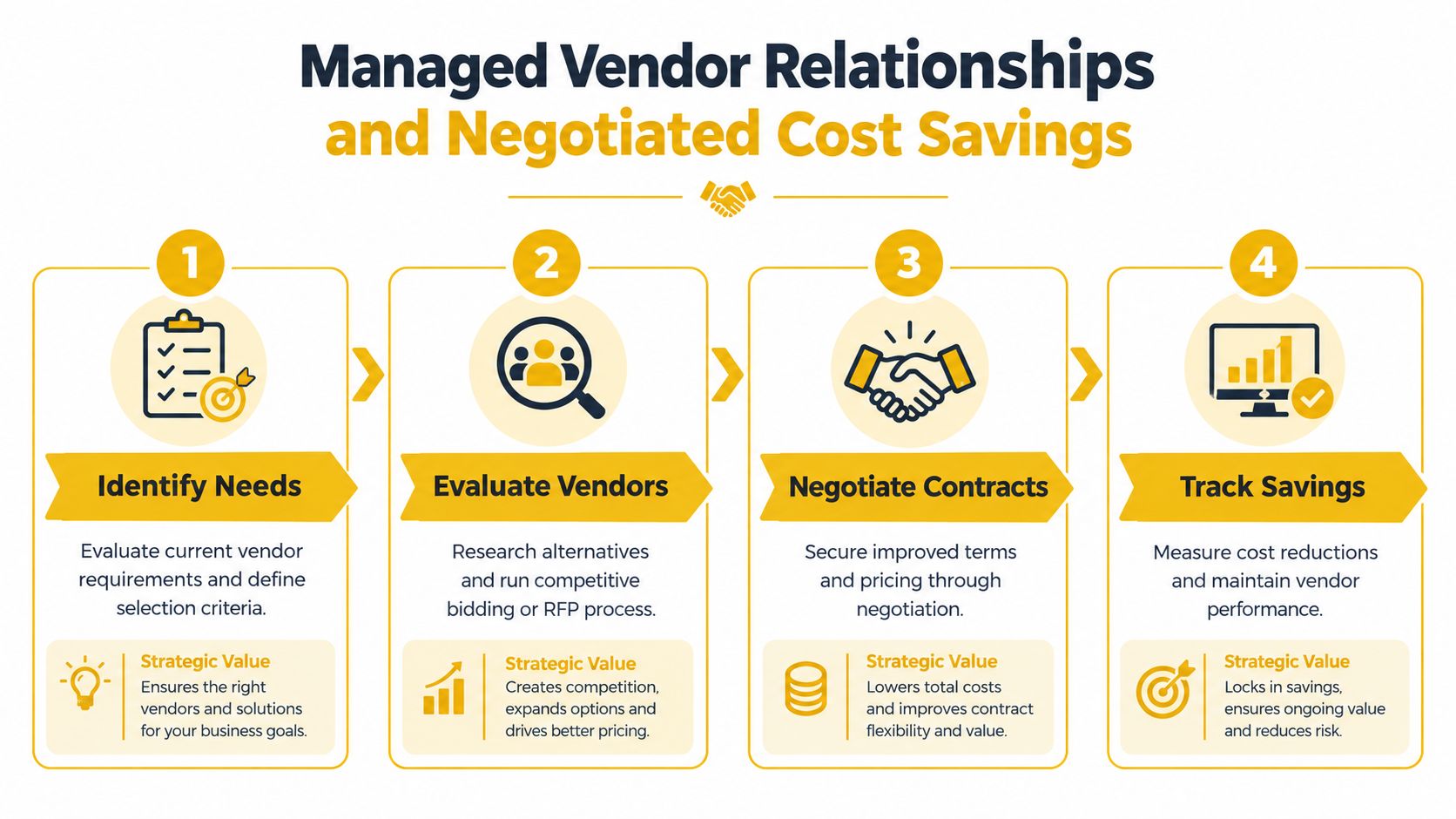
3. Managed Vendor Relationships and Negotiated Cost Savings of $X
Vendor management demonstrates more than communication. It shows that you can compare alternatives, protect service quality, document decisions, and negotiate within constraints. Use $X only when the saving is real, attributable to your work, and supported by contracts, invoices, renewal records, or an approved business case.
Lead with the commercial result in a resume bullet: “Managed renewals for [vendor category], evaluated competing offers against [service and risk criteria], and negotiated $X in verified annual savings without reducing required service levels.” If you can't disclose the exact amount, use a qualitative result or state the scope of responsibility without fabricating a figure.
Explain how you protected quality
A credible interview answer doesn't present cost reduction as the only objective. Describe the criteria you used, such as uptime commitments, response times, data handling, implementation effort, user adoption, or termination terms. If you ran a request for proposal, explain how you defined requirements, compared bids, involved stakeholders, and documented the recommendation.
For a finance or business analysis role, emphasize total cost, renewal timing, forecast implications, and approval controls. For product management, discuss user needs, vendor capability, and roadmap risk. For operations, show how you maintained continuity while changing terms or suppliers. For a technical role, include security, integrations, data portability, and support requirements.
The trade-off is speed versus negotiation depth. A quick renewal may reduce immediate disruption, while a competitive process can uncover better terms but requires more coordination. Explain why you chose your approach and what risk you accepted.
Don't claim savings from a price reduction if usage, scope, or service levels also changed. Separate the negotiated effect from unrelated budget changes. Interview Pilot can help you practice a concise commercial narrative that keeps the methodology and evidence clear.
An effective STAR response should cover the supplier problem, the evaluation process, the negotiation, and the verified business result. Your personal documents, not a template, must supply the amount.
4. Implemented Process Automation Saving Y Hours Per Week
Automation is persuasive when it removes a known bottleneck while preserving control. Administrative teams often manage repetitive data entry, reconciliations, status updates, report preparation, and notifications. Those tasks can reveal technical judgment because you had to understand the workflow before selecting a script, macro, integration, or no-code tool.
Start with the manual process. What triggered the work? Where did people retype information? Which errors appeared? What approval or audit step couldn't be removed? Then describe the intervention and the result.
A resume bullet can follow this pattern: “Automated [repetitive process] with [tool or technology], saving Y hours per week and adding [validation, approval, or exception handling] to maintain accuracy.” Replace Y with a measured figure based on time logs, observed cycles, or a defensible estimate. If the result was reduced rework rather than time, say that.
Choose the simplest reliable solution
An Excel macro may be appropriate for a controlled internal report. A Python script may suit a repeatable transformation with more complex logic. Zapier or another workflow platform may connect systems quickly, but it can introduce permission, monitoring, and subscription dependencies. The right answer isn't always the most technical one.
For a software engineering interview, be ready to explain inputs, transformations, error handling, testing, deployment, and maintenance. For a business role, translate the technical work into capacity released, fewer handoffs, or more consistent reporting. For operations, describe how exceptions were routed and who owned the process after launch.
Practical rule: Automate the repetition, not the judgment. Keep approvals, exceptions, and data-quality checks visible.
The trade-off is immediate efficiency versus long-term maintainability. A quick automation can save time today but fail when a column changes or an employee leaves. Explain the documentation, ownership, testing, and fallback process you created. Interview Pilot's mock sessions can help you deliver both a business-level answer and a technical follow-up without overstating your role.
5. Coordinated Multi-Stakeholder Project and Delivered On-Time, On-Budget
Administrative coordination often resembles project management before the job title changes. You may have maintained a plan, tracked dependencies, collected approvals, prepared status reports, coordinated vendors, and resolved blockers. The evidence matters most when you define your ownership instead of implying that you personally delivered every part of a team outcome.
Begin with scope. State the participating departments, external parties, deliverable, constraints, and your role. A strong resume bullet might say: “Coordinated [project] across [teams and vendors], maintained the delivery plan in Jira or Asana, tracked risks and approvals, and delivered [result] within the approved timeline and budget.”
Make the constraints visible
Interviewers learn more from the complication than from the word “successful.” Explain whether the project faced scope creep, limited resources, conflicting stakeholder priorities, incomplete requirements, or a supplier dependency. Then show the mechanism you used to respond, such as a decision log, weekly risk review, change request process, or escalation path.
For product management, highlight prioritization, requirements, and stakeholder alignment. For consulting, emphasize structured problem-solving and communication. For operations, focus on handoffs, service continuity, and implementation discipline. For technical roles, explain how you translated business needs into tickets, acceptance criteria, documentation, or release coordination.
Avoid claiming “on budget” if you only tracked invoices. Say that you monitored spend, prepared approvals, or reported variances unless you owned the budget and can prove the final position. Likewise, distinguish coordinating a launch from owning its revenue outcome.
Use the STAR method examples to prepare a response with a brief Situation, a specific Task, the Actions you personally took, and a measurable Result. Keep the first answer concise, then offer detail when the interviewer asks about tools, conflict, or risk.
6. Developed Training Materials and Onboarded New Team Members
Training materials turn tacit knowledge into a repeatable operating asset. An administrative professional who creates an onboarding guide, records a walkthrough, runs orientation sessions, or maintains role documentation demonstrates communication, judgment, and the ability to scale knowledge beyond one conversation.
Start with the learner's problem. New employees may not know which systems to access, where to find procedures, who approves requests, or how work moves between teams. Your contribution might have been a written guide, video series, checklist, live session, peer shadowing plan, or a combination.
Measure the learning outcome carefully
Useful evidence includes the number of people trained, time to complete required tasks, recurring questions, assessment results, completion rates, or feedback. Don't claim that training improved retention or satisfaction unless you measured it. A defensible bullet could read: “Created onboarding documentation and facilitated sessions for [audience], standardizing access, workflow, and escalation guidance and reducing repeated setup questions.”
For a senior technical role, frame the work as knowledge transfer and developer enablement. Explain how you documented environment setup, API integration, deployment conventions, or incident procedures. For leadership-track roles, emphasize coaching, feedback loops, and continuous improvement. For operations, show how the materials supported consistent execution across locations or shifts.
The trade-off is detail versus speed. A guide may answer more questions but overwhelm a new hire. A short path with links to deeper material is often easier to use. Test the material with someone unfamiliar with the process, observe where they hesitate, and revise the unclear steps.
Employee onboarding guidance from Supercenter can provide a comparison point for thinking about structured onboarding, but your interview answer must remain grounded in what you personally created and delivered.
Practice two versions with Interview Pilot. The behavioral version should focus on the learner's problem and outcome. The technical version should explain documentation design, tools, maintenance, and how you handled updates.
7. Improved Data Quality and Established Governance Processes
Data quality work is a strong bridge from administration to analysis, engineering, and data operations because it links careful execution to decision reliability. You may have found duplicate records, inconsistent fields, missing values, outdated ownership, or conflicting definitions while maintaining a CRM, spreadsheet, reporting system, or shared database.
Describe the discovery before the fix. Did a reconciliation fail? Did two reports disagree? Did users report inconsistent results? Did a validation rule expose a pattern? Then explain the control you introduced, such as SQL checks, Excel validation, duplicate rules, required fields, exception queues, documented definitions, or a review cadence.
A resume bullet might read: “Audited [dataset or workflow], identified [issue], and introduced [validation or governance control], improving [accuracy, completeness, consistency, or reporting reliability] based on [your measurement method].” Use exact record counts or percentages only when your evidence supports them.
Translate quality into business value
For a data analyst role, discuss how the correction affected reporting and analysis. For data engineering, explain the validation logic, pipeline location, monitoring, and failure handling. For business operations, focus on how reliable records improved follow-up, forecasting, compliance, or prioritization.
Don't confuse data cleaning with governance. Cleaning fixes existing records. Governance also defines ownership, standards, permitted values, change control, and ongoing monitoring. If you only performed the first task, describe it accurately. If you established the second, explain how people adopted and maintained it.
The trade-off is control versus usability. Too few rules allow inconsistent data. Too many rigid rules can block legitimate exceptions and encourage workarounds. A credible answer explains how you tested the rules, handled exceptions, and assigned responsibility for future quality.
For spreadsheet-heavy interviews, rehearse the scenario with Excel interview questions. Prepare to explain the same example in plain business language, then in enough technical detail to show that you understand the control rather than merely operated it.
8. Led Process Improvement Initiative Resulting in Measurable Efficiency Gains
Process improvement starts with observation, not a preferred tool. Map how work moved, identify the queue or rework, collect baseline evidence, and speak with the people who perform each step. Administrative professionals often see bottlenecks early because they coordinate the handoffs between requesters, approvers, vendors, and delivery teams.
A strong example can involve redesigning a support workflow, removing duplicate approvals, clarifying intake requirements, consolidating calendars, or standardizing a recurring report. Your resume bullet should name the process, the intervention, and the verified result: “Analyzed [workflow] using [method], removed [bottleneck or redundant step], and improved [cycle time, throughput, error rate, or user experience] by **[truthful measure].”
Show how people adopted the change
A process isn't improved when a document is published. It improves when people use the new path and the outcome holds. Explain how you gathered input, tested the change, trained users, communicated the reason, handled resistance, and monitored performance afterward.
For consulting, emphasize diagnosis and stakeholder interviews. For operations, focus on cycle time, capacity, service quality, and handoffs. For product management, connect the workflow to user needs and prioritization. For technical roles, discuss requirements, automation opportunities, data capture, and validation.
The main trade-off is standardization versus local flexibility. A single process can improve consistency, but teams may need controlled variations because their risks or customers differ. State which parts you standardized and which exceptions you allowed.
Use before-and-after comparisons for cycle time, error rates, or throughput when you have them. A benchmark study of administrative services identifies these process and service measures as practical ways to evidence impact in a case-study format through its administrative performance measurement overview. If you can't calculate a lift, report adoption, reduced rework, fewer escalations, or another observable result instead.
Interview Pilot's customization controls can help you rehearse different framings, but the substance must come from your process map, stakeholder evidence, and actual outcome.
8-Point Administrative Experience Comparison
| Example | Implementation Complexity 🔄 | Resource & Efficiency ⚡ | Expected Outcomes 📊 | Ideal Use Cases 💡 | Key Advantages ⭐ |
|---|---|---|---|---|---|
| Led Cross-Functional Scheduling and Calendar Management for 50+ Team Members | 🔄 Medium–High, multi-team coordination, time zones, tooling | ⚡ Medium, admin overhead up front; tools improve ongoing efficiency | 📊 Fewer conflicts; better time allocation (e.g., X% conflict reduction) | Operations; Product Management; Project Management; Hiring | ⭐ Shows scale handling, logistics, measurable scheduling impact |
| Streamlined Document Management and Created Searchable Knowledge Base | 🔄 Medium, migration, taxonomy, adoption work | ⚡ High long-term efficiency; Moderate initial effort | 📊 Faster retrieval (e.g., 45→5 min), higher access/adoption metrics | Documentation-heavy roles; Remote teams; Eng & PMs | ⭐ Improves access, reduces lookup time, supports scale |
| Managed Vendor Relationships and Negotiated Cost Savings of $X | 🔄 Medium, contract negotiation, stakeholder alignment | ⚡ High efficiency in spend; low ongoing overhead after contracts | 📊 Direct cost savings (dollars/%), improved vendor terms | Finance; Procurement; Product Mgmt; Consulting | ⭐ Clear financial impact; demonstrates negotiation & business acumen |
| Implemented Process Automation Saving Y Hours Per Week | 🔄 Medium, design, scripting/RPA, testing and rollout | ⚡ Very High, significant hours saved after deployment; initial dev cost | 📊 Time saved/week, error reduction, scalability across teams | Software Eng; Data; Operations; Repetitive manual workflows | ⭐ High ROI, technical problem-solving, scalable productivity gains |
| Coordinated Multi-Stakeholder Project and Delivered On-Time, On-Budget | 🔄 High, complex stakeholder management and scope control | ⚡ Variable, depends on project size and tools (Jira/Asana) | 📊 On-time/on-budget delivery, achieved project KPIs (e.g., revenue targets) | Product Management; Consulting; Program/Project Mgmt | ⭐ Demonstrates leadership, delivery reliability, cross-functional coordination |
| Developed Training Materials and Onboarded New Team Members | 🔄 Low–Medium, content creation and delivery iterations | ⚡ High efficiency for onboarding; Moderate upfront effort | 📊 Reduced ramp time, improved satisfaction/retention metrics | Senior Engineers; People Ops; Team Leads; Consulting | ⭐ Shows communication, mentorship, scalable onboarding impact |
| Improved Data Quality and Established Governance Processes | 🔄 High, pipeline fixes, validation rules, governance setup | ⚡ Medium, ongoing governance effort; large downstream efficiency gains | 📊 Accuracy improvement (e.g., 87→99%), error reduction, trusted analytics | Data Science; Data Engineering; BI; Analytics | ⭐ Increases data reliability, enables better business decisions |
| Led Process Improvement Initiative Resulting in Measurable Efficiency Gains | 🔄 Medium, analysis, redesign, change management | ⚡ Medium–High, requires analysis resources; yields notable efficiency gains | 📊 Time/cost/quality improvements (e.g., resolution time −35%) | Consulting; Operations; Product Management; Business Analysis | ⭐ Demonstrates analytical thinking and measurable operational impact |
Choose the Evidence That Matches the Role
Don't submit all eight examples to every employer. Select the evidence that mirrors the target role's decisions, tools, and success measures. A product manager may respond best to scheduling across competing priorities, cross-functional project coordination, and process improvement. A data role may value document structure, data governance, and automation. An operations role may need vendor management, workflow redesign, and reliable scheduling. A technical role may be most interested in automation, documentation, data quality, and the way you manage dependencies.
Administrative experience remains relevant because employers continue to treat prior experience and structured training as common signals for higher-responsibility administrative work. The Bureau of Labor Statistics overview reports that prior work experience was required for 55.6% of office and administrative support workers and 87.2% of executive secretaries and executive administrative assistants in 2025. The same source reports that on-the-job training was required for 90.3% of office and administrative support workers and 74.0% of executive secretaries and executive administrative assistants. That context makes a resume built around evidence more useful than one built around a task inventory.
Build a small evidence bank before you apply. For every relevant example, save:
- One resume bullet: Use an action, scope, method, and result. Keep the wording direct and tailor the tool names to the job description.
- One STAR version: Prepare a short Situation and Task, spend most of the answer on your Actions, and finish with the Result and what you learned.
- One technical explanation: Be ready to explain the system, workflow, data, tool choice, controls, and maintenance.
- One trade-off: State what you optimized and what you had to protect, such as speed versus accuracy or standardization versus flexibility.
- One proof point: Keep the report, tracker, approval record, audit trail, feedback, or before-and-after comparison that supports the result.
Replace every placeholder before the example reaches your resume. X, Y, and $X are scaffolding, not achievements. If you don't know the exact number, use a defensible qualitative description rather than guessing. Employers can probe inflated claims, while a precise explanation of your role often carries more weight than a dramatic figure you can't substantiate.
Your delivery should also change with the audience. A recruiter may need the operational result in plain language. A hiring manager may ask how you handled conflict, exceptions, or adoption. A technical interviewer may ask about automation logic, permissions, validation, integration, or failure recovery. Prepare the same experience at each level, but don't turn a simple workflow into a technical project it wasn't.
Interview Pilot's AI Mock Interview sessions can help you rehearse concise and technical versions, and its question bank can expose follow-up questions for administrative, operations, product, data, or engineering interviews. Use those sessions to improve clarity, pacing, and recall. Present only genuine responsibilities, truthful metrics, and outcomes you can explain from beginning to end.
Interview Pilot offers AI Mock Interview sessions, a searchable question bank, and live interview assistance for technical and non-technical roles. Use it to rehearse how your administrative experience maps to tools, trade-offs, and measurable results, then visit Interview Pilot to prepare your own evidence bank.
Topics
administrative experience example
resume examples
interview answers
administrative skills
resume bullet points
Continue reading
Career
Synonym for Conflict Resolution: Smart Alternatives
Find the best synonym for conflict resolution for resumes, interviews, and professional writing. Clear alternatives ranked by tone, context, and credibility.
September 2, 2026
13 min read

Career
8 Synonyms Work Ethic: Resume and Interview Examples
Explore 8 synonyms work ethic alternatives with resume wording, interview examples, strengths, trade-offs, and tips for choosing the right phrase.
September 21, 2026
19 min read

Career
Average Salary Crime Scene Investigator: Full Breakdown
See the real average salary crime scene investigator roles pay in 2026, with breakdowns by region, experience, employer type, and career progression paths.
September 14, 2026
17 min read