









Career
Synonym for Conflict Resolution: Smart Alternatives
Find the best synonym for conflict resolution for resumes, interviews, and professional writing. Clear alternatives ranked by tone, context, and credibility.
Interview Pilot Editorial Team
13 min read
Mediation is the most credible versatile synonym for conflict resolution, followed by de-escalation and dispute resolution. Choose among those three based on whether you guided a neutral process, lowered tension, or handled a formal dispute.
You're probably looking at a resume bullet, interview answer, or report that says “conflict resolution,” and the phrase feels accurate but flat. Hiring managers see the same wording repeatedly. The problem isn't that the term is wrong. The problem is that it often hides what you did.
The right alternative names the mechanism, the setting, and the outcome. Mediation signals a neutral third-party process. De-escalation shows that you reduced tension under pressure. Dispute resolution fits formal workplace, legal, procurement, and contractual contexts. This guide ranks those options and maps each one to the document and situation where it carries the most credibility.
Why the Right Synonym Changes How You Sound
A hiring manager skimming resumes may see “conflict resolution” on line after line and stop noticing it. The phrase describes a desirable capability, but by itself it doesn't reveal whether you mediated between colleagues, calmed an upset customer, negotiated with a supplier, or helped a project team reach agreement.
That distinction matters because conflict carries negative weight. On a resume, it can suggest a chaotic workplace if you use it without context. Terms such as mediation, de-escalation, and stakeholder alignment shift attention toward your method and judgment. They show the reader what you contributed rather than naming the existence of a problem.
Practical rule: Don't replace a phrase merely to sound original. Replace it to describe the work more precisely.
Use mediation when you served as a neutral third party between people who disagreed. Use de-escalation when emotions, complaints, or pressure were rising and your intervention restored a workable conversation. Use dispute resolution when the disagreement involved formal procedures, employee relations, contracts, procurement, or legal documentation.
The choice also depends on the audience. A resume rewards concise action language. An interview rewards a clear explanation of what you did. A formal report needs terminology that won't overstate your authority or confuse one process with another.
The promise is simple: every alternative below is tied to a specific context and judged for credibility. Vague buzzwords weaken your case. Precision makes the same experience sound more mature, controlled, and trustworthy.
Five Families of Conflict Resolution Synonyms
A flat alphabetical list encourages careless substitution. Group the language by intent instead. The five families below help you choose a term based on the outcome you delivered.
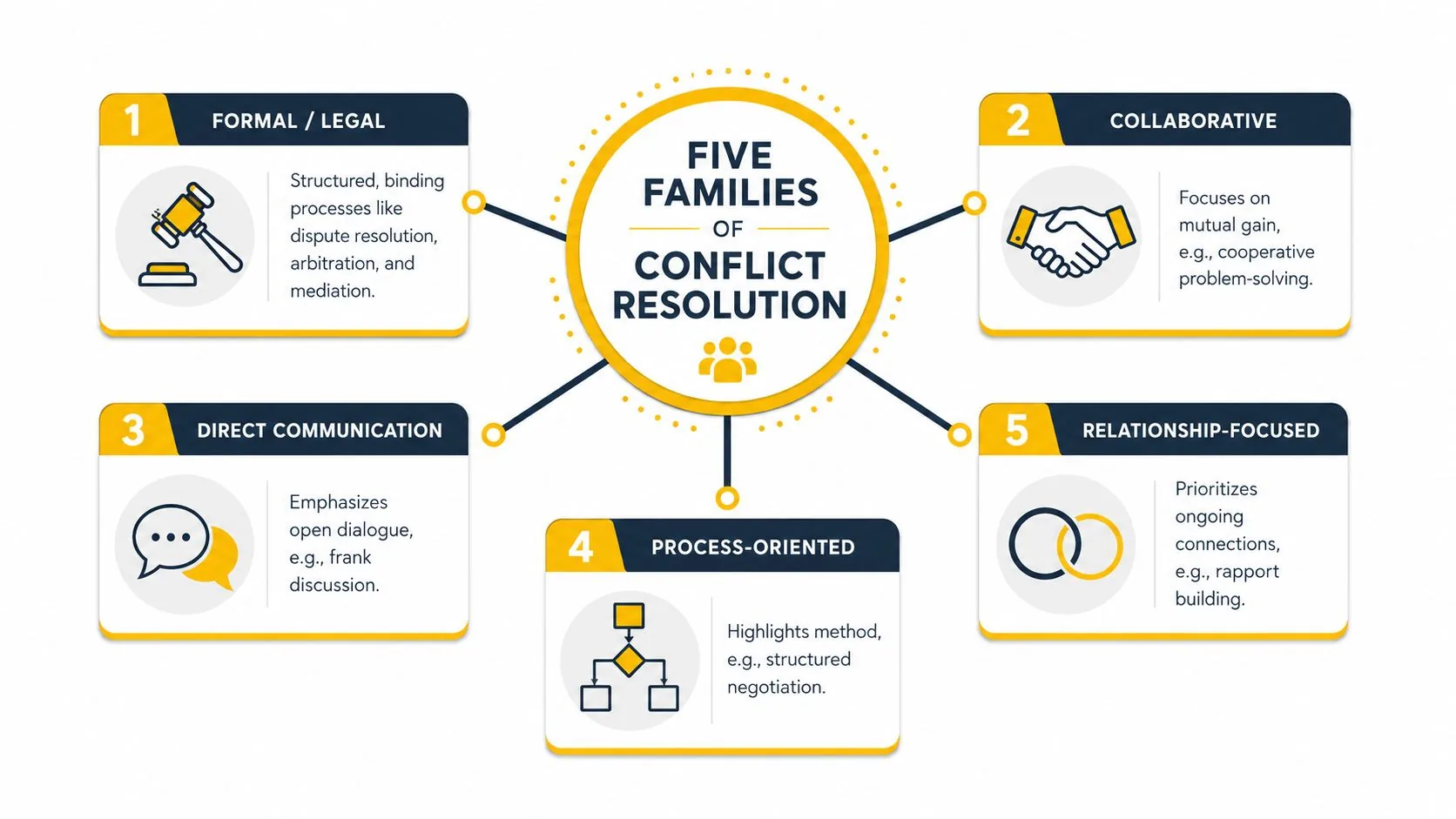
Formal and legal language
Dispute resolution, mediation, arbitration, and settlement belong in contracts, HR documentation, compliance materials, and legal-facing writing. “Mediation” implies a neutral third party. “Arbitration” implies a formal process in which an arbitrator may decide the dispute, so don't use it unless that actually happened. For terminology research beyond this article, find the best synonyms for clarity by comparing meaning rather than swapping words mechanically.
Process and managerial language
De-escalation, issue resolution, problem-solving, and troubleshooting work best in resumes, performance reviews, and customer-support descriptions. This family is especially useful when your role involved calming a situation, identifying the cause, and moving the work forward.
Relational and interpersonal language
Peacemaking, relationship management, bridge-building, and reconciliation emphasize trust and ongoing relationships. They can suit community, coaching, employee-experience, and team-culture roles. They're less persuasive in a technical resume unless you connect them to a specific action.
Strategic and organizational language
Stakeholder alignment, consensus-building, negotiation, and diplomacy position conflict work as leadership. These terms land hardest in executive resumes and interviews, but they require evidence. “Stakeholder alignment” means little if you can't name the competing interests you aligned.
Collaborative and facilitative language
Facilitation, collaborative problem-solving, dialogue facilitation, and consensus-building fit HR business partners, agile leaders, coaches, and cross-functional managers. This is the most overused family when candidates claim “collaboration” without explaining how they structured the discussion.
Pick the family that matches your actual contribution. The impressive-sounding term is worthless if it describes work you didn't perform.
Top Synonyms Ranked by Credibility and Tone
Credibility comes from accuracy, not formality. Each term below can work, but only in the situation it describes.
| Synonym | Definition | Best Context | Example Sentence | Credibility Verdict |
|---|---|---|---|---|
| Mediation | A neutral third party guides people toward their own agreement. | HR, management, employee relations | “Mediated a disagreement between product and engineering leads by clarifying shared delivery priorities.” | Use freely when you were neutral. |
| De-escalation | Reducing tension so people can communicate and act productively. | Customer support, operations, service roles | “Used de-escalation techniques to calm frustrated customers and identify workable next steps.” | Use freely when pressure was central. |
| Dispute resolution | A formal or structured process for addressing a disagreement. | Legal, procurement, contracts, HR | “Managed supplier dispute resolution by documenting issues, coordinating stakeholders, and tracking agreed actions.” | Use freely in formal settings. |
| Negotiation | Direct discussion aimed at reaching agreement on terms or interests. | Procurement, sales, partnerships, leadership | “Led vendor negotiations to align scope, delivery expectations, and commercial terms.” | Use with evidence. |
| Facilitation | Structuring a conversation or meeting so participants can work productively. | Agile, workshops, cross-functional teams | “Facilitated planning sessions that helped design and engineering agree on release priorities.” | Use freely when you ran the process. |
| Conflict management | Containing or reducing the effects of disagreement over time. | Management, team leadership, ongoing employee relations | “Applied conflict-management practices to maintain communication during a prolonged team disagreement.” | Use with evidence. It can imply containment rather than resolution. |
Credibility order: mediation, de-escalation, dispute resolution, facilitation, negotiation, conflict management.
Negotiation ranks lower only because candidates often claim it without showing what they negotiated. Conflict management is valid, but it's weaker when the reader expects a completed resolution.
Resume Bullet Rewrites That Use Each Synonym
“Responsible for conflict resolution between team members” fails because it uses a passive duty phrase, gives no scope, and shows no outcome. The stronger pattern is specific verb + precise synonym + scope + outcome.
Don't invent a metric to make a bullet look stronger. If your work produced a measurable result, include it. If it didn't, describe the concrete outcome without fabricating a percentage, dollar amount, or time reduction.
| Role | Original Bullet | Rewritten Bullet | Synonym Used |
|---|---|---|---|
| Customer support specialist | “Handled conflict resolution with customers.” | “Applied de-escalation techniques to acknowledge customer concerns, clarify the underlying issue, and agree on practical next steps.” | De-escalation |
| Project manager | “Responsible for conflict resolution between project stakeholders.” | “Led stakeholder negotiations between product, engineering, and operations to align scope, ownership, and delivery priorities.” | Negotiation |
| HR specialist | “Managed employee conflicts.” | “Coordinated mediation conversations for employee-relations matters, documenting concerns and agreed follow-up actions.” | Mediation |
| Team lead | “Used conflict resolution to help team members work together.” | “Built consensus among team members with competing approaches by clarifying decision criteria and recording the final direction.” | Consensus-building |
| Engineer | “Resolved conflicts between technical teams.” | “Supported dispute resolution between platform and application teams by isolating the technical disagreement and documenting options for review.” | Dispute resolution |
The HR example should only say “mediation” if you acted as a neutral intermediary. If you managed the case, documented facts, or coordinated escalation, use employee-relations case management or issue resolution instead.
For more help turning duties into evidence-based bullets, use this resume bullet examples guide. Then audit every line for three questions: What action did you take? Who was involved? What changed afterward?
Interview Answers That Sound Confident and Specific
Interviewers don't remember “I'm good at conflict resolution.” They remember the mechanism. Your answer should show how you listened, identified the competing needs, acted, and moved the work forward.
A behavioral answer can sound like this:
Situation: “Two teams disagreed about whether a customer request should be added to an active release.”
Task: “I needed to protect the release plan while making sure the customer-facing concern wasn't dismissed.”
Action: “I used stakeholder negotiation to separate urgent requirements from preferences, then documented the trade-offs and asked both leads to agree on the decision criteria.”
Result: “The teams agreed on the immediate scope and recorded the remaining request for a later planning discussion.”
The phrase stakeholder negotiation belongs in the Action segment because it names the mechanism. Don't call this mediation unless you were a neutral third party. If you owned the release decision, say you led the negotiation.
For a situational question, use de-escalation:
“I'd start by lowering the temperature rather than defending the policy immediately. I'd listen without interrupting, restate the concern to confirm I understood it, explain what I could and couldn't change, and offer a practical next step. If the issue involved another team, I'd document the facts and coordinate an issue-resolution conversation with the right owner.”
Keep your delivery calm and concrete. Avoid stacking synonyms to sound more refined. One accurate term, followed by observable behavior, is more convincing than a string of labels.
For a useful preparation framework, review how to answer “How Do You Handle Conflict?” in an interview. The strongest answer usually explains the shared goal, the facts you used, and the solution you helped create.
Buzzwords to Drop and Stronger Replacements
Weak language hides the work. “Team player who handles issues” doesn't identify the issue, your action, or the result. “People person” is a personality claim, not evidence. “Problem solver” is too broad to distinguish conflict work from routine troubleshooting.
Replace the label with the process you used:
| Weak phrase | Why it fails | Stronger replacement |
|---|---|---|
| “Team player who handles issues” | No action, scope, or outcome. | “Facilitated cross-functional discussions to clarify ownership and agree on next steps.” |
| “People person” | Unverifiable and unrelated to a specific contribution. | “Used de-escalation and active listening to address customer concerns.” |
| “Problem solver” | Could describe almost any job function. | “Led issue resolution by identifying the root cause, assigning owners, and tracking follow-up.” |
| “Conflict navigator” | Sounds invented and vague. | “Coordinated mediation between colleagues with competing priorities.” |
| “Excellent at conflict resolution” | A self-rating without proof. | “Negotiated competing stakeholder requirements and documented the agreed decision.” |
The phrase conflict resolution itself isn't banned. Keep it when the job description uses that exact skill and your evidence supports it. Just don't use it as a substitute for describing what happened.
Run this audit before submitting your resume:
- Action: Does the bullet begin with a verb such as mediated, facilitated, negotiated, or de-escalated?
- Context: Can the reader tell who disagreed and why?
- Accuracy: Does the chosen synonym describe your actual role?
- Evidence: Have you included a concrete outcome without inventing data?
- Repetition: Does another bullet already make the same claim?
Matching the Synonym to Workplace, Legal, and HR Contexts
The same event can require different language depending on who will read it. A manager's performance review should sound practical. An HR record should sound precise and procedurally careful. Legal correspondence should avoid casual wording.
| Synonym | Workplace | HR Context | Legal Context |
|---|---|---|---|
| Mediation | “Mediated a disagreement between team members over project ownership.” | “Supported mediation discussions and recorded agreed follow-up actions.” | “Participated in mediation concerning the parties' disputed obligations.” |
| Dispute resolution | “Managed dispute resolution between departments to restore project coordination.” | “Applied informal dispute-resolution procedures before escalation.” | “Advised on dispute-resolution options under the relevant agreement.” |
| De-escalation | “Used de-escalation during a tense team discussion.” | “Used de-escalation to maintain a constructive employee-relations conversation.” | Usually avoid unless describing conduct, not the legal process. |
| Grievance resolution | Usually too formal for a routine peer disagreement. | “Coordinated grievance resolution in line with internal policy.” | Use only when the matter is formally a grievance. |
| Negotiation | “Negotiated a workable allocation of shared project resources.” | “Negotiated practical adjustments while documenting employee concerns.” | “Led negotiations toward settlement terms.” |
| Arbitration | Avoid unless a formal arbitrator decided the matter. | Use only for a genuine arbitration process. | Appropriate when the dispute used arbitration. |
In ordinary workplace writing, de-escalation, mediation, and dispute resolution are usually the strongest choices. In HR writing, informal conflict resolution may be accurate when no formal process occurred. In legal writing, dispute resolution, settlement, and negotiation carry the right register.
Avoid calling a manager's conversation “arbitration.” That word implies a formal process and can overstate your authority. For interview practice involving peer disagreements, use this guide on answering “Tell me about a time you had a conflict with a coworker”.
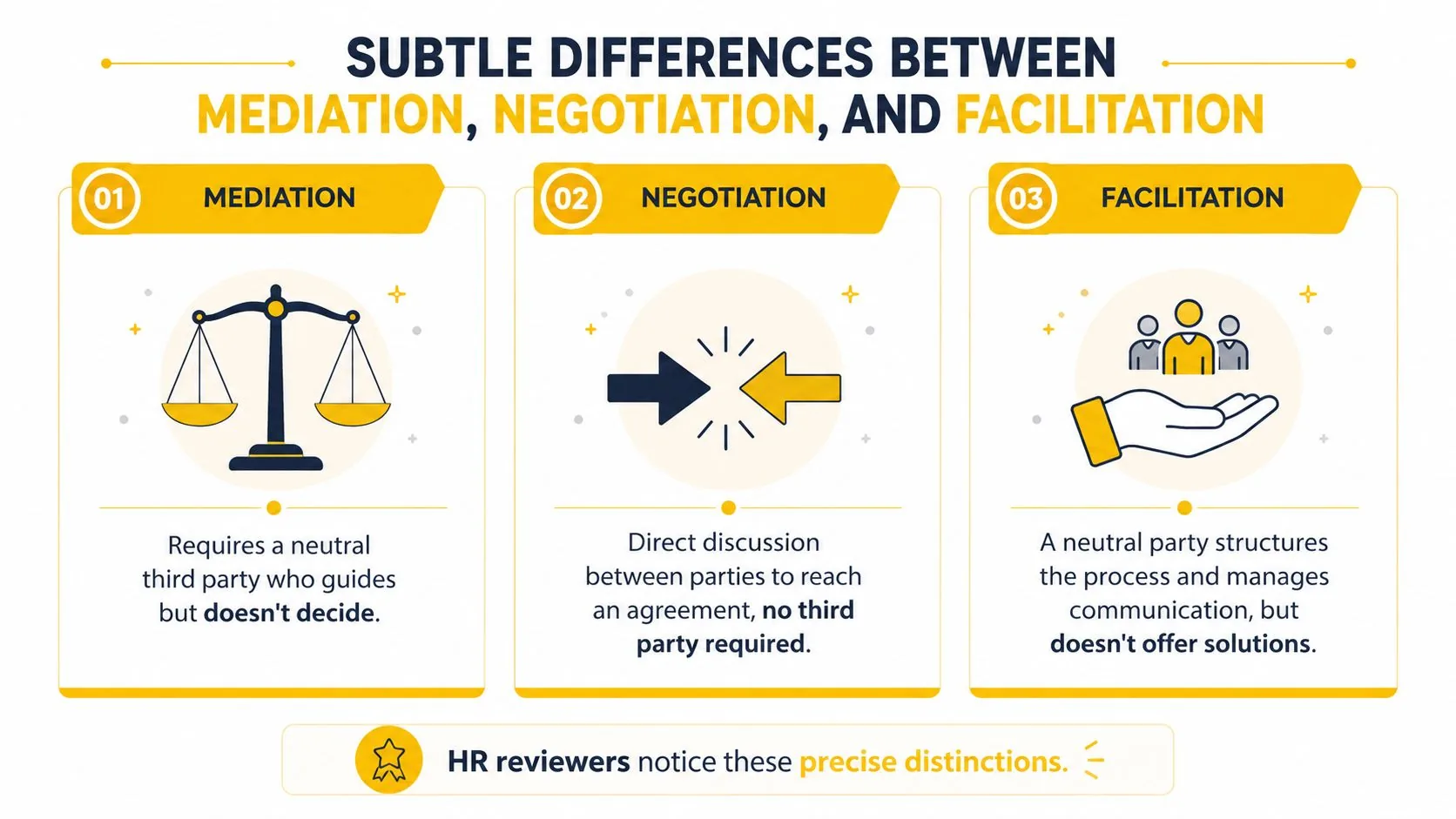
Subtle Differences Between Mediation, Negotiation, and Facilitation
These three terms are related, but they aren't interchangeable. Controlled-vocabulary practice treats equivalent terms as retrieval variants while still preserving one controlled concept, and terminology guidance recommends explicit equivalence relationships and consistent term forms. That logic applies to resumes too. Use the term that matches the actual process, not the term that sounds most senior.
| Process | Who participates | Who initiates or guides | Typical outcome | Resume signal |
|---|---|---|---|---|
| Mediation | Disputing parties plus a neutral third party. | The mediator structures the discussion but doesn't decide for the parties. | A voluntary agreement or documented understanding. | Neutral judgment and structured employee-relations skill. |
| Negotiation | The parties with competing interests or terms. | One or both parties lead direct discussion. | An agreement on terms, priorities, or trade-offs. | Commercial judgment and influence. |
| Facilitation | A group working through an issue or decision. | A facilitator manages the process and communication. | A productive discussion, decision, or shared plan. | Process leadership without claiming ownership of the solution. |
Consider a team disagreement about a delivery priority. If you guided two people toward their own agreement as a neutral intermediary, that was mediation. If you represented one team and bargained directly with another, that was negotiation. If you ran a structured meeting so the group could examine options and decide, that was facilitation.
The distinction is subtle, but HR reviewers notice it. Use facilitation when you managed the conversation. Use mediation when neutrality was central. Use negotiation when you exchanged positions, interests, or terms directly.
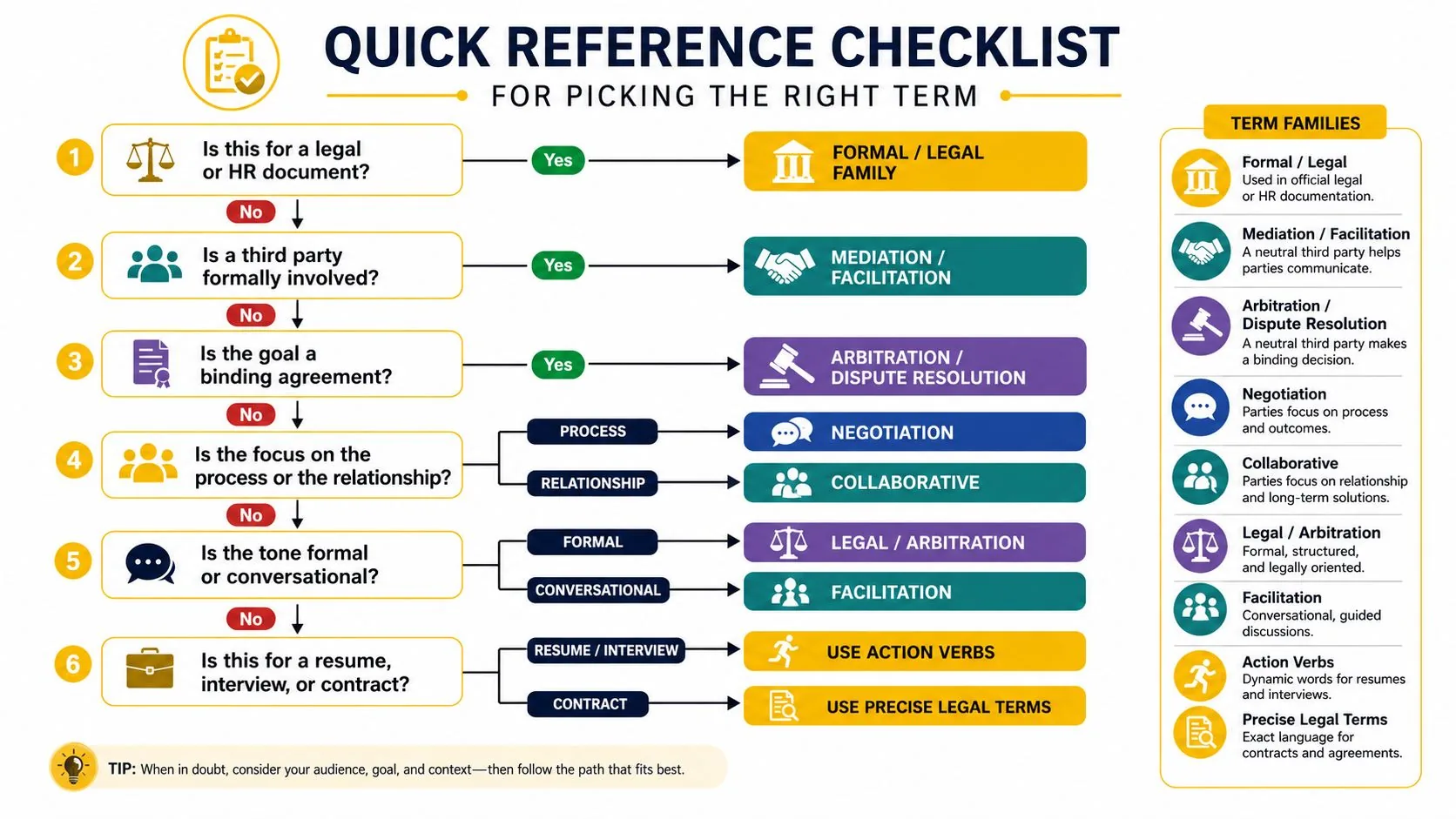
Quick Reference Checklist for Picking the Right Term
Use this six-question filter before choosing a synonym for conflict resolution:
- What are you writing? A resume needs an action verb. A report needs procedural precision. An interview answer needs a mechanism and an outcome.
- Who will read it? A recruiter, HR reviewer, hiring manager, lawyer, and colleague won't interpret formality in the same way.
- Was a third party involved? If you were neutral, consider mediation. If you structured a group process, consider facilitation.
- What outcome did you produce? Use negotiation for agreed terms, de-escalation for reduced tension, and dispute resolution for a structured dispute process.
- What tone fits? Choose formal language for contracts and HR records. Choose plain process language for resumes and spoken answers.
- Can you prove the term? If you can't explain exactly what you did, choose a simpler and more accurate phrase.
A quick example: you calmed an upset customer, identified the misunderstanding, and arranged a practical solution. “De-escalation” survives the filter. “Mediation” doesn't, because there wasn't a neutral third party. “Arbitration” is completely wrong because no formal decision process occurred.
When you're uncertain, use issue resolution for practical workplace work or dispute resolution for formal settings. The safest default is the term that makes your action easiest to explain.
Related Skill Language and Cross-References
The strongest skill combinations are specific: mediation and dispute resolution, de-escalation and active listening, negotiation and stakeholder management, or facilitation and consensus-building. Avoid combinations such as “synergy-driven conflict resolution,” which sound polished but don't tell the reader what you did.
| Related Skill Term | Best Conflict Resolution Pairing | Best Context |
|---|---|---|
| Negotiation | Stakeholder alignment | Leadership and procurement |
| Mediation | Employee relations | HR and management |
| De-escalation | Active listening | Customer support and operations |
| Arbitration | Dispute resolution | Legal and contractual work |
| Consensus-building | Facilitation | Cross-functional teams |
| Emotional intelligence | Relationship management | People leadership |
| Decision-making under pressure | Issue resolution | Operations and service roles |
For broader resume wording, consult StoryCV's skills section guide. It's useful when you need to connect a precise conflict-related term to the rest of your professional profile instead of placing disconnected skills in a keyword list.
Interview Pilot offers guided mock interviews, a searchable bank of role-specific questions, and real-time suggested answers for technical and behavioral interviews. Use it to rehearse a conflict example until your synonym, actions, and outcome sound natural, then visit Interview Pilot to practice with a framework adapted to your target role.
Topics
career
article
conflict resolution
synonym for conflict resolution
resume synonyms
interview answers
Continue reading

Career
33 Best Resume Bullet Examples for Job Seekers
Use these resume bullet examples to turn weak job descriptions into strong, quantified achievements for any role.
July 10, 2026
11 min read

Career
Best Job Search Engines in 2026: Where to Find Legit Job Postings
A practical guide to the best job search engines in 2026, including general boards, niche sites, and company career pages for legit openings.
July 8, 2026
8 min read

Career
8 Administrative Experience Example Templates
Use these administrative experience example templates for resumes and interviews, with metrics, bullet points, analysis, and practical tips.
September 28, 2026
20 min read