
















Career
When to Apply for Jobs: Timing by Industry and Career Stage
Learn when to apply for jobs by industry, career stage and hiring season, with clear timelines for graduates, seasonal roles and experienced hires.
Interview Pilot Editorial Team
Updated November 9, 2026
17 min read
In 2025, 78% of surveyed U.S. college graduates said they had already started their job search, according to ZipRecruiter's survey of nearly 3,000 rising and recent graduates. That number reframes when to apply. Most candidates don't wait for one perfect month, and you shouldn't either. Postings, applications and hiring run on three separate calendars, so your best window depends on the calendar you need to meet.
When to Apply at a Glance by Industry and Career Stage
Start here if you need a window today. Find your row, then check the closing date on any live posting, because that date always overrides a general window.
| Context | Apply window | Why this window | On schedule if |
|---|---|---|---|
| Finance and investment banking, summer internships | Late summer to fall before the internship | Analyst and intern classes are filled ahead of the season | Applications are submitted before the fall recruiting peak |
| Consulting, next year's class | Early fall through winter | Recruiting runs ahead of start dates | First-round interviews are booked by winter |
| New graduate roles, final year | Six to eight months before graduation | Recent graduates began searching about 6.4 months before graduation | Applications are going out every week from the start of the final year |
| Seasonal retail, logistics and hospitality | August to October | September and October hold nearly half of seasonal postings | Offers are in hand before the season starts |
| Software engineering, data and product roles | Continuous, with focus in spring and early summer | Postings peak in spring and early summer | Applications are sent every week while relevant postings are open |
| Public sector and government | Within the posted window | Fixed closing dates, usually open for two to four weeks | Applications are submitted a few days before the posted close date |
| Experienced hires changing careers | Continuous, planned for a search of several months | Searches for changers often run longer than planned | A weekly application count is tracked from the first week |
How to Read Your Row
Finance and consulting hire classes, not one person at a time, so recruiters fill next summer's or next year's seats months ahead. Missing that cycle usually means waiting for the next one, even if you're qualified.
Software, data and product roles work differently. Employers post all year, so you're matching a live need rather than a class start date, and a steady weekly pace beats a single burst.
Public sector postings are the strictest case. A fixed closing date isn't a suggestion, and late applications typically aren't reviewed at all, however strong they are.
Career changers rarely face one deadline. Your constraint is stamina and evidence, since you need time to translate past work into the language of the new field.
Practical rule: Match your context, check the posting's closing date, then move to the section that covers your case.
Treat every window in the table as a starting point for planning, not a promise that a specific employer will follow it.
Why Hiring Follows a Yearly Cycle
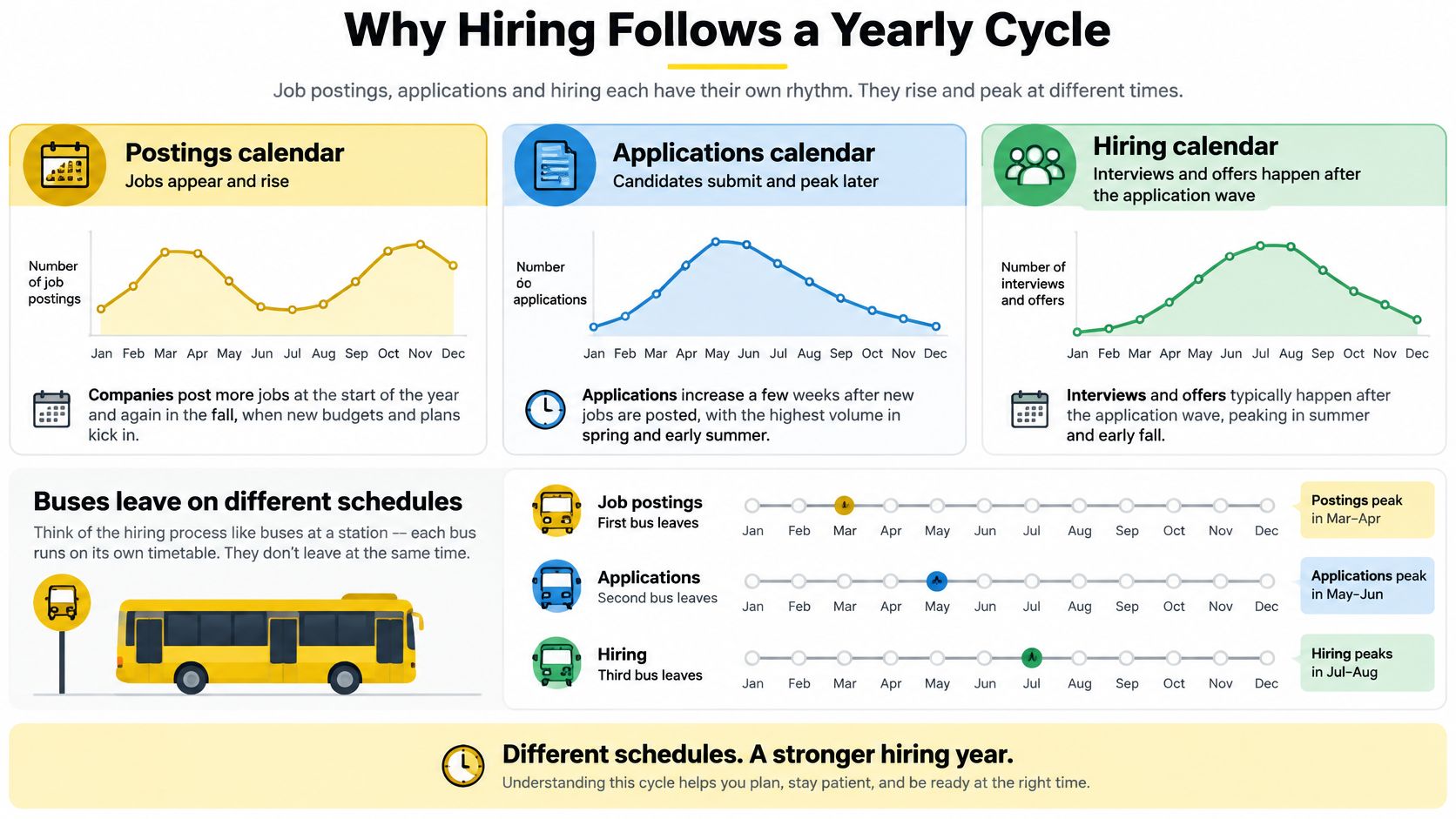
Think of hiring as a bus timetable. Buses leave on a fixed schedule, passengers arrive at different hours, and what matters is the gap between when you show up and when the next bus departs.
Three calendars create that gap. The postings calendar is when employers list jobs. The applications calendar is when candidates send applications. The hiring calendar is when employers finish interviews and make offers. They don't peak together.
What the Pattern Looks Like
A 2025 LinkedIn Economic Graph analysis reported in Fortune's coverage of the September hiring surge found that job postings generally peak in spring and early summer, often around May, while job applications typically peak earlier, from January through May. The same analysis reported that hiring and job transitions usually peak between July and September, decline sharply in December, and rise again in January.
That sequence explains advice that otherwise sounds contradictory. Applying in January puts you in a pipeline before employers complete more hiring later. Applying in late spring and summer targets a period when job availability and hiring activity are both relatively strong. Both moves can be right, because they meet different calendars.
Why Every Window Feels Contested
The same analysis found that hiring remained more than 20% below its pre-pandemic level and that the number of jobs available per applicant was 6% lower than a year earlier. Fewer hires and fewer jobs per applicant mean timing helps, but it doesn't remove competition.
Use the rhythm this way. Prepare during slower months so your résumé and examples are ready. Apply actively from January through May, keep monitoring roles through July to September, and treat December as slow rather than closed. Some employers still post then, and a prepared candidate faces fewer rivals for attention.
A pattern is not a guarantee for one employer. It's a reason to be ready before a peak, not a reason to stop applying after it.
Graduate Recruiting Timeline by Months Before Graduation
If you want a job that starts at graduation, graduation is the deadline you count back from, not the day you start. The U.S. Class of 2025 began its job search an average of 6.4 months before graduation, compared with 6.0 months for the Class of 2024, according to the National Association of Colleges and Employers' 2025 Student Survey. Students are starting earlier because each stage adds delay.
| Months before graduation | Main action | Milestone | Check before moving on |
|---|---|---|---|
| 9 to 12 months | Choose target roles and map your résumé to them | Target list drafted | Two or three role families are chosen |
| 6 to 8 months | Begin applying to graduate and entry-level postings | First applications sent | Applications are going out every week |
| 3 to 5 months | Keep applying and rehearse interview answers | Interview pipeline active | Mock interviews are scheduled |
| 0 to 2 months | Apply to late-posting roles and track open processes | Offers and decisions logged | Each decision date is recorded |
| After graduation | Continue through rolling postings, using alumni and the career center | Search continues | Weekly application count is kept |
Why Each Phase Comes in This Order
At 9 to 12 months out, you're choosing, not applying. Pick two or three role families, read real postings for each, and note the skills they repeat. If you're still surveying the options, our guide on how to find entry-level jobs helps you build that first target list.
At 6 to 8 months out, applications start going out weekly. This feels early because start dates feel far away, but recruiters screen, interview and decide in sequence, and each step takes weeks. A late start compresses every step after it.
From 3 to 5 months out, two tracks run at once. You keep applying to new postings while rehearsing for interviews from earlier ones. Students often pause applications when the first interview arrives, then have nothing moving if it ends without an offer.
Constraints Students Forget
- Campus recruiting calendars: Career fairs and employer deadlines cluster early in the academic year, so a résumé finished in spring misses them.
- Internship timing: A final internship can supply your best project examples, so draft application material before it ends, while the work is fresh.
- Coursework peaks: Exams will collide with interviews, so front-load applications before your heaviest term.
In the final two months, chase late-posting roles and log every decision date. After graduation, rolling postings, alumni networks and your career center keep the search moving.
The rule of thumb is simple. Start applying before your final semester if the goal is a role that starts at graduation.
Seasonal Roles and the Late-Summer Window
Two months carry nearly half of the year's seasonal hiring. An analysis of postings from August through December in 2024 and 2025, reported by SHRM's seasonal hiring coverage, found that September and October together held 46.9% of seasonal posting activity in 2024 and 48.2% in 2025.
| Measure | Figure | What it means |
|---|---|---|
| Share of seasonal postings in September and October | 46.9% in 2024, 48.2% in 2025 | Nearly half of activity falls in two months |
| Change in seasonal posting activity, August to September 2025 | Up 44% | Openings expand quickly once employers staff up |
| Change in posting activity, October to November 2025 | Down about 24% | Waiting until November leaves far fewer openings |
The shape is a steep climb, a short peak, then a drop. Seasonal posting activity in that data rose 44% from August to September 2025, then fell about 24% from October to November. Retail, logistics, hospitality and customer support employers staff up before holiday and year-end demand, so the jobs appear well before the busy season itself.
The seasonal calendar is its own clock, and it runs ahead of the two calendars that govern most hiring. A graduate scheme moves on a recruiter's schedule set months in advance. A warehouse or a hotel moves on a staffing schedule set weeks in advance. If you need work by December, the clock you have to meet is the staffing one, and it starts in late summer.
A Schedule That Matches the Shape
- In July, prepare: Write short role-specific answers, build a simple seasonal résumé and fix your availability dates.
- In August, start searching: Set job alerts for your target employers so new postings reach you the day they appear.
- In September and October, submit most applications: Apply as soon as postings appear, while volume is highest.
- From November, check for late postings only: Expect fewer openings and faster closing dates.
Don't assume the largest number of seasonal jobs will still be open right before the season starts. By then, employers are training people they hired weeks earlier.
The two-month concentration and the August-to-September climb show up in both seasons, which makes that part of the pattern sturdier. The drop after October comes from one season, 2025. Treat the whole schedule as a pattern from past years rather than a fixed date for any one employer, and let alerts do the work memory cannot.
How Fast to Send Each Application
You've probably heard that you must apply within 24 to 96 hours or lose your chance. That rule is incomplete. Timing advantages appear to be correlations rather than proof that submitting earlier causes more interviews, and the strength of the effect varies by study, a distinction Job200's review of application timing research lays out. Early applicants may be better prepared applicants.
So the key question isn't how fast you can click submit. It's whether extra time would make your application materially stronger.
A Decision Rule You Can Actually Use
- Apply within a day when your résumé is already targeted and you meet the core requirements. Nothing will improve by waiting.
- Take extra days when tailoring changes your evidence of fit, such as adding a project, case or portfolio example for a technical, finance or consulting role.
- Never submit a rushed application just to beat an arbitrary clock. A generic résumé sent fast is still a generic résumé.
Fast and generic is rational for high-volume roles where your qualifications match the posting almost word for word. Slightly later and customized is rational when the posting asks for specific evidence you can supply, but haven't written down yet.
Say a data role asks for dashboard work you've done but never described. Two days spent adding the project, its tools and one measurable result gives a screener something to select. Submitting the old résumé in hour one gives them nothing new to notice.
Why Fit Now Beats Volume
In 2025, the median Class of 2025 graduate had submitted 10 job applications before graduation, compared with 6 for the Class of 2024, according to the National Association of Colleges and Employers' 2025 Student Survey as reported in this graduate applications analysis. When everyone sends more, volume alone stops setting anyone apart.
That also means pacing matters, so it helps to think through how many jobs you should apply to per day rather than treating every posting as an emergency.
Track it yourself: Record outcomes by application age, role type, referral status and tailoring effort. Your own results should replace a universal cutoff.
After a month, you'll know whether speed or tailoring is earning your interviews, which is more useful than any general rule.
Prepare and Practice on the Interview Timeline
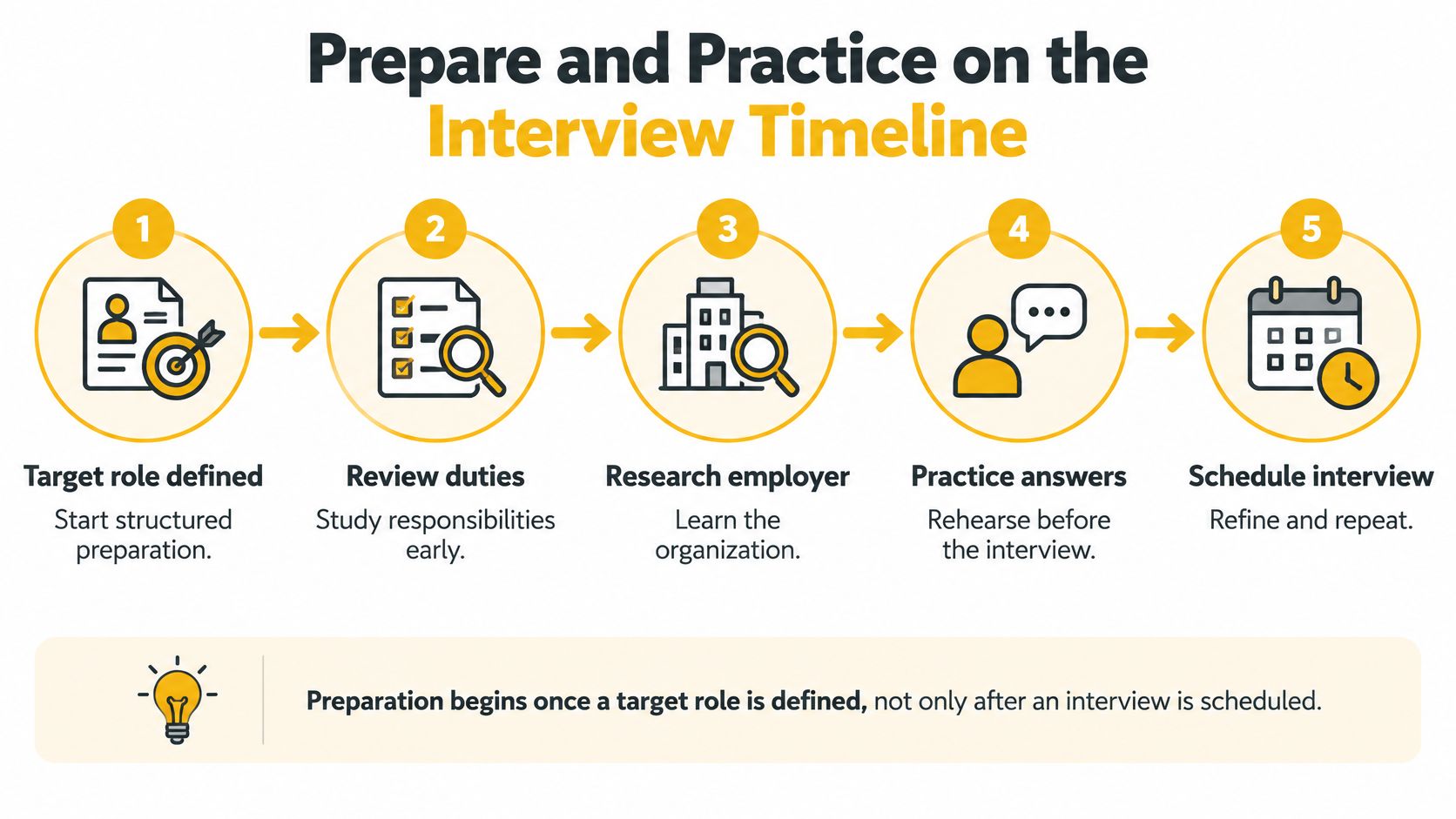
Preparation runs on its own calendar. Postings appear on one schedule, applications go out on another, and interviews arrive when employers choose. Start structured preparation as soon as you have a defined target role, not only after an invitation lands.
The U.S. Department of Labor's interview tips recommend reviewing the position's duties, requirements and evaluation methods, then practicing questions tied to the competencies in the announcement. That advice fits how structured interviews work. Candidates are compared against consistent question categories and standardized criteria, so memorizing a generic script misses what you're scored on. It works like studying for a test whose sections are published in advance.
The flow below shows preparation beginning at target selection, long before an invitation arrives.
The Sequence, Step by Step
- Map the posting to competency blocks. For technical roles, use blocks such as algorithms, system design, debugging, domain knowledge and behavioral evidence. Your résumé should supply one example per block.
- Run a diagnostic mock interview. Record recurring gaps and prioritize the lowest-performing competency first, rather than rehearsing what you already do well.
- After an invitation, budget focused time. Indeed's guide to interview preparation time reports approximately five to ten focused hours for a typical interview as an average preparation estimate, spread across employer research, résumé-to-role mapping, spoken answers and rehearsal.
- Several days before, run full mock sessions. Answer aloud under time limits so knowledge gaps and communication gaps both surface while you can still fix them.
- In the final 24 to 48 hours, switch to targeted drills. Shorten the sessions, then verify the meeting link, equipment, documents and environment.
- Sign in a few minutes early. That buffer absorbs most login and audio problems before the interview begins.
This short video walkthrough shows how a structured practice session is set up before you run your own.
How to Judge Your Own Practice
Review recordings for four faults: excessive pauses, unclear structure, unsupported claims and results you didn't quantify. Fix one fault per session instead of trying to polish everything at once. A single repair gives you something to measure next time.
Avoid memorized scripts. They break when a question arrives phrased unexpectedly, while adaptive practice keeps you responsive. For multilingual or high-stakes interviews, add role-specific terminology and listening checks for unfamiliar accents.
Before a first interview, our help center suggests a 5-minute checklist. Use it as your final pass: link tested, documents open, résumé nearby, room quiet, water within reach.
Build Your Application Calendar
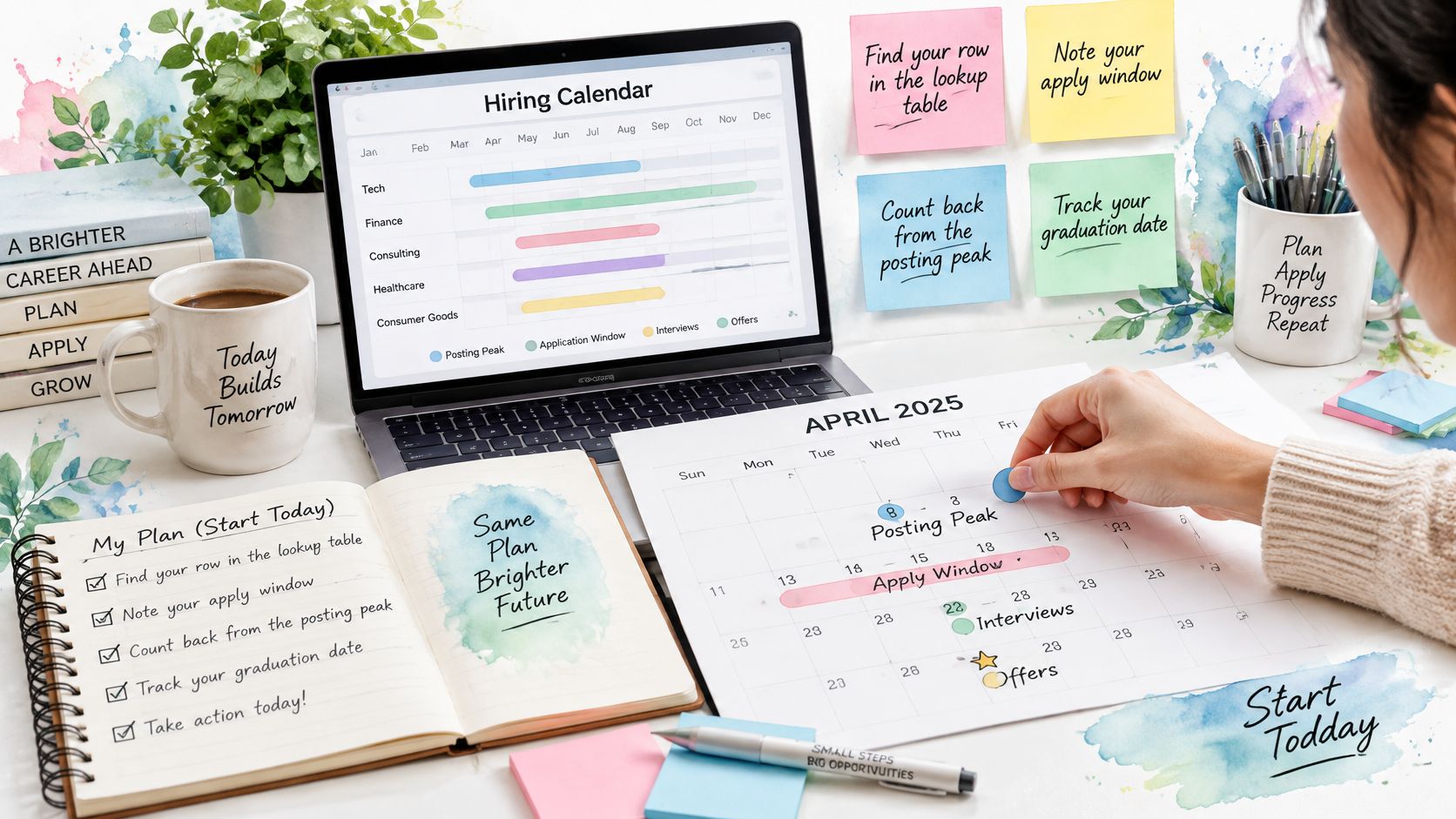
You now have windows, cycles and preparation steps. A calendar turns them into dates you'll act on. If you're mapping several deadlines at once, it helps to plan clearer timelines with Fluidwave so application, interview and follow-up dates sit in one view.
Seven Steps to a Working Calendar
- Find your row in the table at the start of this guide and note your apply window.
- Count back from the posting peak or your graduation date to set a start week.
- Set a weekly application target and keep it even when a role looks like a long shot. A steady cadence protects you when one process stalls.
- Budget for a longer search. In 2025, 37% of graduates without a job expected their search to take four to six months, according to Monster's 2025 State of the Graduate Report, based on a Harris Poll of 1,009 U.S. adults aged 18 to 24. Plan savings and momentum for that range.
- Follow up once, at the date the employer stated. If no date was given, one reported benchmark places the median time to fill a nonexecutive role at 39 days, while early-career hiring research found the most common process length was three to four months for 46% of employers, figures summarized in this analysis of early application and hiring timelines. Wait until a process has run well past the relevant range, then send a single polite status check.
- Keep applying while any process is open. A long timeline doesn't mean an offer is more likely, and pausing costs you weeks you can't recover.
- Track weekly. Record application age, role type, referrals and tailoring effort, then end each week by choosing the next application you'll send. A simple system for how to track job applications keeps those fields in one place.
Distinguish four milestones for every role: posting date, submission date, interview completion and stated decision date. Most follow-up anxiety comes from treating them as one blurry wait.
You can start using Interview Pilot for free through a Start for Free button, with a free plan that requires no payment, so practice can begin the same week your calendar does.
Your first action this week is small. Pick your row, set your start week, and send the first application on the day you chose.
When your calendar schedules an interview, Interview Pilot helps you prepare with guided mock interviews, a searchable question bank and real-time support during live online interviews. Build your application timeline first, then practice against the competencies your target role tests. Visit Interview Pilot today and start rehearsing before your next application window opens.
Topics
when to apply
job application timing
graduate job search
seasonal hiring
job search timeline
Continue reading
Career
Resume for Retail: Examples and Steps That Get Interviews
Build a resume for retail that gets callbacks, with a format guide, before-and-after bullet examples by role, keyword tips and fixes for common mistakes.
November 9, 2026
14 min read

Career
How Long Should a Cover Letter Be?
Keep a standard cover letter within one page, with enough specific evidence to explain your fit. Learn what to cut and when application instructions take priority.
November 8, 2026
3 min read
Career
How to Address a Cover Letter With or Without a Name
Choose a professional cover-letter greeting when you know the recipient, only know the hiring team, or cannot find a name without guessing titles or gender.
November 8, 2026
3 min read