
















Career
Resume for Retail: Examples and Steps That Get Interviews
Build a resume for retail that gets callbacks, with a format guide, before-and-after bullet examples by role, keyword tips and fixes for common mistakes.
Interview Pilot Editorial Team
Updated November 9, 2026
14 min read
Full-time retail jobs drew 39 applications per opening in March 2024, a 50% year-over-year increase, according to iCIMS data reported by Chain Store Age. That stack is why a resume for retail fails when it reads like a copied shift list.
Reviewers skim for the role, the size of the work, and whether you can be scheduled. A cashier who held a tight drawer, a stock associate who cut empty-shelf complaints, and a holiday hire who trained two people on the register can all show that. You do not need a management title. You need proof a stranger can compare in a few seconds, and you need to stop pasting keywords your history cannot defend in an interview.
Retail Resume Format at a Glance
The U.S. Bureau of Labor Statistics listed approximately 4,271,400 jobs among retail sales workers in 2025, with retail salespersons accounting for about 4.0 million of them. Employment in the broader group is projected to show little or no net change from 2025 to 2035, yet the BLS still projects roughly 550,600 openings a year on average, mostly from people changing occupations or leaving the workforce. Similar titles compete for those vacancies, so the page has to separate you with scope and results, not a longer duty list.
| Section | What to include | Retail-specific detail |
|---|---|---|
| Header | Name, city, phone, email, availability | Add weekly availability and shift flexibility; skip full street address |
| Summary | Two to three lines: years, store type, strongest result | Name the store format (grocery, apparel, electronics) and one number |
| Experience | Employer, title, dates, three to six bullets per role | List hourly and seasonal roles in the same format, newest first |
| Skills | Eight to twelve skills taken from target postings | Cash handling, POS systems, inventory counts, merchandising only if true |
| Education and certifications | Degree, diploma or training | Food handler, safety or loss prevention certificates with year earned |
| Languages | Each language with a real level | Name the level (conversational, fluent, native) so it matches what you can do |
Header. City and a phone that you answer are enough. A street address does not help a scheduler. Put days and shifts you can work on that same line.
Summary. Keep it to two or three lines: years, store format, one result. A cashier moving toward shift lead can write: "Five years in grocery and apparel retail, from cashier to shift lead, keeping end-of-shift cash variance under $5 across 150+ daily transactions."
Experience through languages. Newest role first, whether the job was hourly, seasonal, or salaried. Three to six bullets on recent work, one line on older jobs. Skills should be eight to twelve items you can do on day one. Name the year on a food handler, safety, or loss prevention card. For languages, write conversational, fluent, or native. "Some Spanish" collapses the first time a customer needs a return explained.
A reader should find your role, your strongest result, and your availability in under 10 seconds. If they cannot, the summary is vague or the page is over-designed.
How to Build a Retail Resume Step by Step
Build one truthful base, then make a short copy for each store. Rewriting the whole file every time usually buries the lines that match the posting. I would change the top third and the newest role first, and leave older jobs alone unless a requirement points at them.
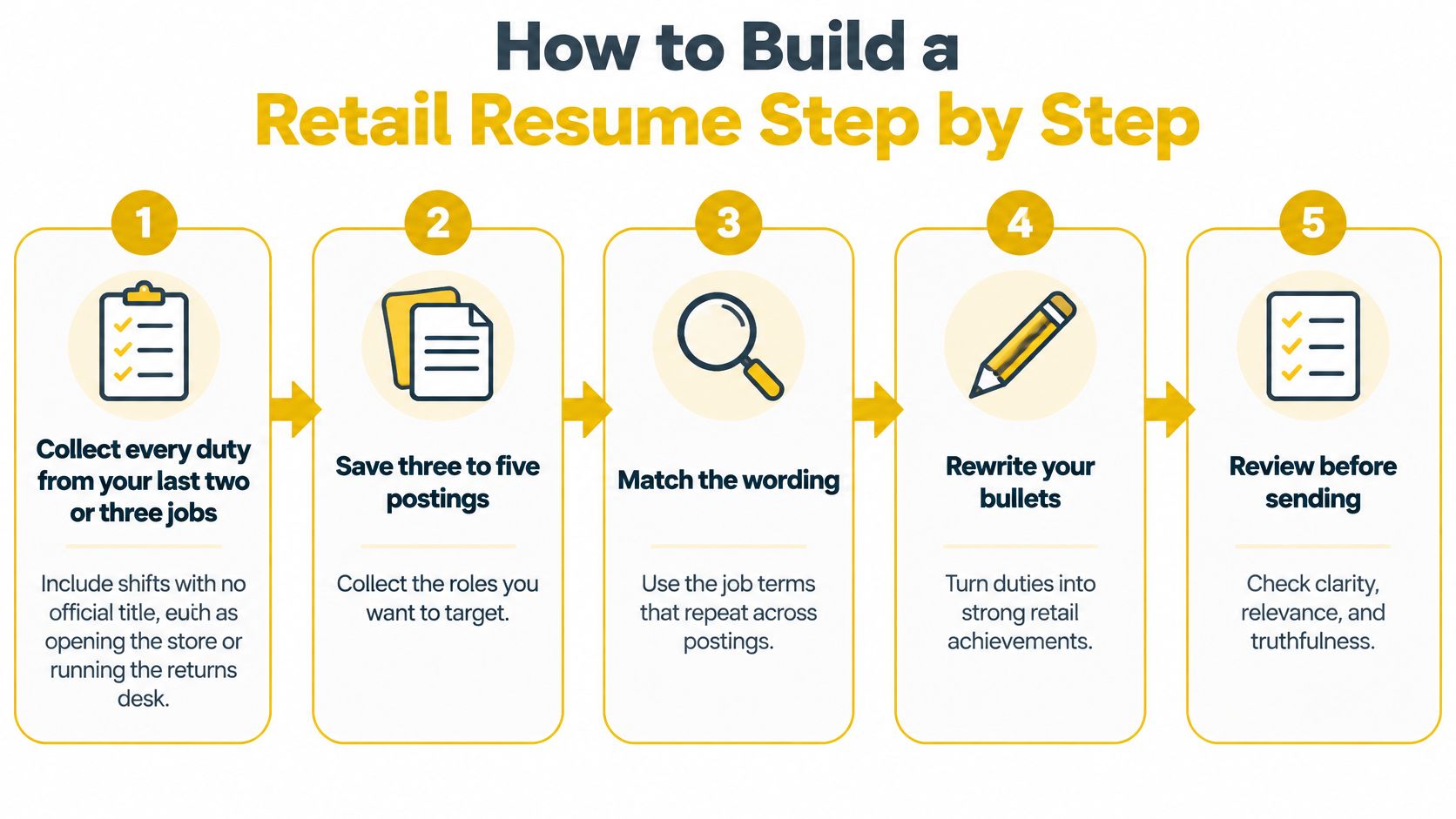
Collect, match, then rewrite
List the work you performed. Write every duty from your last two or three jobs, including shifts with no official title. Opening the store, running the returns desk, or covering the fitting room still counts. If you skip untitled work, the resume looks thinner than the job you performed.
Save three to five postings. Pull roles you would accept and underline requirements that show up more than once. Repeated lines are what that employer screens for. A one-off phrase in a single ad is a weak reason to rebuild the page.
Make the base longer than the version you send. Keep complete, truthful experience in a master file, even if it runs past one page. The sent copy can be shorter. The master is where you look when the next posting asks for inventory counts or new-hire training.
Map each repeated requirement to one bullet you can defend. If nothing in your history matches, leave the phrase out. Inventing "loss prevention" or "visual merchandising" creates a problem the moment someone asks how you did it.
Turn the duty into action, process, scale, and result. "Stocked shelves" becomes "Replenished 1,200+ SKUs weekly, reducing stockout incidents by 18%." Use your own counts. The pattern is what matters: what you did, to what volume, with what change.
Move the closest matches up. Summary first, then the newest role. That is the part people read. A strong replenishment line buried under register duties will not get credit.
Save a named copy. File it under the employer, and note the date and whether you heard back. You cannot tell which wording helped if every application is one overwritten document.
If sorting untitled shifts into clean lines is the slow part, a builder that helps you turn career experience into a resume can hold the master draft while you tailor copies. For where a skill belongs, this note on how to list skills on a resume keeps the skills block from repeating the same phrase as your bullets.
Practical rule: Mirror the posting's words only where they truthfully fit. A page that revises the top third usually beats a page that rewrites every line and still has nothing to prove.
Retail Bullet Examples Before and After by Role
Customer service and communication still show up constantly in retail hiring, but training and stock handling became prominent requirements too. JobsPikr reported 2025 volumes of about 1.89 million training mentions, 1.86 million communication mentions, and 1.4 million stock-handling mentions. Bullets that only say "helped customers" miss the operational half of that demand.
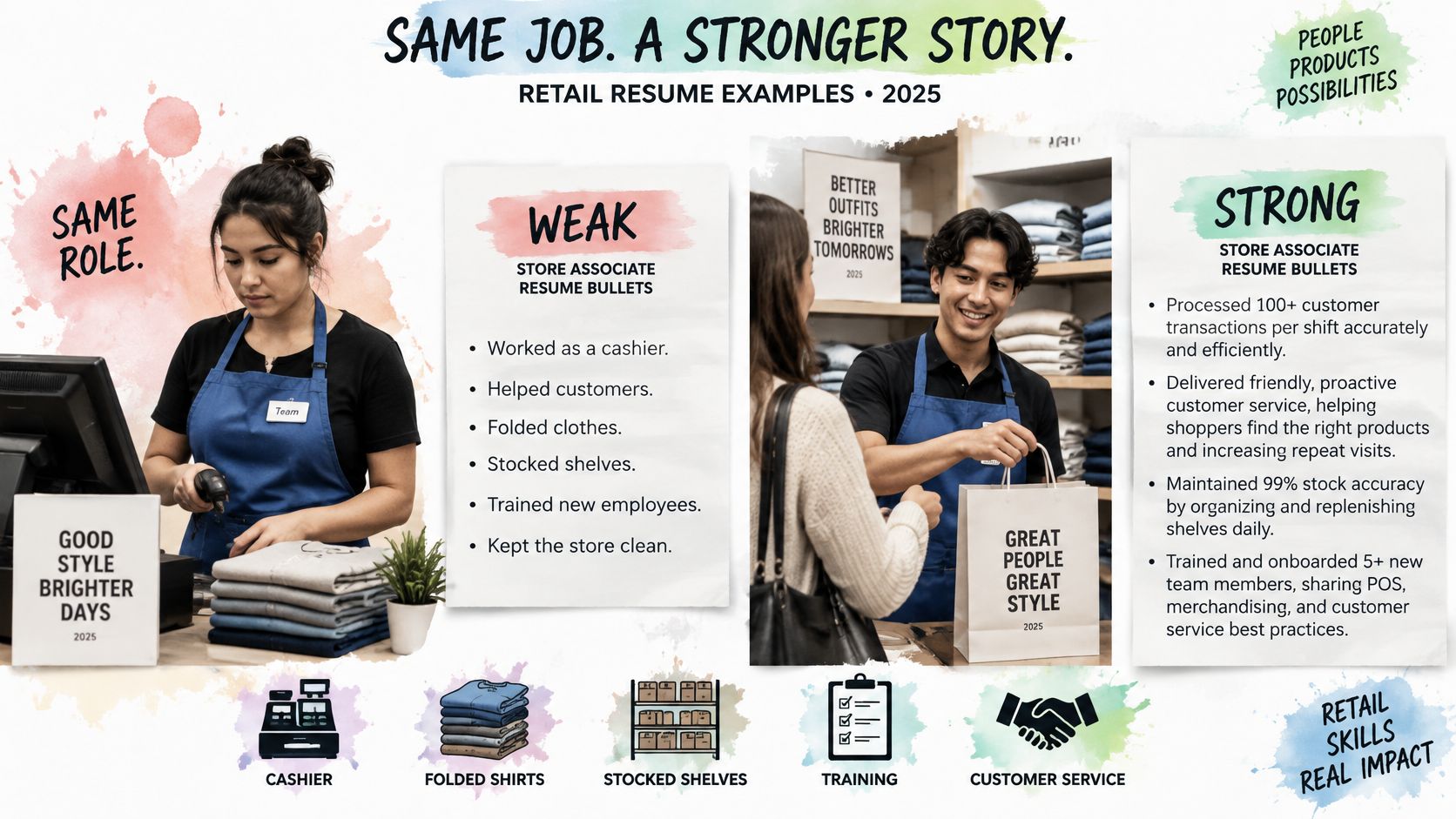
The samples below are models. Replace every figure with a number you can explain from a schedule, a sales report, or manager feedback. If you estimate, label it approximate and be ready to say how you got there.
| Role | Weak bullet | Stronger bullet |
|---|---|---|
| Cashier | Operated the register and handled payments | Processed 150+ transactions per shift with cash variance under $5 over six months |
| Sales associate | Helped customers find products | Guided 25+ shoppers per shift to the right product, lifting your verified add-on sales share for the department |
| Stockroom associate | Stocked shelves and unpacked deliveries | Replenished 1,200+ SKUs weekly, cutting stockout reports by 18% |
| Shift supervisor | Supervised staff on the floor | Trained and scheduled 8 associates, lowering new-hire turnover from 40% to 22% in one year |
| Career changer from hospitality | Waited tables and took orders | Managed 40+ daily orders across two POS terminals, resolving complaints before checkout |
What the stronger line adds
Cashier. "Operated the register" is the job title repeated. The stronger line names volume and accuracy over six months. If your store posts drawer totals, use those. If you only remember "almost never short," do not invent $5.
Sales associate. Guiding shoppers is the process. The add-on share is the result, and it has to be yours. A department report or a manager's weekly note is enough. A guessed percent is not. If you need a fresher verb than "operated," a synonym for cashier is fine, but the number still has to survive a question.
Stockroom associate. Unpacking boxes is a duty. Replenishing a SKU count and cutting stockout reports is an operation. You can claim this without a lead title if you owned the aisle.
Shift supervisor. "Supervised staff" hides the two results stores track: people trained and people who stayed. Use this pattern only if you built the schedule or ran the training, not because the title sounds senior.
Hospitality career changer. Table service already has order volume, more than one terminal, and complaints handled before the guest pays. That maps to a sales floor faster than a soft-skill list does.
Same scorekeeping shows up off the sales floor. Operators who improve middle-mile trucking margins track a process, a volume, and a result. Your replenishment or drawer line should do the same.
You do not need a "retail technology" title to show adaptability. Training a new hire on the register, fixing a pickup order, or using the inventory gun are ordinary shifts. Write them as outcomes. A 30-second walk-through of how to judge a bullet before you send it:
Turning Hourly and Seasonal Work into Evidence
A 2015 study commissioned by the National Retail Federation found that 71% of hiring managers believed retail provides foundational skills transferable to other industries, and they recommended putting that experience on the resume. The abilities they cared about lined up with what retail employees said they used regularly: following directions, working with different people, staying calm under pressure, helping teammates, showing respect, and multitasking.
That finding cuts both ways. If you are leaving retail, those shifts are evidence, not a footnote. If you are entering retail from hourly work, the same standard applies. Name the process and one result. Do not hope the reviewer will translate "helped out" for you.
Three rewrites
Holiday hire. Weak: "Worked retail during the holidays." Stronger: "Seasonal sales associate, November to January, covered 20+ peak shifts and trained two temporary cashiers on returns." The dates explain the short stint. The shift count shows reliability.
Caregiving, gig work, or a family shop. Weak: a gap, or "helped with the family business." Stronger, pick one true line: "Coordinated weekday rides and appointments for two relatives while keeping a weekend retail schedule," or "Completed 30+ grocery deliveries a week with a photo confirm on every drop," or "Ran Saturday checkout at a family bodega, balancing a small drawer and reordering the top sellers." One result each. Do not stack all three unless you did all three.
The gap line. "Seasonal sales associate, holiday period, returned to school." One line with dates beats a blank that invites a guess.
For more patterns across jobs, these transferable skills examples show how to name the skill the next employer needs before you cite the hourly proof.
Lead with the skill the new posting asks for, then support it with the shift that proves it. A grocery closer who wants an office coordinator role should open with scheduling and calm problem-solving, not with "excellent customer service."
Common Retail Resume Mistakes and How to Fix Them
The costliest mistake is a duty list with no results. It reads as routine, and the reviewer has nothing to compare against the next applicant who wrote a number. Fix that before you touch fonts.
| Mistake | Why it hurts | Fix |
|---|---|---|
| Duty list with no results | Reads as routine and gives no proof | Add scale and one measurable result to each recent role |
| Generic traits such as hard-working | Cannot be checked against anything | Replace with the specific shift, task or outcome that showed it |
| POS listed as a headline skill | Appeared in under 4% of analyzed retail postings | Keep it only inside a bullet that names the system and a result |
| Unexplained employment gap | Triggers questions before the interview | Add a one-line explanation with dates |
| Overstated language or skill level | Fails in the first conversation | Use the level you can actually hold a conversation at |
| Resume over two pages for entry level | Reviewers skim and stop | Cut older duties to one line and keep recent roles detailed |
Each fix fits in half an hour.
Duty list. Add scale and one result to each recent role. Transactions per shift, SKUs counted, or people trained. If you lack a percent, use a count you remember and mark it approximate.
Generic traits. "Hard-working" and "team player" cannot be checked. Replace them with the close you covered or the truck you finished. The behavior is in the task.
POS as a headline. In a 1,786-posting analysis from Huntr, POS systems appeared in fewer than 4% of retail advertisements, while customer service and communication dominated. Keep the system name inside a bullet that also has a result, such as drawer accuracy on a named register. Do not lead the skills block with it.
Gaps and inflated levels. One dated line closes a gap. A language level you cannot hold in conversation fails in the first minute on the floor. Say the level you can use with a customer.
Length. For an entry-level or hourly role, a file past two pages gets skimmed and dropped. Collapse older duties to one line. Keep detail on the last role or two.
I would fix the missing results first. That single change gives a reviewer something to rank. The other rows are cleanup.
Keywords, ATS Rules and Final Pre-Submission Check
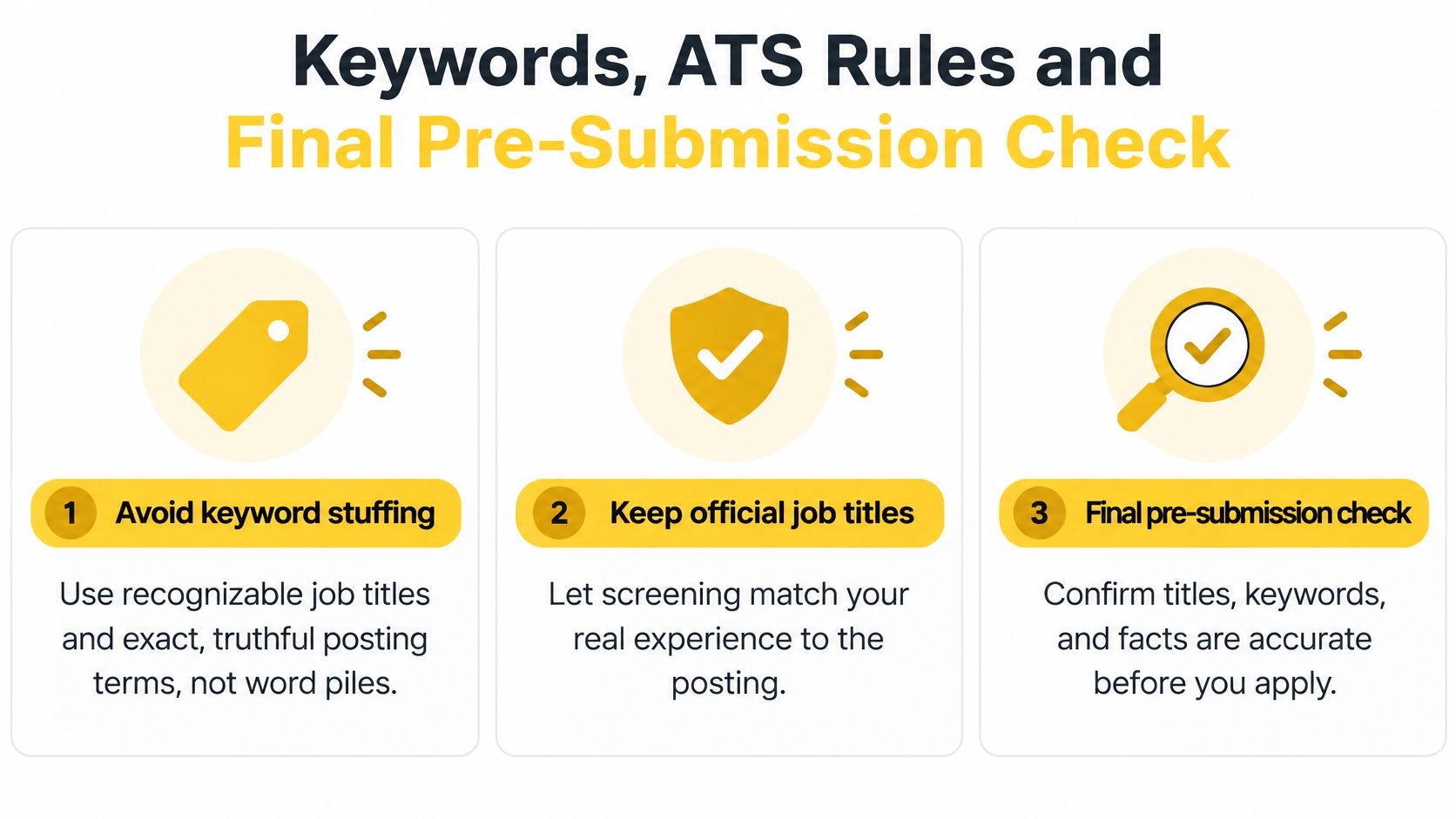
Keyword matching helps when the phrase is your real job title or a task you did. It hurts when the page becomes a pile of posting words with no bullet behind them. For a plain account of how screening software reads a file, these ATS insights from HR Management 365 pair well with the rules below.
One 2025 retail hiring article claimed that about 75% of recruiters use an ATS and that systems may filter out roughly 75% of resumes before human review. Effective Retail Leader is right to treat both figures cautiously, because that article does not identify a clearly independent primary dataset. Write for a parser and for a person anyway.
Keep official titles so a screen can match "cashier" or "sales associate" to the posting. Use a posting phrase only where your experience matches it. Skip tables, text boxes, columns, and graphics in the file you upload, since some parsers misread them. Send a one-page, plain version for hourly and entry-level roles, and a fuller version only for supervisory jobs. Add what templates skip: weekly availability, work authorization where a posting requires it, stores you can reach, and each language at a real level.
- Read the top third as a hiring manager. The summary should name store type and the strongest result.
- Check that each recent bullet has an action, a process, a scale, and a result you can explain.
- Confirm repeated posting requirements appear only next to true experience.
- Save the file under the employer's name and log the date you sent it.
- After a consistent sample, ideally at least 30 applications per version, compare callback rates before you change the base, a comparison method outlined by 22 Skills.
Interview Pilot is one option among several once the page is honest. We can create an interview profile by importing from a resume or a job posting, attach the resume document, and use the resume templates already in the app so practice questions follow the same evidence as the file you sent.
A retail interview still turns on the same proof as the resume: what you handled, at what volume, and what changed. Interview Pilot pairs that document with real-time answer suggestions, mock practice, and a question bank so you can rehearse the bullets out loud before a live online interview. When the page is ready, visit Interview Pilot and run the stories you can defend.
Topics
resume for retail
retail resume examples
retail resume keywords
retail resume tips
retail job resume
Continue reading

Career
When to Apply for Jobs: Timing by Industry and Career Stage
Learn when to apply for jobs by industry, career stage and hiring season, with clear timelines for graduates, seasonal roles and experienced hires.
November 9, 2026
17 min read

Career
How Long Should a Cover Letter Be?
Keep a standard cover letter within one page, with enough specific evidence to explain your fit. Learn what to cut and when application instructions take priority.
November 8, 2026
3 min read

Career
How to Address a Cover Letter With or Without a Name
Choose a professional cover-letter greeting when you know the recipient, only know the hiring team, or cannot find a name without guessing titles or gender.
November 8, 2026
3 min read