









Interviews
Retail Management Interview Questions: 10 Answers for 2026
Master retail management interview questions on operations, KPIs, leadership and scenarios. Get model answers, STAR tips and prep strategies for 2026.
Interview Pilot Editorial Team
Updated October 30, 2026
18 min read
You know your sales. You can walk a floor and name the slow aisle. Then the interviewer asks how you would manage shrink across a 40-person store, and the answer stalls. That freeze is common, and it costs offers.
Retail management interview questions mix three types. Behavioral questions ask what you already did. Situational questions ask what you would do on a Saturday with two call-outs. Analytical questions ask which number you moved, and how you know it stuck. Interviewers score the structure of an answer as heavily as the content. A tidy story with no result loses to a shorter story that names a baseline, an action, and a result.
The sector is too large for product talk alone. The International Labour Organization estimated that wholesale and retail trade accounted for more than 420.5 million jobs worldwide in 2020, with retail and commerce representing 15.5% of the global female workforce, compared with 11.7% of the global male workforce. Scheduling, inclusive leadership, and service recovery sit beside conversion.
These ten questions cover sales, coaching, angry customers, shrink, KPIs, peak season, labor, conflict, merchandising, and a missed-target turnaround. For each one, I'll name what gets scored, then a sample answer shape that ends in a number. Prepare two follow-ups for every story before you log on.
1. Tell me about a time you increased sales or store performance
Interviewers aren't scoring enthusiasm. They're scoring whether you can name a sales driver, change a behavior, and prove the lift lasted.

Build the story on conversion, not traffic. Say the store converted 18% of visitors. You set a greeting-and-approach standard and added product-pairing prompts at the fixture. Over 90 days, conversion moved to 22%. Baseline, behavior, window, result. That's the whole arc.
A second shape uses units per transaction. The team sat at 1.6. You coached a two-item add-on on the top three categories and checked the register report every Friday. Units per transaction reached 1.9, and you kept the prompt after the signs came down.
Fit shows up in the math, not the adjectives. In a Hogan Assessments business-outcome summary, high-fit sales managers exceeded financial targets by 13%, about $560,000 on average, while low-fit managers missed targets by 6%. Your story should sound like the first manager.
Follow-ups to prep:
- The report name: Which system or weekly pack held the number.
- What you stopped: The habit you killed so the new one stuck.
- The coaching loop: One observation, one redo, one check the next week.
Brand-specific sales probes work the same way. The Target interview questions and answers guide shows how big-box interviewers press past a slogan and into the figure.
2. How do you handle an underperforming employee?
Picture a cashier whose error rate is the worst on the team. A weak answer jumps to a write-up. A strong one diagnoses first.
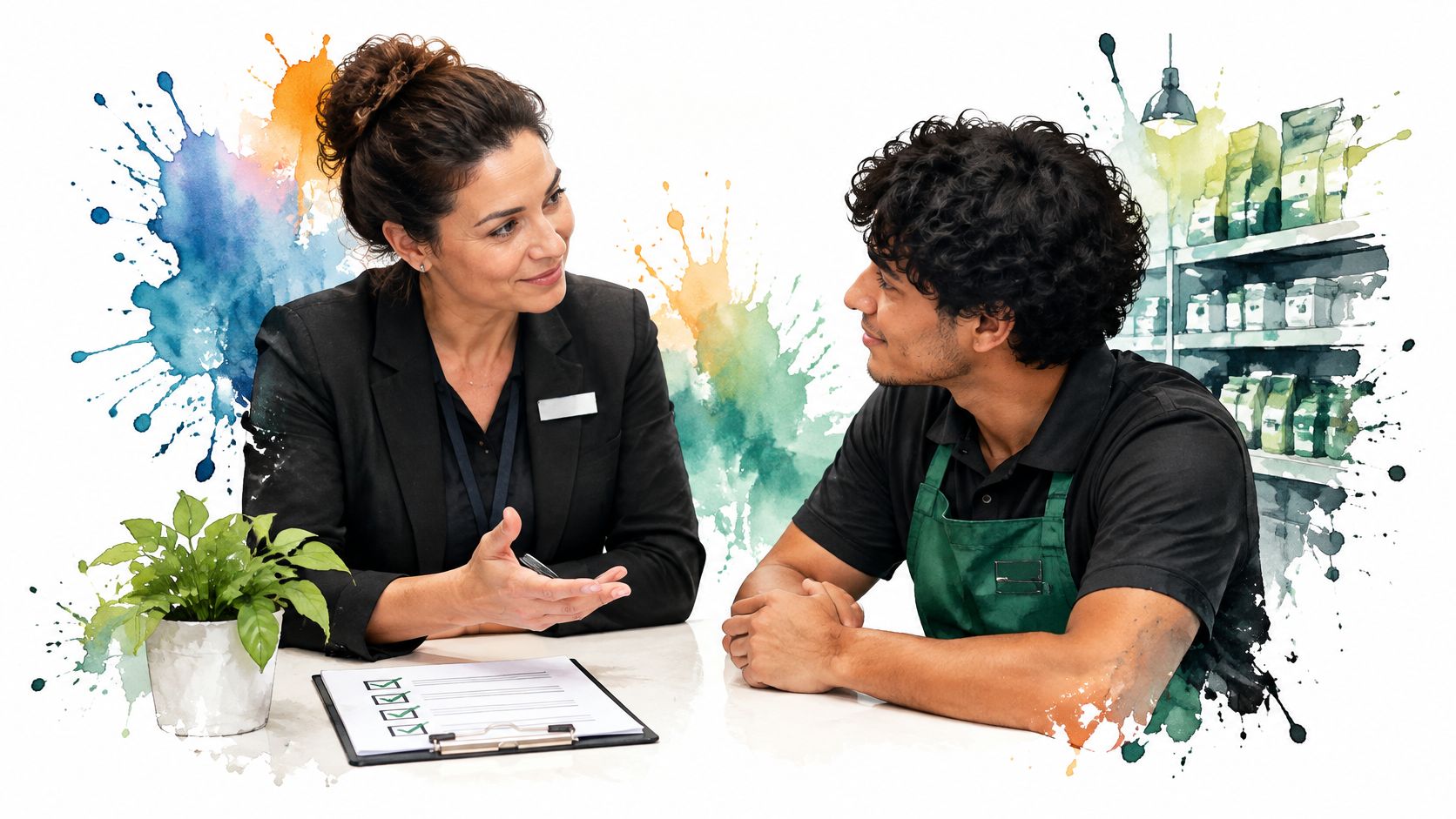
Interviewers score fairness, a clear standard, and a timeline. Skill, will, and an outside constraint are different problems. Treat them the same and you look careless.
Say you watched three transactions, found a training gap on voids, ran a short refresher, and set Friday checkpoints. Errors fell inside a month. If the issue is attendance, keep it private, name the expectation, fix a real scheduling clash if one exists, and put the plan in writing. Involve HR when policy says you must. Empathy without a date is counseling. A date without support is a trap.
The Society for Industrial and Organizational Psychology, via SHL's retail hiring guidance, treats structured interviews as standardized questions scored against consistent criteria. Expect the same probe for every candidate: situation, action, measurable outcome.
Follow-ups to prep:
- The gap in numbers: Errors per hundred transactions, or missed shifts in 30 days.
- What you documented: Dates, the standard, and who else was in the room.
- If it failed: How you exited the person without dumping the work on the team.
The same coaching spine shows up in broader management interview questions and answers. Retail just makes the metric more visible, because the till doesn't negotiate.
3. How would you handle an angry or escalated customer?
This one is scored on sequence, not warmth. Listen, name the feeling, move to facts, then offer only what you can approve.
Say a customer disputes a ticketed price. You acknowledge the frustration, check the tag against the file, honor the posted price, and thank them for catching it. You don't argue the intent of the sign. A damaged-item case moves off the floor, gets a replacement or a refund within policy, and gets a note so the same SKU doesn't fail the next guest.
Practical rule: Acknowledge the emotion in one sentence, then switch to the fact you can verify. Staying in the feeling is how a two-minute fix becomes a scene.
Say out loud what you can approve and when you call a store manager or the contact center. Then close with the process fix. A bad price file is a recovery today and a scan audit tomorrow. Interviewers downgrade answers that "make the customer happy" with no limit and no follow-up.
Follow-ups to prep:
- Your approval line: Refund amount, price match, or a manager call.
- Safety: When you step back, call security, or clear the aisle.
- The process change: The one control you added after the guest left.
Recovery language is a skill you can rehearse. These customer service interview answers are a clean drill for the first thirty seconds, which is where most candidates ramble.
4. How do you manage inventory accuracy and shrink?
Shrink is theft, damage, and admin error. Interviewers want a preventive cadence, not a story about one dramatic catch at the door.

Use a number you can defend. Say shrink sat at 2%. You ran weekly cycle counts on the high-loss categories, tightened the receiving check against the ASN, and brought shrink under 1%. Name the report. Exception reports, negative on-hands, and unscanned markdowns tell you more than a hallway hunch.
A second shape is narrower. One department kept missing. You traced it to markdowns that never hit the gun, retrained that process, and rechecked the same locations for four weeks. Loss prevention that blocks the aisle will hurt conversion. I would rather fix the scan than post another "we prosecute" sign.
External partners can help on the theft slice, including firms that prevent organized retail crime, but the interview still wants your controls, not a vendor name.
Follow-ups to prep:
- Count cadence: Which categories, which day, who owns the variance.
- Receiving: What "short" means and who signs the claim.
- Customer cost: How you keep recovery from turning into a search at the exit.
5. Which KPIs do you track, and how do you use them?
Don't recite a dashboard. Pick three to five metrics and tie each one to a decision you would make on a Tuesday.

Sales per labor hour tells you whether the schedule matches the rush. Conversion tells you whether traffic is buying. Average transaction value tells you whether the basket is thin. Inventory turnover tells you whether product is stuck. Gross margin return on the inventory you hold is the one I add when the role owns buying, not just the floor.
Say you reviewed sales per labor hour every Monday and moved hours into the 11 a.m. to 2 p.m. window. Service scores rose and you stayed inside the labor budget. If conversion is soft and traffic is fine, you coach selling, not ads. If conversion is healthy and the basket is flat, you work attachments and adjacencies.
Share the same three numbers in the huddle. A metric the team never sees doesn't create accountability. A metric with no owner is a poster.
Follow-ups to prep:
- The decision: What you changed in the next schedule or the next display.
- The pair: Why you never read conversion without traffic, or ATV without units.
- The lag: How many weeks you wait before you call a trend real.
6. How would you prepare your store for a peak season such as the holidays?
Peak questions score whether you can plan in weeks, not in panic. Start with last year's sales by day and hour, then this year's promo calendar.
Say you built a 12-week plan. Week one locks the forecast and the temp requisition. Midway you cross-train cashiers onto replenishment. Two weeks out you set a holiday checkout lane and a stockout backup with distribution for the top items. Displays move if a hero SKU is short, so you don't advertise an empty table.
A backup for stockouts, call-outs, and a down register belongs in the same plan as the sales target. Peak fails in the gaps, not in the slogan.
Name owners and dates. "We'll be ready" isn't a milestone. A milestone is "temps certified on returns by the Friday before the first flyer." Keep service standards written, because seasonal staff won't absorb culture by osmosis. I would rather over-train the return desk than discover the policy on December 26.
Follow-ups to prep:
- The forecast source: Prior-year hours, not a guess from last December's memory.
- Temp ramp: How many shifts before someone works a peak alone.
- The failure mode: What you cut first if payroll or freight slips.
7. How do you build a schedule that balances labor cost and customer coverage?
Labor is usually the lever you can still move after the buy is done. Interviewers want a method: traffic by hour, a labor budget, availability, and the local rules on breaks, minors, and predictive scheduling.
Say hourly traffic showed a spike from 4 p.m. to 7 p.m. and a dead Tuesday morning. You added peak coverage, trimmed the slow open, held sales per labor hour inside budget, and watched service scores instead of assuming fewer hours meant worse service. Protect openings, closings, and receiving. A store that saves payroll by skipping the truck just moves the cost into shrink and empty shelves.
Schedules published late create call-outs. Build availability into the grid, post early, and keep a small bench for the known gaps. Don't pretend a new tool fixes morale.
In Robert Half's retail employment research, 64% of surveyed retail managers said AI and automation projects had affected hiring efforts. If a scheduler improves efficiency but shreds people's weeks, say when you would override it.
Follow-ups to prep:
- The constraint: Budget, coverage minimums, or a labor law you won't break.
- The override: A sick call at 7 a.m. and who you move first.
- Retention: How early posting cut last-minute holes.
8. Describe a time you resolved a conflict between team members
Keep the drama short. Interviewers score neutrality, a private listen, and a rule that stops the fight from returning on the next shift.
Two associates argue over break coverage during a rush. You meet each one alone, restate the break order, and set a shared handoff so the floor isn't abandoned. You don't pick a favorite in the aisle. A shift lead and a stocker clashing over priorities gets a five-minute reset and a written handoff: truck first until 10 a.m., then recovery. Service standards stay up while you sort the people.
Listen to both sides before you decide. A public verdict feels fast and usually restarts the argument at the next break.
End on the lasting change, not on who was "difficult." If the same pair clashes again, that's a performance issue, and you already have a process for that. Don't reuse a coaching story and hope they don't notice.
Follow-ups to prep:
- What each person wanted: In one sentence, no character sketch.
- The new rule: Who owns it on the next three shifts.
- Customer impact: How you kept the line moving while you stepped away.
9. How do you ensure visual merchandising and planogram compliance?
Standards only work if someone audits them on a calendar. Interviewers score repeatability, not your taste.
Say you ran a weekly planogram audit. A seasonal bay sat off-plan, so you corrected it with a one-page checklist: photo, facings, price, and sign. Compliance went from "we think it's fine" to a pass rate you could review in the Monday huddle. A second story is commercial. You turned a high-traffic table toward new arrivals and tracked category engagement, not compliments from the district walk.
Brand standards and local taste will clash. Follow the planogram on national programs, and use the flex table for what this store's customers stop for. If you can't link a move to conversion, units, or a sell-through window, don't claim a win. Teams that understand how retail planograms support consistent merchandising argue less about "whose display" and more about whether the bay matches the file.
Follow-ups to prep:
- The audit: Day, owner, and what "fail" triggers before the weekend.
- The exception: When a local fixture may deviate, and who approves it.
- The metric: Sell-through or conversion on that bay, with a date.
10. How would you turn around a store that has missed sales targets for several months?
Diagnose before you announce a plan. Interviewers score whether you separate traffic, conversion, price, staffing, and mix, then pick a few actions with owners and dates.
Say traffic was flat and conversion had slipped. You retrained product knowledge and fitting-room service and lifted conversion over the next quarter. You didn't launch a new promo on top of a selling problem. If the leak is markdowns, you cut buy quantities and slow the promotion cadence so margin recovers while sales hold. Three to five actions is the limit. Ten priorities is no priority.
Omnichannel misses hide inside "sales are down." A pickup order that shows available and isn't on the shelf is a conversion problem and an inventory problem. ANCOR's note on retail labor-market trends describes demand shifting toward e-commerce, logistics, data analysis, technology implementation, and omnichannel customer experience skills. Your turnaround should mention fulfillment labor, not only the sales floor.
Tell the team the first win in week two. Silence reads as blame.
Follow-ups to prep:
- The split: Traffic versus conversion versus margin, with the one you chose.
- Owners and dates: Three actions, three names, a 30-day check.
- What you will not do: The campaign you refused until the process was fixed.
How the 10 retail management interview questions compare
| Item | Question type | Core skill tested | Recommended framework | Key metric to cite |
|---|---|---|---|---|
| Tell me about a time you increased sales or store performance | Behavioral | Commercial awareness and goal-setting | STAR | Sales growth, conversion rate, average transaction value, or units per transaction |
| How do you handle an underperforming employee? | Situational | Coaching, accountability, and fairness | Diagnose the cause, set expectations, provide support, and document progress | Error-rate reduction or progress against the improvement plan |
| How would you handle an angry or escalated customer? | Situational | De-escalation and service recovery | Acknowledge emotions, clarify facts, offer a solution, and escalate when needed | Resolution and follow-up quality; no specific metric provided |
| How do you manage inventory accuracy and shrink? | Technical and operational | Inventory control and loss prevention | Cycle counts, receiving controls, and exception reporting | Shrink rate or inventory discrepancy reduction |
| Which KPIs do you track, and how do you use them? | Analytical | Data-driven decision-making and financial literacy | Select three to five KPIs and link each to an action | Sales per labor hour, conversion rate, average transaction value, gross margin return on investment, or inventory turnover |
| How would you prepare your store for a peak season such as the holidays? | Situational and planning | Forecasting and cross-functional coordination | Build a timeline covering demand, staffing, inventory, training, and contingencies | Prior-year sales patterns and service levels; no specific outcome metric provided |
| How do you build a schedule that balances labor cost and customer coverage? | Situational and operational | Workforce planning and cost control | Match hourly traffic forecasts to labor budgets, availability, and coverage needs | Labor cost and customer coverage; no specific numeric target provided |
| Describe a time you resolved a conflict between team members | Behavioral | Conflict resolution and communication | STAR, with neutral listening and follow-through | Lasting resolution and team working relationship; no specific metric provided |
| How do you ensure visual merchandising and planogram compliance? | Operational | Attention to detail and execution of brand standards | Conduct regular audits, correct gaps, and review results | Planogram compliance or category engagement |
| How would you turn around a store that has missed sales targets for several months? | Strategic and situational | Diagnosis, prioritization, and leadership | Identify root causes, prioritize actions, assign owners, and track milestones | Sales performance, conversion, or gross margin |
Turn Your Store Experience Into Interview-Ready Stories
Pick four or five results you can explain without a binder. Map each one to a question above. Write it in STAR, and make the last line a number you measured yourself: conversion, shrink, sales per labor hour, units per transaction, error rate, or a service score. If you can't say how you counted it, it isn't ready.
Rehearse out loud. A live interview punishes the answer you only wrote. Time yourself to about ninety seconds, then stop. Add two follow-ups per story: the report you used, and what you changed so the gain survived the next month. I recommend practicing the failure version too. A store that missed plan, told plainly, with a diagnosis and a dated fix, beats a year of unbroken wins you can't prove.
Employers are already running this as a system, not a chat. After Casey's moved to structured interviews, standardized questions, and automated progression, average time-to-hire fell below four days, with a hiring rate of about one applicant in four. You may get a tight script and a scorecard. Charisma won't carry a blank result.
Use the same evidence file for every round. One page is enough: the metric, the baseline, the action, the date, and the sustain step. When a interviewer swaps "sales" for "shrink" or "a missed quarter," you re-aim the story instead of inventing a new life.
Interview Pilot can sit alongside that prep. We offer AI mock interviews with an evaluation of your answers, plus a question bank you can search by words and filter by type, including behavioral and leadership prompts, so a retail story gets rehearsed before the live call.
Interview Pilot provides suggested answers during a live online interview, guided mock sessions, and a question bank you can search before a store-manager screen. Use it to practice the ten prompts here until each story ends on a number you can defend. Visit Interview Pilot and run the next retail round out loud before you take the actual one.
Topics
retail management interview
retail manager interview
store manager questions
STAR method answers
retail leadership interview
Continue reading

Interviews
8 Interview Questions About Multitasking: Sample Answers
Master interview questions about multitasking with 8 behavioral questions, scoring criteria, STAR answer frameworks, and sample answers for every level.
October 25, 2026
19 min read

Interviews
Interview Questions Strengths
Interview questions strengths. Master interview questions on strengths with STAR methods, role-specific examples, and clear strategies
October 15, 2026
16 min read

Interviews
Top 8 Behavioral Questions for Consulting Interviews
Explore 8 behavioral questions for consulting interviews with STAR sample answers, interviewer intent, and tips for tailoring responses to consulting cases.
October 9, 2026
20 min read