









Interviews
8 Interview Questions About Multitasking: Sample Answers
Master interview questions about multitasking with 8 behavioral questions, scoring criteria, STAR answer frameworks, and sample answers for every level.
Interview Pilot Editorial Team
Updated October 25, 2026
19 min read

You've rehearsed your experience, your skills, and your proudest project. Then the interviewer asks you to describe juggling three deadlines at once, and your mind goes blank. You say you're great at multitasking, list everything you did, and watch the interviewer write nothing down.
That answer fails for a predictable reason. Interview questions about multitasking rarely reward doing everything at once. They test prioritization, communication, and self-awareness, plus whether you know when switching helps and when it hurts quality. Interviewers also score you differently by level. An individual contributor needs a personal system for sequencing work. A manager needs that system plus delegation, escalation, and trade-off decisions for other people.
Treat multitasking as several different tests, not one trait. In a study of 224 university students identifying concurrent multitasking, task switching, and complex multitasking, no single ability fully explained performance across all three forms. A question about monitoring messages while presenting is not the same test as coordinating three projects with dependencies. Diagnose which one you're being asked about before you answer.
Each question below gives you a sample answer, an individual contributor versus manager split, and the signals that gain or lose points. Steal the structure, not the story. Replace every detail with your own work, your own deadline, and your own result.
1. Tell Me About a Time You Had to Juggle Multiple Competing Priorities
This question opens most interviews about workload because it reveals your default ranking rule. Interviewers aren't counting tasks. They're listening for deadline, business impact, and dependencies, in some clear order, and for proof that nothing important slipped through unnoticed.
Use STAR, which means Situation, Task, Action, and Result. Name at least three competing demands. One task plus a busy week doesn't show prioritization. It's also the kind of story used across behavior-based interview questions for hiring managers, so a clean version travels well to other rounds.
Sample Answer
As a data analyst during quarterly reporting, finance needed a reconciliation by Wednesday, product wanted an A/B test analysis, and a dashboard bug was affecting executives. I ranked each request by deadline and impact, confirmed the Wednesday date with finance, and blocked focused sessions for the reconciliation. I told product the analysis would arrive Thursday and automated part of the dashboard query to fix the bug the same day. All three delivered on time, and report refresh errors dropped to zero that month.
Notice the sequencing. The candidate doesn't claim simultaneous work. She triages, blocks, communicates a later date, and fixes the smallest urgent item fast.

Role Split and Scoring
- Individual contributor: Emphasize your personal ranking rule, your focus blocks, and the exact message you sent to the team that had to wait.
- Manager: Add who you reassigned, which commitment you renegotiated, and how you protected the team from taking on a fourth priority.
Scoring signals: Named priorities, explicit ranking logic, proactive updates, measurable result. Red flags: Vague busyness, no trade-off, everything finished with no cost, and an answer longer than about ninety seconds with no outcome. Quantify what you can, such as on-time delivery or errors reduced, and stop.
2. How Do You Prioritize When Everything Seems Urgent
Everything urgent usually means nobody has asked a clarifying question yet. Interviewers want a repeatable framework for separating a real deadline from a loud request, and they want to hear you check with stakeholders before you reorder your day.
Name one framework you use in practice. The Eisenhower Matrix separates urgent from important. Impact and effort scoring works too. Don't list three frameworks you read about last night. Pick one, then show the conversation that made it work.
Sample Answer
I use a simple urgent versus important matrix. When everything looks urgent, I ask the requester for the business consequence and the real deadline. A sales lead once asked for a same-day custom report while I was finishing a board model. I asked what decision the report supported, and it turned out they needed it Friday, not that day. I scheduled it for Thursday, delivered the board model first, and kept my manager informed.
That question about the decision is the whole answer. It converts pressure into information. Task difficulty matters here too. In a controlled 2015 experiment with 636 participants, forced multitasking hurt performance when the primary task was difficult but helped when it was easy. A strong candidate protects complex work and treats routine work more flexibly.
Role Split and Scoring
- Individual contributor: Show how you verify deadlines, propose a new date, and confirm the order with your manager before you start switching.
- Manager: Show how you make competing requesters resolve the conflict together, instead of silently absorbing both deadlines yourself.
Scoring signals: One named framework, clarifying questions, and a daily or per-request priority check. Red flags: Saying you always say yes, working late as your only strategy, and treating the last person who messaged you as the top priority.
3. Are You a Good Multitasker and Why or Why Not
Answer yes with enthusiasm and you've walked into the trap. This question tests whether you understand the difference between managing several responsibilities over time and splitting attention between demanding tasks in the same moment. The second one is expensive.
The research is clear enough to reference briefly. Experiments summarized in the American Psychological Association overview of multitasking research report that brief mental blocks from repeated switching may consume as much as 40% of productive time. Earlier work by Joshua Rubinstein, Jeffrey Evans, and David Meyer found people lost time moving between tasks, and the penalty grew as tasks became more complex or unfamiliar. You don't need to lecture. One sentence shows self-awareness.
Sample Answer
I manage several workstreams at once, but I don't believe in constant task switching. Switching costs time and raises error rates, so I batch similar work, like reviewing email and messages in set windows, and I protect blocks for deep work. Last quarter I carried three active projects, and that structure kept all three moving without missed deadlines.

Role Split and Scoring
- Individual contributor: Describe your own batching, time blocking, and task board habits, and name the type of work you refuse to split.
- Manager: Describe how you set team norms, such as focus hours and response-time expectations, so people aren't rewarded for instant replies.
Scoring signals: A clear distinction between sequencing and simultaneous attention, plus honest limits. Red flags: Claiming you thrive on constant interruptions, or saying you can't handle more than one project. Interviewers want judgment, not bravado and not fragility.
4. Describe a Time You Managed Multiple Projects and Something Went Wrong
Pick a real failure that's recoverable, then spend most of the answer on the recovery. Interviewers score early detection, ownership, and a process change. They discount stories where the problem was someone else's fault and nothing changed afterward.
Structure it as before and after. What signal did you miss, when did you spot it, who did you tell, and what system exists now because of it. If your story involves a slipped date, it's worth also preparing a focused answer about missing a deadline in an interview because interviewers often follow up there.
Sample Answer
I was leading two software integration projects with overlapping releases and underestimated testing time on one, which put a client milestone at risk. As soon as I saw it, I told both stakeholders, proposed a phased release, and requested one additional QA resource. We delivered the critical phase on time. Afterward I started a weekly capacity review, which has caught similar overlaps early ever since.
Interruptions and overload degrade the primary task, which a 2025 peer reviewed study on task interruptions notes prior research consistently shows. Naming that cost makes your process change sound necessary, not cosmetic.

Role Split and Scoring
- Individual contributor: Own your estimate or your missed signal, and show the personal checklist or risk log you built afterward.
- Manager: Own the staffing or sequencing decision, and show how you reallocated people without burning out the same person twice.
Scoring signals: Fast disclosure, a specific fix, no blame aimed at teammates. Red flags: A humblebrag disguised as a failure, a catastrophe with no lesson, or a recovery that depended only on working harder.
5. How Do You Handle Interruptions While Working on an Important Task
Interviewers want your triage rule in the moment, not a speech about valuing focus. What do you do in the first thirty seconds after a ping, and how do you get back into the original task without losing your place?
Modern workloads make this a realistic test, not a hypothetical one. In Microsoft's 2025 Work Trend Index on the infinite workday, employees in the high-ping group faced interruptions roughly every two minutes, up to 275 interruptions per day under the report's calculation. A credible answer assumes interruptions will happen and plans for resumption.
Sample Answer
When someone interrupts focused work, I first decide whether it's truly urgent. If it is, I handle it and write down exactly where I stopped and the next step, so I can resume quickly. If it can wait, I note it and reply with a time I'll get to it. My team uses status indicators and daily focus blocks, so people know when to reach me and what response time to expect.
That written restart note is the detail interviewers remember. It turns a vague claim about focus into a recovery cue they can picture.
Practical rule: Never leave a task without leaving yourself a next action. Resumption is a skill, and interviewers score it.
Role Split and Scoring
- Individual contributor: Focus on classifying severity, preserving task state, and giving the requester an expected response time.
- Manager: Add how you shield the team, route interruptions to an on-call or rotation, and review recurring interruptions as a process problem.
Scoring signals: A clear urgent versus deferrable rule and a resumption habit. Red flags: Saying you ignore everyone, or saying you drop everything for every message. Both read as poor judgment, just in opposite directions.
6. Describe Balancing a Technical Project With Urgent Stakeholder Requests
A data pipeline is halfway built when a stakeholder reports a broken campaign dataset needed that day. Interviewers want to hear how you assessed the impact, chose what to pause, and made the trade-off visible. Strong answers show triage before reaction, with a specific technical action and a clear conversation about scope.
Describe the decision, not just the fix. An urgent request can justify changing the sprint, but the team needs to know what will move and why. For broader delivery examples, see project management interview tips for technical candidates.
Sample Answer
I was building a data pipeline when marketing reported that a campaign dataset was broken and needed a same-day fix. I checked the impact, corrected the immediate data quality issue, and documented the root cause. I then worked with the product owner to move a nonessential feature to the next cycle. Afterward, we introduced an intake form so ad hoc requests entered one queue for triage, rather than arriving through scattered meetings and chat messages.
The intake process matters because it shows how you handle the next urgent request, not only the current one. Give a concrete example of what the queue captures, such as the business impact and requested deadline, and explain who decides whether planned work should move.
Role Split and Scoring
- Individual contributor: Explain how you assessed severity and business impact, what you changed technically, and how you recorded the decision while keeping the main project's next step clear.
- Manager: Explain who took the urgent work, how you protected planned delivery, and how you negotiated scope or an error-budget trade-off with stakeholders.
Scoring signals: A defensible triage decision, root-cause analysis, stakeholder agreement on what moved, and a process change that routes future requests into a single queue. Red flags: Heroics without documentation, treating symptoms without investigating the cause, or promising both deadlines without naming what will be delayed.
7. How Do You Keep Track of Multiple Tasks Deadlines and Tools
This answer should be the shortest one you give. Interviewers want one trusted system, a capture habit, and a review rhythm. A long tour of five apps signals that your system is fragile and mostly lives in your memory.
Name tools you genuinely use, whether that's Jira, Asana, Notion, Trello, Outlook, or a paper planner. Then explain when you review them. If you're comparing options, resources on the best AI productivity tools for organizing work can help, but in the interview, your habit matters more than the brand.
Sample Answer
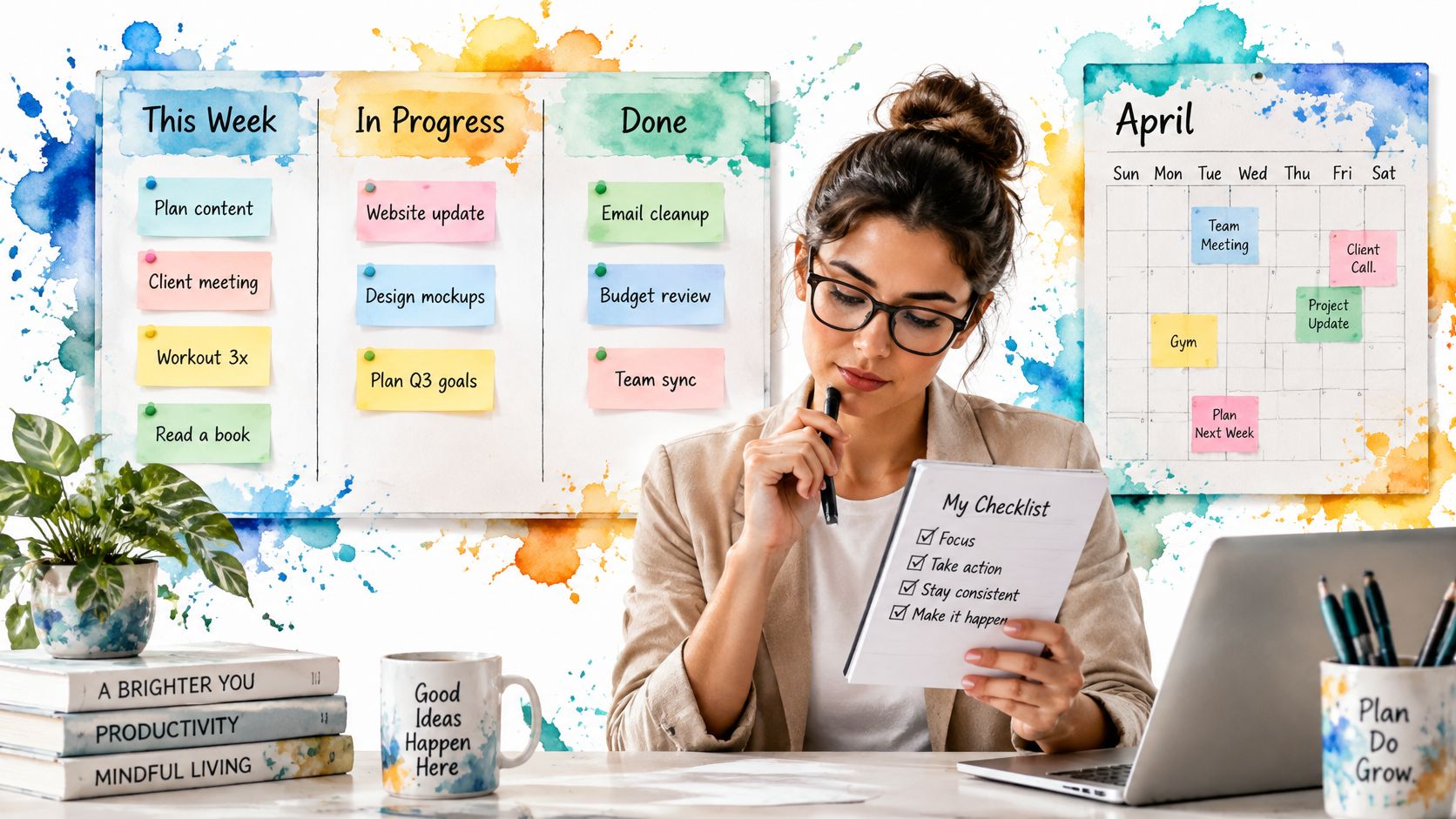
I use one task board for everything, with columns for This Week, In Progress, and Waiting On Others. Every new request goes on the board within minutes, with a deadline and an owner. Monday I review deadlines and dependencies, and Friday I clean up and plan the next week. That system carried the reporting tasks for a large cross-team project without a missed weekly deadline.
Context matters for credibility. In SurveyMonkey's 2024 workplace culture research, 46% of U.S. full-time hybrid or remote workers reported multitasking during a work call. A visible board is how you avoid relying on memory during those calls.
Role Split and Scoring
- Individual contributor: Show capture speed, one source of truth, and a weekly review you can sustain on a bad week.
- Manager: Show shared visibility, clear owners, and how the board surfaces overload before it becomes a missed deadline.
Scoring signals: Simplicity, written deadlines, and a recurring review. Red flags: Keeping tasks in your head, checking the board only when something is late, and tool switching as a hobby.
8. Tell Me About Asking for Help With Several Tight Deadlines
Asking for help early is a strength signal, and interviewers know junior candidates fear it looks weak. What actually looks weak is waiting until the deadline, then announcing you're overwhelmed. They're scoring self-awareness, timing, and how you frame the request.
Bring data to that conversation in your story. A task list with estimates turns a complaint into a planning discussion. It also gives your manager something concrete to reassign, defer, or descope.
Sample Answer
During my internship I had a research report, two client presentations, and a data cleanup task due in the same week. By Tuesday I could see I couldn't finish everything at high quality. I showed my supervisor my task list with time estimates and asked which items to prioritize. She reassigned the cleanup to a colleague with the right expertise. I delivered the report and presentations on time, and I now estimate workload realistically at the start of each week.
There's a longer-term reason to raise overload early. In research involving 382 full-time employees on impulsive multitasking, impulsive multitasking may produce short-term gains while increasing cognitive load, attention residue, working-memory problems, and anxiety over time. Escalation protects quality, not just your evening.
Role Split and Scoring
- Individual contributor: Show that you quantified the overload, proposed an order, and asked before quality dropped.
- Manager: Show that you escalated a resourcing conflict with options and costs, rather than redistributing overload onto your team without telling anyone.
Scoring signals: Early timing, estimates, a benefit to the team, and a planning lesson. Red flags: Framing help as rescue, asking with no proposed priority order, and presenting overwork as proof of commitment.
How each multitasking question is scored and which role it suits best
| Item | Best For | Answer Framework | Key Signal Interviewers Score |
|---|---|---|---|
| Tell me about a time you had to juggle multiple competing priorities. | Showing practical prioritization across competing responsibilities | STAR: name priorities, rank by deadline and impact, communicate trade-offs, share results | Clear decision logic, stakeholder communication, measurable outcome |
| How do you prioritize when everything seems urgent? | Demonstrating judgment when requests compete | Use a framework such as urgent-versus-important; clarify deadlines and impact, align with stakeholders, reassess | Repeatable approach, sound judgment, balanced communication |
| Are you a good multitasker? Why or why not? | Showing self-awareness about multitasking and focus | Distinguish managing several workstreams from simultaneous task switching; describe batching or time blocking and give an example | Realistic self-awareness, structured workflow, concrete evidence |
| Describe a time when you had to manage multiple projects at once and something went wrong. | Demonstrating accountability and recovery from a setback | Explain the issue, take ownership, communicate early, adjust the plan, and describe a process improvement | Transparency, ownership, learning, measurable improvement |
| How do you handle interruptions while working on an important task? | Explaining how you balance responsiveness and focused work | Triage urgency, set expectations, record where you stopped, then resume the task | Effective triage, clear communication, reliable return to focus |
| Describe a time you had to balance a technical project with urgent requests from stakeholders. | Technical candidates managing planned work and urgent requests | Triage the request, assess technical and business impact, communicate trade-offs, improve the process | Technical judgment, stakeholder alignment, protection of planned work |
| How do you keep track of multiple tasks, deadlines, and tools? | Showing reliable organization and follow-through | Name a simple tracking system, capture requests, and review deadlines and dependencies regularly | Sustainable system, consistent review, few missed commitments |
| Tell me about a time you worked on several tasks with tight deadlines and had to ask for help. | Demonstrating teamwork and awareness of capacity limits | Recognize workload constraints early, share task estimates, ask for specific support, reflect on the outcome | Timely escalation, constructive collaboration, realistic planning |
Turn Your Multitasking Stories Into a Reusable Answer Bank
You don't need eight separate stories. You need four stories you can flex. Build one or two STAR stories for prioritization, one for recovery when something went wrong, and one for asking for help. Most interview questions about multitasking are variations of those three situations with different wording.
Write each story in bullet form first, not as a script. Capture the competing demands, your ranking rule, the person you informed, the trade-off you accepted, and the result. Scripts sound rehearsed and collapse when an interviewer interrupts with a follow-up. Bullets let you start at the most relevant point and still land the outcome.
Then write two versions of each story. Your individual contributor version leads with your personal system, your focus blocks, your restart notes, and your escalation timing. Your manager version leads with delegation, capacity, and stakeholder negotiation. Same facts, different emphasis. If you're interviewing for a step-up role, practice the manager version even if your title hasn't caught up yet, because that's the level being scored.
Pay attention to which form of multitasking each question targets. A question about handling interruptions tests resumption and triage. A question about several projects tests coordination and dependencies. A question about whether you're a good multitasker tests whether you'll deliberately refuse to split attention on complex work. Naming that distinction in your first sentence makes the rest of the answer sound targeted instead of generic.
Rehearse out loud with a timer. Aim for a tight answer you can finish without rushing, and record yourself once to catch filler, trailing endings, and missing results. Reading quietly won't expose those problems. Many candidates use AI mock interviews with an evaluation of their answers to test clarity under pressure, then search a question bank by Behavioral or Leadership type to find variations of the same question before the actual interview.
Finish your preparation with a short red flag audit. Remove any claim that you do everything at once, any story with no cost or trade-off, and any answer where working late is the entire strategy. Replace them with a ranking rule, a communication step, and a measurable result. That's the pattern interviewers reward, whether the role is technical, operational, or customer facing. Prepare that pattern once, and you can reuse it across every variation they ask.
Practice these multitasking answers out loud before your next interview with guided mock sessions and a searchable question bank you can filter by Behavioral or Leadership type. Visit Interview Pilot to rehearse your prioritization, recovery, and asking-for-help stories and get an evaluation of each answer before it counts.
Topics
multitasking interview questions
behavioral interview questions
prioritization interview questions
STAR method answers
interview answer examples
Continue reading

Interviews
60 STAR Interview Questions and Sample Answers (2026)
Learn how to answer STAR interview questions with a simple framework, fill-in-the-blank template, and sample answers for common behavioral interviews.
June 22, 2026
11 min read

Interviews
Top 10 Engineering Manager Interview Questions in 2026
Engineering manager interview questions on hiring, incidents, system design, and feedback, with frameworks and sample answers for your next loop.
October 23, 2026
20 min read

Interviews
10 Common Job Interview Questions and Answers for 2026
Prepare with 10 common job interview questions and answers, including model responses for different experience levels and job types, plus formatting tips.
October 17, 2026
20 min read