











Interviews
10 Interview Questions DevOps Candidates Should Know
Prepare for interview questions DevOps candidates face, with example answers and exercises on CI/CD, IaC, reliability, monitoring, culture, and troubleshooting.
Interview Pilot Editorial Team
Updated September 20, 2026
37 min read

You're in the interview, and the panel doesn't ask, “What is Kubernetes?” They ask why a deployment failed after a seemingly safe infrastructure change, what telemetry you'd check first, and how you'd decide whether to roll forward or roll back. That's the shape of interview questions DevOps candidates face now. Employers don't just test tool recognition. They test whether you can explain delivery, recovery, and operations under pressure.
That focus lines up with how hiring guides frame the role. Common interview areas include CI/CD, cloud platforms, containerization, Infrastructure as Code, version control, monitoring, logging, and performance optimization, with added attention to collaboration, incident response, and problem-solving in production according to this DevOps interview guide from Indeed. Strong answers connect those topics to execution. They show how code moves, how systems fail, and how teams respond.
The ten prompts below are written as realistic evaluation questions, not glossary terms. For each one, use the same answer pattern when you practice: clarify the scenario, state assumptions, describe your approach, explain trade-offs, name likely failure modes, and finish with how you'd verify success. That structure keeps answers concise and evidence-based.
1. Design a CI/CD Pipeline
A good answer starts with questions, not architecture diagrams. Ask what kind of application you're shipping, how often releases happen, what rollback tolerance exists, and whether production uses containers, VMs, or serverless. A pipeline for a small internal API shouldn't look like one for a regulated public product.
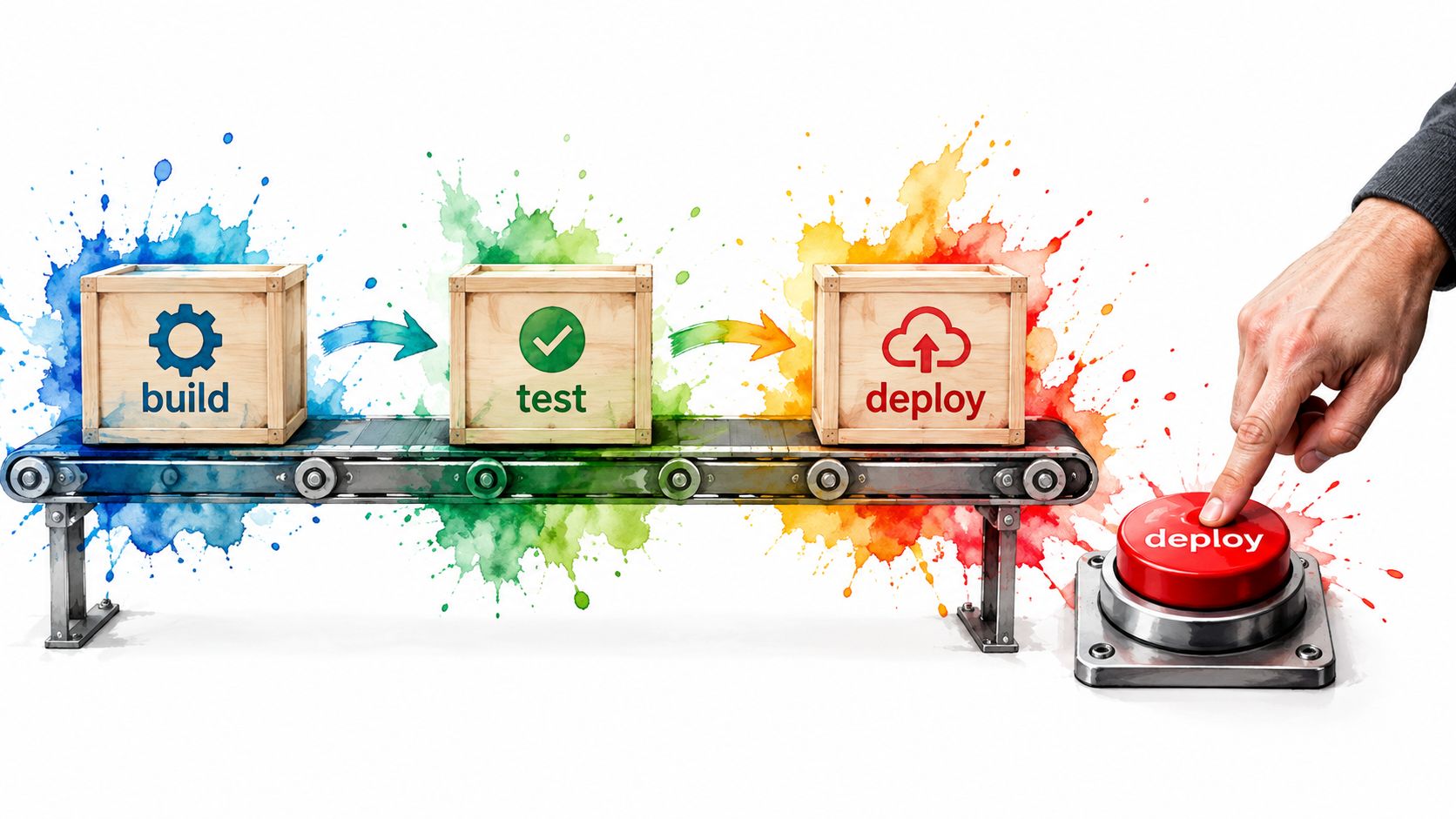
A strong design usually flows from commit to build, test, artifact creation, deployment, and verification. Name the controls that make each stage safe: branch protections in Git, reproducible builds, automated unit and integration tests, signed artifacts, deployment approvals where risk justifies them, and post-deploy health checks. If you mention Jenkins, GitLab CI, GitHub Actions, Argo CD, or Spinnaker, explain why they fit the workflow instead of dropping names.
What a strong answer should include
Candidates stand out when they show release judgment rather than “always automate everything.” Blue-green and canary are useful, but they're not free. Blue-green burns more environment capacity. Canary depends on solid metrics and fast rollback logic.
- Clarify release shape: Describe whether you're handling a monolith, microservices, or batch jobs, and whether one pipeline serves all workloads or only the app tier.
- Control artifacts: Explain where build outputs live, how versions are tagged, and why you deploy immutable artifacts instead of rebuilding in later environments.
- Secure the path: Mention secret injection, least-privilege service accounts, dependency scanning, and environment separation.
- Plan for failure: Include rollback criteria, smoke tests after deployment, and what happens if database migrations partially succeed.
Practical rule: The best pipeline answer explains how a bad change stops automatically before customers notice.
Teams are also putting more scrutiny on delivery flow because the market for DevOps skills keeps expanding. One market report projects the global DevOps market at USD 19.57 billion in 2026, rising to USD 51.43 billion by 2031 at a 21.33% CAGR, which helps explain why interviewers probe both delivery depth and business impact in this DevOps market report from Mordor Intelligence.
For structure practice, sketch your answer with these system design templates. Then rehearse a short scenario around scaling with a DevOps pipeline: “traffic doubles during a release window and one region starts returning errors.” Explain whether you pause, reroute, or continue.
2. Infrastructure as Code Implementation
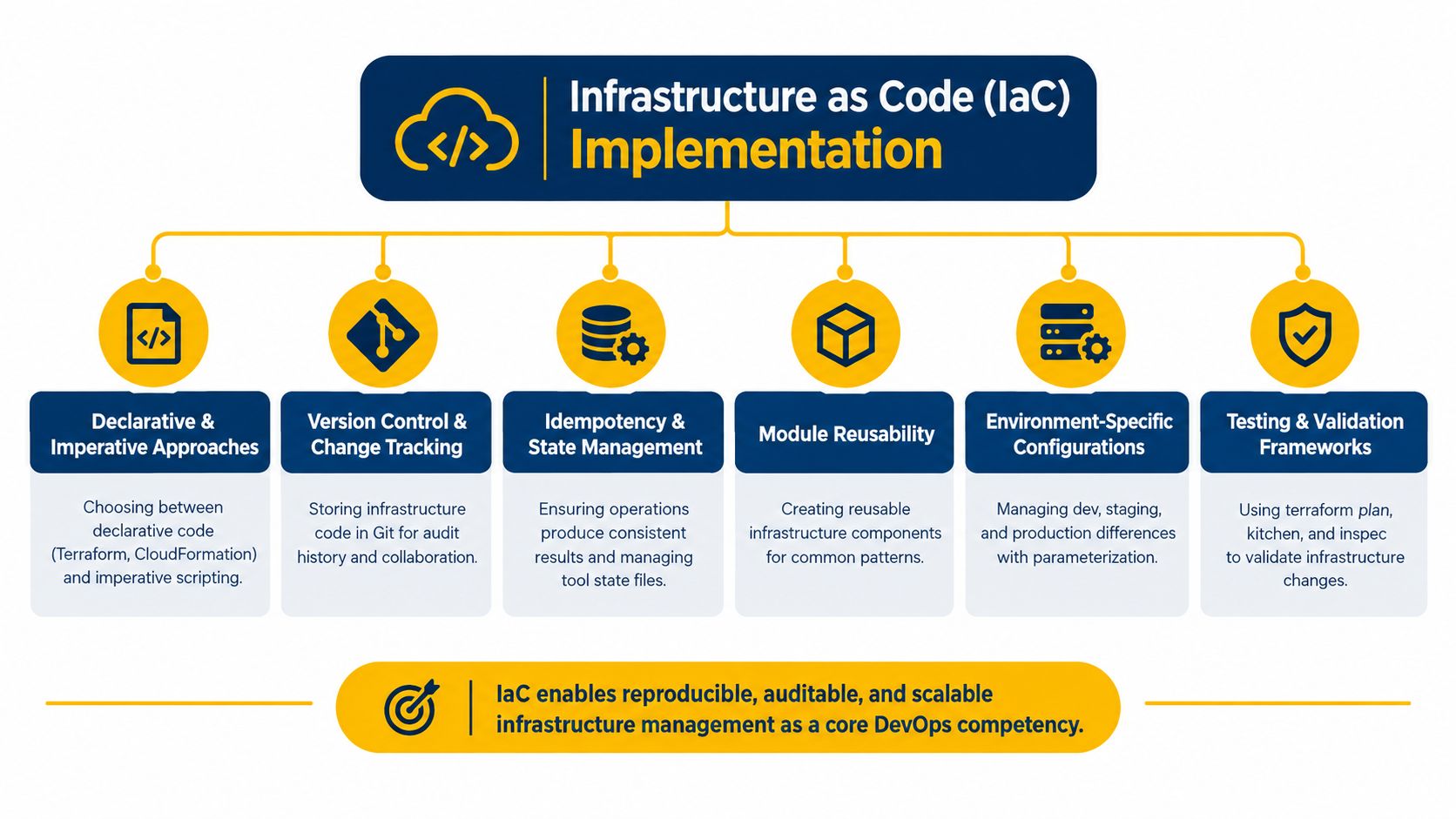
An interviewer gives you this prompt: production was patched in the cloud console at 2 a.m. to stop an outage, and the morning Terraform run now wants to remove that fix. Your answer to that scenario says more than any tool definition. It shows whether you treat IaC as a repository of truth, a deployment convenience, or a control system for risky changes.
Good answers start with decision boundaries. Define what belongs in provisioning code, what belongs in configuration management, and what should never be changed by hand except under an incident policy. Terraform might fit multi-cloud provisioning and shared modules. CloudFormation can make sense for AWS-heavy teams that want tighter platform alignment. Ansible often belongs later in the chain for host setup and application configuration, not for managing long-lived cloud primitives.
Interviewers are evaluating whether you can run IaC safely under real operating pressure.
One way to structure your answer is to walk through the lifecycle of a change instead of reciting features:
1. Before the change
State where code lives, how reviews happen, and how teams prevent one engineer from applying unreviewed infrastructure. Mention pull requests, environment separation, and policy checks. If you use modules, explain how you version them and how consumers adopt updates without forcing every environment to change at once.
2. During the change
Explain what the execution path looks like. A strong answer covers plan output review, remote state, state locking, and short-lived credentials from the CI system rather than long-lived keys on laptops. If the interviewer asks about existing infrastructure, mention imports and the risk of importing resources with poor naming or inconsistent tags.
3. After the change
Cover drift detection, auditability, and rollback limits. Infrastructure rollbacks are not always symmetrical. Reverting a security group rule is simple. Reverting a database replacement or a deleted queue may not be. Good candidates say that clearly.
The trade-offs matter here more than the tool names:
- A shared module library improves consistency, but one bad module release can affect every team that consumes it.
- Per-environment overrides help teams ship around local constraints, but they also create silent divergence that appears during recovery or scaling.
- Strict drift enforcement keeps environments aligned, but auto-reconciling every manual change can recreate an outage if the emergency fix was correct and the code was stale.
A strong answer should also include failure handling. If state is corrupted, say how you recover from backup and verify that the recovered state still matches real resources before running another apply. If two applies race, explain locking and approval controls. If a resource was changed outside code, explain whether you import the change, recreate the resource, or intentionally keep it outside IaC because the operational cost of control exceeds the benefit.
For rehearsal, use this prompt and answer it out loud in under two minutes:
A manual production change fixed an outage, drift detection fires, and the next apply proposes to undo the fix. What do you do?
Hit these checkpoints in order:
- Stabilize the live service first.
- Record the emergency change in code or document why it should remain outside IaC.
- Reconcile state deliberately, with review, instead of forcing an immediate apply.
- Check whether the manual fix exposed a gap in module design, approval flow, or incident procedure.
That answer shows operational judgment, not just Terraform familiarity.
3. Container Orchestration and Kubernetes Architecture
A common interview prompt sounds simple: "How would you run this service on Kubernetes?" In practice, the interviewer is testing whether you can make architecture choices under production constraints. Start with the workload and the failure mode, not with API object definitions. A payments API, a batch worker, and a stateful queue should not get the same answer.
Here is a stronger way to frame your answer under pressure.
Evaluation prompt: You need to deploy a customer-facing service to Kubernetes, keep rollouts low risk, and support scaling during traffic spikes. Explain the architecture you would choose and where Kubernetes is the wrong fit.
A strong answer usually covers four decisions.
First, pick the right controller for the workload. Deployments fit stateless APIs and web services. StatefulSets fit databases, brokers, and clustered systems that need stable identity or ordered startup. DaemonSets fit node-level agents such as log shippers or security sensors. Jobs and CronJobs fit finite or scheduled work. Good candidates also say when they would keep a workload off Kubernetes, such as a database that depends on storage performance the platform cannot deliver consistently, or a small service where cluster overhead adds more operational cost than value.
Second, explain traffic flow from user to pod. Cover ingress or load balancer entry, Service routing, DNS discovery, and readiness gates. Weak answers drift into vocabulary. Strong answers tie each component to a live operating decision. For example, readiness probes protect rollouts from sending traffic to a pod that started but has not connected to its dependencies yet. Bad probe design can also cause a healthy pod to flap and drop out of rotation.
Third, cover storage and failure handling. PersistentVolumeClaims and storage classes matter only if you explain what happens during node loss, rescheduling, backup, and restore. Interviewers listen for whether you understand that "pod restarted" and "data recovered" are separate problems.
Fourth, address guardrails. RBAC, namespaces, network policies, image provenance, and pod security controls belong here because cluster design and security design are linked. A team that gives every workload broad node or secret access will eventually pay for it during an incident.
Use trade-offs, not a glossary.
If the interviewer asks about scaling, do more than name HPA. Say what signal drives scaling, CPU, memory, request rate, queue depth, or a custom business metric, and explain the failure case. Fast horizontal scaling can overload a database, exhaust IP space, or create noisy autoscaling if requests are bursty. Sometimes the right answer is to scale a queue consumer slowly on purpose and protect the downstream system.
If the interviewer shifts into troubleshooting, treat it like an incident review. For example:
Pods are healthy, but users receive 502 errors after a deployment. What do you check first?
Build your answer in this order:
- Confirm whether the 502 comes from ingress, an internal proxy, or the application.
- Check Service selectors and Endpoint objects to verify traffic is pointed at the intended pods.
- Review readiness probe behavior and recent rollout events to see whether pods were marked ready too early.
- Inspect ingress rules, TLS configuration, and upstream timeout settings.
- Verify the app can still reach dependencies such as auth, cache, or database services.
That sequence shows operational judgment. It also shows you know Kubernetes problems often come from the boundary between objects, not from the pod itself.
For rehearsal, practice one version of this answer with an OS-level angle. Explain what node pressure, cgroup limits, DNS resolution, and container networking do to application behavior, then tighten the answer with these Linux interview question drills.
A concise answer should leave the interviewer with three clear signals. You can map workload type to the right controller, you understand how traffic and storage behave under failure, and you can explain where Kubernetes adds value versus where it adds complexity.
A short visual refresher can help before mock interviews.
4. Monitoring, Logging, and Observability Strategy
A service goes slow at 2:13 a.m. CPU is fine. Memory is steady. Error rate barely moves, but checkout time climbs and support starts getting customer complaints. That is the kind of situation this interview topic is really testing. The interviewer wants to know how you build visibility that helps an engineer find the cause, make a safe decision, and reduce time to recovery.
Good answers start with user impact, then move inward through the system. State what you need to observe at each layer: user-facing symptoms, service behavior, dependencies, and infrastructure constraints. If you begin by listing tools, you sound like you memorized a stack. If you begin with decision points, you sound like someone who has operated production systems.
One strong way to answer is to treat the question like an evaluation prompt: “Design an observability strategy for a service that has APIs, background workers, and a database.” Then explain what a usable setup must let the team do.
Answer-building checkpoints
- Detect user-visible problems quickly with service-level indicators such as latency, error rate, and throughput.
- Separate cause from symptom by collecting metrics for the app, its dependencies, and the underlying compute and network path.
- Use structured logs with correlation IDs so one failing request can be traced across services.
- Sample or retain traces in a way that supports incident work without creating unreasonable storage cost.
- Route alerts by severity and ownership, with clear expectations for who responds and what first action they take.
Trade-offs matter here. Full-fidelity tracing improves investigations, but cost rises fast in high-volume systems. Long log retention helps with compliance and forensic work, but it also raises storage cost and increases the chance of retaining sensitive data longer than intended. Aggressive alerting catches regressions faster, but it can train teams to ignore pages. Candidates who mention these trade-offs sound more credible than candidates who recite product names.
A strong answer should also distinguish the jobs of each signal type. Metrics are for trend detection, thresholding, and capacity planning. Logs are for event detail and state changes. Traces are for following a request through multiple hops when dashboards show only part of the story. Interviewers listen for whether you know which signal to check first under pressure.
If you want one sentence that usually lands well, use this: observability is only useful if it shortens diagnosis and changes what the on-call engineer does next.
There's another angle interviewers increasingly care about. Modern DevOps hiring now tests how candidates discuss AI-assisted operations, operator oversight, uncertainty during incidents, and communication across distributed teams, but many public question sets still barely cover it in this hiring-trend interview guide. If you mention anomaly detection or auto-remediation, explain the stop conditions too. Say when automation can restart a worker or shift traffic, and when it must hand control to a human because the blast radius is unclear.
Use this rehearsal prompt: “The dashboard shows increased latency, but CPU and memory look normal.” A solid response should cover downstream dependency timing, connection pool exhaustion, thread or worker saturation, lock contention, recent deploy changes, DNS or network path shifts, and whether your trace sampling would even capture the slow path. For practice, answer it in under 90 seconds, then answer it again with more detail on alert thresholds, dashboards, and what evidence would confirm or rule out the database.

5. Incident Response and Disaster Recovery Planning
At 2:13 a.m., the primary region drops out of rotation. Error rates spike. Replication status is stale, the last backup completed, and nobody can yet prove whether the database replica is current enough to promote. That is the kind of interview prompt that separates a candidate who has operated systems from one who has only read runbooks.
A strong answer starts by classifying the failure before naming tools. Bad deploy, regional outage, data corruption, credential compromise, and upstream provider failure each change the recovery path, the approval chain, and the acceptable risk. Recovery objectives matter, but interviewers also want to hear what evidence you would collect in the first five minutes and what decision you would delay until you know more.
Use the answer as a timeline, not a glossary.
First 5 minutes: confirm blast radius, freeze risky changes, assign an incident lead, and check whether the problem is isolated to one service, one dependency, or one region.
Next 15 minutes: validate backups, compare replica lag against your tolerance for data loss, decide whether failover is safer than degraded service, and publish a clear status update.
Recovery phase: restore service in the lowest-risk mode first, then verify data integrity, customer impact, and backlog drain before declaring the incident stable.
The trade-off interviewers care about is speed versus correctness. Automatic failover can cut downtime, but it can also promote bad state, split traffic across inconsistent systems, or hide the fact that the control plane is healthy while the data plane is not. Manual approval slows response, yet it gives the team one checkpoint to verify replica freshness, DNS behavior, cache warmup, and whether the failover target can carry production load.
What should a strong answer include?
- Recovery targets tied to system behavior, not just acronyms. Explain what data loss is acceptable for this service and what downtime the business can absorb.
- Restore testing. Backups only count if the team rehearses restore time, integrity checks, and dependency startup order.
- Role clarity. Name who can declare the incident, who approves failover, who communicates externally, and who stays focused on technical mitigation.
- Degraded mode decisions. Say when you would serve read-only traffic, queue writes, disable noncritical features, or keep one workflow offline to avoid making recovery worse.
One detail often makes an answer sound real. Candidates who mention uncertain replication state and explain how they would verify it usually stand out. That could mean checking replication lag metrics, last applied log position, checksum validation on a critical table, or application-level reconciliation after promotion. For broader planning context, tie your scenario back to BCP practices for cloud operations.
Rehearsal prompt: “Your primary region is down. The standby region is available, but the database replica may be behind.” Practice a 90-second answer that covers evidence gathering, failover approval, customer communication, and the point where you choose degraded service instead of a full cutover. A polished answer sounds calm, names the risk of promoting stale data, and shows how recovery decisions protect both uptime and correctness.
6. Security in DevOps
A realistic interview version of this topic sounds like an operating problem: a release is ready, a new dependency pulls in a critical CVE, and the service also needs a production credential at runtime. The interviewer is testing whether you can place controls at the right points, decide what blocks a deploy, and explain who gets an exception and under what evidence.
A strong answer follows the path of change through the system and names the decision at each checkpoint.
Prompt: “How do you build security into a DevOps workflow without slowing delivery to a crawl?”
Build your answer around these checkpoints:
- Source and review: signed commits if your team uses them, branch protection, code review, and rules for handling secrets before code ever reaches CI.
- Build and dependency control: SCA for libraries, image scanning for base layers, and a policy for severity thresholds that block builds.
- Identity and secrets: vault-backed retrieval, short-lived credentials, rotation, and workload identity instead of long-lived static keys.
- Infrastructure policy: IaC checks for open security groups, public storage, missing encryption, risky IAM bindings, and drift from approved patterns.
- Runtime guardrails: admission control, least-privilege service accounts, network policy, container runtime limits, and audit logging that preserves evidence without spilling sensitive data.
The answer gets better when you explain what you would block automatically versus what you would review manually. Teams that fail every build on every medium finding usually create alert fatigue and exception sprawl. Teams that ignore supply chain issues until production create a different failure mode. A practical middle ground is to block known exploitable paths, secret exposure, and high-risk privilege changes, then require documented exceptions for time-bound cases.
Here is the part many candidates skip. Security controls need ownership. If a pipeline flags a vulnerable dependency, say who can approve a temporary exception, how long that exception lasts, what compensating control applies, and where the audit record lives.
What a credible answer should include
Interviewers usually listen for judgment more than tool names.
For example, “we scan containers” is weak. “We pin base images, scan during build, sign approved artifacts, and reject unsigned images at deploy time” shows a chain of custody. “We store secrets in a vault” is also incomplete. Add retrieval method, rotation cadence, access scope, and what happens when the secret leaks.
If you want to sharpen the behavioral side of your answer, the phrasing in these cybersecurity interview questions is useful for threat modeling, escalation, and evidence handling.
Rehearse with one concrete failure
Use this scenario: “A production secret appeared in logs after a failed deploy.”
Practice a 90-second answer with this order:
- Contain exposure. Restrict access to the log system, stop further logging of the secret, and identify where else that secret may have propagated.
- Rotate credentials. Replace the secret, revoke dependent sessions or tokens, and confirm applications picked up the new value.
- Measure blast radius. Check access logs, deployment logs, CI artifacts, and any copied log sinks.
- Fix the path. Change application logging, pipeline redaction, and secret injection so the same failure does not recur.
- Record the exception and follow-up work. Document impact, evidence, and the control changes that close the gap.
Candidates stand out when they mention trade-offs that happen in real systems. Full log deletion may destroy forensic evidence. Keeping logs untouched may preserve the leaked secret longer than necessary. A mature answer explains how to preserve evidence, restrict access, rotate fast, and sanitize downstream retention where policy allows.
7. Scaling and Performance Optimization
A service is timing out under peak load, CPU sits at 35%, and the team is asking whether to double the node count. That is the kind of scaling question interviewers are really asking. They want to hear how you find the limiter before you spend money or spread the problem across more machines.
A strong answer starts with a diagnosis path, not a scaling tactic. Describe the workload shape first. Interactive traffic behaves differently from batch jobs, and steady growth behaves differently from flash spikes. Then identify where latency is building: application threads, connection pools, database locks, queue depth, storage IOPS, network hops, or a slow upstream API. Candidates who answer well usually name the first graphs they would check, such as request rate, p95 latency, saturation, error rate, queue backlog, and database wait time.
Use the prompt like an evaluation drill: “Our checkout API slows down every evening. Walk me through what you do in the first 30 minutes.”
Good answers usually cover checkpoints like these:
- Confirm the symptom. Is the problem throughput, latency, timeout rate, or error rate?
- Find the saturated resource. CPU, memory, disk, network, locks, worker concurrency, or downstream connection limits.
- Check whether scaling the app tier helps or only pushes more traffic into a constrained database or third-party service.
- Separate short-term protection from long-term fixes. Rate limiting, queueing, and temporary capacity buys time. Query tuning, index changes, caching strategy, or partitioning address the cause.
Trade-offs matter here because nearly every performance fix shifts pressure somewhere else.
Horizontal scaling improves throughput and failure tolerance, but stateless app nodes are the easy case. Session affinity, distributed caches, write coordination, and idempotent workers add operating overhead. Vertical scaling is faster to execute and often useful during an incident, but it increases blast radius and eventually hits instance limits.
Caching cuts read load and can flatten traffic bursts. It also creates invalidation rules, stale reads, warm-up delays, and surprise failure modes when the cache cluster is slow or empty. A candidate stands out by saying where caching belongs. CDN for static assets, application cache for hot objects, database cache for repeated reads, or queue buffering for burst absorption.
Autoscaling deserves a more careful answer than “set CPU to 70%.” CPU may be a poor signal for worker pools waiting on I/O. Request concurrency, queue depth, or latency can be better triggers. Slow startup times also matter. If new instances take four minutes to become useful, autoscaling may react after the user-visible incident has already started.
Database answers should stay grounded in workload type. Read replicas help read-heavy systems. They do little for write contention, lock waits, or a bad schema. Sharding can remove a ceiling, but it makes joins, migrations, and operational recovery harder. Interviewers are listening for that trade-off awareness.
Platform design belongs in this discussion too. Google Cloud's announcement of the 2025 DORA report notes broad adoption of internal platforms and links platform quality with stronger delivery outcomes in DevOps maturity in Google Cloud's announcement of the 2025 DORA report. In interview terms, that means scaling is not only a service-level tuning exercise. Good teams also standardize autoscaling policies, performance budgets, load-test templates, and safe defaults through a platform.
For rehearsal, use this scenario: “Response time doubles during peak traffic, but CPU and memory remain low.”
Answer it in this order:
- Check saturation signals that are not CPU-bound. Thread pools, DB connections, queue depth, storage latency, and external API timing.
- Inspect request patterns. Look for N+1 queries, lock contention, bursty consumers, or a noisy neighbor on shared infrastructure.
- Trace one slow request end to end. Separate app time from database time and network wait.
- Apply a low-risk mitigation. Increase connection pool only if the database can absorb it. Add caching only if stale reads are acceptable. Scale workers only if the bottleneck is parallelizable.
- Name the graph you would watch after the change to confirm you improved the constraint.
That last step is where weaker answers usually fall apart. They propose a fix but do not define the success signal. A strong answer closes the loop: “I expect p95 latency to drop, queue depth to stabilize, and database wait time to stay flat after the change.”
8. Version Control and Branching Strategies
Friday, 4:40 p.m. A production bug needs a fix before the weekend. A feature branch that touched the same service has been open for nine days, passed some checks, and is nowhere near releasable. That is the interview prompt behind version control questions. The interviewer is not testing whether you can recite Git Flow terms. They are testing whether you can keep change history, release timing, and recovery options aligned under pressure.
Strong answers start with operating constraints. How often does the team deploy. How long do code reviews sit open. Do services release independently or in coordinated batches. Is Git also the control plane for infra or application config. Branching strategy follows from those choices.
A candidate who answers well usually covers four decisions:
- Integration frequency: Small, frequent merges reduce conflict buildup and expose integration failures earlier.
- Release isolation: Some teams need a place to stabilize a release candidate without freezing all development.
- Hotfix path: Urgent fixes need a controlled route to production, then back into the main development line.
- Audit and rollback: Tags, commit history, and release mapping need to make it obvious what is running and how to revert it.
Here is how I would frame the trade-offs in an interview.
Trunk-based development fits teams that deploy often, keep pull requests small, and trust CI to reject bad merges quickly. It lowers merge pain and shortens feedback loops. It also puts pressure on test quality, code review discipline, and feature-flag hygiene. Without those controls, the branch model looks fast on paper and unstable in production.
Feature branches help when work is large or risky and needs isolation before merge. That isolation has a cost. The longer the branch lives, the less confidence you have that passing tests still reflect current reality on main. Interviewers want to hear that you would keep these branches short-lived, rebase or merge from main regularly, and split oversized changes where possible.
Release branches are useful in shops with scheduled releases, regulated signoff, or support teams that need a stable patch line. They can reduce late-cycle churn in the release candidate. They also create extra bookkeeping. Bug fixes may need cherry-picks. Teams can accidentally support multiple truths if they are not strict about what merges where.
GitOps changes the discussion a bit. In that model, Git is not only a collaboration tool. It is part of the runtime control path and an audit record for operational changes. That raises the bar for commit clarity, approval flow, and branch protection because a merge may trigger deployment or configuration drift correction.
A practical answer should also mention workflow controls, not just branch names. Protected branches, required status checks, CODEOWNERS, signed commits where needed, release tags, and a documented revert process matter more than arguing over one Git model versus another.
Tool sprawl also affects this area. Analysts at Gearset found in Gearset's 2025 DevOps report that teams with more consolidated toolsets were more likely to deploy quickly and less likely to spend a full day on deployment tasks in Gearset's 2025 DevOps report. The interview takeaway is simple. Every extra handoff between source control, CI, release tracking, and change approval increases the chance that branch policy exists in theory but not in day-to-day practice.
Use this rehearsal prompt:
A hotfix must ship now while a large feature branch remains open and touches the same files. What do you do.
A strong answer should hit these checkpoints:
- Cut the hotfix from the production-safe branch or the current release branch, not from the stale feature branch.
- Keep the change narrow. Fix the defect, add or update the test that proves it, and avoid unrelated cleanup.
- Run the normal review and CI path unless there is a declared emergency process. If there is one, name the compensating controls.
- Tag the release so the exact hotfix commit maps to the deployed version.
- Merge the hotfix back into main and any active release line that would otherwise miss it.
- Reconcile the open feature branch so it does not reintroduce the defect on merge.
For practice, answer in 60 seconds, then in 3 minutes. In the short version, state your branch choice and your safety checks. In the longer version, explain what you would verify after deploy: the bug symptom is gone, no rollback indicators have appeared, and the feature branch now contains the fix or has been rebased to pick it up. That is the difference between a source-control answer and an operations answer.
9. Configuration Management and Environment Parity
A service passes tests in staging, then fails in production because one env var has a different name, a secret version changed, or a background worker points at the wrong queue. Interviewers use this topic to check whether you treat configuration as an operational system, not a bag of settings.
A strong answer starts with one decision. Promote the same artifact through environments, and change behavior through controlled configuration inputs. That usually means environment variables, mounted config, secret managers, or a central configuration service. Then explain how you prevent drift, how you detect it, and what you do when parity is expensive.
Here is a better way to frame the interview question:
Your app works in staging but fails in production after deployment. The code diff is small. How do you determine whether configuration drift is the cause, and how do you prevent it next time?
Good candidates do not stop at “store config outside the app.” They explain the operating checks.
Answer-building checkpoints
- Define the boundary between code, config, and secrets.
- Keep environment-specific values out of the image and out of the repository unless they are non-sensitive defaults.
- Validate configuration before rollout with schema checks, startup checks, and deployment gates.
- Track configuration changes with versioning, approval, and rollback paths.
- Detect drift by comparing declared state against actual runtime state.
- Explain which parts of staging must match production closely, such as auth flows, network policy, service discovery, and backing service behavior.
Trade-offs matter here. Full parity costs money and time. Exact production clones are often unnecessary for low-risk services, but weak parity around identity, networking, TLS, feature flags, or managed service versions leads to false confidence. The best answers name the areas where mismatch creates misleading test results.
Interviewers also want to hear how you troubleshoot under pressure. If a deploy fails only in one environment, check the effective runtime configuration, not just the source files. Compare injected env vars, secret versions, config maps, startup logs, and service endpoints. If the app supports it, expose a sanitized config diagnostic endpoint or startup report so operators can confirm what the process loaded.
For rehearsal, use this prompt:
You need to rotate a database connection string used by several services without downtime. What is your rollout plan?
A strong answer should cover:
- Whether the database can accept both old and new credentials during a transition window.
- The order of operations for updating secrets, restarting or reloading workloads, and confirming adoption.
- How each service reads configuration. At startup only, on signal, or through dynamic reload.
- What happens if one service misses the update and keeps using the old secret.
- What metrics and logs you watch for authentication failures, connection churn, and partial rollout.
Practice in two passes. In 60 seconds, give the rollout order and the rollback path. In 3 minutes, add the failure mode analysis: one service did not reload, one pod has stale config, or the old credential was revoked too early. That shows you understand configuration parity as a live reliability problem, not just an application settings question.
10. Team Structure, Collaboration, and Communication in DevOps
A useful interview prompt here sounds like a real operating problem, not a culture question: Your product team ships its own service, a platform team manages Kubernetes and CI/CD, and an incident spans both. Who leads, who decides, and how do you keep communication accurate while the system is still changing?
Strong candidates answer by defining interfaces between teams, then showing how those interfaces hold up under pressure. The interviewer is listening for ownership, escalation paths, and decision speed. They also want to know whether collaboration reduces risk or just adds meetings.
Two team models come up often. Neither is universally right.
If product teams own services end to end, they usually move faster because the same people build, deploy, and support what they run. The trade-off is uneven operational maturity across teams. One service may have strong alerts and rollback automation, while another depends on tribal knowledge.
If a central platform team owns more of the delivery stack, standards improve and duplicated work drops. The trade-off is queueing. Product teams can become blocked on platform changes, and responsibility gets blurry during incidents unless escalation rules are explicit.
A strong answer should cover four things, but it does not need to present them as a checklist in the interview. Tie each point to an operating decision:
- Service ownership: Name who owns deployment approval, runtime health, rollback decisions, and post-incident fixes.
- Platform boundaries: Explain what the platform team provides. CI templates, base images, observability defaults, secret delivery, policy guardrails, or cluster operations.
- On-call structure: Show how incidents escalate across application, platform, database, and security boundaries without forcing everyone onto every page.
- Communication path: Distinguish technical coordination in the incident channel from stakeholder updates for support, leadership, or customer-facing teams.
The strongest answers also explain documentation in concrete terms. A runbook should tell an on-call engineer what to check first, what commands or dashboards to use, when to roll back, and who to pull in next. An architecture diagram should clarify dependencies that affect incident scope. A post-incident review should produce one of three outputs: a code change, an automation change, or a process change. If it produces none of those, it was only a discussion.
Interviewers often probe on conflict. For example, a product team wants deployment freedom, while the platform team wants standardization. Handle that as a policy design problem. Keep paved-road defaults for the common path, then define an exception process with clear risk review. That shows judgment. Full central control slows delivery. Full local freedom usually creates inconsistent security, observability, and recovery behavior.
One sentence matters a lot in this section: clear status updates are part of incident management.
If asked how you communicate during an outage, give actual wording, not principles. A solid update sounds like this:
We are seeing elevated checkout errors after the last deployment. We have paused further releases and are comparing application logs, dependency health, and recent config changes. Customer impact is active in one region. Rollback will start if error rate does not improve after the current mitigation check. Next update in 15 minutes.
That answer works because it states impact, action, uncertainty, decision criteria, and timing.
Use this rehearsal exercise:
A deployment causes customer-facing errors. The product team owns the code, the platform team owns the cluster, and leadership wants updates every 15 minutes. How do you run the response?
Practice it in three layers:
- In 45 seconds, assign incident commander, technical leads, and stakeholder update ownership.
- In 90 seconds, explain what each team checks first and when you choose rollback over continued diagnosis.
- In 3 minutes, describe the follow-up. Runbook updates, alert tuning, ownership gaps, and one structural change that would make the next incident easier to handle.
That turns a soft-sounding interview topic into what it really is: an evaluation of how teams make decisions together when reliability, speed, and accountability pull in different directions.
DevOps Interview: 10-Topic Comparison
| Item | 🔄 Implementation complexity | ⚡ Resource requirements | ⭐ Expected outcomes | 📊 Ideal use cases | 💡 Key advantages / tips |
|---|---|---|---|---|---|
| Design a CI/CD Pipeline | High, multiple stages, integrations, rollback logic | Medium, CI runners, artifact repo, test infra | Reliable, frequent releases; reduced deployment risk ⭐⭐⭐ | Continuous delivery needs, microservices, fast release cadence | Automate incrementally; ask scope questions; plan secrets and rollback |
| Infrastructure as Code (IaC) Implementation | Medium‑High, declarative paradigms, state management | Medium, IaC tools, state backend, testing frameworks | Reproducible, auditable infrastructure; consistent environments ⭐⭐⭐ | Multi‑env or multi‑cloud infra, repeatable provisioning | Choose tools by portability; enforce state/version control; test plans |
| Container Orchestration & Kubernetes Architecture | High, distributed control plane, networking, storage | High, clusters, storage, networking, operator expertise | Scalable container management and orchestration ⭐⭐⭐ | Microservices at scale, many containers, cloud‑native platforms | Start with cluster basics; address storage, networking, RBAC; practice hands‑on |
| Monitoring, Logging & Observability Strategy | Medium, instrumentations, pipelines, alerting design | Medium, metrics DB, log storage, tracing and dashboarding | Faster detection/diagnosis; improved reliability ⭐⭐ | Production systems requiring visibility and SLO tracking | Define what to observe first; balance retention vs cost; design alerts to reduce noise |
| Incident Response & Disaster Recovery Planning | Medium‑High, RTO/RPO design, failover automation | Medium, backups, multi‑AZ/region infra, runbooks | Minimized downtime and business impact; tested recovery ⭐⭐⭐ | Systems with strict SLAs, critical data or high availability needs | Start with RTO/RPO; automate failover; run blameless RCAs; rehearse chaos tests |
| Security in DevOps (DevSecOps) | Medium‑High, pipeline integration, policy enforcement | Medium, scanners, secrets store, policy engines | Reduced security risk; improved compliance and traceability ⭐⭐ | Regulated environments, public apps, supply‑chain sensitive systems | Shift security left; automate scans and secrets rotation; manage false positives |
| Scaling & Performance Optimization | Medium‑High, tuning across stack, autoscaling logic | Medium‑High, load testing, caching, CDN, DB replicas | Better throughput, lower latency, cost efficiency ⭐⭐ | High‑traffic services, rapid growth, peak events | Profile to find bottlenecks; use caching/CDNs; design autoscaling policies |
| Version Control & Branching Strategies | Low‑Medium, policy and workflow decisions | Low, git hosting, CI hooks, code review tools | Improved collaboration, traceability, stable releases ⭐⭐ | Any team development workflow, CI/CD integration | Match strategy to team size; enforce reviews and CI on PRs; document conventions |
| Configuration Management & Environment Parity | Medium, templating, secrets, drift detection | Low‑Medium, config stores, secret managers, validation tools | Fewer env‑specific failures; reproducible deployments ⭐⭐ | Multi‑env deployments, 12‑factor apps, feature flagging | Separate config from code; validate templates; monitor drift; use feature flags |
| Team Structure, Collaboration & Communication | Medium (organizational change), roles, on‑call, culture | Low, collaboration tools, training, documentation time | Improved delivery, resilience, and knowledge sharing ⭐⭐ | Organizations adopting DevOps culture or scaling teams | Promote cross‑functional teams, blameless postmortems, measurable DORA metrics |
Turn Each Question Into a Rehearsed Decision
The fastest way to improve on interview questions DevOps candidates face is to stop memorizing definitions and start rehearsing decisions. For each topic above, build one answer that sounds like something you'd say in a live interview. Keep it compact. Clarify the scenario, state your assumptions, propose an approach, explain the trade-offs, identify failure modes, and define how you'd know the solution worked.
That structure matters because DevOps interviews usually test operating judgment under ambiguity. You won't always get perfect requirements. Sometimes the interviewer intentionally leaves out details so they can see whether you ask the right questions first. A candidate who says, “It depends on release frequency, rollback tolerance, and whether the service is stateful,” sounds far more credible than one who jumps directly into a preferred toolchain.
Write one concise answer for each of the ten prompts. Then add one practical exercise. Sketch a CI/CD pipeline. Review an IaC plan. Trace a Kubernetes traffic path. Build an alert rule. Walk through a failover decision. Describe a secrets rotation. Diagnose a scaling bottleneck. Resolve a hotfix branch conflict. Validate a configuration rollout. Draft an incident update. The exercise forces your answer out of theory and into execution.
Keep your examples grounded in real work, even if the systems were small. A modest but clearly explained deployment process is more convincing than a vague claim about “enterprise-scale infrastructure.” Interviewers usually trust detail over drama. If you can describe what broke, how you detected it, what you changed, and what you'd improve next time, you're giving them the signal they want.
It also helps to practice delivery separately from content. A good answer can still land poorly if it's scattered, too long, or overloaded with tool names. Rehearsal should include technical precision and verbal discipline. Answer in two to three minutes. Pause between steps. Use plain language. Name one or two tools only when they support your reasoning.
If you want a structured way to do that, Interview Pilot is one option for running mock interviews, reviewing a question bank, or using Copilot-style assistance to rehearse how you explain technical and behavioral answers. Used well, tools like that can sharpen structure and confidence. They don't replace judgment, hands-on operations work, or the need to think clearly about trade-offs.
The best preparation is still the same. Take each prompt and turn it into a decision you can defend.
If you want structured practice for interview questions DevOps teams ask, Interview Pilot gives you mock interviews, a searchable question bank, and real-time answer support across technical and behavioral rounds. Use it to rehearse clearer pipeline, incident, Kubernetes, and observability answers so you can focus on judgment instead of freezing when the interviewer pushes into production scenarios.
Topics
interview questions devops
DevOps interviews
CI/CD interview
Kubernetes interview
DevOps preparation
Continue reading

Interviews
10 Interview Question on Linux Topics to Master
Prepare for an interview question on Linux with 10 essential topics, commands, examples, and troubleshooting scenarios for technical roles.
September 19, 2026
23 min read

Interviews
What Is Behavioral Based Interviewing and How to Master It
Learn what is behavioral based interviewing, how the STAR method works, real answer examples for candidates, scoring tips for interviewers, and proven prep
September 20, 2026
20 min read

Interviews
8 General Manager Job Interview Questions
Prepare for general manager job interview questions with leadership frameworks, sample answers, follow-ups, and criteria for strong responses.
September 19, 2026
21 min read