













8 General Manager Job Interview Questions
Updated September 19, 2026
21 min read
Interview Pilot Editorial Team
Most advice about general manager job interview questions overvalues polish. A confident candidate who speaks smoothly about culture, leadership, and vision can still miss the bar for a GM role. Interviewers aren't hiring a motivational speaker. They're hiring someone who can run a business unit, make trade-offs, handle pressure, and keep people performing when priorities collide.
Strong answers have a pattern. They connect leadership behavior to business outcomes. They explain how the candidate made the decision, not just what happened after. They acknowledge trade-offs, especially around headcount, customer impact, speed, and cost. And they show evidence of execution, because modern GM interviews increasingly rely on structured, role-specific question sets rather than a few generic prompts. Indeed's general manager guide alone lists 31 common questions and groups them around recurring themes like delegation, motivation, leadership style, and strategic planning in a format that reflects how standardized these interviews have become across major markets (Indeed general manager interview guide).
That matters for preparation. You don't need clever answers. You need reusable proof.
The eight questions below work as a dual-purpose system. If you're a candidate, use them to build answers with evidence. If you're an interviewer, use them to separate GM-level judgment from polished but shallow talk. The sequence moves from people leadership and problem solving into financial performance, executive disagreement, metrics, change, talent, and strategic alignment. For added practice structure, this AI interview prep guide is a useful companion.
1. Tell Me About Your Leadership Style and How You've Managed Teams

A weak answer names a style. A strong answer explains how that style changes by situation.
General manager job interview questions often start here because leadership style reveals whether the candidate can coach, delegate, confront, and prioritize. Public manager-hiring guidance consistently centers on coaching, effective delegation, communication, success measurement, decision-making, criticism, deadlines, and motivation. That pattern shows how heavily GM interviews are weighted toward leadership behavior rather than narrow technical expertise (Greenhouse manager interview guidance).
Build the answer around operating behavior
A credible structure is simple. State your default approach, explain when you flex it, then prove it with one example.
For example: “I lead with clear expectations, visible metrics, and regular coaching. With new or struggling team members, I'm more hands-on. With proven managers, I delegate outcomes and stay close to risks, not every task.”
That works because it shows judgment. It avoids the common trap of saying “I'm a servant leader” or “I'm collaborative” without showing what that looked like on Monday morning.
Practical rule: If your leadership answer doesn't include delegation, accountability, and development, it's probably too soft for a GM interview.
A realistic example might involve a new site manager who needed weekly coaching on scheduling and labor planning, while an experienced operations lead only needed monthly business reviews and decision rights over staffing adjustments. The point isn't the label. The point is whether you knew when to direct, when to support, and when to get out of the way.
What interviewers should listen for
Use these signals to judge depth fast:
- Strong signal: The candidate explains how they adapt by team maturity, business risk, or urgency.
- Weak signal: They confuse being liked with leading effectively.
- Follow-up prompt: “Tell me about a time your style didn't work and what you changed.”
- Evidence to ask for: Team size, scope, succession examples, examples of coaching or performance correction.
Candidates who want sharper language for this answer can study leadership style interview answer examples. Rehearse until the answer sounds operational, not philosophical.
2. How Do You Drive Revenue Growth and Manage Profitability?
Many candidates drift into strategy theater. They talk about vision, customer focus, and commercial instinct, but they never show how they balanced growth against margin, capacity, or execution risk.
A GM owns trade-offs. Growth that strains delivery can hurt retention. Cost cutting that weakens service can damage future revenue. The best answers show that the candidate understands both sides of the P&L.
Use a growth plus discipline frame
A practical answer framework has four parts:
- Revenue lever: Where did growth come from, such as mix, pricing, sales productivity, customer retention, or capacity utilization?
- Constraint: What could have gone wrong, such as margin pressure, service quality, inventory, or labor cost?
- Decision: What did you choose to prioritize and why?
- Control mechanism: How did you monitor whether the move was working?
A solid example sounds like this: “I don't treat revenue and profitability as separate conversations. I look at where the business can grow without creating delivery failure. In one unit, we shifted attention from low-value volume to accounts with stronger repeat demand and better service fit. At the same time, we tightened review of discounting, staffing patterns, and vendor spend so growth didn't come with hidden cost creep.”
That answer works even without invented numbers because it shows commercial logic, risk awareness, and financial discipline.
What separates GM judgment from sales enthusiasm
Interviewers should push past “I grew the business” and ask how the candidate diagnosed the economics.
The strongest candidates can explain not just what made money, but what looked like growth and actually destroyed quality or margin.
Useful follow-ups include:
- “What did you stop doing?” Mature operators know growth often requires subtraction.
- “How did you know the improvement was sustainable?” This reveals whether they relied on a one-off win.
- “What trade-off did you accept?” Good GMs rarely claim a frictionless result.
Independent recruiting guidance for GM hiring also points toward compact, high-signal assessments, with one source arguing that five to seven strong, consistently asked questions outperform larger unstructured sets, while another uses a scorecard across profit-and-loss, operations, people, customers, and handoff criteria (general manager interview scorecard guidance). That's exactly why candidates should prepare concise, scoreable answers instead of broad strategy monologues.
3. Describe a Complex Problem You Solved and Your Problem-Solving Approach

A general manager rarely solves clean problems. Most are messy, cross-functional, and time-sensitive. The issue may look like declining output, but the cause might be poor handoffs, weak manager capability, or bad incentives.
So the interviewer isn't only testing whether you “fixed it.” They're testing whether you framed the problem correctly before acting.
Show your method, not just your heroics
Use a disciplined sequence:
- Define the core problem.
- Gather inputs from the functions involved.
- Identify constraints and options.
- Choose a path and explain why.
- Describe what changed after execution.
Here's a practical scenario: a branch or site is missing targets, customer complaints are rising, and managers blame staffing. A shallow answer says, “I hired faster and motivated the team.” A stronger answer says, “I reviewed staffing, schedule coverage, service times, and escalation patterns, then found that the issue wasn't just headcount. We had poor shift overlap and unclear ownership during peak demand. I changed coverage, reassigned decision rights, and introduced a short daily review to catch failures earlier.”
That answer shows diagnosis. Diagnosis is what GM interviews are really after.
Interviewer signals and failure modes
- Strong signal: The candidate distinguishes symptoms from root causes.
- Risk signal: They present themselves as the lone fixer and leave out collaboration.
- Follow-up prompt: “What alternative did you reject, and why?”
- Evidence to request: How they used data, who they influenced, what they changed in process or accountability.
Some of the best public GM interview frameworks repeatedly emphasize delegation, prioritization, conflict resolution, KPI ownership, budget allocation, and cross-functional leadership, often alongside scorecards and standardized evaluation methods (manager interview framework from Loyola University Chicago). That makes this question especially revealing. Strong candidates don't just tell stories. They make their reasoning easy to score.
If you want more scenario reps before the interview, review problem-solving interview scenarios for managers.
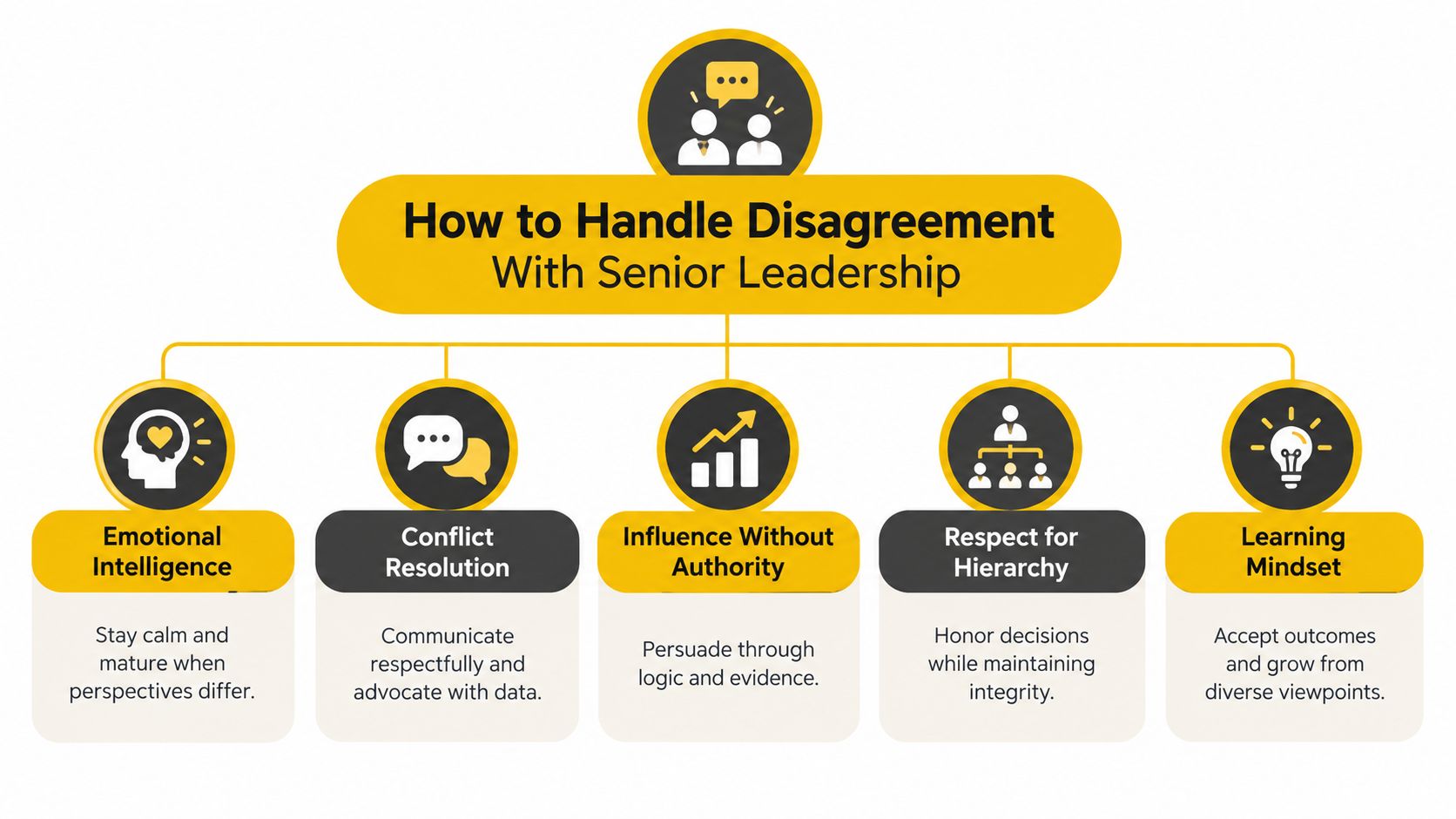
4. How Would You Handle a Situation Where You Disagreed With Your Boss or Senior Leadership?
This question exposes maturity fast. Many candidates overcorrect in one of two ways. They either sound passive and overly agreeable, or they sound like they need to win every argument.
Neither is GM behavior.
A general manager should challenge respectfully, use evidence, understand the broader context, and then execute the final decision unless the issue crosses an ethical or legal line.
A strong answer has two phases
First, explain how you raise the disagreement. Second, explain what you do after the decision.
A credible example sounds like this: “If I disagree, I try to understand the objective behind the direction before arguing the tactic. I bring alternatives with likely trade-offs, not just objections. If leadership still decides differently, I align the team and execute cleanly. If the issue creates legal, ethical, or material business risk, I escalate through the right channel.”
That answer works because it shows both backbone and discipline.
Respectful disagreement is not the same as silent disagreement. Interviewers want evidence that you can influence up without creating drag below.
The underused angle in GM interviews
One of the biggest gaps in public prep content is how candidates answer hard prompts involving layoffs, budget cuts, and workforce trade-offs. Many question lists still emphasize teamwork and conflict but underplay how a GM should decide when to cut costs, preserve headcount, or communicate painful choices while protecting execution quality (Indeed hiring guide for general manager interviews). If your example includes cost pressure, don't flatten it into “I put people first.” Show how you weighed morale, service levels, legal risk, and financial reality.
Interviewers should ask:
- “What facts did you bring into the disagreement?”
- “What did you do once the final call went against you?”
- “When would you escalate instead of comply?”
The best answers don't romanticize conflict. They show controlled judgment.
5. What Metrics Do You Track, and How Do You Use Data to Make Decisions?
Candidates often make two mistakes here. They list too many metrics, or they name a dashboard but never explain how it changed a decision.
A GM should track a small set of measures that connect operating activity to financial and customer outcomes. The exact list changes by industry, but the logic shouldn't.
Pick metrics that prove operating control
A good answer usually spans four buckets:
- Financial: Margin, cost trends, budget variance, or contribution by segment
- Operational: Throughput, service levels, cycle time, quality, or capacity use
- Customer: Retention, complaints, repeat business, or service recovery patterns
- People: Turnover, manager bench strength, productivity, or training completion tied to performance
Then explain how those metrics drive action. For example: “I don't track metrics for reporting theater. I use them to spot where execution is slipping. If customer complaints rise while labor hours are flat, I want to know whether the issue is staffing, training, scheduling, or process design before I authorize more cost.”
That answer shows that data is a decision tool, not a decoration.
Why this matters more now
Recent GM hiring guidance increasingly asks about data analysis, process improvement, and how candidates stay current with industry trends, but many interview pages still don't explain how to answer in a more automated, analytics-heavy operating environment. That gap matters because the World Economic Forum projects that 39% of workers' core skills will change by 2030 (general manager interview template discussing data and technology expectations). A GM who can't translate dashboards, automation, and process data into action will sound dated.
Good metric answers connect signal to intervention. Great ones also explain which metric can mislead you if viewed alone.
For interviewer-side evaluation, ask for one example where data contradicted instinct. That's where real operating discipline shows up. Candidates can also review broader management interview questions about metrics and decisions, then sharpen their thinking further with this data driven leadership guide.
6. Tell Me About Your Experience Managing Change and Driving Organizational Transformation
Change stories reveal whether a candidate can lead through uncertainty or only operate in stable conditions.
The weak version of this answer is a project update. “We implemented a new system.” “We reorganized the team.” “We rolled out a process.” The strong version explains why the change was necessary, where resistance came from, how buy-in was built, and what controls prevented drift.
Start with the resistance, not the rollout
If you want to sound like a GM, describe the human and operational friction up front.
For example: “The transformation itself wasn't the hardest part. The hardest part was getting middle managers to change how they made decisions and what they reviewed weekly. So I treated the change as a management-system shift, not just a process launch.”
That's the kind of answer that separates operators from project narrators.
A practical scenario could involve consolidating reporting lines after expansion, adopting a new operating cadence, or redesigning a service process that several departments resisted because it changed ownership boundaries. The strongest answers mention communication rhythm, local objections, quick wins, and how the candidate reinforced the new behavior after the initial launch.
What interviewers should probe
- Where did resistance come from? Frontline staff, middle managers, functional leaders, or customers?
- How did you sequence the change? Pilot first, full rollout, phased controls, or parallel process?
- What did you do when adoption lagged? Coaching, process redesign, staffing changes, or escalation?
A polished answer that skips resistance usually means the candidate either didn't lead the change or didn't notice what made it hard. Neither is reassuring at GM level.
7. How Do You Attract, Develop, and Retain Top Talent on Your Team?
Most candidates answer this like a people-ops brochure. They say they care about development, recognition, and culture. That isn't enough.
A GM should treat talent as an operating asset. Hiring quality affects execution speed. Manager capability affects consistency. Retention affects customer experience, safety, and cost. Development affects bench strength when growth or turnover hits.
Make the talent system visible
A stronger answer shows a repeatable management process:
- Attract: How do you define the role, assess fit, and avoid vague hiring?
- Develop: How do you coach, stretch, and prepare people for more responsibility?
- Retain: How do you identify burnout, stagnation, or manager-related risk before someone quits?
A realistic answer might sound like this: “I don't separate retention from management quality. I focus on hiring people into clear roles, onboarding them quickly into our standards, and giving managers a regular cadence for feedback and development. When someone strong looks disengaged, I don't wait for an exit interview. I look at workload, manager support, growth path, and whether we're using them well.”
That's practical. It connects talent to execution.
What good interviewer follow-ups expose
If a candidate says they develop people, ask who on their team became ready for larger scope because of their coaching.
That single follow-up often reveals the gap between intention and evidence.
Other useful probes:
- “How do you handle a high performer who undermines standards?”
- “What's your approach when a manager can deliver results but can't keep a team?”
- “How do you know whether a retention problem is compensation, workload, or leadership?”
General manager job interview questions around talent aren't asking whether you value people. They're asking whether you can build a team that performs reliably without constant rescue from above.
8. How Do You Ensure Your Team Stays Aligned With Company Strategy and Executes on Goals?
Alignment sounds abstract until a business misses targets because every team optimized for something different.
This is one of the clearest GM filters because it shows whether the candidate can translate strategy into operating rhythm. Public guidance for managerial interviews repeatedly points toward structured competency areas and standardized evaluation. That includes prioritization, KPI ownership, resource allocation, and cross-functional leadership, rather than broad “fit” conversations. In practice, that means good GM answers should show how business goals become team decisions and measurable controls, not just motivational messaging.
Explain the cadence, not just the intent
A practical answer has three layers:
- How you convert company priorities into team goals.
- How you communicate and review those goals.
- How you handle conflict when priorities compete.
For example: “I align teams by reducing strategy into a short list of operating priorities with clear owners, measures, and review cadence. I don't assume one kickoff meeting creates alignment. Managers need recurring reviews where they can surface trade-offs, capacity limits, and cross-functional dependencies before execution drifts.”
That answer works because it sounds like management, not aspiration.
What credible execution evidence looks like
Interviewers should listen for details such as meeting cadence, decision rights, escalation paths, and how the candidate resets priorities when the business changes.
Useful signals include:
- Strong signal: The candidate can explain how goals cascade to individual ownership.
- Weak signal: They talk about communication a lot but never describe accountability.
- Follow-up prompt: “Tell me about a time two strategic priorities conflicted. What gave?”
- Evidence to request: Examples of goal changes, resource reallocation, or course correction.
If the answer never gets down to who reviewed what, how often, and what happened when teams slipped, it probably isn't GM-level execution.
8-Point GM Interview Comparison
| Question | Implementation Complexity 🔄 | Resource Requirements ⚡ | Expected Outcomes ⭐ / 📊 | Ideal Use Cases 💡 | Key Advantages |
|---|---|---|---|---|---|
| Tell Me About Your Leadership Style and How You've Managed Teams | Medium 🔄, conversational, requires probing for specifics | Low ⚡, interviewer time + candidate prep | ⭐⭐, reveals maturity; 📊 qualitative + some metrics (team size, promotions) | Hiring managers evaluating people leadership and cultural fit | Reveals self-awareness, delegation, coaching mindset |
| How Do You Drive Revenue Growth and Manage Profitability? | Medium–High 🔄, needs financial context and follow-ups | Medium ⚡, company financials or candidate metrics needed | ⭐⭐⭐, shows P&L capability; 📊 measurable revenue/margin outcomes | GM, BU leaders, roles with P&L responsibility | Demonstrates strategic financial thinking and impact |
| Describe a Complex Problem You Solved and Your Problem‑Solving Approach | Medium 🔄, requires structured STAR storytelling | Low–Medium ⚡, interviewer probing; candidate prep | ⭐⭐⭐, highlights analytical process; 📊 measurable results when provided | Cross-functional leadership, crisis resolution, strategic roles | Exposes structured thinking, collaboration, and impact measurement |
| How Would You Handle a Situation Where You Disagreed With Your Boss or Senior Leadership? | Low–Medium 🔄, sensitive, needs behavioral nuance | Low ⚡, brief scenario-based discussion | ⭐⭐, reveals judgment and influence; 📊 mainly qualitative | Senior hires, roles interacting with executives | Assesses emotional maturity, diplomacy, escalation judgment |
| What Metrics Do You Track, and How Do You Use Data to Make Decisions? | Medium 🔄, depth varies by function | Medium ⚡, may require technical follow-ups or examples | ⭐⭐⭐, indicates data-driven discipline; 📊 clear KPIs and actions | P&L owners, ops, product, customer success leadership | Demonstrates measurable decision-making and accountability |
| Tell Me About Your Experience Managing Change and Driving Organizational Transformation | High 🔄, complex timelines and stakeholders | High ⚡, evidence of outcomes, stakeholder examples, timeframes | ⭐⭐, shows change leadership; 📊 impact often long-term and qualitative | Transformations, restructures, technology or cultural change | Evaluates stakeholder management, resilience, and adoption strategy |
| How Do You Attract, Develop, and Retain Top Talent on Your Team? | Medium 🔄, involves HR partnership and long-term metrics | Medium ⚡, hiring/retention data, development examples | ⭐⭐, shows people strategy; 📊 retention and promotion metrics useful | Roles responsible for team growth, succession planning | Reveals recruiting strategy, development focus, and retention levers |
| How Do You Ensure Your Team Stays Aligned With Company Strategy and Executes on Goals? | Medium 🔄, requires frameworks (OKR/MBO) and cadence | Medium ⚡, needs tools, meeting cadence, tracking artifacts | ⭐⭐⭐, indicates execution discipline; 📊 measurable goal attainment | Scaling teams, strategy execution roles | Translates strategy into measurable goals, accountability, and alignment |
Turn Your Experience Into Executive-Level Evidence
Preparation for general manager job interview questions gets easier when you stop treating every prompt as separate. Most of the interview is really testing a small set of executive capabilities: leadership, judgment, execution, financial discipline, talent management, and operating control. That means you don't need dozens of disconnected stories. You need a small library of strong ones that can flex across prompts.
Start by choosing one authentic example for each core competency. Pick stories where you owned the decision, not just supported someone else's project. Then map each story to five parts: situation, decision, action, trade-off, and measurable result. That structure matters because GM interviews have become increasingly standardized, with public guides often listing 30 or more questions and organizing them into repeatable competency areas rather than relying on generic conversation alone. That repeatability is visible across employer and hiring-platform guides that categorize questions around decision-making, coaching, budgeting, communication, and prioritization.
After that, build your follow-ups. Most candidates practice the main answer and ignore the harder second question. That's a mistake. For every story, prepare concise follow-ups on failure, stakeholder resistance, what you'd change now, and how you knew your intervention was working. If you've handled budget shortfalls, tough staffing choices, or process changes under pressure, those examples are especially valuable because they reveal real GM trade-offs.
Keep your delivery tight. Independent GM hiring guidance suggests that short, standardized assessments with a small number of consistently asked questions can outperform longer unstructured interviews, which means rambling hurts you twice. It weakens the answer and makes you harder to score. Aim for focused responses that explain the problem, your decision logic, and the evidence behind the result.
Rehearsal should be practical, not theatrical. Use mock interviews to test pacing, clarity, and whether your answer sounds operational instead of generic. Tools like Interview Pilot can help here through AI Mock Interview sessions, a searchable Question Bank, and Copilot customization that lets you adjust tone and depth for different interview styles. If you use any live-interview assistance, treat it as subject to the interviewer's rules and expectations. Preparation is the main job. Assistance should never replace judgment.
One more habit is worth keeping. Before the interview, ask yourself: if I removed the title from my story, would the answer still sound like a general manager was in charge? If the answer is no, tighten it until your ownership, trade-offs, and evidence are unmistakable. That's what turns experience into executive-level proof. And if you're also refining your positioning before you interview, this guide on how to customize your resume for a specific role pairs well with the same evidence-first approach.
Interview Pilot gives candidates structured ways to practice exactly the kind of questions covered here, including AI mock interviews, a large question bank, and live online interview support across desktop and mobile devices. If you want to turn broad management experience into tighter, evidence-based answers for GM interviews, visit Interview Pilot.
Related Articles

Interviews
10 Interview Question on Linux Topics to Master
Prepare for an interview question on Linux with 10 essential topics, commands, examples, and troubleshooting scenarios for technical roles.
September 19, 2026 · 23 min read

Interviews
10 IT Help Desk Interview Questions to Practice
Practice 10 IT help desk interview question examples with troubleshooting scripts, customer-service responses, and practical task strategies.
September 18, 2026 · 26 min read

Interviews
10 Management Interview Questions and Answers
Prepare with 10 management interview questions and answers covering leadership, conflict, prioritization, budgets, failure, feedback, and team building.
September 18, 2026 · 25 min read