













How to Answer Tell Me About Yourself Interview
Updated September 16, 2026
15 min read
Interview Pilot Editorial Team
You've updated your résumé, researched the company, and prepared for technical questions. Then the interviewer opens with, “Tell me about yourself,” and your carefully planned preparation disappears. You start with your education, jump through every job you've held, and realize you're still talking long after the answer stopped being relevant.
That reaction is common, but it's avoidable. “Tell me about yourself” isn't casual small talk. It's your opening positioning statement. Interviewers use it to decide whether your experience, communication style, and motivation deserve deeper questions. A strong answer is concise, specific, and aimed directly at the role.
What Interviewers Want From This Answer
Hiring managers are assessing what you can contribute, how clearly you communicate, and why this job makes sense for you. They are looking for a focused signal of your value, not a complete account of your life or every line on your résumé.
Your opening presence matters. A widely cited job-interview dataset reports that about 55% of hiring managers decide within 8 seconds of meeting a candidate, while 75% form a negative impression within the first 5 seconds, according to first-impression interview statistics from ZipDo. These figures do not prove that the decision is final before you speak. They do show why your first answer should sound prepared, composed, and relevant.
The same source reports that applicants have only about 6 minutes and 25 seconds in the first meeting to impress interviewers. Use that limited attention carefully. Skip childhood stories, unrelated hobbies, and a line-by-line résumé recital. Give the interviewer a clear reason to keep exploring your experience.
The three quiet evaluation points
As you answer, the interviewer is checking three areas:
- Role-relevant competence: Do your past responsibilities connect to the work this position requires?
- Communication clarity: Can you organize information, prioritize what matters, and answer without constant prompting?
- Motivation and fit: Does your interest in this role sound deliberate, or would the same answer fit any employer?
A rambling response weakens a strong background because it makes prioritization harder to trust. A heavily memorized response creates another problem. If every sentence sounds polished but disconnected from the position, the interviewer hears preparation without judgment.
Practical rule: Treat the opener as a screening pitch, not an invitation to narrate your life.
A 2026 interview-statistics roundup reports that 93% of hiring managers ask some version of “Tell me about yourself”, according to CareerLaunchKit's interview statistics. Prepare the answer before the interview, then deliver it conversationally. Memorize the structure and key proof points, not every word.
Use Present, Past, Future as the answer's backbone. Establish what you do now, select earlier evidence that proves your relevance, and explain why this opportunity fits your next move. This structure also gives you room to adjust the emphasis for your seniority, career history, or reason for changing roles. Candidates with gaps, pivots, or layoffs should address those facts briefly and return the focus to capability and direction.
The Present-Past-Future Formula in Practice
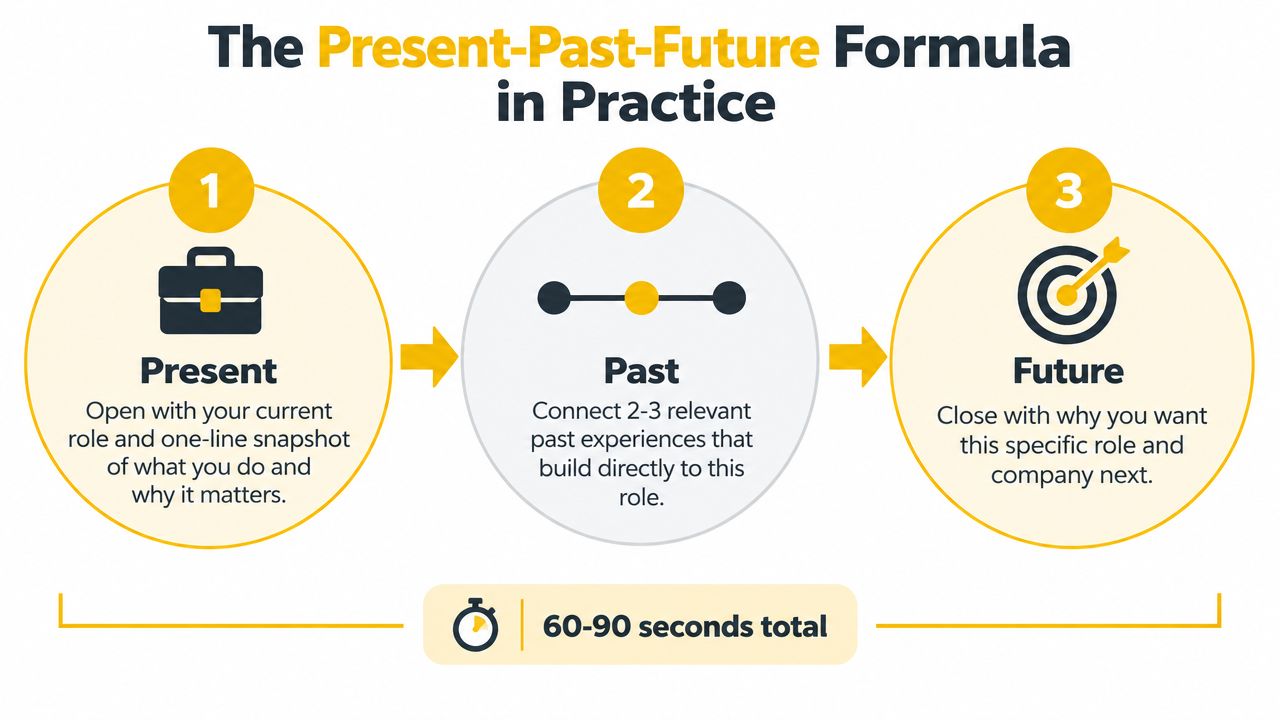
A hiring manager asks, “Tell me about yourself,” and you have about a minute to establish relevance. Use the Present-Past-Future formula to control the answer: show what you do now, select earlier evidence that supports your fit, then explain why this role is the right next move.
Present
Start with your current role, experience level, and specialization. Your title alone is too vague. State the work you own and connect it to the position you want.
“I currently lead a team of four in B2B demand generation, with a focus on turning product messaging into qualified pipeline.”
That sentence gives the interviewer your role, scope, function, and relevance. If you are unemployed, use your most recent position as the anchor, then describe your current focus, such as consulting, coursework, or a targeted job search.
Keep this part brief. Your current value should guide the answer, not disappear beneath background detail.
Past
Choose one or two experiences that prove you can handle the target role. Include outcomes when they clarify your contribution, but do not force numbers into the response.
“Before that, I rebuilt our content planning process and partnered with sales on a product launch, which taught me how to connect customer insight, messaging, and revenue goals.”
The Past section should create a clear bridge, not reproduce your employment history. Leave out older positions unless they explain a capability the employer needs. A software engineering candidate might cite a relevant project. A career changer should emphasize transferable work and explain the connection without apologizing for a different path.
For more guidance on connecting your spoken answer to your résumé, use this walk-through-your-resume interview guide.
Future
Close with the responsibility you want and the contribution you are ready to make. “I want to grow” says little. Name the type of work or problem that attracts you, then connect it to this employer's role.
“I'm looking for a role where I can bring that cross-functional marketing experience to a growing product team, and this position stood out because it combines strategic positioning with hands-on launch ownership.”
Keep the full response to roughly 60 to 90 seconds. Fit three beats into that window: current focus, relevant proof, and a specific reason for applying. Rehearse the structure and evidence, not every word, so the delivery remains conversational.
Here is the finished version:
“I currently lead a team of four in B2B demand generation, focusing on turning product messaging into qualified pipeline. Before that, I rebuilt our content planning process and partnered with sales on a product launch, which developed my ability to connect customer insight, messaging, and revenue goals. I'm now looking for a role where I can bring that cross-functional experience to a growing product team, and this position stood out because it combines strategic positioning with hands-on launch ownership.”
Stop once the interviewer understands your current value and direction. A long account of previous jobs weakens the answer by replacing judgment with chronology.
Scripts Tailored to Your Experience Level
The framework stays consistent across careers, but the emphasis changes with seniority. Entry-level candidates need to establish potential. Mid-career candidates need to show progression. Senior candidates need to demonstrate scope and judgment.
An entry-level answer shouldn't pretend that a university project equals years of ownership. That overstatement makes the candidate sound inexperienced in a less flattering way. Lead with relevant coursework, internships, projects, tools, and the problems you've already practiced solving.
A mid-career candidate should avoid listing every promotion. Pick a signature accomplishment and explain how it shaped the capability you're bringing forward. The story should feel intentional, not like a collection of unrelated jobs.
Senior candidates should lead with scale and impact. They can mention team leadership, business transformation, operating scope, or a management philosophy, but they still need to connect those points to the employer's immediate needs.
| Seniority Level | Present, What you do now | Past, Relevant proof | Future, Why this role |
|---|---|---|---|
| Entry-level | “I'm a recent information systems graduate focused on data analysis and process improvement.” | “In my internship, I built reporting dashboards and worked with operations teams to identify recurring delays.” | “I'm looking for a role where I can apply those analytical skills while learning from an experienced business team.” |
| Mid-career | “I'm a product marketer focused on positioning, launches, and customer-led growth.” | “In my current role, I led a messaging refresh and built a launch process that improved coordination between marketing, sales, and product.” | “I'm ready to take that experience into a broader product environment where I can own strategy as well as execution.” |
| Senior | “I'm an operations leader who builds scalable systems across fulfillment, planning, and customer service.” | “I've led cross-functional transformations, developed managers, and used process redesign to improve reliability without sacrificing service quality.” | “This role appeals to me because the company needs an operator who can connect day-to-day execution with long-term scale.” |
The biggest mismatch is simple: junior candidates oversell, while senior candidates undersell. Junior applicants should claim what they've done and show learning speed. Senior applicants should state their scope and outcomes plainly instead of hiding behind modest, generic language.
For more help shaping the opening positioning statement, review this sample career statement resource.
Choose your emphasis in five seconds: potential for entry-level, progression for mid-career, and scope for senior roles.
Your language should also match the function. A finance candidate can emphasize analysis and decision support. A software engineer can focus on systems, collaboration, and delivery. A product manager should connect customer problems to prioritization and outcomes. The structure remains stable, but the proof must sound native to the job.
Handling Career Gaps and Pivots Without Sounding Defensive
Maya is a mid-career product marketer who was laid off after nine months in her last position. She's interviewing after a 14-month gap and worries that the silence on her résumé will dominate the conversation.
Her mistake would be trying to hide the gap inside a long career narrative. Her other mistake would be spending the entire opener explaining why the layoff happened. She needs one clean sentence of context, followed by evidence that she stayed active and is ready to work.
Maya could say:
“Most recently, I worked in product marketing, where I supported launches and refined messaging for a growing software business. After a company restructuring ended that role, I used the following period for freelance marketing projects, completed a product marketing certificate, and launched a small side product to keep practicing customer research and positioning. I'm now looking for a full-time role where I can bring that hands-on experience into a larger product organization.”
That answer names the layoff without sounding apologetic. It also gives the interviewer useful evidence: freelance work, relevant learning, and a practical project. The gap becomes context, not the headline.
Match the explanation to the situation
A caregiving break can be stated directly without personal detail:
“I stepped away from full-time work for caregiving responsibilities, and I'm now ready to return to a role where I can use my project management and stakeholder skills.”
A health-related break requires even less disclosure:
“I took time away for a personal health matter, it's resolved, and I'm ready to return to full-time work.”
For an industry pivot, focus on the capability you're carrying forward:
“I'm moving from customer success into product operations because the process improvement work I led became the part of my role I wanted to pursue more deeply.”
Advice on gaps can be inconsistent. Some guidance recommends leaving the gap out of the opener, while other guidance favors a concise explanation when the gap is prominent or relevant. The practical middle ground is stronger: name a visible gap once, spend only a short portion of the response on it, then return to competence and readiness, as discussed in this guidance on answering about a résumé gap.
Name the gap once, in one sentence, then pivot to the value you built and the role in front of you.
Common Mistakes That Cost You the Interview
Most weak answers fail for predictable reasons. The fix isn't memorizing a clever script. It's enforcing a few hard boundaries.
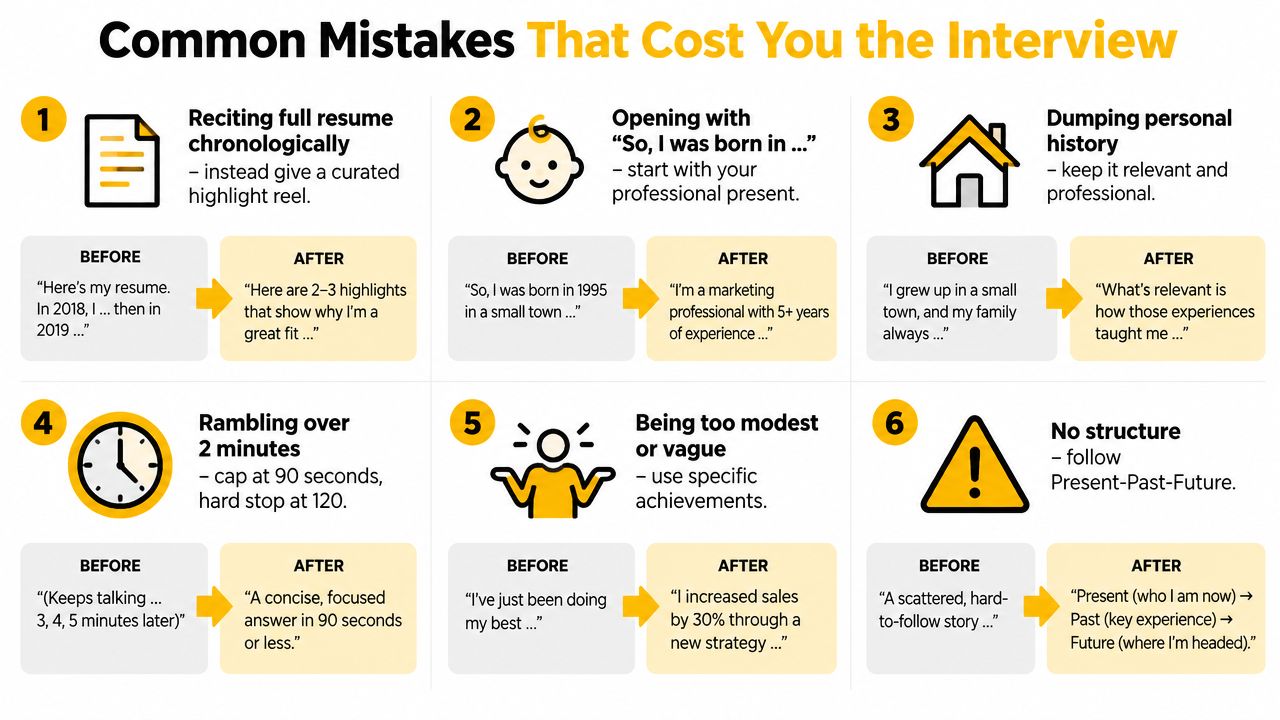
Reciting the résumé chronologically
“After university, I joined my first company, then moved to another company, and after that…”
This forces the interviewer to find the relevance themselves. Replace it with a curated bridge:
“I've built my career around improving customer operations, moving from hands-on service work into process design and team leadership.”
Rule: Curate your history. Don't read it aloud.
Opening with personal biography
“So, I was born in…”
Your birthplace, childhood, and early interests rarely help the interviewer evaluate your fit. Start with your professional present, even if that present is a recent graduation, a transition, or a return to work.
“I'm a recent graduate with project experience in data analysis and a strong interest in operational decision-making.”
Rule: Start where your professional relevance starts.
Dumping personal history
Family details, hobbies, and emotional background can make the answer feel unfocused. Personal information belongs in the conversation only when it directly supports the role or responds to a specific question.
“I've focused my recent work on coordinating complex projects across technical and commercial teams.”
Rule: If a detail doesn't support role fit, remove it.
Giving a five-minute monologue
Long answers bury your strongest evidence. Robert Half's interview guidance warns that answers extending beyond about two minutes can lose impact, so set a clear stopping point and let the interviewer ask for more.
“I currently manage implementation projects, previously led a process redesign, and I'm interested in bringing that experience to a larger customer operations team.”
Rule: Target 60 to 90 seconds, with a hard stop at 120 seconds.
Oversharing why you left
A complaint about a former manager or a detailed account of workplace conflict creates risk before trust has formed. Keep the explanation factual and redirect toward what you want next.
“The role ended after a restructuring, and I'm now looking for a position with deeper ownership of product strategy.”
Rule: Explain the transition without litigating the past.
Ending without a role bridge
A strong résumé summary still fails if the interviewer can't tell why you're sitting in front of them.
“That combination of implementation experience and process improvement is why this role caught my attention.”
Rule: Finish with the job, not your last achievement.
Candidates who want more examples of answer quality and interview preparation can use the GetTheCall blog as an additional resource. The point isn't to copy someone else's wording. It's to notice whether each answer makes a clear claim, supports it, and connects it to the role.
These six fixes all enforce the same backbone: Present gives context, Past supplies proof, and Future creates relevance. If your answer fails, diagnose which beat is missing instead of adding more information.
Rehearsal Plan and Delivery Checklist
An answer can contain strong examples and still weaken your candidacy if you rush, ramble, or rely on filler. Prepare both the content and the delivery. Your goal is a clear opening that gives the interviewer an easy reason to ask the next question.
Use a three-pass practice method
First pass, outline only. Write three or four prompts instead of a script: current role, relevant proof, core strength, and reason for applying. This prevents rigid memorization, so a slightly different question does not disrupt your answer.
Second pass, time the full answer. Say it aloud and record yourself. Remove every sentence that does not support Present, Past, Future, or role fit. Keep Past tight. Candidates often spend too long explaining how they reached their current position.
Third pass, deliver it to another person. Ask the listener to interrupt only when they lose the thread or hear an unclear claim. You are testing whether the answer works for someone else, not whether it sounds polished in your own head.
Control the delivery
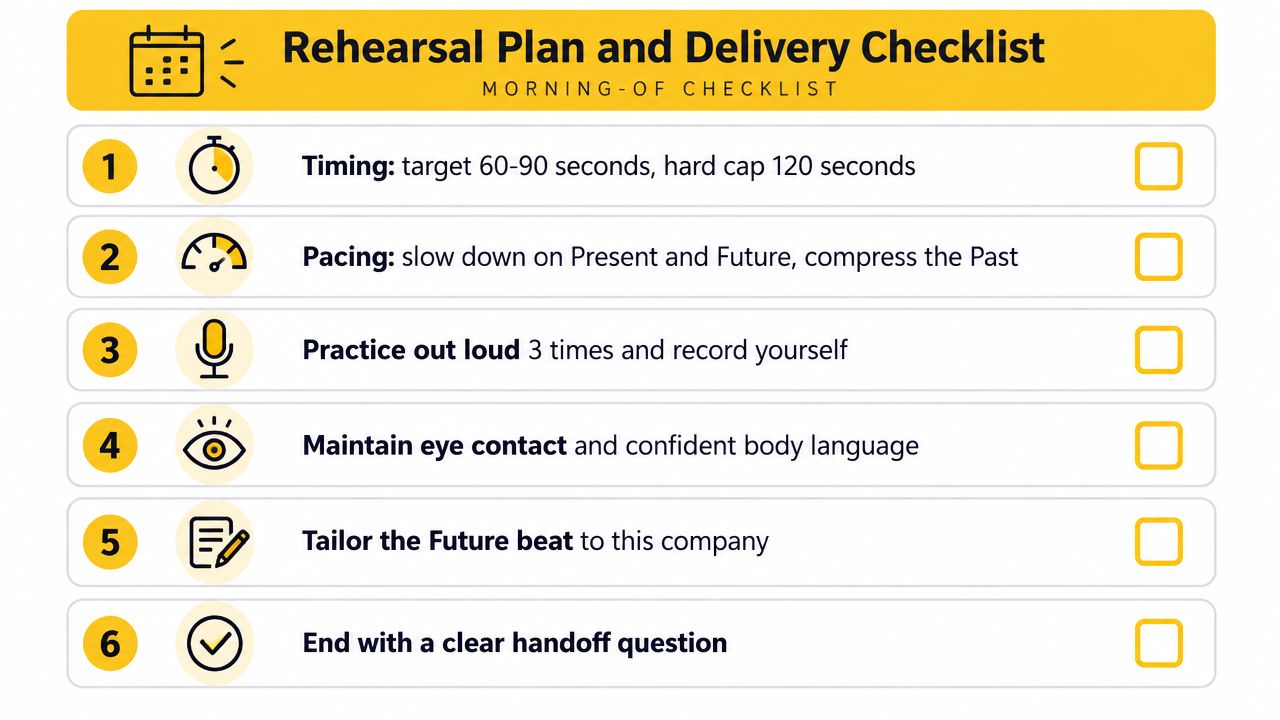
Target 60 to 90 seconds, with a firm maximum of 120 seconds. Slow slightly during Present and Future because those sections establish your identity and motivation. Compress Past into selected evidence that supports your fit.
Maintain natural eye contact without staring. Avoid uptalk, where statements sound like questions. Use two deliberate pauses, one after Present and one before the Future close. Each pause gives the interviewer time to follow your point and keeps you from sounding rushed.
Print or screenshot this morning-of checklist:
- Content: I have one clear Present statement.
- Proof: My Past includes relevant evidence, not every job.
- Relevance: My Future statement names this role or its core challenge.
- Timing: The answer fits the target window and stays below the hard cap.
- Delivery: I have practiced aloud, not only in my head.
- Voice: I have removed filler words and vague self-descriptions.
- Body language: I will sit upright, maintain natural eye contact, and keep my hands relaxed.
- Environment: My camera, microphone, lighting, and résumé are ready.
- Recovery: If I lose my place, I will pause and return to Present, Past, Future.
- Handoff: I will stop cleanly and let the interviewer choose the next question.
The objective is not a perfect monologue. It is a controlled opening that earns the next question.
Interview Pilot provides guided mock interviews, role-specific question practice, and suggested answers during live online interviews. Build and rehearse your Present-Past-Future response, then visit Interview Pilot to practice against the questions you are likely to hear.
Related Articles

Career
10 Technical Interview Questions Electrical Engineering
Master technical interview questions electrical engineering with model-answer guidance across circuits, power, control, semiconductors, and PCB design.
September 14, 2026 · 22 min read

Career
Average Salary Crime Scene Investigator: Full Breakdown
See the real average salary crime scene investigator roles pay in 2026, with breakdowns by region, experience, employer type, and career progression paths.
September 14, 2026 · 17 min read

Career
8 Another Phrase for People Skills for Interviews
Find another phrase for people skills with eight resume-ready alternatives, interview examples, and practical guidance for choosing the right wording.
September 13, 2026 · 20 min read