
















Interviews
10 English Speaking Practice App Options Compared for 2026
Compare the top English Speaking Practice App options by conversation format, feedback quality, pronunciation tools, and price to find your fit.
Interview Pilot Editorial Team
Updated November 15, 2026
18 min read
You have a job interview in three weeks. You can explain your work clearly in writing, but when you have to speak, you pause, search for words, and lose the thread. That's the gap most learners are trying to close, and it's not solved by tapping through vocabulary cards.
App store listings don't make the choice easier. Nearly every English speaking practice app promises to improve your speaking, yet the products work in very different ways. Some give you an AI tutor you can talk to at midnight. Some book you with a professional tutor. Others match you with a peer partner who wants to learn your language.
The scale behind that choice is large. The British Council teaching page states that approximately 1.4 billion people worldwide want to learn or are currently learning English. In 2025, English accounted for 54.85% of online language-learning market revenue, according to Mordor Intelligence. You're not choosing in a niche. You're choosing how you'll produce spoken sentences, get corrected, and keep going daily.
This list groups ten options by who you practice with, then checks pronunciation feedback, free access, and what breaks down without a person. If you're also choosing for a child, this age guide for young English learners covers a different set of trade-offs. For adults with a speaking goal, start here and match the format to the job.
1. ELSA Speak
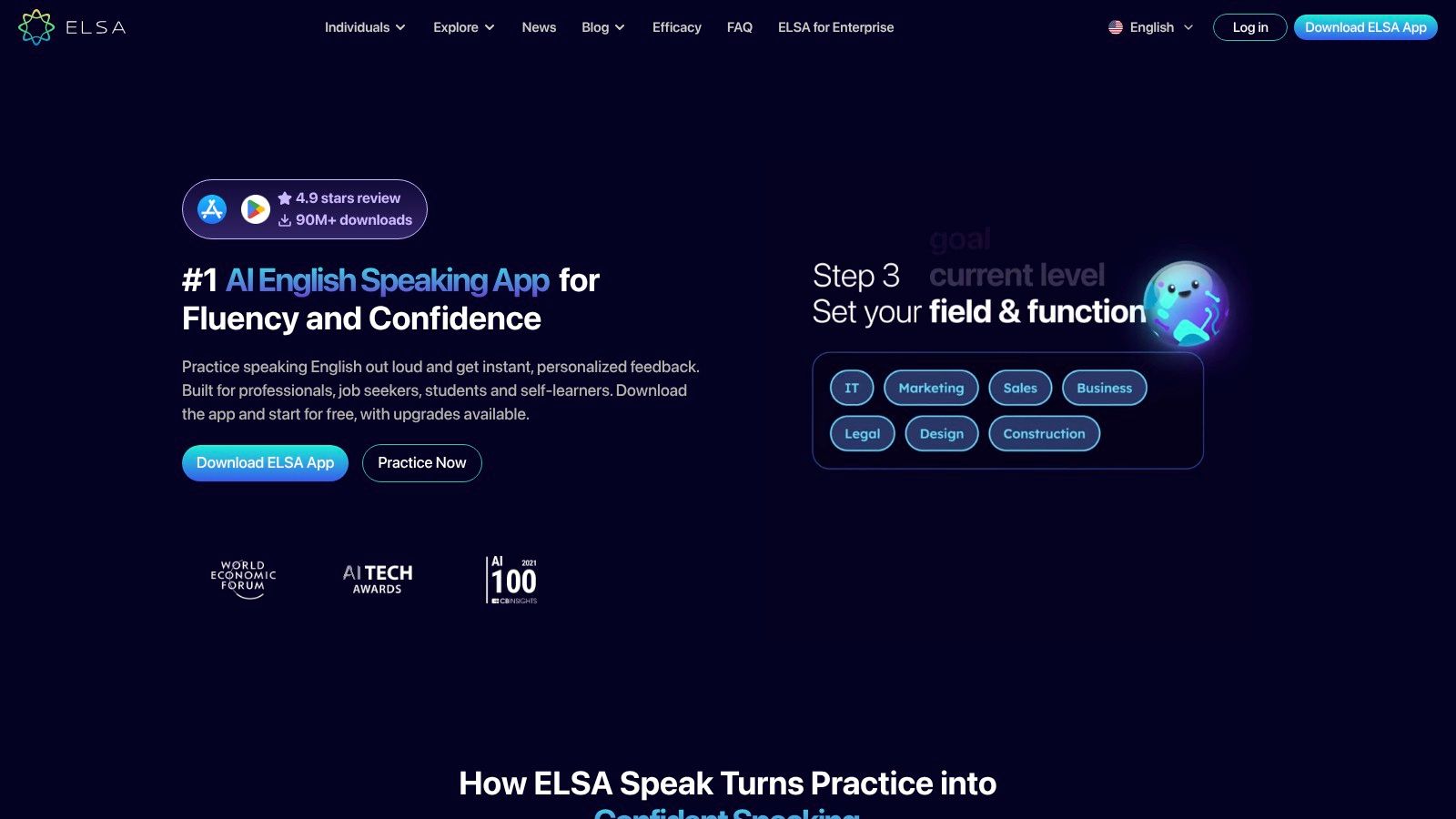
If people often ask you to repeat yourself, start with pronunciation before open conversation. ELSA Speak combines structured lessons with AI conversations and sound-level pronunciation feedback, so you can see which sound in a word is causing the problem. That specificity is its main strength.
What you actually do in a session
You work through bite-sized lessons on a personalized path, then use AI role-play for real-life situations. Eligible plans add practice for interviews, presentations, and exams. For interview wording and structure, pair that drill work with focused English interview practice so clearer sounds carry into longer answers.
- Strength: It tells you what to fix in a sound, not just that a sentence scored poorly.
- Access: There's a free tier and a 7-day trial of paid access, but free practice is limited.
- Limit: It's stronger on pronunciation than on broader interview strategy, follow-up handling, or story structure.
Many learners don't use it alone. As of March 2024, more than 40% of users of each of the AI English-conversation apps Speak, SpeakBUDDY, and ELSA Speak also used Duolingo, according to ValuesCCG. That pairing pattern makes sense. One app builds the habit, the other fixes the sounds.
Best fit: You know what you want to say, but listeners struggle to understand you, and you need daily pronunciation correction before an interview or presentation.
2. BoldVoice
BoldVoice is narrower than ELSA, and that's deliberate. It focuses on pronunciation and accent training for clearer speech in meetings, presentations, and interviews. It isn't trying to be your full English course.
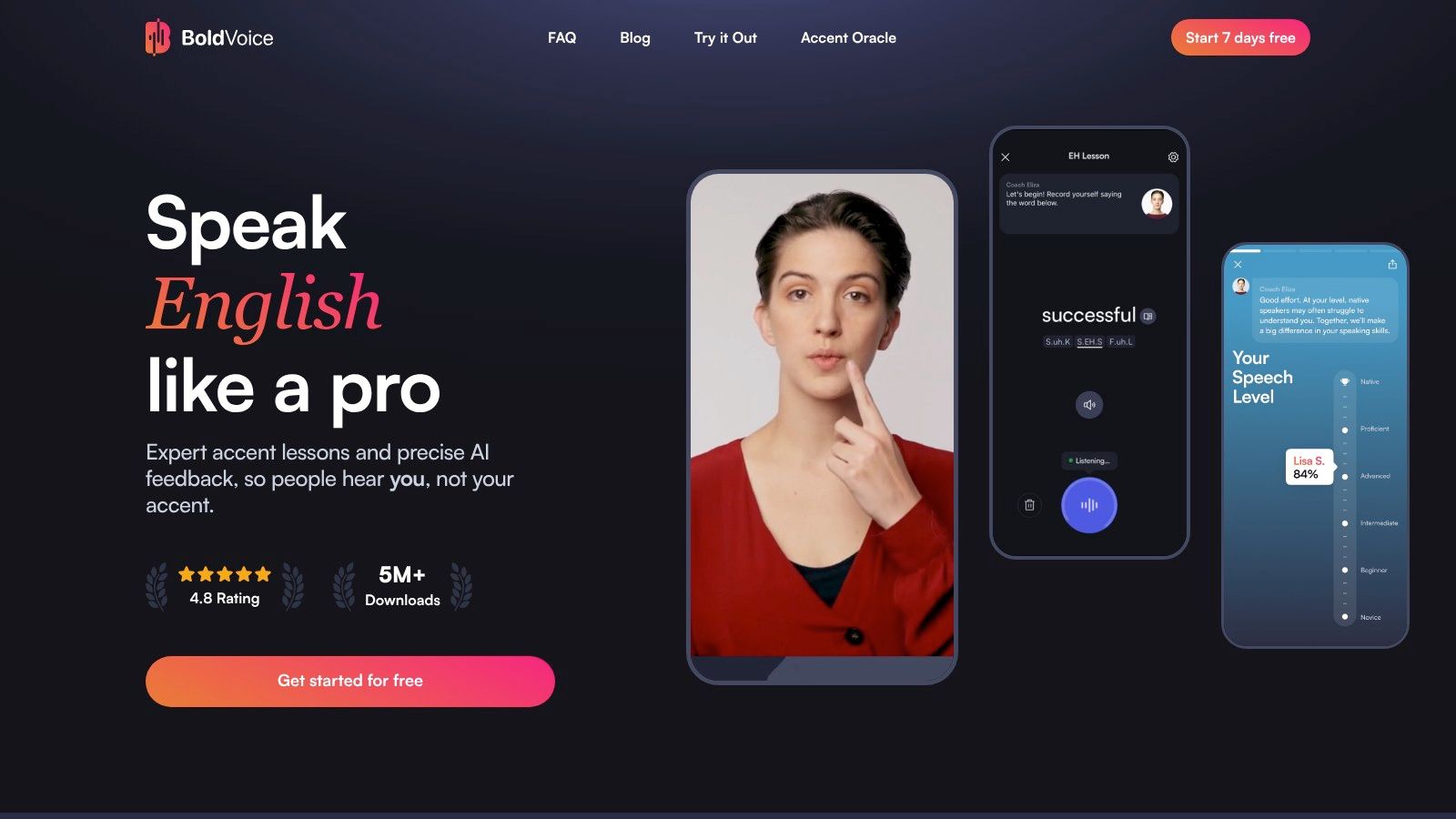
You watch video lessons from accent coaches, then practice with AI feedback on your pronunciation. A personalized plan sequences the work, and you can practice with custom text as well as guided materials. That last feature matters if you have a specific introduction, project summary, or set of technical terms you need to say cleanly.
Practical rule: Practice the exact sentences you'll say at work, not random word lists. Intelligibility on your own material transfers faster than a generic score.
Expect the right kind of gain, and no more. In a 2025 empirical study published in Nature, an AI-powered mobile app produced significant gains in overall speaking performance, especially pronunciation and fluency, but no statistically significant improvement in vocabulary or grammar. BoldVoice won't fix weak word choice. It can make the words you already have easier to understand.
- Strength: Short lessons with explanations fit a daily routine.
- Limit: Full access requires a subscription, and it doesn't replace live conversation.
Best fit: You're preparing to be heard clearly in professional settings and you want a focused, repeatable routine for speech clarity, not general English study.
3. Praktika
When you have ten minutes and no practice partner, Praktika lets you start speaking right away. You talk with AI tutors, so you can repeat an answer without arranging a session or worrying about making mistakes in front of someone. That privacy can make it easier to build a regular routine.
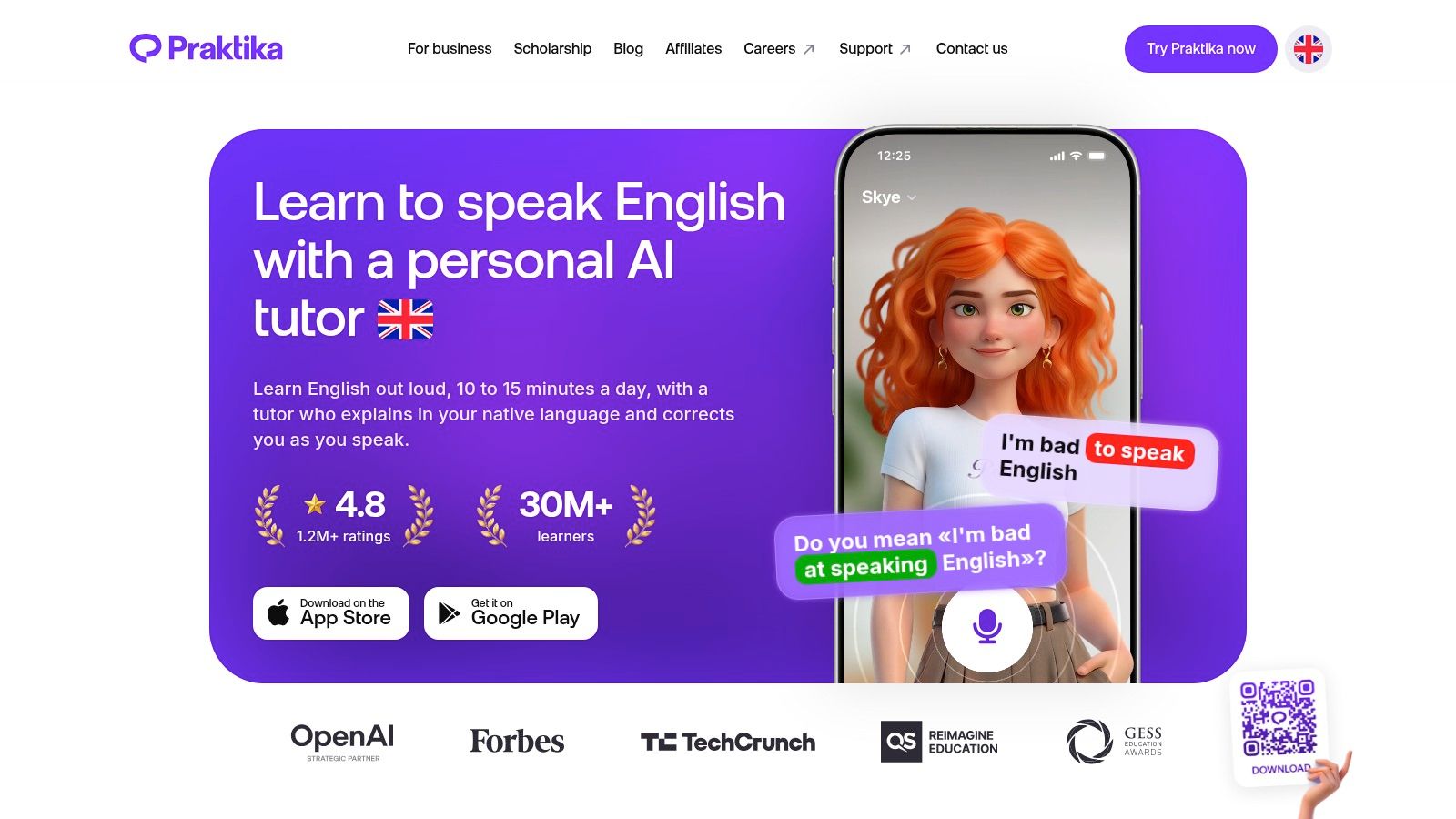
Lessons focus on speaking aloud, with corrections and explanations during practice, personalized goals, and role-plays that include job interviews. Beginners can also get explanations in their native language. For more structured interview rehearsal, online interview practice can help you work through answers under time pressure.
Where the format helps and where it stops
Private practice gives you room to repeat a difficult answer and get more comfortable saying it. Research on mobile-assisted speaking in the JETLE journal identifies anxiety as consistently associated with lower speaking performance. Practicing with an AI tutor may help you focus on the words and ideas you want to express.
The trade-off is that an AI tutor cannot respond like a person who looks confused, interrupts, or asks an unexpected follow-up. Treat role-play as rehearsal, then practice with a human partner when you need to handle unpredictable reactions.
Best fit: You want frequent, private speaking practice before moving on to conversations with a tutor or partner.
4. Loora
Loora assumes you already know some English basics. It isn't built for complete beginners, and it doesn't spend your time on multiple-choice exercises. You talk, then you review.
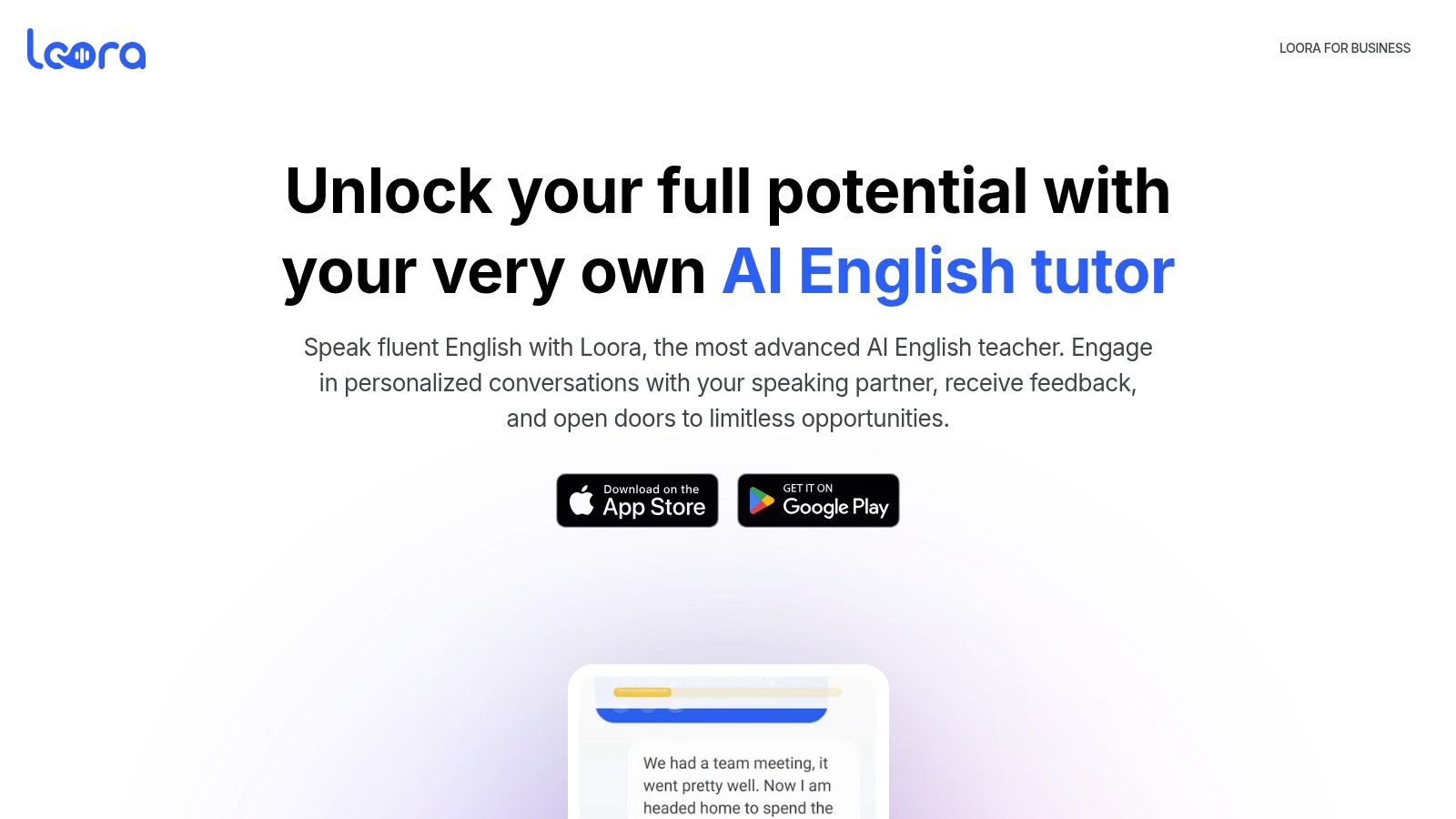
Sessions use AI conversations and role-play on everyday or work-related topics. Afterward you get feedback on pronunciation and grammar, with transcripts and sentence-level notes you can study line by line. Each lesson ends with a key takeaway to guide your next session.
That post-session design is the difference. Feedback doesn't interrupt every part of the conversation, so you can finish a thought and learn to keep going when you make a mistake. That's a real interview skill. Interviewers don't pause to correct your verb tense. You need to recover and continue.
- Strength: Speaking stays central, and transcripts make your recurring errors visible.
- Limit: AI feedback can't match a human tutor's judgment about tone, nuance, or whether an answer responded to the question.
- Limit: If your grammar foundation is thin, you'll need foundational study alongside it.
Use the transcript actively. Pick one recurring error per week, rewrite those sentences correctly, and say them aloud in your next session.
Best fit: You're an adult learner past the basics who wants open conversation practice, then clear written feedback you can review without being stopped mid-sentence.
5. Talkpal
Variety is Talkpal's argument. Instead of one lesson format, it offers call, role-play, debate, and dialogue modes, plus writing practice, in English and many other languages. If a single routine bores you within a week, that range helps.
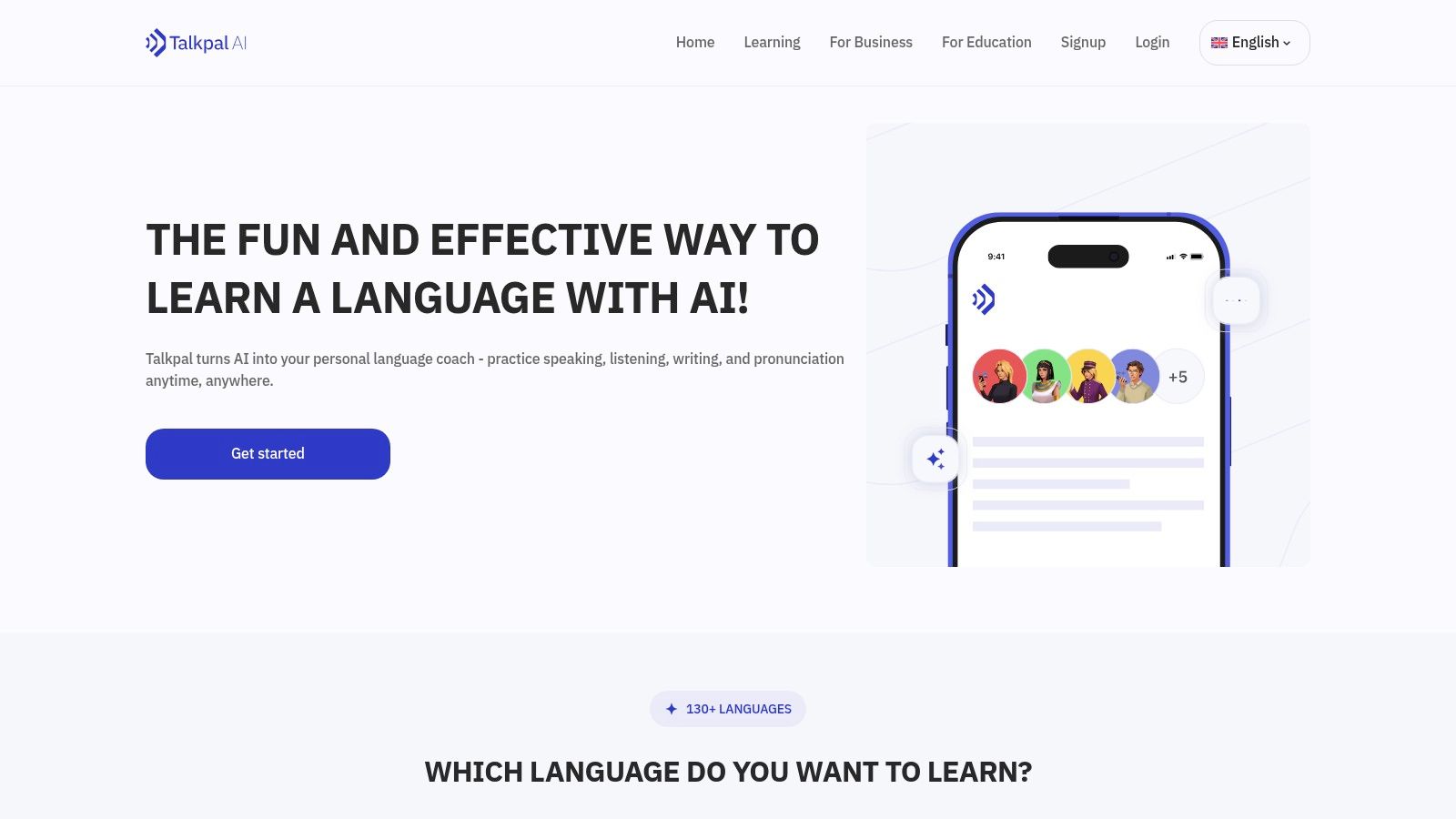
Modes worth using for speaking goals
- Call mode: Closest to speaking without visual support, which exposes how much you rely on reading.
- Debate mode: Forces you to organize a position and respond, useful for discussion-heavy work.
- Role-play: Best for rehearsing a specific situation, such as a service call or a first meeting.
You also get pronunciation assessment and progress tracking, with access on web, iOS, and Android. There's a free Basic plan, but daily use is limited and full use requires Premium. You need an internet connection, so it won't solve practice on unreliable connectivity.
The demand for this kind of tool isn't speculative. In 2024, language-learning apps recorded 316 million global downloads, according to LingoBright. Downloads don't equal fluency, though. Talkpal's modes only help if you pick one that matches your goal and stay with it long enough to see your errors repeat.
Best fit: You want several ways to practice speaking in one English speaking practice app and you'll use debate or call practice, not just guided dialogues.
6. Speak
Speak sits between a course and an open AI tutor. You follow a structured speaking curriculum with situational role-play, then use the AI tutor to ask questions and build custom practice. That balance suits learners who get lost without a path but stall in a rigid one.
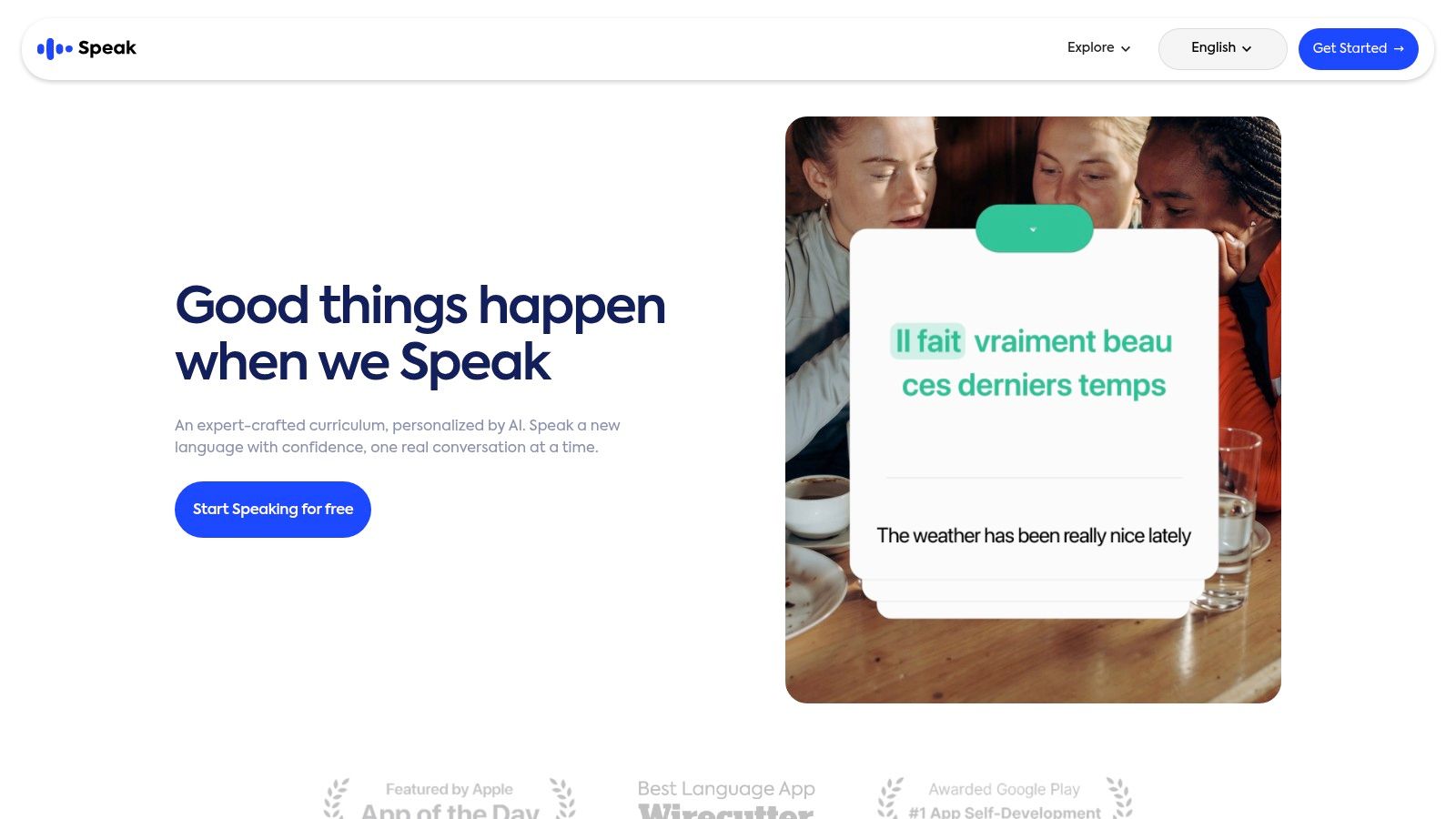
English learners also get a Pronunciation Coach. Higher tiers add personalized lessons and review features that can tailor practice around your goals and mistakes. That mistake-based review is where the value is. Repeating a lesson you already passed feels productive and changes little.
Don't judge an app by lessons completed. Judge it by whether the same error shows up less often when you answer an unscripted prompt.
There are two checks before you rely on it. Eligible users get a 7-day trial, but you'll need a paid subscription after that. English course availability also depends on your native language, since courses are offered to speakers of selected languages. Confirm your language is supported before you build a routine around it.
Mobile habits shifted fast when routines broke. More than 30 million new learners began studying a language on Duolingo from March 11 through April 30, 2020, 67% more than the same period in 2019, according to the Duolingo Global Language Report 2020. Speak is built for that now-normal pattern, short daily phone sessions instead of a weekly class.
Best fit: You want guided structure plus open-ended speaking, and your native language is supported for its English course.
7. Cambly
Everything above is AI. Cambly changes who you're talking to. You practice with English-speaking tutors in one-to-one lessons or small-group sessions, in real time, with real reactions.
That human element catches what automated scoring misses. A tutor notices when your answer is grammatically fine but too long, too vague, or off topic. Private+ and Pro add lesson recordings and transcripts, and Pro adds structured, goal-oriented tutor support. Recordings matter more than most learners expect, because you can hear filler words and rushed endings you didn't notice live. Between tutor sessions, free mock interview practice online keeps your spoken answers warm without using up paid lesson time.
Costs and constraints to plan around
- Price: It's more expensive than self-guided AI apps, so daily long sessions may not be realistic.
- Scheduling: Availability depends on tutor schedules and your plan limits.
- Age limit: The small-group plan is for adults aged 21 and older.
Use tutor time for judgment, not drills you could do alone. Bring two interview answers, deliver them cold, and ask where a listener would get lost.
Best fit: You need to be understood by a real listener and want feedback on meaning and delivery, not just sound accuracy.
8. Preply
Preply is a marketplace, not a single method. You choose an English tutor using filters for specialty, price, availability, and language, read reviews, take a trial lesson, and then work one-to-one online. Your results depend heavily on who you pick.
That choice is the advantage if your goal is specific. You can look for tutors who handle interview preparation, business English, pronunciation, test preparation, or general conversation. A tutor who prepares candidates in your field will push on role vocabulary and follow-up questions in a way a general AI English speaking practice app won't.
It's also the risk. Tutor quality, teaching style, and rates vary, and finding a suitable tutor can take time. Regular practice costs more than a free language exchange. Budget for two or three trial lessons before you decide, and judge each trial by one test. Did the tutor make you speak more than they spoke, and did corrections come with a reason?
- Strength: Lessons can be closely adapted to a goal such as an upcoming interview.
- Strength: You can compare lower-cost tutors with more specialized ones before paying for a package.
- Limit: There's no consistent curriculum unless you and your tutor build one.
Bring a target to the first lesson. "I have a data analyst interview in four weeks and I lose structure on project questions" gets you a useful plan. "I want to improve my speaking" gets you small talk.
Best fit: You have a defined outcome and a deadline, and you're willing to screen tutors to find one who teaches to that outcome.
9. HelloTalk
HelloTalk removes the teacher entirely. It connects you with people who speak the language you want to practice, and you help them with yours. Practice happens through text, voice, and video messaging, live voice rooms, and community posts, with translation and correction tools in the chat.
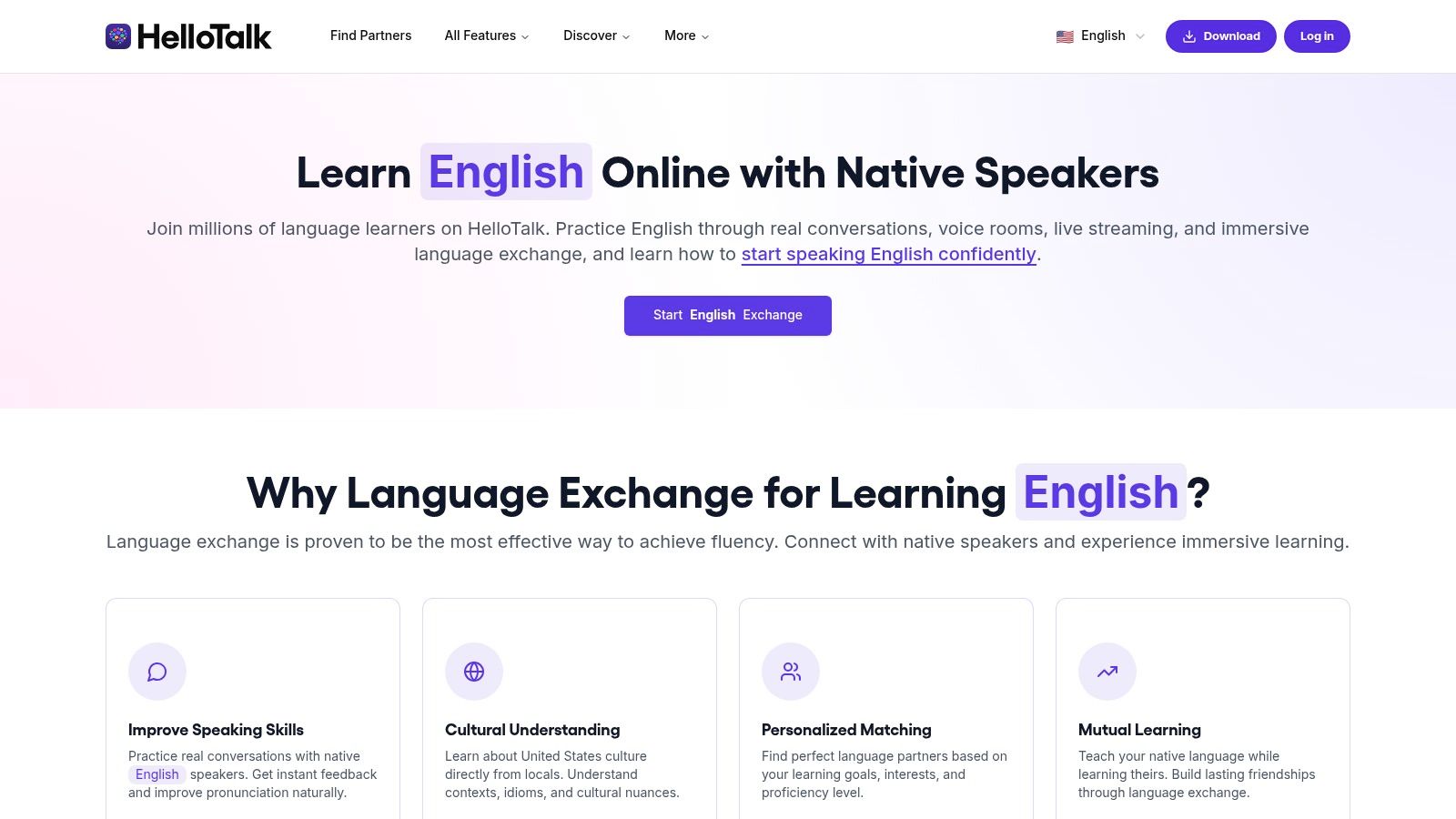
The exposure is useful. You'll hear different voices, speeds, and everyday phrasing that a scripted lesson smooths out. Voice rooms let you listen first and join when you're ready, which suits learners who aren't ready for a one-to-one call.
But be clear about what you're not getting. Conversation partners aren't necessarily trained teachers. They may correct a word and miss the structural problem, or let errors pass to keep the chat friendly. Practice quality and consistency depend on whom you connect with, and some features, including certain bilingual rooms, may require VIP access.
Safety check: Don't share your résumé, employer details, or personal documents with exchange partners. Practice your interview stories in general terms.
Free language exchange is available, which makes HelloTalk a strong supplement. It isn't a reliable sole source of correction.
Best fit: You already get correction elsewhere and you need low-cost, regular exposure to natural, unscripted English from varied speakers.
10. Tandem
Tandem is also language exchange, with the emphasis on finding a partner for reciprocal practice. You connect with English speakers who want your language, then use text, voice notes, audio calls, or video calls. Community and group conversation features add other ways in, and Tandem Pro is optional.
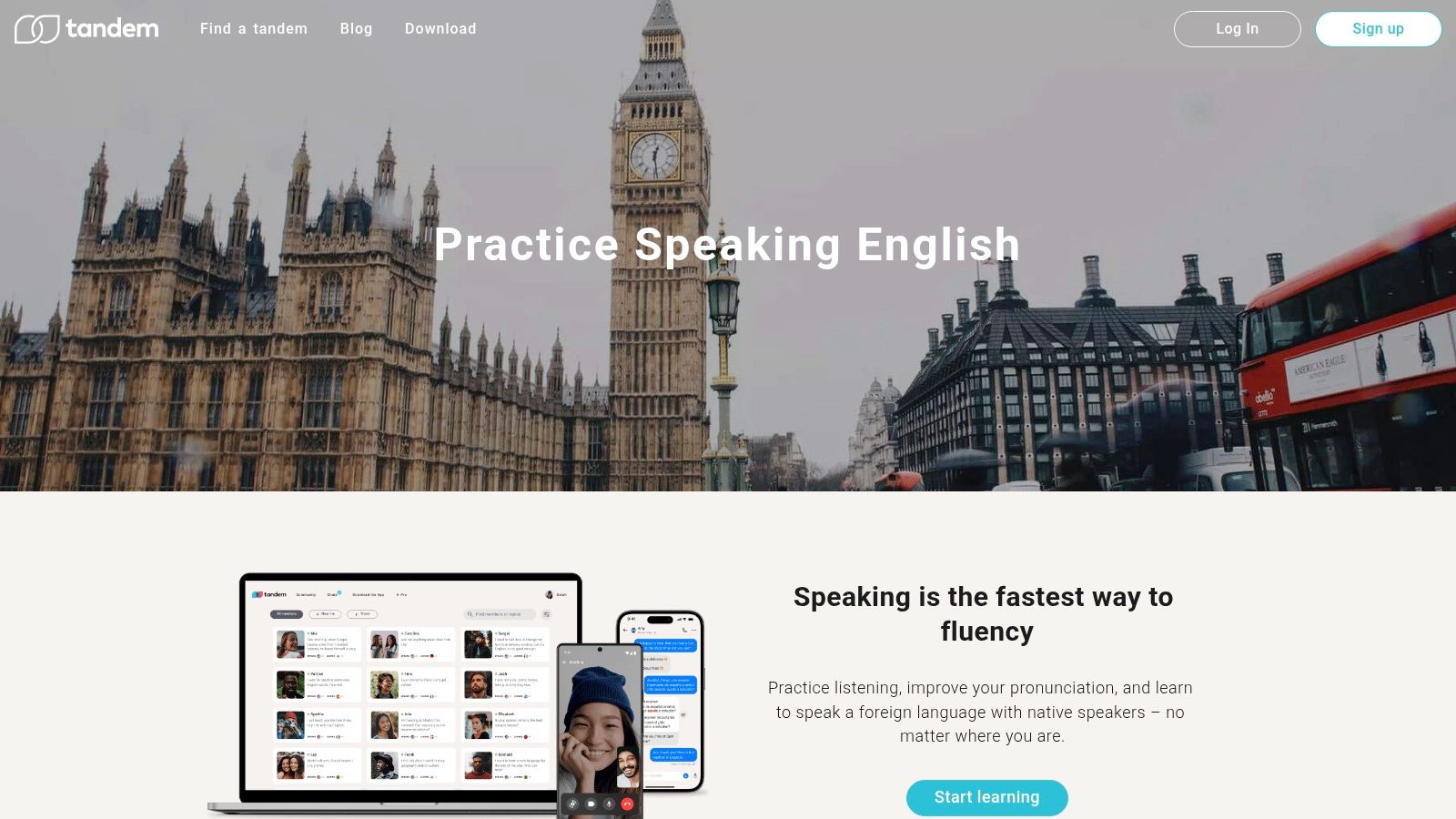
The benefit over scripted exercises is unpredictability. A partner changes the subject, misunderstands you, or uses an informal expression you have to work out from context. That friction is what live interviews contain and what most drills remove. You'll also hear different accents, which improves listening flexibility.
The weakness is reliability. Partners are peers, not necessarily qualified teachers. Finding someone reliable can take time, and the whole arrangement depends on both people showing up and splitting time fairly between two languages. Many exchanges fade after two weeks. Treat the first month as screening, keep sessions short and scheduled, and agree on how you'll correct each other.
Free practice is available, which is why Tandem fits tight budgets. In 2025, English represented approximately 40.0% of global language-learning-app market revenue, equivalent to about $4.96 billion, according to DataIntelo. A free peer option inside a market that paid is rare, and worth using if you manage its limits.
Best fit: You want real conversation without paying per lesson and you can offer your own language consistently in return.
How the 10 English speaking practice apps compare on format, feedback, free access, and best use
These apps differ most in who you speak with. AI tools let you repeat practice on demand, tutors respond to your answers in real time, and language partners bring natural conversation but less structured correction. Free access also varies, so check whether a free tier or trial gives you enough speaking time before committing.
| App | Practice Format | Pronunciation Feedback | Free Option | Best For |
|---|---|---|---|---|
| ELSA Speak | AI conversations, role-play, and guided lessons | Detailed sound-level feedback | Free tier with limited features | Pronunciation and fluency practice |
| BoldVoice | Coach-led video lessons and AI-guided exercises | AI pronunciation feedback | Free access is limited; full access requires a subscription | Focused accent and speech-clarity training |
| Praktika | Spoken conversations and AI tutor role-play | Corrections and explanations during practice | Free access is available | Frequent speaking practice and interview role-play |
| Loora | Open AI conversations and role-play | Pronunciation and grammar feedback | Free access is available | Adult learners practicing everyday or work-related English |
| Talkpal | AI calls, role-plays, debates, and dialogues | Pronunciation assessment and progress tracking | Basic plan with limited daily use | Varied AI speaking practice |
| Speak | Guided curriculum, situational role-play, and AI tutoring | Pronunciation Coach for English learners | 7-day trial for eligible users | Combining structured lessons with open-ended practice |
| Cambly | One-to-one tutor lessons and small-group sessions | Targeted feedback available on higher tiers | Free access is available | Real-time conversation with English-speaking tutors |
| Preply | One-to-one online lessons with a chosen tutor | Depends on the tutor and lesson goals | Trial lessons may be available, depending on the tutor | Personalized English or interview instruction |
| HelloTalk | Text, voice, video, and live voice rooms | Correction tools available | Free language exchange | Informal practice with English speakers |
| Tandem | Text, voice notes, audio calls, and video calls | No specific pronunciation feedback listed | Free language exchange | Informal conversation with language partners |
AI practice offers privacy and repeatability, but a simulated conversation cannot fully reproduce the timing, misunderstandings, and follow-up questions of speaking with a person. Use an AI tutor to build fluency and rehearse common situations. Choose a tutor when you need a person to respond to your specific goals, or a language partner when your priority is informal conversation. Free access can help you start, though limits on features, lesson availability, or daily use may affect how consistently you can practise.
Matching Your Practice Stack to Your Speaking Goal
Start with the goal, not the app. Write down the exact speaking task you're preparing for, whether that's a job interview, a client presentation, a visa interview, or daily meetings. Then decide which part is failing. People often guess wrong here, and they buy pronunciation training when their real problem is that their answers have no structure.
If listeners can't understand your sounds, an AI English speaking practice app built for correction is the right base. ELSA Speak and BoldVoice give you specific pronunciation work you can repeat daily. Loora and Speak add open conversation with feedback you can review. That layer is affordable, private, and available whenever you have ten minutes.
If you're understood but you ramble, freeze on follow-ups, or can't explain technical work under pressure, you need a person. Cambly gives you real listeners on a plan. Preply lets you select for specialty. Before you pay for either, it's worth knowing the right questions to ask a tutoring center or tutor about goals, correction style, and how progress gets measured. A tutor who can't describe how they'll track your errors will mostly chat with you.
Use HelloTalk and Tandem as the exposure layer, not the correction layer. They teach you how people talk and build tolerance for accents and speed. They won't reliably fix the grammar pattern you keep repeating, and they shouldn't be your only feedback source before a high-stakes conversation.
The demand behind all of this keeps growing. In 2025, English was the most studied language on Duolingo in 154 countries, an increase of 14% from 2024, according to Duolingo's 2025 Language Report. From January 1 through December 3, 2025, Duolingo was also the most downloaded language-learning app worldwide, according to Statista. Popularity tells you where the habit lives. It doesn't tell you which tool fixes your problem.
So test before you pay. Use a free tier or trial for one week. Record yourself answering the same prompt on day one and day seven, without reading. Listen for three things only. Did you finish your sentences, did the same pronunciation error recur, and could a listener summarize your point? If nothing changed, a longer subscription won't fix it.
If your target is a job interview specifically, combine general speaking practice with a dedicated rehearsal tool. Interview Pilot offers AI mock interviews with an evaluation of your answers, plus a Question Bank and a Playground for trying answers. That gives you role-specific questions to rehearse aloud while your speaking app handles pronunciation and fluency reps underneath.
I recommend most learners run two layers, not five. Pick one app for daily correction and one for human or interview-specific pressure. More apps usually means more streaks and less speaking.
If an interview is the deadline driving your practice, use Interview Pilot to rehearse spoken answers in AI mock interviews, get an evaluation of each answer, and work through its Question Bank by role. It runs on Mac, Windows, iPhone, Android, and the web, so you can practice the same questions wherever you do your daily speaking reps.


Topics
English speaking app
pronunciation feedback
AI conversation practice
speaking practice tools
language exchange apps
Continue reading

Interviews
Communication Skills Examples for Interviews That Work
Sample answers for the communication skills interviewers test: explaining complex ideas, listening, conflict and feedback, with a simple structure to use.
November 17, 2026
Interviews
8 Interview Tips for Finance Jobs: Prep Guide for 2026
Discover interview tips for finance jobs, from DCF and valuation questions to STAR stories, market awareness, mock practice, and smart follow-ups.
November 16, 2026
18 min read

Interviews
How to Use Your Phone as a Second Screen
Turn your phone into a second screen for a Windows PC or Mac: apps, cable options, Wi-Fi limits and how to set it up for a live online interview.
November 16, 2026