
















Interviews
Project Manager Interview Questions: 10 Model Answers
Prepare for project manager interview questions with 10 model answers covering behavioral, technical, and scenario-based topics, plus tips for 2026.
Interview Pilot Editorial Team
Updated November 12, 2026
22 min read
The interview is going well until minute twenty. The hiring manager asks you to walk through a project that went off track. You have that story ready, and you tell it cleanly. Then she asks what your sponsor said when you moved the date, and why you didn't escalate sooner, and the answer you prepared no longer fits the question.
That gap is where offers are lost. Published sets of project manager interview questions don't lack volume. ICS Learn's 8-question guide is compact, Adaface's 2024 list runs to 62 questions, and Candidatescreenings' 2025 set goes to 174. More questions isn't the bottleneck. Knowing why an answer works is.
What most lists skip is the signal. Every question below is a proxy: the interviewer is testing one behavior and using your project story as the evidence. Once you know what's being measured, you stop memorizing lines and start choosing material.
This guide covers 10 questions across behavioral, technical, and scenario territory. Each one comes with the signal the interviewer listens for, a structure for the answer, a worked example, and a tip that changes with the role and organization you're targeting.
1. Tell me about a time a project went off track and how you recovered it

Every panel asks this one. The version that lands isn't the most dramatic. It's the one where you can explain, without hedging, what broke, who you told, and what you changed.
What the panel is scoring: diagnosis, communication under pressure, and whether you can rebuild a plan you still believe in. A story where you personally worked nights to save the date reads as a rescue, not a recovery.
In a global survey of 4,069 people involved in leading or facilitating projects, the five highest-priority capabilities were relationship building, collaborative leadership, strategic thinking, creative problem solving, and commercial awareness, according to PMI's 2021 talent-gap research. Notice what's absent from that list: no tool, no methodology. The question is a proxy for the first four.
The structure that survives follow-up questions
Situation in two sentences. Task in one. Then spend your time on three moves: the root cause you found, the trade-off you chose, and the people you told. Finish with a baseline-versus-final number and the process change that stopped it recurring.
Say a vendor misses a deliverable on a software release. You trace the delay to an approval step nobody owned, re-sequence the remaining work around it, negotiate a contract amendment that protects the launch date, and name an approver in the plan.
- Pick a real setback. A trivial wobble gives the interviewer nothing to probe.
- Dwell on actions, not the problem. Two sentences of context is enough.
- Quantify accurately. Days recovered or cost avoided beats "the client was happy."
- Close on prevention. The change you made afterward separates managers from firefighters.
Role-specific tip: in a fixed-price or regulated environment, lead with the documented change order and the audit trail. In a product team, lead with how you re-planned with the engineers instead of over their heads.
For pacing and follow-up handling, this walkthrough of how to ace the behavioral interview is worth an hour before you rehearse.
2. How do you handle scope creep?
A request for one extra dashboard can add six days to a project. The interviewer wants to know whether you can make that trade-off visible before the team starts work.

Scope changes often become difficult when decision rights and sponsor support are unclear. Show that you have a process for assessing requests and getting the right approval.
The answer structure: log the request, assess its impact against the baseline, present options, record the decision, then update the plan.
- Record the request. Note who asked, what they need, and when.
- Assess the impact. Estimate the effect on time, cost, resources, and milestones.
- Present trade-offs. Add budget, extend the date, replace existing work, or defer the request to a later phase.
- Confirm approval before work starts. Record the decision and update the plan so the team has a clear baseline.
For example, an executive requests an extra dashboard during development. Explain the estimated six-day impact and offer to replace a reporting feature that has seen little use. The request becomes a decision about priorities and capacity, not an informal addition to the team's workload.
Signal interviewers listen for: you protect delivery commitments without treating every change as a refusal. A strong answer connects the request to its impact, gives the decision-maker clear options, and shows how approval is recorded.
Role-specific tip: In agency or client-services work, check the contract and follow its change-control process. In a product team, compare the request with roadmap priorities and agree what work it displaces.
3. How do you manage conflicting requirements from stakeholders?
Sales has promised a date. Engineering won't ship on an unstable base. Both have a case, and the interviewer is listening for whether you have a method or whether you'd bounce the decision upward.
In a PMI survey of 2,841 project professionals, stakeholder management and engagement was emphasized by 93% of respondents when handling scope challenges and by 94% when facing timeline constraints. The lesson for your answer is that conflict resolution isn't a soft add-on. It's the main event.

Separate the framework from the decision
Map who has power and who has interest, then agree the criteria before anyone argues about features. Risk, revenue, effort, and regulatory exposure are defensible. Preference isn't. Run the prioritization session yourself so the trade-off happens in one room instead of four emails.
A product launch works as an example. Sales wants three features, engineering wants two weeks of hardening. You run a MoSCoW session, agree that the compliance feature is a Must, move two sales requests to Could, and record the deferral in a decision log with the approver's name.
- Name the stakeholders and their actual goals. Vague answers about "alignment" score nothing.
- Name the framework. MoSCoW, a RACI matrix, or weighted scoring, and why it fit.
- Escalate as a choice, not a complaint. "We can have A or B by June" is an escalation a sponsor can act on.
- Confirm in writing. One paragraph after the meeting prevents the decision from reopening.
Role-specific tip: in enterprise or regulated settings, the compliance stakeholder's veto is real, so frame the criteria around risk tolerance. In a startup, speed is the criterion and the argument is about sequencing, not scope.
For more on the surrounding preparation, these project management interview tips cover the stages before and after the panel.
4. How do you estimate project timelines and budgets?
Estimation questions separate people who have run a schedule from people who have read about one. The giveaway is what happens when the interviewer asks what you'd do if the estimate turns out wrong.
In PMI's multinational 2024 project and product management study, more than 90% of respondents rated planning and time management as very or extremely important, alongside communication and problem-solving, as reported in the PMI project and product management research. Estimation is where that priority shows up as a concrete skill.
The answer structure: break the work into a WBS, estimate each package with the people who'll do it, apply three-point estimation where uncertainty is real, size contingency against quantified risk rather than a flat percentage, publish a range with its driving assumption, then track actuals against estimates.
A platform migration is a clean example. Optimistic, most likely, and pessimistic figures for the data cutover produced a weighted schedule. Comparing the total against two similar past migrations calibrated the budget before approval, and the range you presented to the sponsor was 14 to 18 weeks, with the dependency named.
If you want to see the technique working with a distributed team, this video is a decent primer.
Story-level estimation follows the same logic, and sprint poker for remote teams explains the mechanics for teams who can't sit in one room.
- Name the method and the reason. Three-point for high uncertainty, analogous for early ballparks, bottom-up for approval.
- Validate with the doers. An estimate the engineers haven't seen is a guess with a spreadsheet.
- Publish ranges. A single-point promise is a commitment you'll break.
- Compare actuals to estimates. Keep the record, because next year's credibility depends on it.
Role-specific tip: infrastructure and platform work hides unknowns inside the work itself. Schedule discovery spikes with a date on the decision they inform, and say so in the interview.
5. How do you identify and manage project risks?
A risk hasn't happened. An issue has. Candidates who blur the two sound like they manage events as they arrive rather than anticipate them, and that's exactly what the question is designed to expose.
The answer structure: a risk register with cause, event, and impact, a probability and impact score, one named owner per risk, a trigger that says when the response activates, and a review cadence that keeps the list current.
- Name a specific risk you caught early. Not "we had a risk process," but the regulatory approval that looked fine until it wasn't.
- Assign owners outside the project team. The person closest to the risk should own the response.
- Set the escalation threshold in advance. Say which severity level goes to the sponsor and when.
- Size contingency from the quantified risks. A flat 10% is a habit, not a reserve.
Say a product launch depends on a regulatory approval with a three-month backlog. Flagging it in week two lets you add a parallel compliance review track, which costs less than the delay would have. Then report a risk burndown so the sponsor sees high-severity exposure falling period by period instead of taking your word for it.
If your risk register hasn't changed in three weeks, it isn't a register. It's decoration.
Role-specific tip: on fixed-price contracts, convert contingency into money and get it approved at kickoff, because you won't get it later. On agile teams, make the top risks acceptance criteria and review agenda items, where they get discussed every cycle instead of once.
6. When would you use Agile versus Waterfall, and how do you decide?
Anyone who says Agile is always better, or Waterfall is always safer, has just told you they don't choose. The interviewer wants the constraint that settles it.
What actually decides it
- Requirement stability. If the requirements are fixed and knowable, sequential delivery and a single approval gate are cheaper.
- Contract shape. Fixed-price, fixed-scope work usually needs stage gates and formal sign-off, whatever the team would prefer.
- Feedback cadence. If users can react every two weeks and their reaction changes the build, short cycles win.
- Audit and documentation needs. Regulated delivery needs traceability built into the cadence, not bolted on at the end.
The answer structure: name the constraint, choose the cadence, describe the hybrid, then say how you'd measure success. Velocity and burndown for the iterative parts, milestone adherence and gate reviews for the predictive parts.
A compliance payroll migration runs best with fixed scope, external audit gates, and a documented change board. A customer portal whose requirements shift monthly runs better in two-week increments with a demo at the end of each. Same project manager, different controls.
Role-specific tip: consulting and client-services firms usually sell fixed scope, so the strong answer describes how you run stage gates inside two-week cycles rather than arguing that Agile is better. In a product company, describe how you'd protect a fixed date with scope flexibility.
7. How do you handle a team member who is underperforming?
You probably won't have direct authority over this person, and pretending otherwise in the answer is a mistake. Interviewers listen for whether you'd coach, document, or complain.
The sequence they want to hear: a private conversation to find the cause, a restated expectation with dates, concrete support, a written record, and an escalation through the functional manager or HR if nothing moves.
Start with diagnosis rather than motive. Ask what's changed, what's unclear, and what's blocking. The cause is usually one of four things: a skills gap, workload collision with another project, expectations nobody stated, or something personal you shouldn't probe.
Then act. Pair them with someone strong on the missing skill, cut a conflicting assignment, or rewrite the task so the finish line is unambiguous. Put the expectation and the review date in writing, even if it's three lines in a message. Documentation protects the person as much as it protects you.
The question behind the question: can you hold someone accountable when you have no reporting line over them.
A worked example: a developer misses two sprint commitments. The conversation reveals she's been pulled onto support rotation without anyone telling you. You get the rotation reduced with her line manager, agree a two-week checkpoint, and the next sprint lands. No performance plan needed.
- Diagnose before you prescribe. Assuming laziness is the most common interview mistake here.
- Describe concrete support. Pairing, training, reassignment, or a smaller first milestone.
- Document expectations and dates. Then follow up on the date you set.
- Never criticize former colleagues. Talk about the process you ran and the outcome.
Role-specific tip: in a matrix organization, the functional manager owns performance and you supply the evidence. In an agency, the account lead often owns that conversation, so say how you'd brief them.
The management interview questions and answers guide covers the adjacent people questions that usually follow this one.
8. How do you communicate project status to executives?
Executives don't read status reports. They scan for three things: is it on track, what changed, and what do they need to decide. Answer in that order and you'll sound senior before you finish the first sentence.
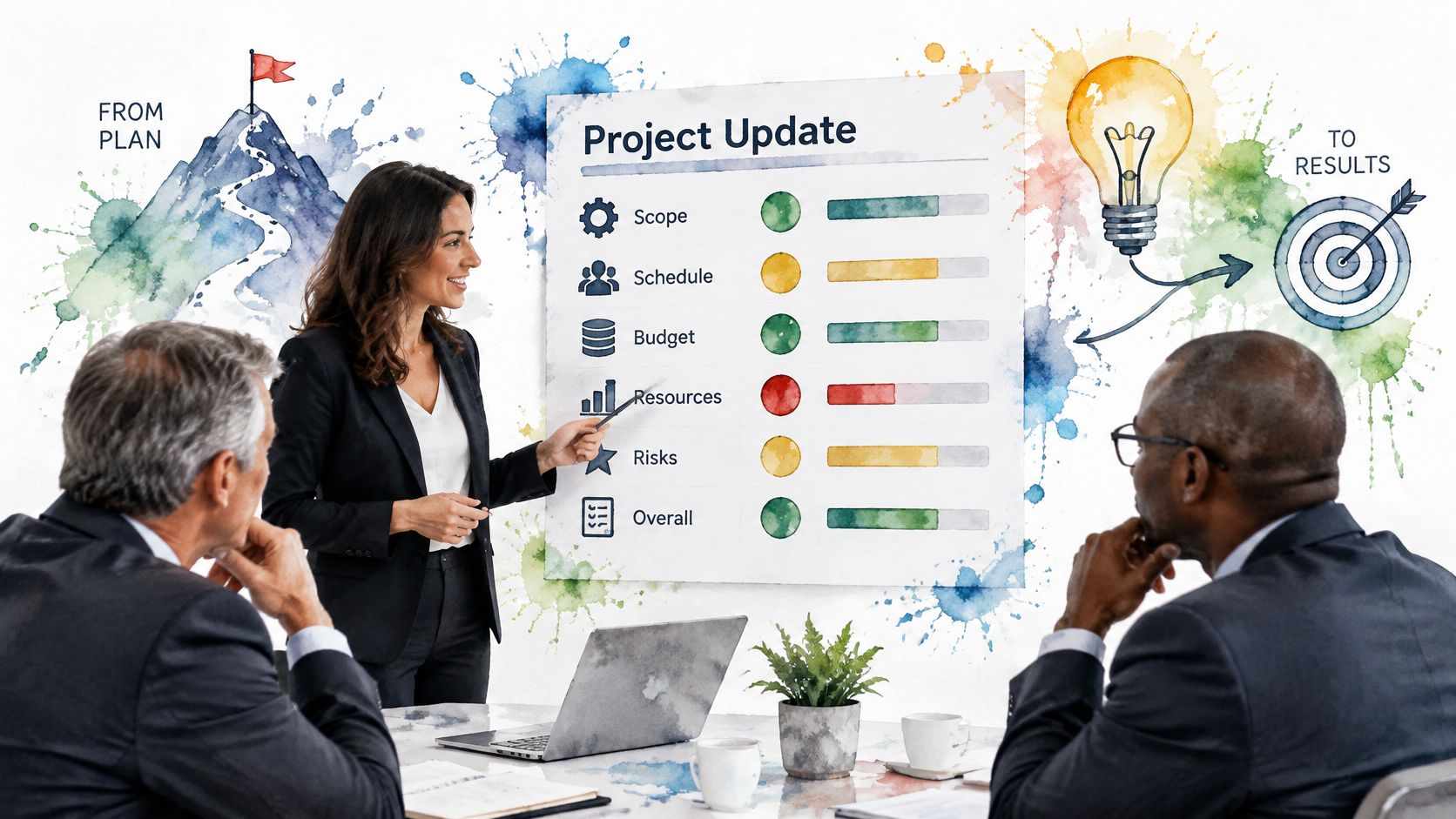
The answer structure: a one-page report with red, amber, green indicators for schedule, budget, scope, and risk. Three bullets on what changed since the last period. Then the decisions needed, each with an owner and a date. Detail goes in an appendix nobody reads until they ask.
Separate leading indicators from lagging ones. Blocked work, aging decisions, and unresolved requirements tell an executive what's coming. A missed milestone tells them what already happened, which is history rather than management.
A steering committee update works as an example. The vendor is late, the schedule is amber, and the report states that the fix costs an extra budget line. The ask is approval by Thursday so the work can restart Monday. That's a decision, not a status update.
- Lead with the bottom line. Status, then risk, then the ask.
- Keep the format identical every period. Executives notice changes in structure more than changes in content.
- Translate technical detail into business language. "The API migration slipped" means nothing. "Two weeks of delay to the checkout launch" means something.
- Adjust cadence to phase and risk. Weekly near a go-live, monthly during a stable build.
Role-specific tip: where sponsor support is thin, attach a named decision owner and a deadline to every ask. An open question with no owner is how projects drift for a month.
9. How do you prioritize when managing multiple projects at once?
Multi-project questions are really about authority. Interviewers listen for whether you know who owns prioritization before you claim you'd rebalance everything yourself.
It's worth turning the question around at the end of the interview too. Career guidance on project management interview questions treats project selection, shifting priorities, decision ownership, sponsor involvement, and resource authority as things candidates should ask employers, precisely because authority varies so much between a coordinator role and a true delivery owner.
The answer structure: a portfolio view, explicit scoring criteria such as revenue impact, regulatory need, strategic fit, and dependency chain, a capacity plan that shows who is over-allocated, escalation to whoever owns the portfolio, and a clear message to the person whose project just moved down.
- State your criteria out loud. Prioritization without stated criteria looks like favoritism.
- Show the capacity constraint. Two releases sharing one QA engineer isn't a scheduling problem, it's a decision.
- Describe one rebalancing. What moved, what slipped, and what the result was.
- Communicate deprioritization directly. The stakeholder hears it from you, not from a status report.
A worked example: two releases share a single QA engineer. You present three options with dates attached, the portfolio owner picks the one that protects the regulatory release, and you tell the other product owner the same day. Keeping dependencies visible helps here, and linking tasks to related notes is a simple way to keep the chain intact as things move.
Practical rule: never deprioritize someone's project in a corridor. Say it in the room where the trade-off was made, and put it in writing the same day.
Role-specific tip: in a PMO, the portfolio board decides and you supply the analysis. In a product-led company, the roadmap owner decides. Claiming authority you won't have is the fastest way to fail the follow-up.
10. Describe how you close a project and capture lessons learned
A project can meet its delivery targets and still leave unfinished work behind. Strong closure covers acceptance, handoff, and what happens to the team and project records after delivery.
The answer structure: explain how you confirm formal acceptance against the agreed objectives, close vendor contracts, release resources, and archive the plan and decision log. Then describe the retrospective and the specific change it produced. Include who will track benefits after handoff and when they will review them.
That follow-up matters. A project delivered on time and within budget may still fall short if nobody checks whether its intended benefits materialize. Explain who owns that measurement. If the project was cancelled, describe the decision's practical result, such as stopping further spend, avoiding a risk, or redeploying the team.
For example, a software launch retrospective identified a testing bottleneck in the final three weeks. The team changed its process so QA joined design reviews from the start, then applied that change to the next two projects.
- Name the closure activities. Cover sign-off, contract close, resource release, and archiving.
- Give one specific lesson and show where it was applied. A lesson matters when it changes later work.
- Include the delivery team in the retrospective. They can explain where the process created delays or rework.
- Keep the answer focused. Use one example to show both closure and follow-through.
Role-specific tip: in a consultancy, explain the handover pack and client sign-off. In an internal role, show how the lesson changed the way a later project was scoped.
What each project manager interview question tests and how to structure your answer
| Item | Core Skill Tested | Recommended Answer Structure | Strongest Signal for Interviewers |
|---|---|---|---|
| Tell me about a time a project went off track and how you recovered it | Problem diagnosis, ownership, recovery planning | Use STAR; explain the root cause, actions, measurable outcome, and prevention steps | Takes ownership and restores delivery with quantified results |
| How do you handle scope creep? | Change control, stakeholder negotiation, trade-off management | Describe a request, assess impact, document it, and present options for approval | Protects the baseline while handling requests constructively |
| How do you manage conflicting requirements from stakeholders? | Stakeholder alignment, facilitation, decision-making | Identify competing goals, apply prioritization criteria, document decisions, and escalate when needed | Balances business value and delivery constraints with clear decisions |
| How do you estimate project timelines and budgets? | Estimation methods, uncertainty management, forecasting | Explain the method, validate with the delivery team, communicate ranges, and refine using actuals | Uses evidence-based estimates and acknowledges uncertainty |
| How do you identify and manage project risks? | Risk analysis, response planning, monitoring | Give an example covering identification, assessment, ownership, response, and ongoing review | Proactively manages risks with clear owners and practical responses |
| When would you use Agile versus Waterfall, and how do you decide? | Delivery approach selection, contextual judgment | Compare project needs and trade-offs, explain the chosen approach, and describe how success was measured | Selects or blends methods based on project context, not preference |
| How do you handle a team member who is underperforming? | Empathy, accountability, coaching | Diagnose the cause, set expectations, provide support, agree on follow-up, and escalate if needed | Addresses performance fairly with concrete support and accountability |
| How do you communicate project status to executives? | Executive communication, concise reporting, escalation | Lead with status, key risks, and decisions needed; use concise, consistent updates | Surfaces bad news early and makes clear, decision-oriented asks |
| How do you prioritize when managing multiple projects at once? | Portfolio thinking, capacity planning, trade-off management | State prioritization criteria, explain resource trade-offs, and describe how stakeholders are updated | Makes priorities and capacity constraints visible to leadership |
| Describe how you close a project and capture lessons learned | Formal closure, handover, continuous improvement | Cover sign-off, handover, resource release, retrospective, and a lesson applied later | Completes closure thoroughly and turns lessons into specific improvements |
Turn These Answers Into Your Own Stories
Pick the three questions you'd least like to be asked. For many candidates that's the recovery story, the underperforming team member, and the closure question, because each one exposes something personal. Write a STAR-structured answer for those three first.
Then cut each one to two minutes and say it out loud. Reading a story without speaking hides the problems: the sentence that runs too long, the detail you can't remember, the moment you say "we" when you mean "I." Record one on your phone and listen back once. You'll hear the filler immediately.
Build a small bank, not a big one
You don't need thirty stories. Five well-chosen ones cover almost every behavioral question in a project manager interview.
- A recovery. A project that slipped and came back.
- A conflict. Two stakeholders with incompatible goals and a decision you drove.
- A refusal. A change you rejected, reframed, or traded out.
- A people problem. Someone underperforming, and what you did about it.
- A closure. What you learned and where you applied it.
Then get someone to interrupt you. The rehearsed version fails because candidates prepare the answer and not the follow-ups: what did it cost, who disagreed, what would you do differently. Have a peer fire three follow-ups at each story and notice where you improvise. That improvisation is the honest part of your answer, and it's what the panel is really testing.
If you'd rather practice against a structured set than invent your own, the Interview Pilot project manager question list covers scope, planning, schedules, resources, dependencies, risks, changes, agile and predictive methodologies, communication, recovery, and governance. Practicing the follow-ups against real question sets beats rehearsing alone.
For structure, CliniRoo's STAR interview walkthrough is a clear refresher on splitting situation, task, action, and result without letting the situation eat the answer. The rest is repetition, done out loud, with someone listening.
Interview Pilot is an AI interview assistant that gives job seekers real-time, customized answers to technical and behavioral questions, and it also runs mock interviews and a searchable question bank you can rehearse against. Load your resume and the job description, then practice the recovery, scope, and stakeholder stories until the follow-ups stop catching you out. Visit Interview Pilot to see how it works.
Topics
project manager interview
PM interview prep
behavioral interview questions
project management interviews
interview answers
Continue reading

Interviews
10 Common Job Interview Questions and Answers for 2026
Prepare with 10 common job interview questions and answers, including model responses for different experience levels and job types, plus formatting tips.
October 17, 2026
20 min read

Interviews
10 Behavioral Questions for Interviews: STAR Answer Guide
Master behavioral questions for interviews with 10 STAR-based examples, sample answers, role-level variations, and practice prompts for every career stage.
October 17, 2026
19 min read

Interviews
8 Situational Interview Questions Examples: Model Answers
Explore 8 situational interview questions examples with model answers, annotated tactics, and variations to practice for any role or industry in 2026.
November 11, 2026
20 min read