
















Interviews
Problem-Solving Interview Questions: Diagnose Before You Solve
Prepare problem-solving interview answers that define the problem, separate evidence from assumptions, test causes, compare options, and verify results.
Interview Pilot Editorial Team
2 min read
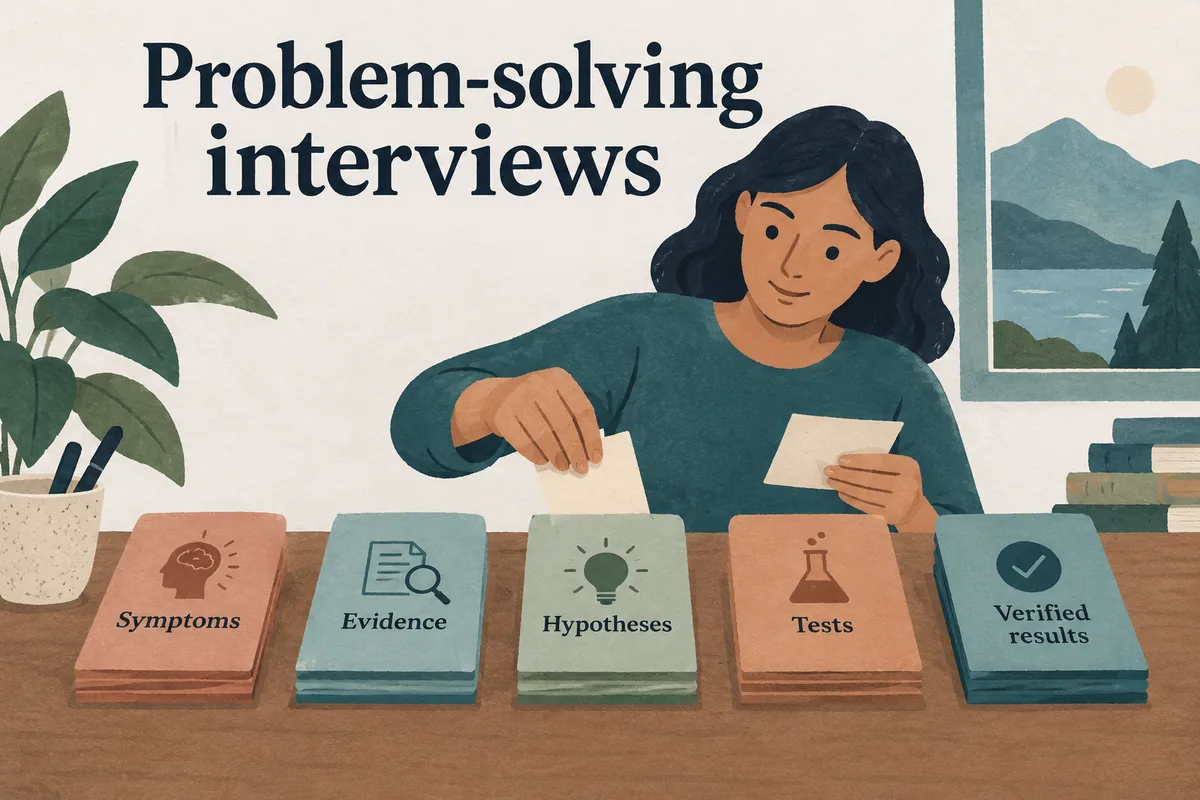
A strong problem-solving answer shows how you reduced uncertainty. Define the gap, gather evidence, test likely causes, choose an action, and verify the original outcome.
NACE's critical thinking competency includes analyzing information from diverse sources and making decisions through sound reasoning. The interview should reveal that reasoning.
Define the problem precisely
Replace “customers were unhappy” with an observable gap: which customers, which task, which period, and what evidence? Separate symptoms from causes and identify the decision owner and constraints.
Problem-solving answer example
Invoice corrections rose after a form change. I compared corrected and unaffected invoices and found most errors involved one newly optional field. Before changing the form, I reviewed five calls and learned the label was being interpreted two ways. I tested revised helper text with support, then monitored correction rates for four weeks. Corrections for that field fell from 18 of 120 invoices to 6 of 126, while other correction categories remained similar.
The example defines denominators and does not claim the change fixed every invoice problem. For another structure, see our challenge-answer guide.
Verify the result
Check the original task, side effects, duration, and alternative explanations. If the evidence is weak, say the result is preliminary.
Use the behavioral interview guide to prepare examples across technical, operational, and interpersonal problems. Choose cases where your judgment—not just the final answer—is visible.
Prepare to discuss a solution you rejected. Name the option, why it initially looked plausible, which evidence or constraint ruled it out, and what risk the chosen approach retained. Comparing real alternatives demonstrates reasoning more clearly than describing the final solution as inevitable.
Topics
interviews
problem solving
behavioral interviews
Continue reading
Interviews
Learning Agility Interview Questions: Learn, Test, and Adapt
Prepare learning agility interview answers about unfamiliar work, feedback, failed assumptions, transfer of learning, and changing course with evidence.
November 7, 2026
2 min read
Interviews
Professionalism Interview Questions: Reliability, Judgment, and Repair
Prepare professionalism interview answers about commitments, boundaries, communication, mistakes, confidentiality, and responding when standards slip.
November 7, 2026
2 min read
Interviews
Teamwork Interview Questions: Contribution, Handoffs, and Accountability
Prepare teamwork interview answers about shared goals, role clarity, communication, handoffs, uneven workload, disagreement, and collective outcomes.
November 7, 2026
2 min read