












Interviews
8 Interview Questions Event Manager Candidates Should Know
Prepare for interview questions event manager candidates face with sample responses, crisis scenarios, competency markers, and practical answer frameworks.
Interview Pilot Editorial Team
Updated October 2, 2026
22 min read

You're halfway through an interview when the hiring manager asks how you'd handle a venue failure, a sponsor demanding changes, and a registration system that has stopped syncing. At the same time, your answer needs to show that you can protect the attendee experience without losing control of budget, vendors, or internal expectations.
That's what strong interview questions for event manager candidates are designed to uncover. Hiring managers want more than a list of successful events. They want evidence of prioritization, stakeholder communication, contingency thinking, measurable outcomes, and calm execution when the original plan no longer works.
For behavioral questions, prepare with STAR, meaning Situation, Task, Action, and Result. For situational questions, explain your decision sequence: protect people, establish facts, communicate clearly, activate alternatives, and document what happens next. Use the questions below for targeted rehearsal, not memorization. Interview Pilot can also help through its AI Mock Interview, Question Bank, and customizable Copilot guidance, particularly when you want to practise the same answer for a corporate, hospitality, nonprofit, or hybrid-event role.
1. Behavioral Tell Me About a Time You Had to Manage Multiple Stakeholders with Conflicting Priorities
Event managers regularly balance the priorities of clients, sponsors, speakers, venue teams, suppliers, finance, marketing, and senior executives. This question tests whether you can create alignment without allowing the loudest stakeholder to control every decision.
A strong answer should make the conflict concrete. Explain what each stakeholder wanted, what constraint prevented you from saying yes to everything, and how you decided which requirements were essential. Then show how you communicated the trade-offs and protected the working relationships involved. Interview preparation guides commonly include questions about leadership, teamwork, budgets, vendors, and contingency planning, which reflects how broad the competency check has become (Indeed's event manager interview guide).
What the interviewer is testing
The interviewer is listening for stakeholder management, conflict resolution, prioritization, and communication discipline. They don't need a story in which every person leaves delighted. They need to see that you can distinguish a critical safety or contractual issue from a preference, then explain the decision without creating unnecessary friction.
Use STAR, but keep the Situation and Task short. Spend most of the answer on your actions:
- Map the conflict: Identify the stakeholders, their interests, and the operational constraint.
- Set decision criteria: Rank safety, attendee impact, contractual exposure, budget, timing, and brand risk.
- Offer options: Present realistic alternatives instead of rejecting a request without a path forward.
- Close the loop: Explain who approved the decision, how you recorded it, and what changed afterward.
For example, you might describe a client requesting a late venue change while suppliers were already contracted. A credible answer would cover the supplier conversations, the cost and timing implications, the options you presented, and how you secured a decision. Don't claim that everyone got everything they wanted. Explain which requirements you protected and which you adapted.
Prepare separate stories involving internal teams, external vendors, and a high-level client. A response that demonstrates only one type of relationship can sound narrow. You can use this guide to behavioral-based interviewing to practise making each example specific without turning it into a memorized script.

2. Situational The Day Before Your Event, Your Primary Venue Has a Major Facility Emergency, What Do You Do
This question isn't asking whether you can produce a perfect backup plan. It tests how you behave when information is incomplete, time is limited, and several decisions must happen in parallel.
Start with safety and verified facts. Ask who has confirmed the emergency, which parts of the venue are unavailable, whether the building can legally and safely host the event, and what the contract says about cancellation or relocation. Don't promise a new venue before you know its capacity, accessibility, permits, loading access, technical infrastructure, and availability.
A practical decision sequence
Your answer should show a communication chain, not just a list of frantic tasks. Explain who has authority to make the final call, who contacts the venue, who checks alternatives, who coordinates suppliers, and who updates attendees. Situational interview questions are distinct from behavioral prompts because they ask how you would respond rather than what you have done, as explained in this situational interview guide.
A disciplined response might follow this order:
- Confirm the incident: Establish the facts and record the time, source, and operational implications.
- Protect people and commitments: Suspend unsafe activity, preserve critical contracts, and identify immovable requirements.
- Activate alternatives: Contact backup venues, suppliers, transport providers, and technical teams at the same time.
- Communicate in stages: Give staff and partners confirmed information first, then send attendees a clear update with practical instructions.
- Document decisions: Keep a decision log covering approvals, costs, changes, and unresolved risks.
The best answer acknowledges that relocation may not be the only option. A delay, partial move, remote delivery, or reduced programme may protect more of the experience than a rushed full relocation. Explain how you'd compare these choices using attendee safety, legal requirements, accessibility, supplier feasibility, cost, and brand impact.
Practical rule: In a crisis answer, stakeholder communication is part of the solution. Don't describe logistics as if people can be moved silently from one plan to another.
Finish with the recovery phase. After the immediate problem, you would reconcile supplier changes, update stakeholders, capture what failed, and improve the contingency plan. That final step shows operational maturity rather than improvisation alone.
3. Technical Walk Me Through Your Event Technology Stack, How Do You Select, Integrate, and Troubleshoot Tools
Event technology is not a collection of fashionable applications. It is an operating system for registration, communication, attendee data, scheduling, access, engagement, reporting, and sometimes streaming. Hiring guides increasingly focus on how candidates use event software, integrate it with CRMs, and manage reporting across multiple workstreams (LinkedIn's event manager interview questions).
Your answer should begin with the event requirements, not your favorite platform. Describe the workflow first: how an attendee registers, how data moves into the CRM, how staff access the information, how updates reach attendees, and how you review performance afterward.
Show technical judgment, not jargon
The competency being tested is technical literacy, tool selection, integration awareness, troubleshooting, and translation between technical and non-technical teams. You don't need to present yourself as a software engineer. You do need to show that you understand dependencies and failure points.
Explain how you assess:
- Fit: Does the tool support the event format, registration rules, permissions, accessibility needs, and reporting requirements?
- Integration: What data needs to move between registration, CRM, email, payment, access, and analytics systems?
- Reliability: What happens if a connection fails, a device loses access, or the primary platform becomes unavailable?
- Usability: Can staff, speakers, vendors, and attendees use the system without avoidable friction?
- Governance: Who owns configuration, testing, data quality, privacy, and escalation?
Use a real troubleshooting story if you have one. State the symptom, isolate the likely cause, test the fix, communicate the impact, and explain the prevention step. If you mention an integration, explain it in plain language. “The registration data didn't reach the CRM” is useful. “We had an API issue” is incomplete unless you can explain what you checked and what changed.

Bring a simple workflow diagram if the interview format allows it. It can show registration, CRM, communications, onsite operations, and reporting without exposing confidential information. The diagram helps you explain the same stack at executive level or in greater technical depth.
4. Leadership Describe a Time You Led a Cross-Functional Team Without Direct Authority, How Did You Influence the Outcome
Event managers often coordinate people who don't report to them. Venue staff have their own management structure, sponsors have commercial priorities, speakers have competing schedules, and internal departments may measure success differently. This question tests whether you can create movement through influence, trust, shared objectives, and clear operating rhythms.
Choose an example where formal authority was limited. If you were the person's manager, controlled the budget, and could assign every task, the story misses the point. Explain what made alignment difficult and how you earned cooperation.
Make influence visible
A good answer shows the steps behind the outcome. You might have held one-to-one conversations to understand concerns, created a shared action plan, clarified decision rights, or connected a request to a stakeholder's own objective. A dashboard can help, but it won't replace the relationship work required when teams disagree about priorities.
Describe:
- The shared result: What did the event need to achieve for everyone involved?
- The resistance: Which stakeholder hesitated, and what legitimate concern did they have?
- The influence approach: Did you use evidence, listening, negotiation, peer support, or escalation?
- The operating mechanism: How did you keep people aligned after the initial agreement?
- The result: What changed in delivery, cost, quality, timing, or stakeholder confidence?
Avoid presenting influence as persuasion theatre. If a finance partner rejected your initial plan, explain how you changed the proposal after understanding the financial risk. If a speaker resisted a production requirement, explain how you showed the effect on the audience experience or programme schedule.
Your answer should also include what you learned about your leadership style. Some event managers lead through detailed structure, others through relationship-building, and many use both depending on the stakeholder. The strongest response shows flexibility without becoming vague.
Prepare for the follow-up question, “What did you do when someone still refused to align?” Explain when you continued negotiating, when you escalated a decision, and how you maintained the relationship afterward. Employers want a leader who can be firm without turning every disagreement into a personal conflict.
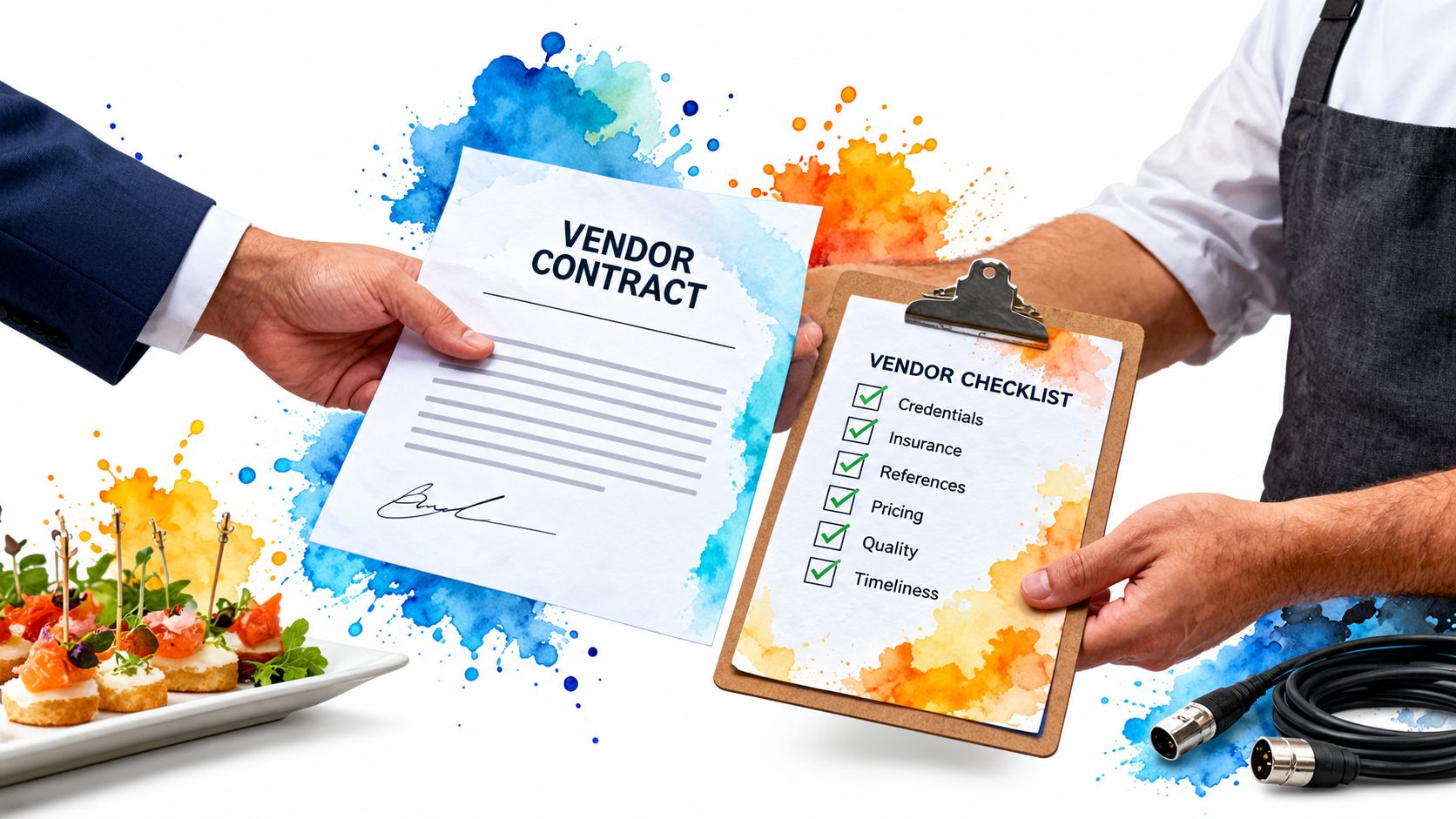
5. Vendor Management Walk Me Through How You Evaluate, Contract, and Manage a Critical Vendor
A vendor can affect the event long before the event day. A weak brief creates inconsistent proposals, an unclear contract creates disputes, and late technical testing leaves little room to recover. This question tests whether you manage vendors as operational partners while protecting the event through clear requirements and controls.
Start with the event need. For catering, that might include menu, dietary, service style, staffing, access, timing, waste, and attendee flow. For AV, it could include room layouts, equipment specifications, rehearsal, technical support, recording, redundancy, and responsibility boundaries. For a venue, it may include access windows, loading, security, accessibility, room turnover, and cancellation terms.
Use a repeatable vendor process
The competency is evaluation, negotiation, performance management, risk control, and relationship judgment. A strong answer doesn't suggest that the cheapest proposal wins. It explains how you compare cost with reliability, quality, flexibility, service capacity, and the consequences of failure.
Walk through your process:
- Define requirements: Create a brief that separates essential deliverables from desirable extras.
- Compare proposals: Use consistent criteria and ask vendors to identify assumptions and exclusions.
- Test capability: Check references, conduct site or technical reviews, and involve the people who will use the service.
- Contract clearly: Document deliverables, deadlines, acceptance standards, change control, escalation, and cancellation arrangements.
- Manage performance: Set meeting cadence, action owners, testing points, and an issue path that becomes more frequent as delivery approaches.
A strong example might involve an AV supplier whose proposed setup looked suitable on paper but lacked a clear recovery plan. Explain how you tested the equipment, clarified support responsibilities, and agreed what would happen if a key component failed. Don't imply that contract penalties alone create reliability. Good vendor management combines commercial protection with clear communication and mutual accountability.
A contract protects the relationship best when both sides understand what success looks like before the pressure begins.
Include a vendor failure story if you have one. Explain the root cause, the immediate recovery, the conversation afterward, and whether you changed the brief, contract, supplier choice, or monitoring process. That final improvement is often more persuasive than claiming the event went smoothly.
6. Budgeting Tell Me About a Time You Had to Reduce Event Costs While Maintaining Quality, What Trade-Offs Did You Make
Budget questions reveal whether you can protect value rather than make indiscriminate cuts. Interviewers want to know how you distinguish between the elements attendees notice, the commitments stakeholders rely on, and the costs that can be redesigned without damaging the event's purpose.
Begin by explaining how you understand the cost structure. Separate fixed and variable costs, committed and discretionary spending, essential delivery requirements, and optional enhancements. Then identify the event outcomes that must remain protected. Those might include safety, accessibility, core content, attendee flow, sponsor obligations, or the quality of a critical production moment.
Show the decision, not just the saving
The competency being tested is financial judgment, cost control, prioritization, negotiation, and stakeholder communication. A strong response may include renegotiating scope, changing suppliers, reducing printed materials, altering the format, consolidating programme elements, or moving spending toward the parts of the experience that matter most.
Explain your approach in this order:
- Diagnose the pressure: Was the issue a sponsor withdrawal, scope change, supplier increase, or internal budget revision?
- Protect the purpose: State which outcomes couldn't be compromised and why.
- Create scenarios: Present a minimum viable plan, a balanced plan, and a preferred plan where appropriate.
- Negotiate intelligently: Ask vendors about scope, timing, volume, and alternative delivery models instead of demanding a blunt reduction.
- Secure approval: Show stakeholders the effect of each option on experience, risk, and delivery.
- Monitor the revised plan: Explain how you tracked changes so savings didn't reappear elsewhere.
Avoid saying that you “cut costs everywhere.” That suggests you don't understand dependencies. Removing printed signage may create registration confusion. Reducing technical support may increase programme risk. Choosing a cheaper venue may add transport complexity. Your answer should name the trade-off and explain why it was acceptable.
A useful example could involve replacing an expensive event feature with a simpler format while preserving the content, accessibility, and attendee flow. Be candid about what changed. Hiring managers trust candidates who can say, “We protected this, reduced that, and accepted this limitation because the alternative created greater risk.”
7. Crisis Management Describe Your Process for Managing an Unexpected Major Issue During an Active Event
An active-event crisis has no clean handoff. You may need to protect an attendee, direct staff, communicate with a venue, adjust programming, and keep uninvolved guests informed at the same time. This question tests whether you rely on a prepared response structure or improvise from panic.
Start with the type of incident, but don't over-focus on dramatic detail. For a medical emergency, severe weather event, security concern, or major equipment failure, the first priority is to follow the relevant emergency procedure and involve qualified responders. An event manager shouldn't replace medical, security, or emergency professionals.
Explain the first minutes and the next review
The competency is safety judgment, command structure, communication, composure, and post-incident learning. Your answer should identify who has authority, how staff receive instructions, what information attendees receive, and how you prevent rumours from filling the communication gap.
A practical crisis framework includes:
- Safety: Protect affected people and create the space responders need.
- Escalation: Contact emergency services, venue security, medical staff, or the designated authority.
- Control: Pause, reroute, isolate, or modify programming according to the incident.
- Communication: Give factual, useful instructions to staff, attendees, speakers, sponsors, and relevant authorities.
- Record: Capture decisions, times, actions, witnesses, and follow-up responsibilities.
- Recover: Restore the programme only when it is safe and operationally credible.
This emergency response planning guide can help you think through the preparation behind a crisis answer, including contacts, escalation, communication, and review.
During an active incident, clear instructions beat reassuring speculation. Say what is known, what people must do, and when they will receive the next update.
A strong example doesn't end when the immediate threat passes. Explain how you reviewed the incident, supported affected staff or attendees, updated the playbook, and addressed any reporting or legal requirements. If you've never managed a major crisis, answer the scenario directly and say what you would do first, who you would involve, and what information you would avoid sharing until verified.
8. Logistics Walk Me Through Your End-to-End Process for a Large Conference
A conference can appear on schedule while registration backs up, speakers miss transitions, or suppliers wait for access. This question tests whether you can connect the brief to site operations, manage dependencies, and improve the next event. Strong answers show the interviewer how you make decisions before, during, and after the live programme.
Start with objectives, audience, format, venue, programme, accessibility, budget, and risk assumptions. Explain how those choices shape registration, room allocation, transport, staffing, technology, supplier access, attendee flow, and communications. State who owns each workstream and which decisions require approval.
Build the answer around operating phases
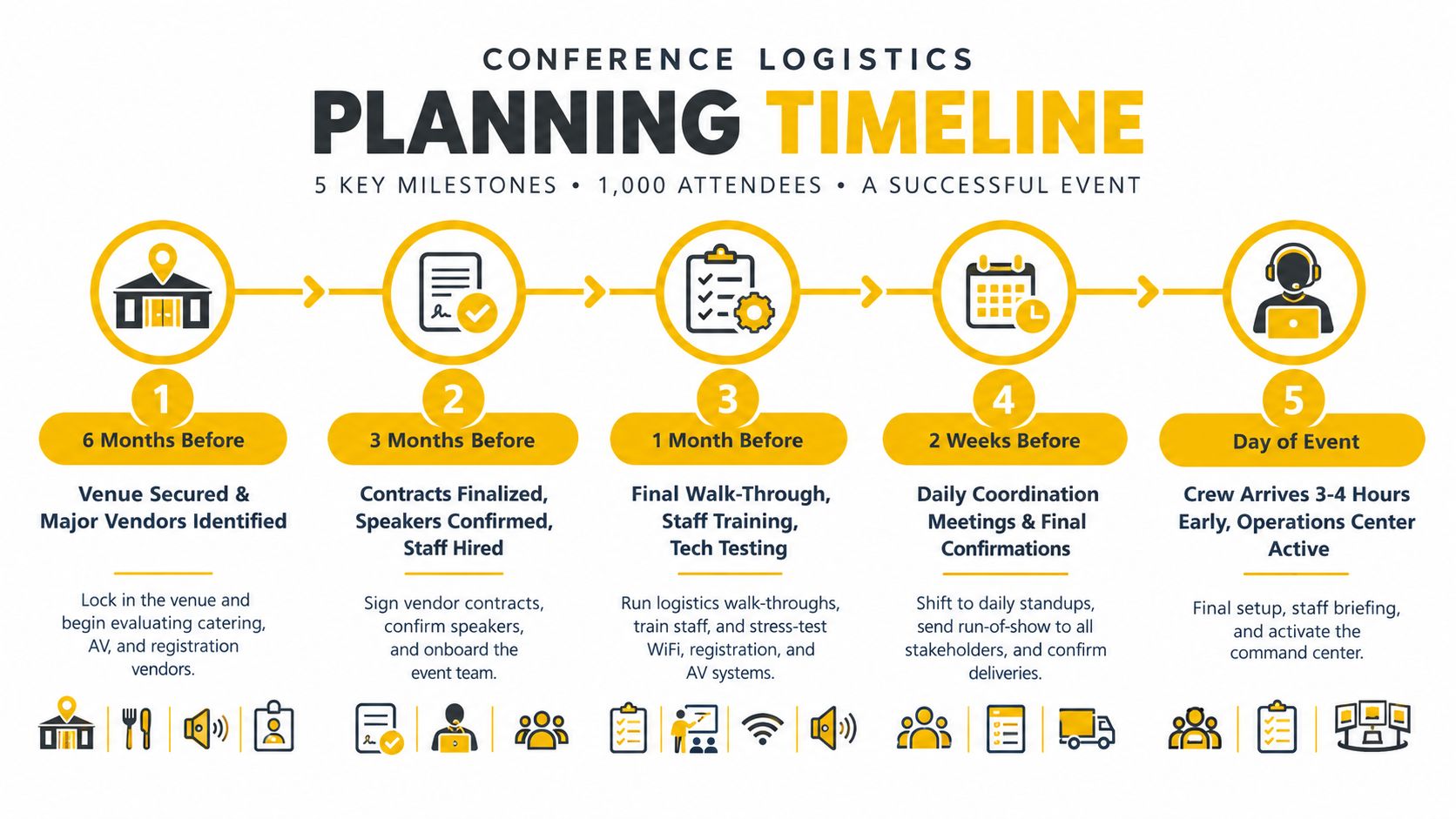
Use four phases to keep the answer clear:
- Planning: Confirm scope, venue requirements, programme structure, suppliers, contracts, registration design, risk ownership, and decision gates.
- Pre-event preparation: Test technology, brief staff, confirm transport and access, check signage and room layouts, finalise attendee communications, and rehearse important transitions.
- Day-of execution: Set up a command point, run a live schedule, assign zone owners, monitor queues and room capacity, manage issues, and update stakeholders.
- Breakdown and review: Coordinate supplier departure, collect assets, close financial actions, review incidents, gather feedback, and record improvements.
Use a specific operating scenario. If several arrival groups reach the venue together and registration queues form, explain how you would locate the bottleneck, adjust signage or staffing, issue clear attendee updates, and change the next session plan. Mention Asana, Monday.com, or a Gantt chart only if you use them. The tool matters less than your ownership model, dependency tracking, and escalation rules.
For a large conference, describe how you divide venue zones and assign accountable leads. Keep one approved source of truth for schedule and site changes. Cover transport, speaker movement, loading, catering timing, AV deployment, accessibility, emergency access, and teardown. For high attendee density, include network planning and security controls alongside registration and attendee flow. Explain how you set capacity from the venue, programme, risk assessment, and attendee profile rather than inventing staffing ratios or throughput figures.
Candidates preparing for a logistics-heavy role can review this project manager interview guide to practise structured delivery and dependency questions. A strong answer sounds like a working briefing: it explains what happens, who owns it, what can fail, and which checks show the event is ready.
Event Manager Interview: 8-Question Comparison
| Question Type | 🔄 Implementation Complexity | ⚡ Resource Requirements | 📊 Expected Outcomes / ⭐ Effectiveness | 💡 Ideal Use Cases | ⭐ Key Advantages |
|---|---|---|---|---|---|
| Behavioral: Tell Me About a Time You Had to Manage Multiple Stakeholders | Moderate, structured STAR responses; interviewer skill matters | Low, interviewer time; candidate prep | Strong insight into past behavior; reliable predictor for stakeholder roles ⭐⭐⭐ | Hiring event managers who coordinate vendors/clients; assessing diplomacy | Reveals real patterns; comparable across candidates |
| Situational: Venue Emergency Day Before Event | Moderate, scenario design needed; assess spontaneity | Low–Medium, consistent scenario, timeboxed interview | Good measure of real-time decision-making and contingency thinking ⭐⭐⭐ | Roles requiring fast crisis decisions; contingency-heavy events | Tests on-the-spot problem solving; comparable scenario for multiple candidates |
| Technical: Walk Through Your Event Technology Stack | High, requires technical probing and evaluation | High, may need diagrams, tool access, technical examples | High for technical fit and integration skills ⭐⭐⭐⭐ | Roles managing tech stack, integrations, hybrid events | Objective assessment of tool knowledge and troubleshooting ability |
| Leadership: Lead Cross-Functional Team Without Authority | Moderate, probes influence techniques and outcomes | Low, interview depth and follow-ups | Good indicator of influence and consensus-building ⭐⭐⭐ | Matrixed organizations; sponsor/vendor coordination roles | Predicts ability to drive results without formal authority |
| Vendor Management: Evaluate, Contract, Manage Critical Vendor | Moderate–High, process and examples often required | Medium, scorecards, contract samples, performance metrics | High for vendor reliability and risk mitigation skills ⭐⭐⭐ | Roles owning vendor portfolios or high-cost vendor relationships | Assesses contract/SLAs, negotiation skill, and contingency planning |
| Budgeting: Reduce Event Costs 20%+ While Maintaining Quality | Moderate, demands quantifiable examples and trade-offs | Low–Medium, budget artifacts or detailed examples | Strong indicator of financial judgment and prioritization ⭐⭐⭐ | Roles with budget ownership or sponsorship dependency | Demonstrates negotiation, cost-driver analysis, and stakeholder communication |
| Crisis Management: Manage Unexpected Major Issue During Active Event | High, complex scenarios or simulations advisable | Medium–High, playbooks, drills, authority chains | Critical for safety and emergency response; high impact ⭐⭐⭐⭐ | Large-scale or high-risk events (festivals, stadiums) | Tests emergency readiness, timeliness of decisions, and communication |
| Logistics: End-to-End Process for 1,000-Attendee Conference | High, comprehensive, multi-domain evaluation | High, timelines, tools (Gantt, staffing plans), references | Very predictive of operational execution success ⭐⭐⭐⭐ | Large conferences, multi-day events, high-attendance logistics | Holistic assessment of planning, resourcing, and contingency coverage |
Turn Strong Examples Into Interview-Ready Answers
A list of event manager interview questions is useful only when it becomes a preparation system. Build a compact answer portfolio rather than trying to write a perfect response to every possible prompt. Your portfolio should contain two STAR stories for stakeholder and leadership questions, one structured explanation of your technology stack, one end-to-end logistics walkthrough, and scenario responses for crisis, venue failure, vendor disruption, and budget pressure.
Choose stories that show range. One stakeholder example might involve a client and external suppliers. Another could involve internal teams with conflicting commercial and operational goals. For leadership, select a story in which you influenced people without formal authority. This makes the constraint visible and gives the interviewer something meaningful to probe.
For technical and logistics answers, use a simple visual structure. Describe the requirement, the workflow, the tools or controls, the failure points, and the result. If you name Eventbrite, HubSpot, Salesforce, Asana, Monday.com, a streaming platform, or another system, be ready to explain what you used it for and what limitations you had to manage. A tool list without decisions won't demonstrate technical competence.
Your crisis and budget responses should make the decision sequence explicit. Say what you protect first, who you involve, what information you verify, what alternatives you compare, and how you communicate the choice. Then explain the review afterward. Employers often learn more from your recovery and prevention steps than from a claim that the original event was flawless.
Rehearse for follow-up questions
Practice concise first answers, then prepare for the questions that usually follow:
- What was your personal contribution? Separate your work from the team's work.
- What would you do differently? Identify a genuine improvement without undermining the result.
- How did you measure success? Use relevant operational, financial, attendee, sponsor, or business outcomes when you have them.
- Who disagreed with you? Explain how you handled resistance.
- What failed? Show ownership, recovery, and prevention.
- How did you keep people informed? Name the channel, cadence, audience, and decision owner.
Review the employer's event type before the interview. A conference, product launch, nonprofit fundraiser, festival, wedding, trade show, and internal company event each involve different stakeholders, risk profiles, attendee expectations, and commercial objectives. Adapt the same underlying story to the employer's constraints, but don't distort your experience to sound more relevant than it is.
Interview Pilot can support additional rehearsal through guided mock interviews, role-specific question practice, and customizable response coaching. Use those tools to improve clarity, pacing, and structure, but keep your own judgment central. An interviewer can tell when an answer is polished but empty. Your advantage comes from explaining the decisions you made, the trade-offs you accepted, and the operating habits you use to keep people safe, informed, and moving toward the same outcome.
Interview Pilot offers guided mock interview practice, role-specific question preparation, and customizable coaching that can help you rehearse event manager scenarios without memorizing scripts. Visit Interview Pilot to practise your stakeholder, technology, budget, crisis, and logistics answers before the interview.
Topics
interview questions event manager
event manager interview
event management careers
event interview questions
Interview Pilot
Continue reading

Interviews
Interview Questions STAR Method Guide
Master interview questions STAR method with role-specific examples, timing breakdowns, and AI practice tips for technical and behavioral rounds.
September 30, 2026
14 min read

Interviews
Behavioral Interview Questions to Ask Candidates
Use behavioral interview questions to ask candidates with competency-based scoring guidance, ideal answer indicators, and practical follow-up tactics.
October 1, 2026
22 min read

Interviews
10 Technical Interview Java Questions to Master
Prepare for technical interview Java questions with 10 practical problems, expected approaches, code examples, complexity analysis, and common traps.
September 29, 2026
3 min read