












Interviews
8 Interview Question on SSIS Answers for 2026
Prepare for an interview question on SSIS with eight practical answers covering packages, transformations, deployment, performance, and troubleshooting.
Interview Pilot Editorial Team
Updated October 3, 2026
22 min read

You're in a data engineering interview, and the interviewer asks you to explain an SSIS package you've built. Before you finish describing the source and destination, they ask why you separated control flow from data flow, what happens when a conversion fails, and how you'd investigate a package that succeeds in Visual Studio but fails under SQL Server Agent. A memorized definition won't carry that conversation.
This list moves through eight interview questions on SSIS, from architecture fundamentals to transformations, reliability, deployment, performance, development practice, and data quality. Each answer connects the concept to a package scenario, an implementation choice, a trade-off, and a concise way to frame your response. Interview Pilot can also support guided mock practice and question-bank rehearsal when you need to explain technical topics clearly under time pressure.
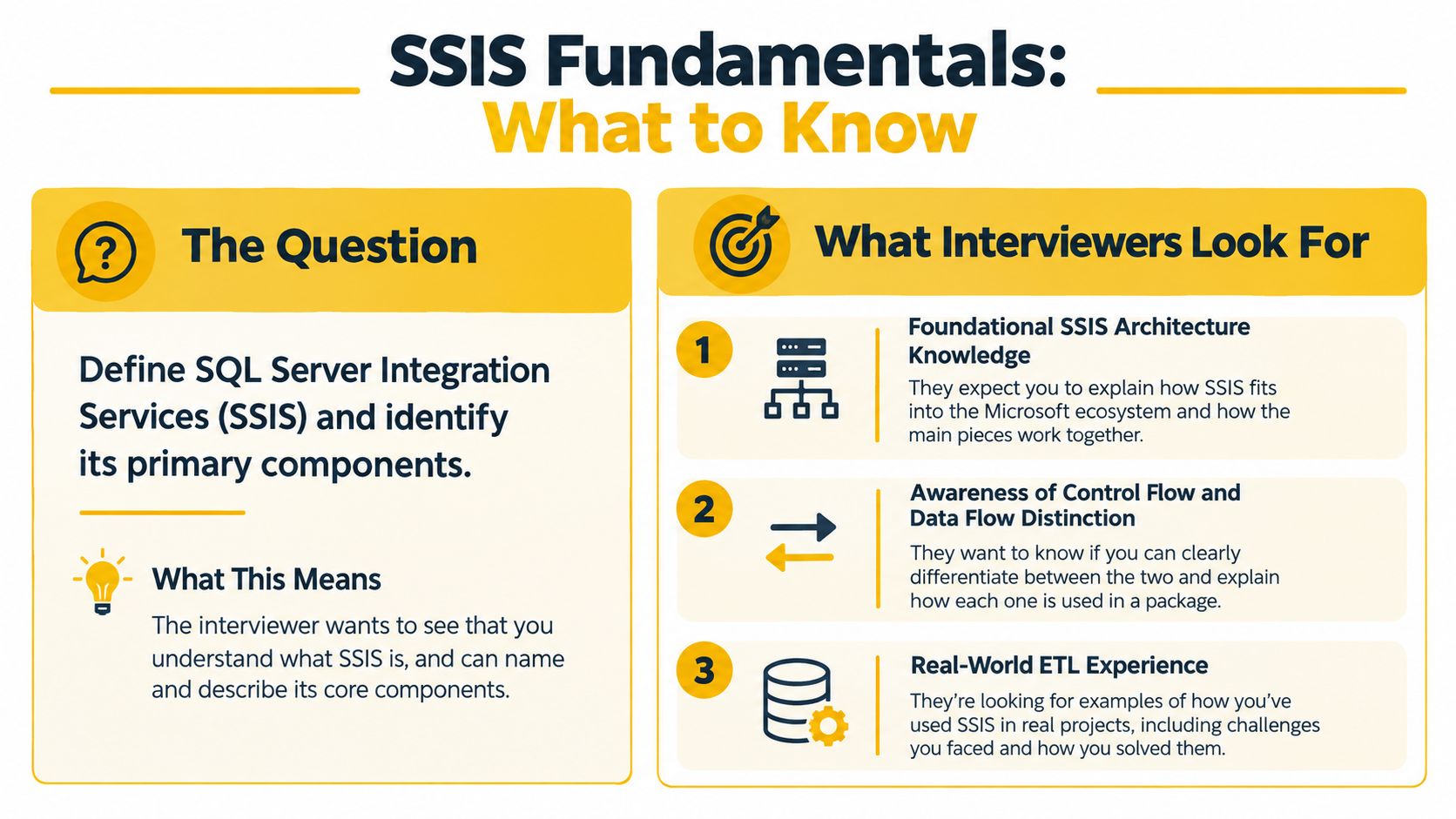
1. What is SSIS and what are its primary components?
SSIS, or SQL Server Integration Services, is Microsoft's platform for building data integration and workflow packages. A strong answer should go beyond calling it an ETL tool. Explain that an SSIS solution combines package execution, workflow orchestration, data movement, transformations, connections, parameters, variables, and operational controls.
You can also show historical awareness. SSIS was first released with SQL Server 2005 as a complete rewrite of Data Transformation Services, or DTS, which had been part of SQL Server since version 7.0. Microsoft positioned SSIS 2005 as a new, scalable ETL platform with an extensible architecture, a new package designer, and improvements in deployment, management, and performance, as described in this background on the transition from DTS to SSIS.
Build the answer around package behavior
Describe the major working parts in terms of what a developer does:
- Runtime engine: Executes the package and manages task and container behavior.
- Control Flow: Defines the order and conditions for tasks, containers, and package-level operations.
- Data Flow Task: Carries rows from sources through transformations to destinations.
- Connection managers: Hold the connection information used by sources, destinations, and tasks.
- Packages and projects: Package the workflow and its configuration so teams can develop, test, deploy, and monitor it.
A practical scenario might be a warehouse load that reads customer files, validates rows, enriches them from SQL Server, and loads accepted records into a warehouse table. The package could use an Execute SQL Task to prepare a staging area, a Data Flow Task to process rows, and a final task to write an audit result.
Interview framing: “I'd explain SSIS through its execution model. Control Flow orchestrates work at the package level, while Data Flow processes rows through sources, transformations, and destinations. I'd then connect those pieces to a package I designed and explain how it was configured for its target environment.”
Don't list every component without showing how they interact. If you need structured rehearsal for this type of explanation, you can use Interview Pilot's question bank to practice concise definitions followed by implementation examples.
2. Explain the difference between Control Flow and Data Flow in SSIS
The clearest distinction is simple: Control Flow decides what happens and when, while Data Flow defines how rows move and change. Control Flow works with tasks, containers, variables, expressions, and precedence constraints. Data Flow runs inside a Data Flow Task and connects sources, transformations, and destinations through paths.
For example, a package might begin with an Execute SQL Task that clears a staging table. A precedence constraint can start a Data Flow Task only when that preparation succeeds. Inside the Data Flow Task, an OLE DB Source reads records, a Derived Column creates a normalized value, a Conditional Split sends valid and invalid rows to different outputs, and an OLE DB Destination loads the accepted data.
Explain the design decision, not only the definition
Suppose a package loads several independent source tables. You might run separate Data Flow Tasks in parallel to reduce waiting, but only when the database, network, and server have enough capacity. Parallelism can shorten elapsed time, yet it can also create contention for memory, destination locks, or source-system resources.
A row-count decision shows the difference especially well. A Data Flow Task can write an audit count to a variable or table. Control Flow can then use that result in a precedence constraint or expression to decide whether to continue, notify an operator, or stop the package. The row-level validation itself belongs in Data Flow, while the decision based on the outcome belongs in Control Flow.
SSIS interview preparation commonly emphasizes this distinction alongside error handling, logging, checkpoints, connection managers, Script Tasks, and SQL Agent execution behavior, as reflected in these practical SSIS interview questions.
Practical rule: Don't put workflow decisions into a Script Component just because the logic feels difficult. First decide whether the requirement concerns package orchestration or row processing, then choose the layer that expresses it most clearly.
3. What are SSIS transformations and can you describe the most commonly used ones?
Transformations operate inside the Data Flow Task. They alter, enrich, aggregate, sort, combine, or route rows between a source and a destination. The best answer names familiar components, then explains why one is appropriate for a particular package.
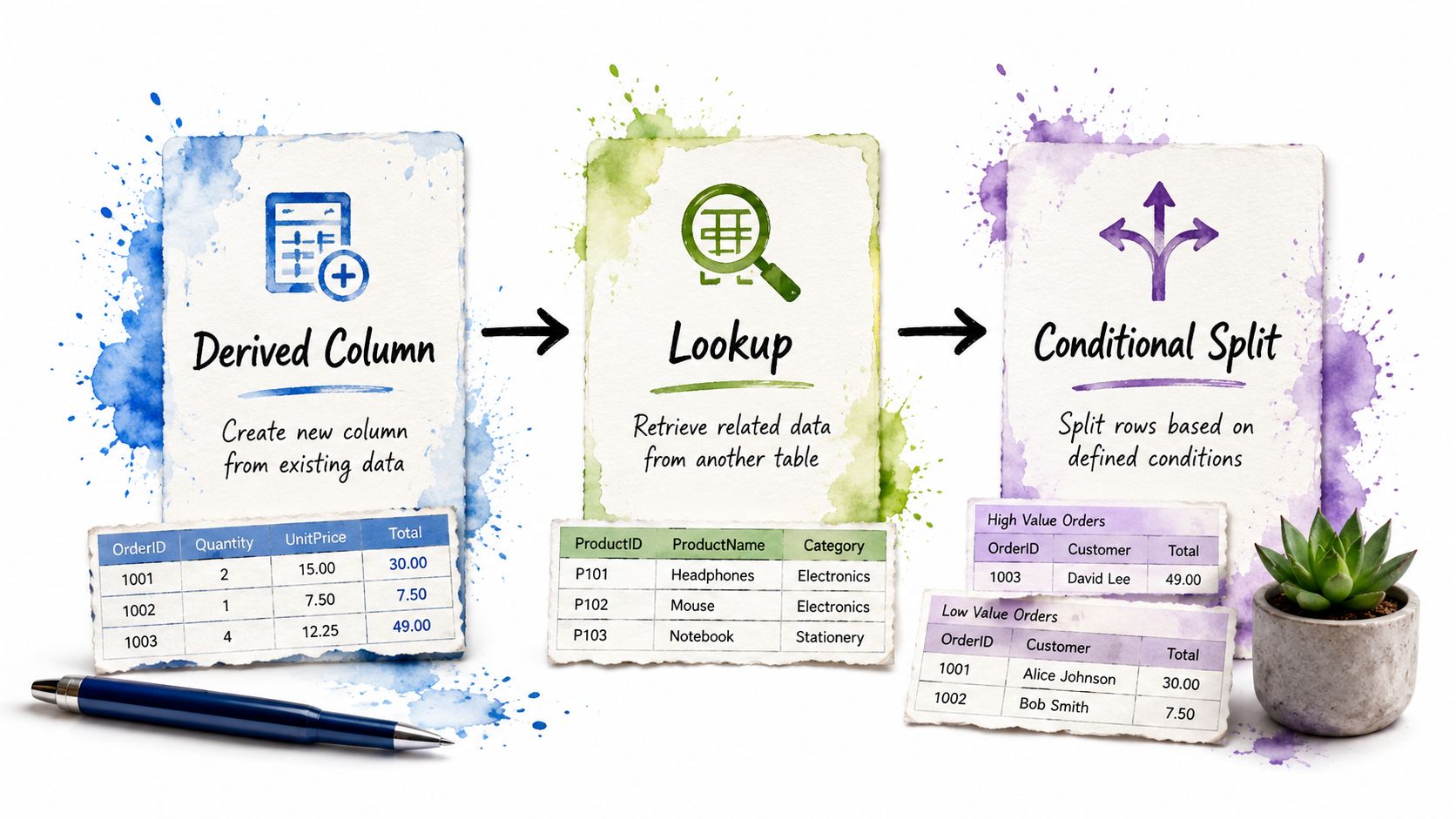
Consider a sales-load scenario. A Derived Column transformation can standardize a text field or calculate a value from existing columns. A Lookup can match a product identifier to a reference table and add a warehouse key. A Conditional Split can route complete rows to the main load, incomplete rows to a correction path, and clearly invalid rows to quarantine.
Match the transformation to the data problem
- Derived Column: Use it for expressions that create or replace columns without changing the overall row structure.
- Lookup: Use it to enrich or validate rows against reference data. Cache behavior affects memory use, so don't select a large cache without understanding the reference set.
- Conditional Split: Use it to route rows according to validation or business rules.
- Merge Join: Use it when two compatible, sorted inputs must be combined.
- Aggregate: Use it to calculate grouped results, such as totals by region.
- Sort: Use it when ordering is required, but remember that sorting can hold data before producing downstream output.
- Pivot and Unpivot: Use them when the input and output shape must change.
A useful trade-off is choosing between a Sort transformation and sorting at the source. If the source query can provide the required order efficiently, that may avoid an extra in-memory operation. If the source cannot provide it, the SSIS transformation may be appropriate, but you should discuss its effect on memory and throughput.
Interview framing: “I choose transformations according to the data problem. I use Lookup for reference enrichment, Conditional Split for explicit routing, and Derived Column for row-level expressions. I also check data types, error outputs, caching, and whether a blocking operation can be moved to the source.”
Your examples can lead naturally into warehouses and analysis tools, especially when explaining where transformation logic belongs in an ETL or ELT design.
4. How do you handle errors and implement logging in SSIS packages?
A production SSIS package needs two separate responses to failure. Error handling decides what happens to a bad row or a failed task. Logging records what happened so an operator can trace the run later. If you treat logging as recovery, reruns become harder to trust.
A common case is malformed dates in a source file. At the Data Flow level, I redirect rejected rows instead of letting one bad record stop the batch. Those rows go to an error table with the original data, the error code, the error column, the package name, and a run identifier. That gives the business team a clean place to review and fix the data without blocking successful rows.
In an integration package that loads customer records, I also split the response by failure type. Row-level issues, such as a lookup miss or conversion error, go to a controlled rejection path. Task-level failures, such as a connection problem or a destination outage, trigger event handlers like OnError and OnWarning. An OnError handler can write structured details to an audit table and notify operations, while checkpoints help the package restart from a safe point after an interruption.
The trade-off is clear. More logging helps diagnosis, but too much logging can clutter audits and slow execution. I log the package name, task name, source, destination, environment, and row counts for read, written, redirected, or rejected rows. I avoid logging every row unless the business process really needs that level of detail. I also make reruns safe, so a failed step can run again without duplicating committed data.
For interview answers, I frame it around production decisions:
Production answer: “I separate row-level rejection from package-level failure. Bad rows go to an error path with enough context for reconciliation. Task failures trigger logging and recovery logic, and I design reruns so they do not duplicate previously committed data.”
Recent SSIS interview guide focused on operational maturity material also reflects this shift toward production concerns, especially performance, memory, parallel execution, transactions, and remote connections.
5. What is the difference between the project deployment model and the package deployment model in SSIS?
The important distinction is the unit of deployment and configuration. In a package-oriented approach, individual packages and their configurations are managed separately. In a project-oriented approach, related packages are deployed and configured as a project, allowing shared parameters and environment-specific values to be managed more consistently.
Use a customer-integration example. A development project might contain packages for customer extraction, address cleansing, reference loading, and warehouse loading. The server name, database name, file location, and other environment values shouldn't be embedded separately in every package. Project-level parameters can centralize values shared by several packages, while package-level parameters can hold settings that apply only to one workflow.
Discuss the trade-off honestly
A project deployment model is usually easier to govern when a team has multiple related packages and separate development, test, and production environments. Centralized deployment and execution history can make it easier to identify the version that ran and to inspect execution results.
The package approach may still exist in an older estate where changing deployment conventions would introduce unnecessary migration risk. Don't dismiss it as useless. Explain that the right decision depends on the existing SSIS version, operational tooling, release process, and cost of migration.
A credible answer also covers parameter scope and security. Environment-specific values should be supplied outside the package where possible, and sensitive connection information should be protected through the organization's approved mechanism. You should be able to explain how a release moves from development to test and then to production, who approves it, and how the team can roll back or restore the prior package version.
Interview framing: “I'd prefer a project-level deployment approach for a coordinated production solution because it gives the team a consistent unit for parameters, configuration, monitoring, and release management. I'd retain a package-based approach only when compatibility or migration risk makes that the safer operational choice.”
6. How would you optimize SSIS package performance for large datasets?
Start with the slowest part of the path. In one package, the source query may be scanning too much data. In another, a Lookup, Sort, or Aggregate may be holding rows in memory before anything reaches the destination. Sometimes the destination is the limit, especially if indexes, constraints, or network latency slow the write.
SSIS performance counters such as Rows read and Rows written help isolate where throughput drops. I also check execution plans, buffer usage, wait conditions, and package logs so the tuning effort targets the actual constraint. The goal is to improve end-to-end flow, not make one component look faster in isolation.
Start with the data flow, not the defaults
DefaultBufferMaxRows and DefaultBufferSize can help when they match the workload, but they are not safe guesswork settings. A wide row can fill buffers early, while larger buffers can increase memory pressure and cause concurrent flows to compete with each other. The SSIS performance interview guidance makes the same practical point, measure before you change.
A credible answer should tie the tuning choice to a package scenario. If the package extracts transactional data, select only the required columns and filter rows as early as business rules allow. If the flow contains a Sort or Aggregate, call out that these components can block output until they have enough input, so the likely fix may be reducing the row set before that point. If the destination is a bulk load into a staging table, describe whether indexes and constraints are disabled during the load window and then restored after validation.
Parallel execution is a useful trade-off, but only when the server has the CPU, memory, source capacity, and destination throughput to support it. Type alignment matters for the same reason. Early conversion errors and repeated casts waste time and create noisy failure paths. In an interview, the strongest framing is simple: explain what you would measure before the change, what you would change in the package, and how you would confirm that reliability and recovery still hold after the load is faster.
Practical rule: Tune the bottleneck you can prove. Buffer changes only make sense after you check source SQL, row width, memory pressure, and destination behavior.
7. Describe your experience with SSIS package development lifecycle and version control
A package change should be traceable from business requirement to production support. For example, a daily customer load may begin with source and target definitions, transformation rules, error handling, and a scheduled completion window. The team then designs the Control Flow and Data Flow, reviews the project, tests representative records, deploys through controlled environments, and monitors the first production runs.
A practical version-control workflow uses Git or Azure DevOps. A developer creates a branch, updates a Data Flow Task and its parameters, and records why a new Conditional Split path is required. The review should examine naming, data types, connection managers, error outputs, performance risks, dependent packages, and configuration changes. Storing the SSIS project with deployment scripts and environment configuration makes the change easier to reproduce, while restricting environment values to parameters prevents development settings from reaching production.
Testing should exercise failure paths, not only a successful package run. Use representative data to check accepted and rejected rows, missing lookup values, duplicate inputs, empty files, connection failures, and reruns after partial completion. Integration tests should verify actual source and destination behavior. Deployment tests should confirm that environment-specific parameters resolve correctly when SQL Server Agent runs the package. A rollback plan might restore the prior project version, reverse a schema change, or replay data from staging. The right option depends on whether the package is restartable and whether the destination load is transactional.
Record the operational details that another engineer needs:
- Purpose: The business process supported.
- Inputs and outputs: Source systems, staging areas, and destinations.
- Rules: How rows are transformed, accepted, rejected, and reconciled.
- Operations: How the scheduler runs the package and where logs are reviewed.
- Recovery: The response for each major failure type.
- Ownership: Who approves changes and investigates data exceptions.
For role-specific rehearsal, Interview Pilot's data engineer interview guide can help structure a project narrative.
Interview framing: “I'd describe one package from requirement through support, including the design review, tests, environment configuration, rollback decision, and production issue I had to address.”
If the example is hypothetical, say so and state the assumptions. Do not claim experience with tools you have not used.
8. How do you approach data quality validation and handling invalid data in SSIS?
In a customer load, data quality rules should be defined before the package sends rows to the warehouse. Start by agreeing what makes a record valid for the business process. Typical checks cover required fields, data types and ranges, reference integrity, uniqueness, formatting, and reconciliation requirements.
Design the package around three outcomes. Valid customer rows continue through the Data Flow. Correctable rows, such as records with a recoverable date or formatting issue, move to a staging or remediation path. Rows that violate a critical business rule move to quarantine with their original values, a rule identifier, and a readable rejection reason. This keeps the destination from becoming the first place where quality problems appear.
Validate at more than one layer
Use a Conditional Split for transparent routing rules and a Lookup to verify reference values, such as customer identifiers. Use a Script Component only when the rule requires custom code. In a practical package, the Lookup can identify unknown customers, while the Conditional Split routes them to a rejection table that stores the batch identifier and source key. A staging table also lets the team inspect, correct, and replay rejected rows without rereading the source.
Validate the output after the load. Compare extracted and loaded record counts, reconcile key totals where appropriate, check for duplicates, and record each variance. A package may report success while producing an incomplete business result if rows disappear without an error or if the source schema changes unexpectedly.
Data quality requires an ownership decision as well. Business owners should approve the rules because a technically valid value can still breach a business policy. Strict rules improve control but increase manual review and rejected volume. Permissive rules protect throughput but can pass unreliable data downstream. Explain who sets the threshold, where exceptions are reported, and how rejected records are investigated.
For preparation on pipeline checks, review how to validate data for pipelines and practise related data analyst interview questions.
Interview framing: “For a customer load, I'd agree validation rules with the business, route valid, correctable, and rejected records separately, and preserve the source context for replay. I'd finish with reconciliation and monitoring so missing rows, duplicate keys, and changing source data become visible.”
SSIS Interview: 8-Point Comparison
| Question | Implementation complexity 🔄 | Resource requirements ⚡ | Expected outcomes ⭐ | Ideal use cases 📊 | Key advantages / Tips 💡 |
|---|---|---|---|---|---|
| What is SSIS and what are its primary components? | Low, conceptual overview of architecture | Low, IDE (BIDS/SSDT) and SQL Server runtime | ⭐ Basic SSIS literacy and architecture awareness | 📊 Interview baseline; entry-level ETL roles | 💡 Explain Control Flow vs Data Flow and name runtime, packages, connection managers |
| Explain the difference between Control Flow and Data Flow in SSIS | Medium, requires architectural clarity and examples | Medium, sample packages and diagrams for demonstration | ⭐ Ability to design clear orchestration vs transformation layers | 📊 Designing ETL workflows and error handling | 💡 Use diagrams; cite task examples (Execute SQL vs Derived Column) and performance implications |
| What are SSIS transformations and can you describe the most commonly used ones? | Medium, practical knowledge of multiple transforms | Medium, test data and hands-on practice | ⭐ Practical ETL skills for row-level manipulation | 📊 Data shaping, enrichment, joins, aggregations | 💡 Mention Derived Column, Lookup, Conditional Split, Sort, Aggregate and sync vs async impacts |
| How do you handle errors and implement logging in SSIS packages? | High, production-grade error handling and observability | High, logging stores, alerting, event handlers, storage | ⭐ Operational reliability, traceability, faster troubleshooting | 📊 Production ETL, compliance, SLA-driven environments | 💡 Use event handlers, error outputs, checkpoints; balance log granularity vs performance |
| Project vs Package deployment model in SSIS | Medium, conceptual plus migration considerations | Medium, Integration Services Catalog and SQL Server 2012+ | ⭐ Improved deployment control and environment management | 📊 Enterprise deployments, CI/CD and multi-environment promotion | 💡 Favor Project model for centralized params; use Package model only for legacy simplicity |
| How would you optimize SSIS package performance for large datasets? | High, advanced tuning and diagnostic approach | High, memory/CPU, monitoring tools, DB tuning | ⭐ Significant speed and scalability improvements | 📊 Large-scale data warehouse loads and high-throughput ETL | 💡 Tune buffers, prefer sorted source over Sort transform, use Bulk Insert and parallelism; measure before changes |
| Describe SSIS package development lifecycle and version control | Medium, process-oriented with tool knowledge | Medium, Git/TFS/Azure DevOps, CI/CD pipelines | ⭐ Better collaboration, repeatable deployments, audit trails | 📊 Team development, release management, production support | 💡 Use feature branches, CI/CD pipelines, code reviews, tests and documentation |
| How do you approach data quality validation and handling invalid data in SSIS? | High, combines business rules and technical validation | Medium–High, profiling tools, staging/quarantine storage | ⭐ Higher data integrity and trustworthiness | 📊 Regulated domains, master data integration, analytics accuracy | 💡 Implement staged validation (valid/correctable/reject), use Conditional Split, lookups, profiling and scorecards; balance strictness vs throughput |
Turn SSIS Knowledge Into Interview-Ready Answers
A strong answer to an SSIS interview question has a repeatable shape. Define the concept in plain language, describe where it sits in the package, give a concrete scenario, explain the trade-off, and finish with the validation or troubleshooting step. That structure keeps you from reciting a disconnected list of transformations or properties.
For the architecture question, define SSIS and show how Control Flow, Data Flow, connections, and packages work together. For transformations, name the component that fits the data problem and explain why you didn't use a less suitable alternative. For error handling, distinguish redirected row errors from task or package failures. For deployment, explain how configuration and release management affect operations. For performance, begin with measurement and identify the bottleneck before proposing a change.
Your examples should make the level of your experience clear. If you personally built a package, say what you implemented, what failed, and how you diagnosed it. If you're answering a hypothetical design question, state the assumptions instead of presenting an imagined project as past experience. Interviewers usually learn more from a careful explanation of boundaries and trade-offs than from an impressive-sounding claim with no implementation detail.
Practice adapting your depth to the role. A junior candidate may need to explain sources, destinations, transformations, variables, and precedence constraints accurately. An experienced candidate should also discuss reruns, observability, scheduled execution, memory pressure, deployment safety, data reconciliation, and maintainability. Current SSIS work often sits in established or mixed environments, so be prepared to explain when preserving an existing package is sensible and when migration to another integration or orchestration approach would improve maintainability. The decision should follow operational fit, not fashion.
Rehearse aloud using realistic prompts:
- Define the SSIS concept without relying on jargon.
- Draw or describe the package flow.
- Explain one implementation detail that matters.
- State the trade-off or failure mode.
- Describe how you'd test, monitor, or recover it.
- Finish with the evidence you'd inspect before changing the design.
Mock sessions are useful because recalling an answer on your own is not the same as explaining it under pressure. Interview Pilot offers guided mock practice and a searchable question bank that can help you rehearse SSIS topics in a role-focused format. Use those sessions to shorten long explanations, expose gaps in your examples, and practice follow-up questions rather than memorizing polished paragraphs.
The final goal isn't to mention every SSIS feature. It's to show that you can make a decision inside a real package, understand what can go wrong, and leave operators with a way to detect, diagnose, and recover from the result. That is what turns a definition into an interview-ready engineering answer.
Interview Pilot offers guided mock interviews, real-time answer support, and a searchable question bank for rehearsing technical topics such as SSIS architecture, troubleshooting, deployment, and data quality. Practice these eight questions aloud, refine your package examples, and visit Interview Pilot to prepare with structured interview tools.
Topics
interview question on ssis
SSIS interview questions
SQL Server Integration Services
ETL interview questions
data engineer interview
Continue reading

Interviews
10 Technical Interview Questions Software Engineer
Master technical interview questions software engineer candidates face, from algorithms and data structures to system design, with practical answer tips.
October 3, 2026
20 min read

Interviews
18 Hour to Salary: How to Convert Pay Correctly
Understand the 18 hour to salary conversion and how overtime, paid time off, and pay transparency laws change your real annual earnings.
October 2, 2026
14 min read

Interviews
8 Interview Questions Event Manager Candidates Should Know
Prepare for interview questions event manager candidates face with sample responses, crisis scenarios, competency markers, and practical answer frameworks.
October 2, 2026
22 min read