
















Interviews
8 IBEW Apprenticeship Interview Questions and Answers
Ace your IBEW apprenticeship interview questions with 8 real questions, strong sample answers, and safety, math, and teamwork prep tips.
Interview Pilot Editorial Team
Updated November 25, 2026
16 min read

Three chairs sit on the far side of a folding table: a journeyman out of the local, a contractor who bids the work, and a training coordinator holding the scoring sheet. One of them asks the first question, and your ten minutes start.
That panel isn't hunting for a polished speaker. It's ranking people who will still show up in year three of a multi-year program, work safely around energized equipment, and pass night-school algebra after a full day on a ladder. The format is short and rigid. Per the Northeast Illinois Electrical Training Center's applicant guidance, a panel of 4 to 10 representatives works through four or five questions in roughly 10 minutes, and at that local the interview score itself determines placement.
The eight questions below are the ones that surface, in some wording, almost every cycle. Each item gives you the answer skeleton that scores and the specific responses that cost candidates points. Skim the common electrical apprentice interview answers for the broad shape, then work through the eight in order.
1. Why Do You Want to Become an IBEW Electrical Apprentice
Motivation is scored first and it's the easiest answer to fake badly. "I like working with my hands" comes out of half the chairs in that waiting room. What scores is a reason that survives the job itself: pulling conduit in an unheated garage in February, sitting in a code class at seven in the evening after eight hours on a lift, and a starting rate well below journeyman scale.
The joint model behind the interview is deliberate. The Library of Congress record of IBEW history notes the September 1941 National Apprenticeship Standards for the Electrical Construction Industry, set by the IBEW, NECA and the Federal Committee on Apprenticeship, and the 1947 founding of the NJATC that became the Electrical Training Alliance. Earlier membership rules also required at least three years of supervised training before a candidate was eligible.
The process itself runs in stages. The Electrical Training Alliance's application guidance describes applicants submitting an application, meeting local minimum requirements, sitting an aptitude battery when required, and, with a qualifying score, facing an oral interview before a committee representing both NECA and the IBEW.
The person who scores well usually walked in having already read the local's program page, and that shows in how calmly they answer.

The Three Beats of a Strong Answer
- The work, concretely. Name one task you understand: bending an offset in EMT, tracing a dead circuit to a junction box, or setting a panel so breakers land at the right height.
- The route. Say why the joint apprenticeship, paid field hours plus classroom instruction, and a journeyman card that travels between states.
- The proof. One real thing you've done that touches the trade, such as rewiring a shed, helping a relative pull a permit, or running low-voltage cable for a side job.
Follow-ups are where a script collapses. Red flags: a three-minute speech with no specifics, "I need a steady paycheck" as your only reason, or "I want to run my own company" before you've pulled a single circuit. The apprenticeship entry requirements guide is a reasonable primer on what programs expect before you apply.
2. Describe a Time You Worked as Part of a Team to Complete a Difficult Task
This one isn't about teamwork in the abstract. The panel is deciding whether you can work beside a journeyman who has to trust you to hold the far end of a 10-foot conduit without dropping it on his head.
Applicants without electrical experience assume that's the weakness. It usually isn't. Experience from retail, a warehouse floor, caregiving, military service, school projects or gig work translates once you make the connection explicit. The breakdown of how IBEW applicants are weighed notes that transcripts and portfolios carry the paper record while the interview itself runs through a small number of structured questions.
Use four beats, about thirty seconds each.
- Situation with a number. "Six of us closed a grocery store at 11 p.m.," not "we had a busy team."
- Task in one sentence. What had to be finished and by when.
- Two actions you took alone. "I took the pallet jack while two others faced the aisles," not "we all pitched in."
- A result you can measure. Hours saved, units shipped, a complaint closed.
Say a stock crew has three hours to face aisles before a district walk. You took the aisle with the heaviest turnover, radioed the two people nearest you when a pallet blocked it, and finished twelve minutes early. That's a complete answer with a witnessable result.

Red flags: every sentence starting with "we," a teammate cast as the villain, or a story that stops before the outcome. Keep your own conduct boring and the result specific.
3. How Do You Ensure Safety on a Job Site, and What Is Lockout/Tagout
This lands early and it decides a lot. Anyone can recite slogans. The panel listens for a sequence delivered in the right order, because the sequence proves you've done it rather than watched a video.
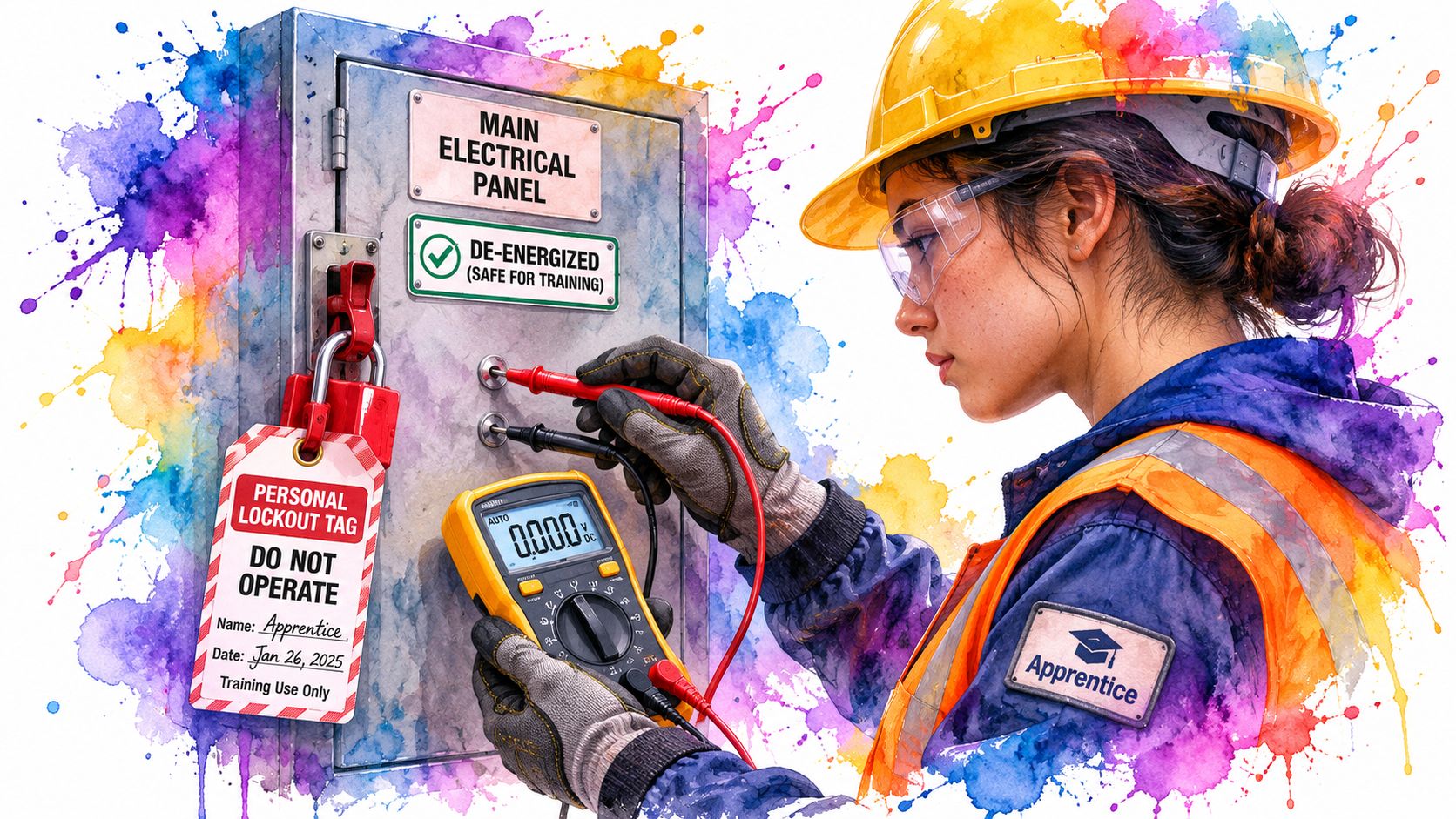
Lockout/tagout means isolating the energy source, locking it out, and proving the equipment dead before a hand goes in. The version an apprentice should be able to say cold:
- Notify and shut down. Tell the people on the equipment, then open the disconnect.
- Isolate and lock. One lock per person working, plus a tag with your name and the date.
- Try and verify. Attempt a start, then test the conductors with a meter rated for that voltage.
- Restore in reverse. Only the person who applied the lock removes it, after every tool and every hand is clear.
Practical rule: Never answer with "I'd just kill the breaker." A breaker is not a lock, and a disconnect is not a guarantee.
A panelist may follow with a twist: the lock is applied but the panel is old and unlabeled. The answer stays the same, plus trace the circuit before you trust the label.
For the wider set of trade questions a contractor might throw at you, from GFCI and AFCI basics to panel schedules, electrician interview questions is worth reading before the interview.
Red flags: "safety is common sense," "that's the electrician's job," or a promise to "stay out of the way." The panel is scoring whether you'd speak up.
4. Explain Ohm's Law and Solve for Current at 120 Volts and 12 Ohms
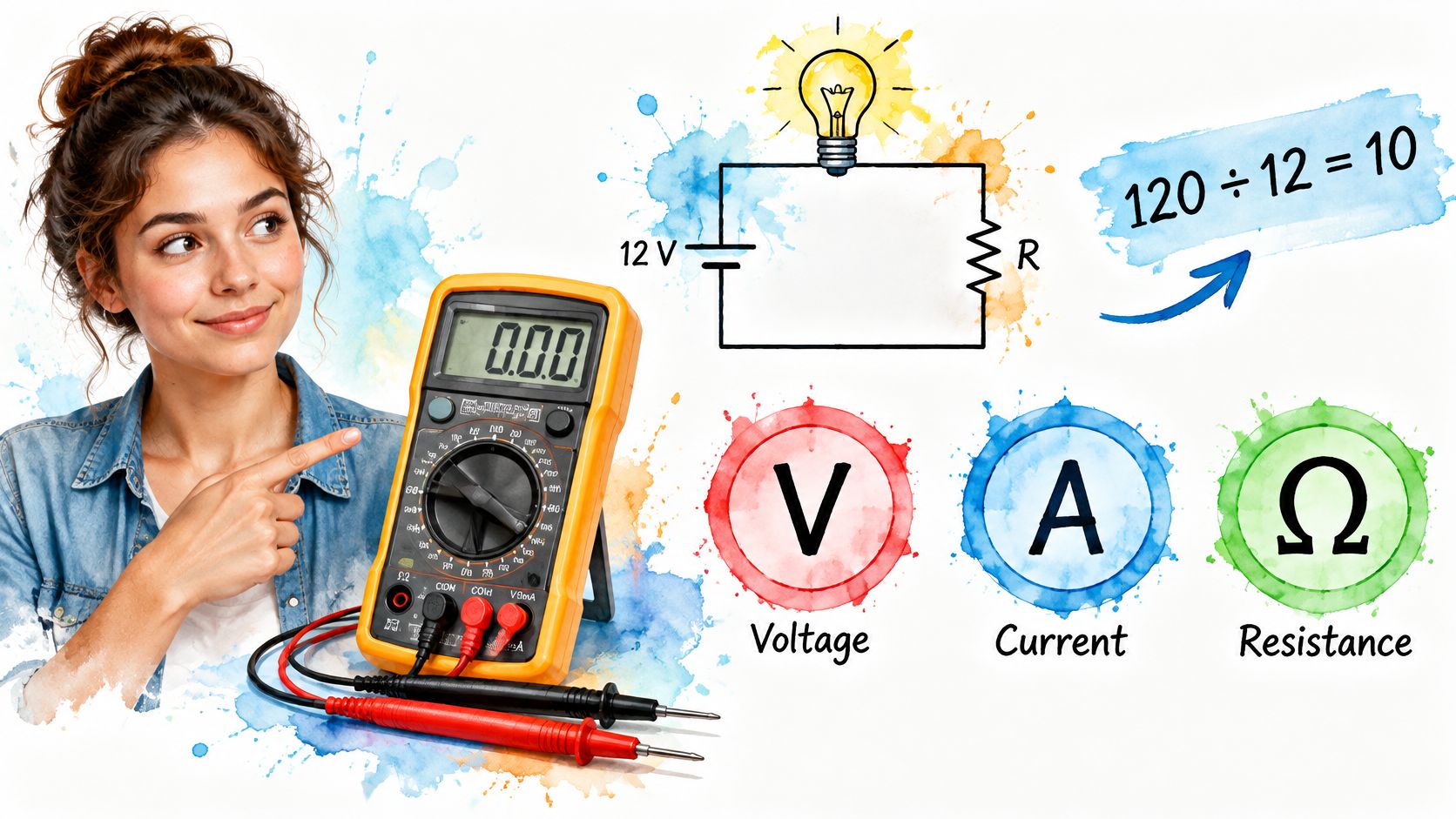
Many panels ask a version of this, and it isn't a trick. Ohm's law ties the three quantities together: voltage equals current times resistance, written V = I × R. Rearranged for current, I = V ÷ R. So 120 volts across 12 ohms gives 10 amperes.
Say the relationship out loud before you compute. Panels score clarity as heavily as arithmetic, and speaking the formula first buys you a second to check the division.
How to Say It Under Time Pressure
- State the relationship. Voltage, current, resistance, one sentence.
- Rearrange for the unknown. Divide both sides by resistance.
- Substitute and compute. 120 divided by 12.
- Name the unit. Amperes, not "amps of resistance."
Then they push. Drop the resistance to 8 ohms on the same 120-volt circuit and current rises to 15 amperes. Fault current behaves the same way, which is why a breaker trips, so connect the number to a real part when you can.
Red flags: multiplying the two given numbers and answering 1,440, giving "10" with no unit, or dodging with "I'd clamp the wire and read it." The panel asked for the math, not the shortcut. This set of technical interview questions for electrical engineers covers the follow-ups that usually come next.
5. Solve Basic Math Such as 3/8 Plus 1/4 and 15 Percent of 80
Say the panel asks for 3/8 plus 1/4. Rewrite 1/4 as 2/8, add the numerators, and the answer is 5/8. For 15 percent of 80, take 10 percent (8), take 5 percent (4), add them, and you have 12.
Talk while you work. A correct answer delivered in silence scores worse than a correct answer with the steps attached, because the panel is buying evidence that you can do this on a ladder with a tape measure in one hand.
Eligibility usually turns on this kind of math too. Applicants commonly need high-school algebra documentation, and the aptitude assessment is built to measure abilities tied to electrical construction, especially algebra and functions plus reading comprehension, before an interview is offered, per IBEW Local 1579's apprenticeship information. The interview question isn't there to re-test arithmetic. It's there to confirm the person behind the score can work with fractions under time pressure.
A tape measure is a fraction tool. If you can read 5/8 on a blade without hesitating, say so, and name the last thing you measured.
Red flags: fifteen seconds of silence, "I'm not a math person," or reporting 0.6 for 5/8 and moving on. Those read as a habit, and the panel has seen where that habit ends up on a cut list.
6. What Would You Do If You Saw a Coworker Bypassing a Safety Procedure
Situational questions are scored on the first move, not the speech. The panel is checking integrity, escalation, and whether you'd create a fight where a quiet conversation would do the job.
The Order That Scores
- Stop the exposure. If the hazard is live, say stop, and keep your own hands off the equipment.
- Talk to the person first. Calm, private, specific: "Mike, that disconnect isn't locked and I'm about to work that circuit."
- Fix the condition. Apply your own lock, isolate the source, remove the bypass once it's safe.
- Escalate if it repeats. Tell the journeyman or foreman, then the safety rep, and put it in writing if the local has a reporting form.
A safe answer never opens with "I'd mind my own business."
Say a journeyman jumpers a fuse to keep a lift running through lunch. You tell him the lift can wait, open the disconnect, apply your lock and tag, and mention it to the foreman at the next break. That's complete: hazard stopped, person respected, chain notified.
Red flags: "I'd yell at him," "not my business," "I'd report him to the hall" as the opening move, or a promise to physically grab someone. Each one tells the panel you'd either freeze or blow up a crew.
7. Describe a Time You Had to Learn a Task You Had Never Done Before
Apprentices learn tasks from scratch for years, so the panel wants a process rather than a personality. "I'm a fast learner" tells them nothing about year two.
The Four-Part Story
Give it in this order.
- The unknown task. Something new: setting up a conduit bender, running a register, learning a scheduling tool.
- The resource. A manual, a code book, a mentor, the manufacturer's instructions.
- The check. How you verified you had it right before you showed it on a jobsite.
- The result, plus what you'd change.
Example: "I'd never bent EMT. I read the instructions on the bender, watched a journeyman do two offsets, then bent my own on scrap and checked the rise with a level. The first was 3/4 inch off. I marked the next one and landed it inside an eighth."
Interview Pilot's guide on answering 'tell me about a time you had to learn something quickly' walks through the follow-ups this story invites, which is where most candidates run dry.
Red flags: no verification step, "I watched a video once," or claiming you already knew the skill. Experienced committee members hear those from people who quit in year two.
8. Are You Prepared for the Physical Demands and Reliability Required of an Electrical Apprentice
Two questions in one, and the second carries more weight. The physical part is easy to answer. Reliability is where the panel takes notes and where the ranking moves.
Answer with evidence instead of promises.
- Attendance. Name the longest stretch you worked without a missed shift and the job it was. A school year with perfect attendance beats "I'm always on time."
- Transportation. The actual vehicle, plus what happens the week it fails.
- Limits. If you have one, say what it is, what you do about it, and what you can still do safely.
- Schedule. Confirm you understand the program adds class hours to a full work week, then name how childcare, a second job or a long commute gets handled.
What the panel writes down: a candidate with a plan, not a candidate with a perfect record.
Say you worked two years of 5 a.m. openings and never missed one, and there's a licensed driver in the household who can take the second vehicle when yours is down. That beats "nothing will ever stop me," which the panel hears as someone who hasn't thought it through.
Red flags: absolutes like "I've never missed a day in my life," a hidden constraint with no plan attached, or blaming a former employer for your attendance record.
All 8 IBEW panel questions compared by what they test and how hard they are to prepare
| Interview Question | Question Type | What the Panel Is Testing | Prep Difficulty |
|---|---|---|---|
| Why do you want to become an IBEW electrical apprentice? | Motivation | Trade knowledge, commitment, and understanding of union-based training | Moderate |
| Describe a time you worked as part of a team to complete a difficult task. | Behavioral | Teamwork, communication, reliability, and safety awareness | Moderate |
| How do you ensure safety on a job site, and what is lockout/tagout? | Safety and technical knowledge | Hazard awareness, safe procedures, and understanding of lockout/tagout | Challenging |
| Explain Ohm's Law. If a circuit has 120 volts and 12 ohms of resistance, what is the current? | Technical knowledge and calculation | Electrical fundamentals, clear explanation, and accurate calculation | Moderate |
| Solve a basic math problem, such as: What is 3/8 plus 1/4, and what is 15% of 80? | Practical math | Accuracy with fractions, percentages, and explaining steps | Moderate |
| What would you do if you saw a coworker bypassing a safety procedure? | Situational judgment | Integrity, respectful communication, and willingness to address hazards | Moderate |
| Describe a time you had to learn a task you had never done before. | Behavioral | Adaptability, structured learning, and willingness to seek guidance | Moderate |
| Are you prepared for the physical demands and reliability required of an electrical apprentice? | Commitment and fit | Realistic expectations, physical readiness, punctuality, and reliability | Moderate |
Turn These Eight Answers into a Confident Interview Day
Two weeks is enough if you use it in order.
Week one, write bullets for each of the eight questions, four lines maximum, with one number, one task and one result apiece. Then record yourself once on your phone and listen back for rambling. You may find you can cut a third of your answer at that point.
Week two, rehearse out loud with someone throwing follow-ups. "Why this local?" "What happens if the resistance doubles?" "What if the foreman brushes you off?" Follow-ups are where memorized answers die, because there's nothing underneath them.
Then do the local homework. Call the JATC office or read its page and confirm the format, the scoring, and the documents it wants. Ask two questions at the end: how classroom hours are scheduled across the year, and how pay progression works from first period toward journeyman scale. Both signal you priced the commitment.
Bring the safety-first mindset with you. Dress like the job, arrive early, and answer the last question as carefully as the first, because panels notice the person who visibly checks out.
I'd run at least two live mock interviews before the actual interview, out loud rather than in your head, since the format is rapid-fire and speed is half the test. Interview Pilot's real-time copilot suggests answers during a live online interview, and its AI mock interviews and question bank let you drill teamwork, safety, math and reliability beforehand. No question list guarantees what a specific panel will ask, since question content can come from public materials, user submissions and general interview patterns rather than one committee's sheet.
Interview Pilot gives job seekers real-time, personalized answers during live interviews, plus AI mock interviews and a question bank you can drill the night before a panel date. The eight questions above reward rehearsal more than charisma, and the fastest way to get it is running them out loud until the follow-ups stop rattling you. Visit Interview Pilot to start a mock session or open the copilot before your interview day.



Topics
ibew apprenticeship
interview questions
ibew interview prep
electrician apprenticeship
jatc interview
Continue reading

Interviews
API Testing Interview Questions: 10 Answers for 2026
Prepare for API testing interview questions with 10 answers covering HTTP methods, status codes, authentication, contract testing, and automation.
November 19, 2026
18 min read

Interviews
What Are Your Expectations? Sample Answers That Work
Answering 'what are your expectations' in an interview? Get sample responses for salary, role and culture, plus follow-ups and questions to ask back.
November 6, 2026
16 min read

Interviews
Question to Ask Hiring Manager: 10 Smart Picks
Find the best question to ask hiring manager at every stage, with practical follow-ups, role-specific adaptations, and real examples.
October 18, 2026
19 min read