
















Interviews
How to Stop Rambling in Interviews: Answers That Land
Learn how to stop rambling in interviews with a four-part answer structure, length targets and recovery moves that keep you on point.
Interview Pilot Editorial Team
Updated November 28, 2026
14 min read
You know the answer. You've told the story before, probably more than once, and it went fine. Then the interviewer asks it in a slightly different way, the clock starts, and somewhere around the second sentence your mouth takes over. You're explaining the team structure. Then the reorganisation. Then a conversation in a corridor three years ago. The interviewer's pen has stopped moving and you can hear yourself doing it, but stopping now feels worse than finishing.
That gap between knowing the answer and landing it is where most candidates lose the offer. Communication skills appear in nearly 55% of job listings, according to Jobscan's 2025 job-market analysis, and what gets assessed in a live interview isn't your vocabulary. It's whether you can tell when you've said enough and hand the conversation back.
Rambling is a stopping-point problem. You didn't decide where the answer ends before you started speaking, so you keep talking in the hope that the ending will show up. It rarely does.
The Four-Part Answer Shape That Stays on Track
A candidate is asked about a deadline they missed. They spend ninety seconds on the team's history and the migration project, then ten seconds on what they did. The interviewer learns a lot about the company and nothing about the candidate. That imbalance is the whole failure, and it's visible in the transcript before anyone judges the answer's content.
The shape below fixes it because each part has a job, and the last part is a door you can walk through.
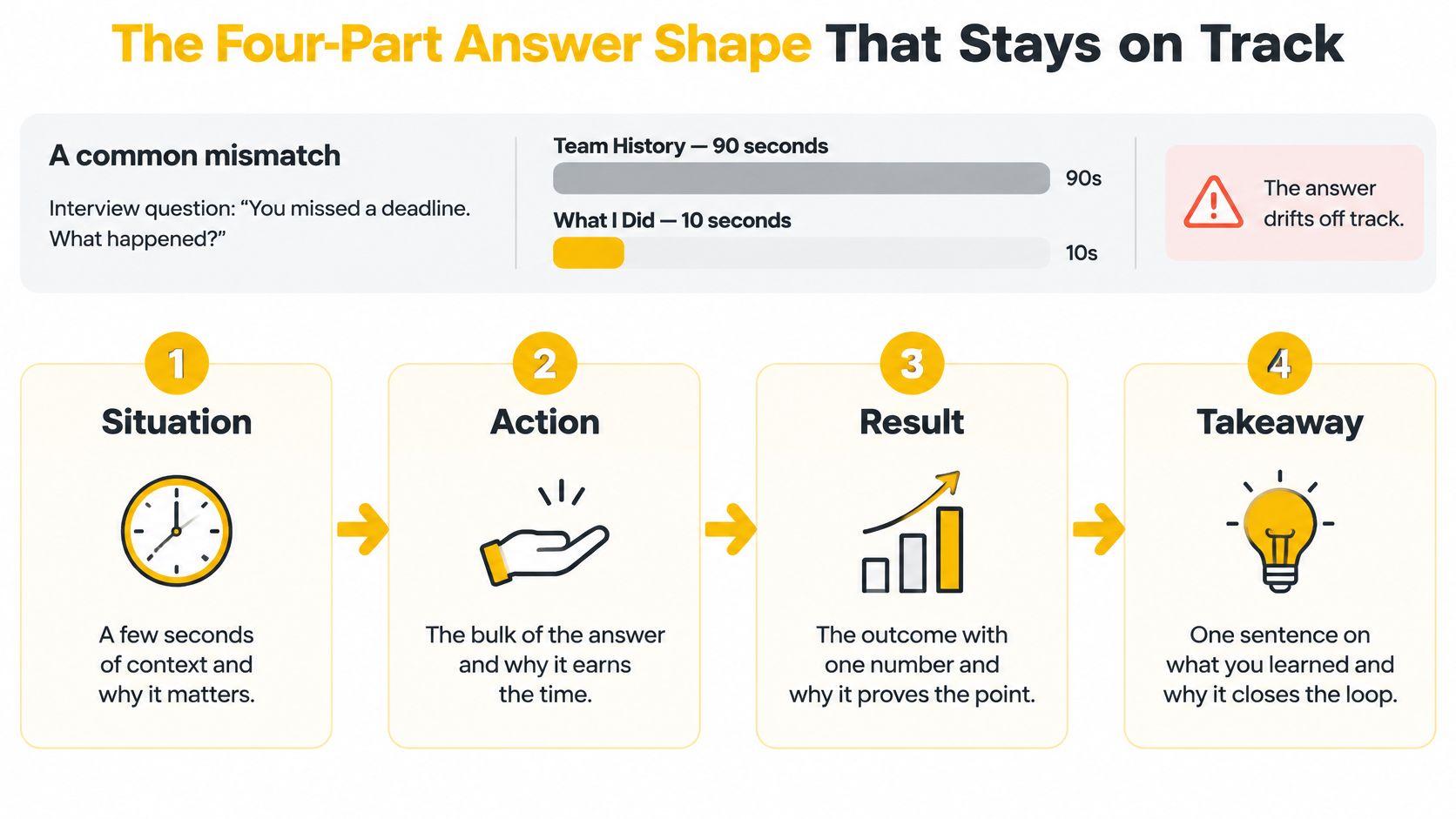
- Pause two or three seconds before speaking. Not to compose a speech, just to choose the headline. Candidates who start instantly are usually talking to find their point. Candidates who pause for a beat already have one.
- Open with one sentence that answers the question directly. "We shipped the client report three days late, and the reason was scope we never agreed." Now the interviewer knows where you're heading, and so do you. Everything after that sentence is support, and support can stop.
- Give only the context the problem needs. Roughly 10% of the answer. The interviewer cares far less about the situation than about what you did inside it.
- Spend 60 to 70% on the actions you personally took. Say "I" where the decision was yours. "We" is accurate for team outcomes and useless for assessing you.
- Finish with a measurable result in 20 to 30%, plus one line on what you learned. Then stop talking. The pause that follows is the interviewer writing notes or choosing a follow-up, not a hole you need to fill.
| Part | Share of the answer | What belongs there |
|---|---|---|
| Headline | One sentence before the story | Direct answer to the question |
| Context | About 10% | Only the setup the problem needs |
| Your actions | 60-70% | Decisions and steps you personally took |
| Result | 20-30% | Measurable outcome and what you learned |
The proportions aren't decoration. Structured interviews use standardised questions and anchored scoring, and Arizona's public-sector guidance recommends predefined rating scales plus at least three benchmark answers (superior, satisfactory and unsatisfactory) to keep evaluation consistent, as set out in the Arizona HR structured behavioral interview guidance. A historical meta-analytic estimate puts structured interviews at a validity coefficient of 0.51 against 0.38 for unstructured ones. That's evidence for the principle of structure, not a promise that your score rises by a fixed amount.
The completion check: mark every sentence as headline, context, action or result. Any sentence that fits none of the four gets cut.
Three habits break the shape. Narrating every chronological detail. Saying "we" when the decision was yours. Ending without an outcome, which leaves the interviewer to guess what changed. Convert each story into four notes (problem, responsibility, two key actions, quantified result) and stop once all four are covered. If the interviewer wants more, expand only the part they name.
Length Targets for Each Question Type
Search for how long an interview answer should be and you'll find the same number repeated: ninety seconds to two minutes. Treat it as a coaching norm rather than a finding. No study establishes an ideal STAR-answer length, and the practical guidance behind the STAR answer length guidance from WiserHours is to give the interviewer enough evidence to assess the situation, action and outcome, then stop for follow-up questions. The clock is a proxy. Information density is the thing.
That has a contrarian consequence. Shorter is not automatically better. Candidates who over-correct into clipped answers strip out the evidence interviewers need, and that hurts most on technical, leadership and career-change questions where the reasoning is the point.
| Question type | Target length | Stop cue |
|---|---|---|
| Behavioral STAR story | 45-90 seconds | Result stated and lesson given |
| Tell me about yourself | 60-90 seconds | Current role, one proof point and a link to this job |
| Why this company | 30-60 seconds | One specific reason tied to the role |
| Technical concept | 30-60 seconds | Definition, one example and the key trade-off |
| Weakness or career change | 45-60 seconds | Honest gap, the step you took and current progress |
| Follow-up request | Only the requested part | Interviewer nods or asks the next question |
How to use the targets without becoming a stopwatch
Time your first answer to each question type. Note whether the stop cue arrived before or after the target length. If the cue came at forty seconds and you kept talking for another fifty, that's the pattern to fix, not the number. If you hit ninety seconds without a result, the shape broke before the timing did.
Speaking rate varies with language proficiency and nerves, so a sixty-second target means fewer words for some candidates than others. A slower, more deliberate speaker needs a tighter story than someone who talks quickly. This is why the cue matters more than the clock: "result stated and lesson given" travels across accents and speeds, while "ninety seconds" doesn't.
If you're preparing for a board or panel seat rather than a standard role, the question mix shifts toward governance judgement and stakeholder reasoning, and the common board candidate interview questions are worth working through so your stop cues match the actual question types you'll face.
For a fuller breakdown of how answer length interacts with question format, the guide to how long interview answers should be covers the trade-offs across more question types.
The principle to carry forward is simple. A complete answer prioritises the action and the result over the background. If you only remember one thing, remember which two parts earn the most airtime.
Building, Rehearsing and Rescuing Short Stories
Preparation is where most rambling is prevented, and it takes less time than people assume. Work through these six steps once and you'll have material for dozens of questions.
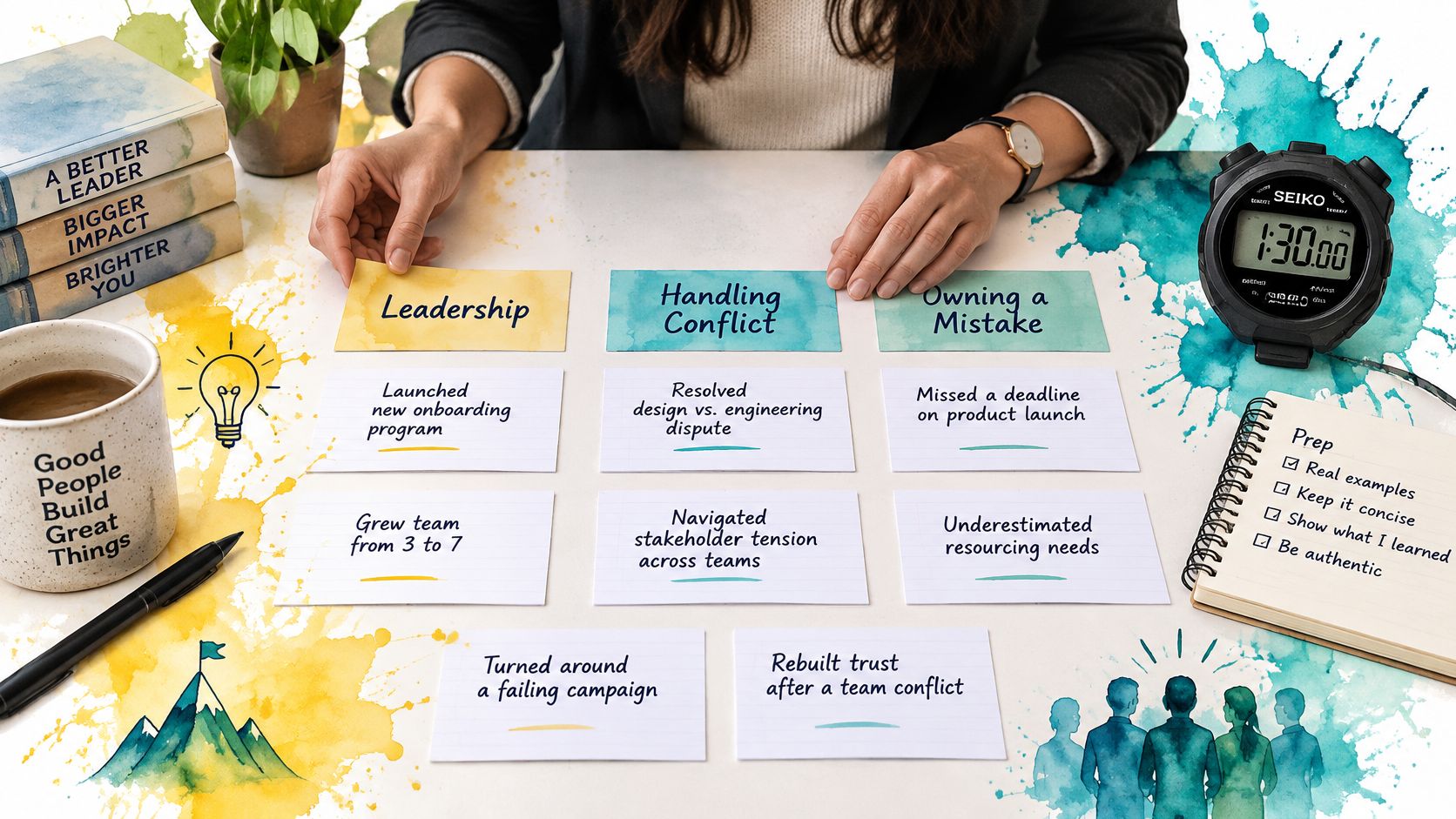
- List eight recent situations from your last two roles: projects, wins, failures, conflicts. Eight is enough to cover almost any competency question.
- Map each one to the competencies the job asks for. Leadership, handling conflict, owning a deadline, influencing without authority. Some stories will cover two.
- Write four notes per story. The problem, your responsibility, two key actions, one quantified result. Four notes, not four paragraphs.
- Pick a backup example per competency. If a story stops fitting the question, you switch rather than restart.
- Rehearse from the keywords, not a script. Memorised wording sounds rigid and collapses the moment the question is phrased differently.
- Record one run-through and check it against the notes. Delete anything that isn't in them.
A story is finished when all four notes are covered, not when it reaches a set number of sentences. That's the difference between rehearsing an endpoint and rehearsing a duration.
What standard advice doesn't cover
Most STAR guidance assumes you can calmly retrieve one relevant story and deliver it in sequence. It says very little about blanking, about three examples competing for the same question, or about the self-correction loop where you fix each sentence as you say it. The UCD Professional Academy STAR interview technique resource frames structured storytelling as a clarity tool, which it is, but clarity in rehearsal and clarity under pressure are different problems.
Over-rehearsal can make this worse. When a memorised phrase vanishes, the urge to restart from the top is strong, and restarting costs you the answer.
| Symptom | Likely cause | Recovery move |
|---|---|---|
| Blanking halfway through a story | Too many details held in memory | Pause, name the point reached, then go to the result |
| Story does not fit the question | Wrong example chosen | Say you will use a different example and give a one-line version |
| Interviewer interrupts | Answer ran past the evidence needed | Stop, answer their exact question, offer more detail |
| Self-correcting every detail | Trying to fix each sentence | Summarise the point and state the outcome |
| Long silence after the question | Anxiety and retrieval load | Take one short pause, then say the headline sentence |
The recovery order matters more than the words. Pause. Name the point you reached in one sentence ("I was explaining how I handled the vendor delay"). Answer the exact question the interviewer asked. Ask whether they want more detail. Then go straight to the result.
Recovery rule: a clean ten-second recovery reads as self-awareness. Restarting the story reads as panic.
Distinguish harmless filler from real derailment. A brief pause is almost always better than filling silence with unrelated background. That distinction matters most for students, non-native speakers and candidates in high-stakes technical interviews, where language retrieval and working memory compete for the same resources. If you want a deeper method for structuring the stories themselves, this guide to storytelling in interviews walks through the narrative side.
Measure Your Answers and Cut Filler Words
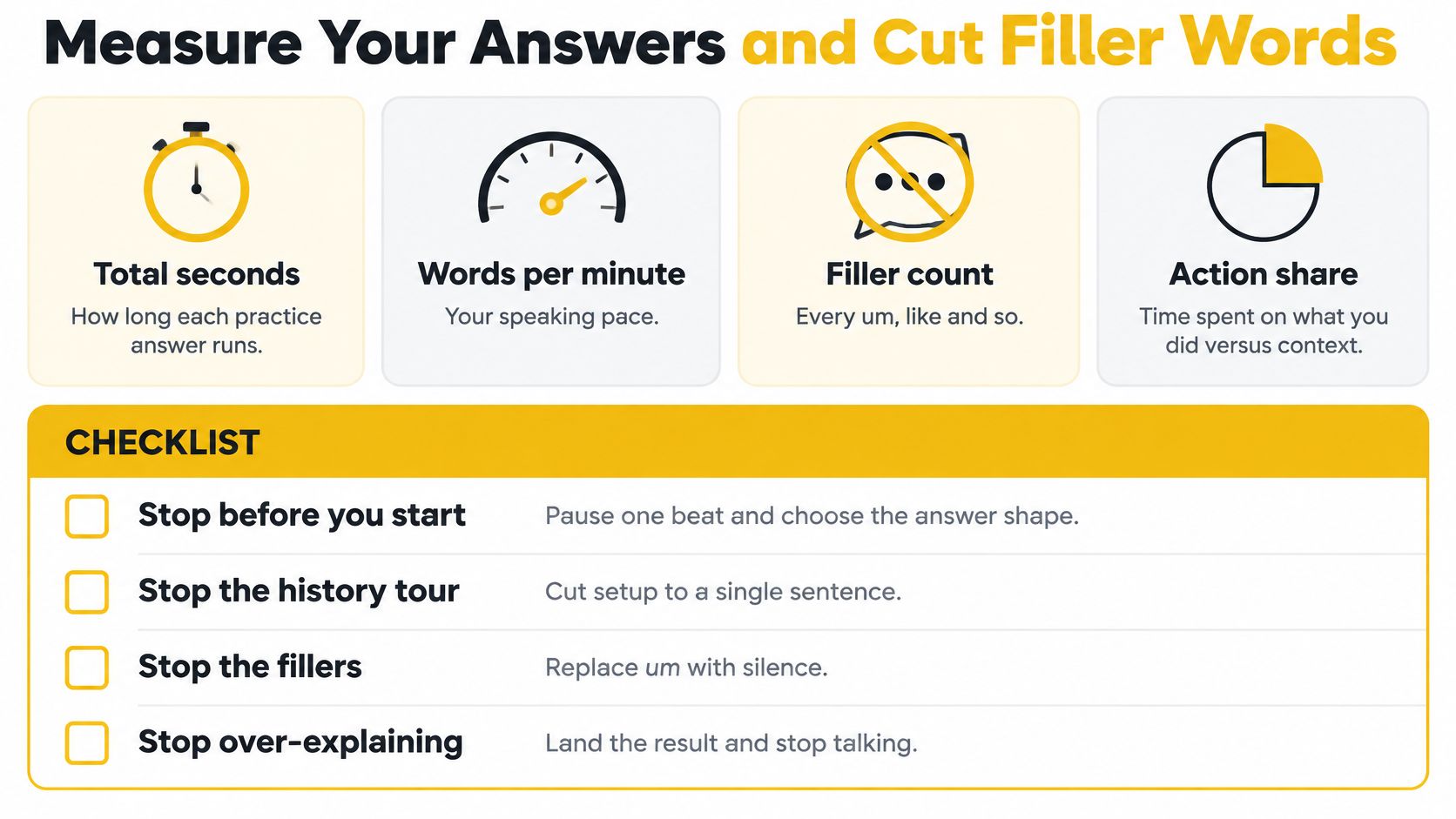
You can't fix what you don't count. Four numbers on every practice answer will tell you more than an hour of re-listening.
- Total seconds: how long the answer runs against the target for its question type.
- Words per minute: your natural pace, so you know how much content fits inside a target.
- Filler count: every um, like, so and basically.
- Action share: the percentage of time spent on what you did versus context.
Then apply the stop rule. If a sentence doesn't establish the situation, clarify your responsibility, explain a decision or prove an outcome, remove it. Run the rule on a transcript once and you'll usually find two or three sentences doing no work.
Where the filler threshold actually sits
A 2024 experiment by Matthew M. Laske and Florence D. DiGennaro Reed tested speeches containing 0, 2, 5 or 12 disfluencies per minute, as reported in the Journal of Applied Behavior Analysis study on disfluency and perceived effectiveness. Five per minute did not reduce perceived effectiveness. Higher rates did, and twelve filler sounds a minute clearly lowered ratings.
| Filler sounds per minute | Effect on perceived effectiveness |
|---|---|
| 0 | Baseline in the study |
| 2 | Below the level that showed no reduction |
| 5 | No reduction in perceived effectiveness |
| 12 | Lowered perceived effectiveness |
That gives you a working threshold of about five filler sounds a minute. Below it, chasing every "um" is a waste of rehearsal time that would be better spent tightening your result sentences. Approaching twelve, listeners start marking you down, and the fix is silence rather than substitution.
The overcorrection trap
The opposite failure is just as common. Corpus evidence from 16,928 answers in AI-led mock interviews found that 52.2% contained fewer than 20 words, though the Wellspoken analysis of answer length and disfluency notes those descriptive figures may not transfer to human interviews or high-stakes settings. A one-line answer isn't the goal, and memorised scripts collapse when the question shifts.
Practical rule: if you can't say which of the four parts a sentence belongs to, it's costing you airtime.
Review one recording a week and compare the numbers with the previous week. Chasing a single perfect answer teaches you less than watching the trend across five.
Start Your Practice Plan This Week
Reading about answer shape changes nothing on its own. Five steps will.
- Pick three stories per core competency from your notes, including one backup you haven't rehearsed much.
- Record two answers a day, one behavioral and one technical or role-specific, so you practice switching shapes.
- Measure each recording against the length target for its question type, the four numbers and your filler count.
- Run one full mock with a friend who interrupts you. Recovery is a skill, and a clean run never tests it.
- Review the week's numbers and tighten the single answer that drifted most.
The case for working on this is straightforward. In a 2025 Michael Page survey of employers in India, 37% selected communication skills as a top hiring priority, according to Michael Page's employer insights on in-demand skills. Clear, bounded answers are how that priority gets assessed in the room.
If your interviews happen in a second language, vocabulary for the setting helps more than grammar drills, and the GCA interview vocabulary guide is a useful starting point for building it.
For solo rehearsal, Interview Pilot's AI mock interviews record your answer and produce an evaluation, including a Delivery Score judged from that recording. You can add your resume and the target job before your first session so the questions match your background, and the practice tools include a Question Bank and a Playground for trying answers. Treat it as one route among several, and the guide to practicing for an interview by yourself covers the rest.
The goal was never the shortest possible answer. It's a clear answer that leaves a natural opening for a follow-up, and a candidate who knows when to stop.
If you want to hear where your answers end, Interview Pilot runs AI mock interviews that record each response and score conciseness, structure and delivery, so you can see the ninety seconds you spent on context before the result arrived. Add your resume and the target job first, and the questions come back matched to your background rather than a generic list. Visit Interview Pilot to run your first recorded answer this week.



Topics
stop rambling interview
interview answer tips
STAR method answers
concise interview answers
interview preparation
Continue reading
Interviews
How to Answer Tough Interview Questions in 2026
Learn how to answer tough interview questions with clear frameworks, a five-step method, sample answers, and fixes for freezing or rambling.
November 26, 2026
16 min read

Interviews
10 Nursing Manager Interview Questions to Expect
Prepare for nursing manager interview questions with 10 real prompts, leadership answer examples, and tips for staffing, budgets, and conflict.
November 25, 2026
19 min read
Interviews
Interview Questions Vice Principal: 10 Q&A Tips
Ace your next interview with the top 10 interview questions vice principal candidates face, plus sample answers and practical preparation advice.
November 23, 2026
25 min read