
















Interviews
How to Answer Tough Interview Questions in 2026
Learn how to answer tough interview questions with clear frameworks, a five-step method, sample answers, and fixes for freezing or rambling.
Interview Pilot Editorial Team
Updated November 26, 2026
16 min read
The interview is on Thursday. You've rehearsed your introduction until it sounds natural, you've read the company's about page twice, and you've picked the shirt. Then you scroll a list of questions and stop at one: "Tell me about a time you made a mistake." Your stomach drops, because you know exactly which mistake they could hear about, and you don't know how to say it out loud without sounding careless.
That reaction is normal, and it's fixable. Learning how to answer tough interview questions isn't about memorising clever lines. It's about recognising what each question is testing, then giving the interviewer the evidence they're checking for. A question about failure isn't asking whether you're flawless. It's asking what you do after something breaks, and that's a story you can build in advance.
Match Each Tough Question to Its Framework
Start with the question that scares people most: "Describe a decision you made that turned out to be wrong." The interviewer isn't collecting confessions. They're checking accountability, so the answer follows four beats: the assumption you made, the consequence that followed, the fix you applied, and the prevention you put in place afterward. Once you see that shape, the question stops being a trap.
Every tough question works this way. Name the skill being tested, and the structure picks itself.
| Question type | What the interviewer tests | Framework to use |
|---|---|---|
| Weakness | Self-awareness and coachability | Real weakness, corrective step, measured progress |
| Failure or mistake | Accountability | Assumption, consequence, fix, prevention |
| Conflict with a manager or peer | Judgment and collaboration | Context, your position, compromise, outcome |
| Employment gap | Honesty and skill continuity | One-sentence reason, skills kept active, return reason |
| Hypothetical scenario | Decision-making | Criteria, options, risks, decision rule |
| Salary expectations | Market awareness | Researched range, then flexibility |
| Live technical or coding problem | Reasoning under pressure | Clarify, state approach, name trade-offs, test |
| Why should we hire you | Role fit | Two or three job requirements matched to evidence |
One distinction trips people up constantly. The gap between behavioral and situational interview questions is the gap between "tell me about a time" and "what would you do if." The first needs a real event with a result. The second needs visible reasoning, not a story you don't have.
Your target role tells you which rows matter most. If you're applying for accounting or finance work, reading the role descriptions posted by Hire Accountants shows you the accuracy, deadline and client-judgment language employers use, which is a fast way to guess what they'll probe.
Label the question in your head before you speak. Two seconds of sorting saves two minutes of wandering.
How to Build an Answer in Five Steps
Why a repeatable sequence beats improvisation
Structure isn't a stylistic preference. The U.S. Office of Personnel Management's guidance on structured interviews defines them as interviews using consistent rules for eliciting, observing and evaluating answers, with questions tied to competencies identified through job analysis. Its evidence review cites a 1994 meta-analysis covering 106 structured-interview studies and 12,847 participants that estimated operational validity at .44, compared with .33 for 39 unstructured-interview studies involving 9,330 participants.
Read that as a candidate, not a researcher. The interviewer is often scoring your answer against a written competency, sometimes on a rating scale, sometimes alongside three other candidates who got the same question. A rambling story gives them nothing to write down. A sequenced answer gives them a line item.
Here's the shape to rehearse.
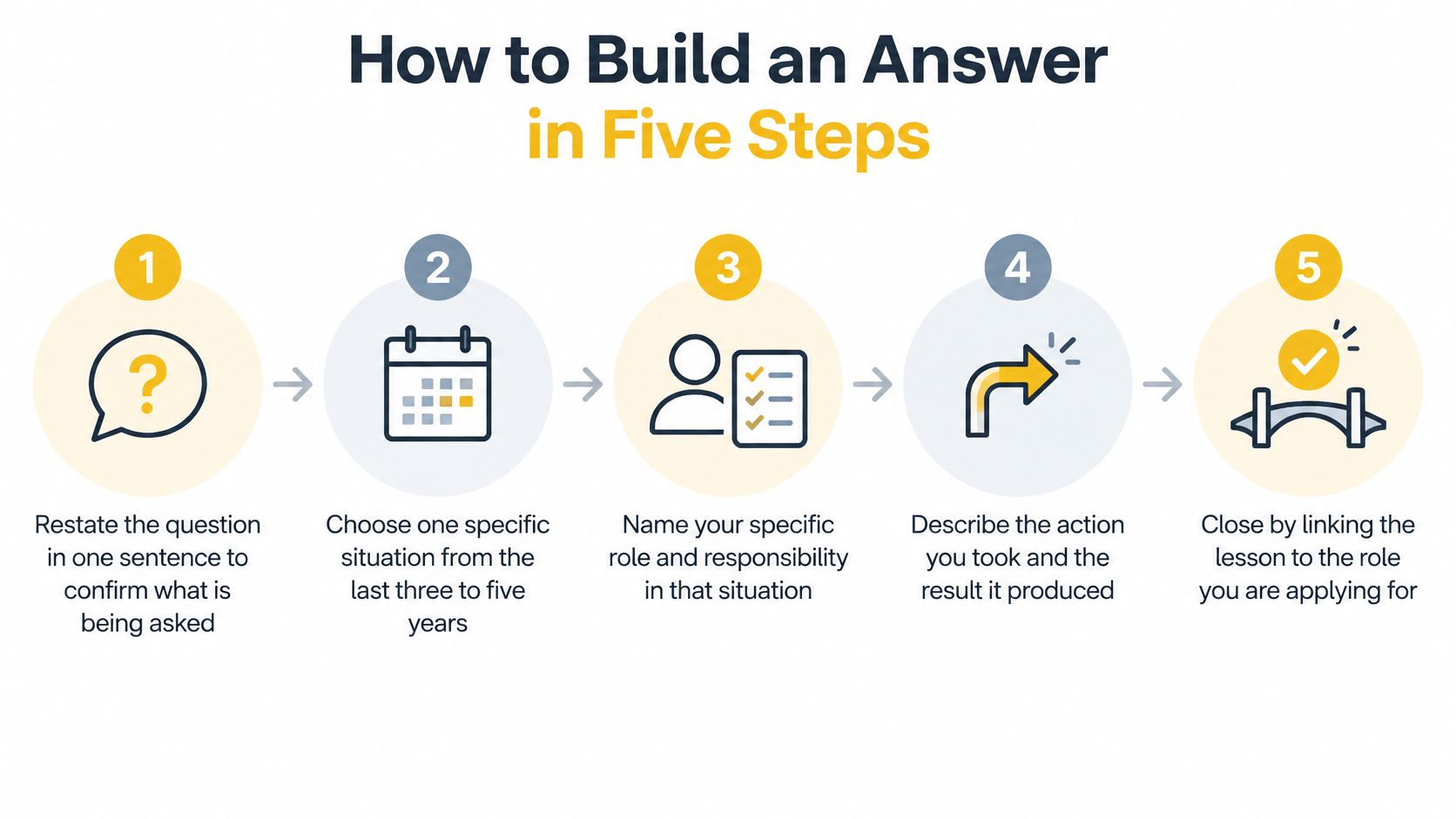
The five steps, and where each one goes wrong
Restate the question in one sentence. Say "So you're asking about a time I had to change direction mid-project," and let them confirm. This prevents a mismatch, the most common reason a good story fails. Candidates skip it, tell a strong story about the wrong problem, and lose the point they were being scored on.
Choose one specific situation from the last three to five years. Give the time period, your role and the constraint in a single sentence: "Last spring I was the sole analyst on a reporting migration, with a fixed quarter-end deadline." The slip here is "at my last job, we often," which tells the interviewer nothing they can verify.
Describe the actions you personally took. Use I for your decisions and we only for shared work. Interviewers listen for that pronoun switch, and an answer that stays at "we" reads like you watched the project happen rather than drove it.
Give a measurable result. Revenue gained, defects reduced, deadlines met, customers retained, team size. This is the step candidates drop most often, and it's the one that turns a nice anecdote into evidence. If you don't have a hard number, use a countable one: tickets closed, weeks recovered, people trained.
Finish with the lesson or the change you made afterward. One sentence linking what you learned to the role in front of you. Without it you've described an event; with it you've demonstrated judgment.
Aim for roughly 90 seconds and stop on the outcome, not on a trailing "so yeah, that was that." Then run one self-check before the interview: could a colleague repeat your result in a single sentence? If they couldn't, the result isn't sharp enough yet.
Answering Questions About Failure and Conflict
Say a candidate committed to a launch date assuming a vendor's API would stay stable. It changed. The launch slipped two weeks. That's the story candidates often try to bury, and it's the one worth telling well.

Interviewers rarely want a perfect record. They want to see how you think once something goes wrong, which is why controlled accountability works better than denial or self-flagellation. State the original assumption, name the observable consequence, describe the corrective action, explain the preventive measure you introduced. Four moves, no drama.
"I committed to the date based on an assumption I hadn't tested. The launch slipped two weeks. I rebuilt the integration test, and now every vendor dependency gets a staging check before we commit to a date."
Notice what that wording does. It owns the decision without calling the candidate incompetent, and it ends on a system change rather than an apology. Concrete detail is what makes this credible: a 1993 meta-analysis of 31 studies published in the International Journal of Selection and Assessment put the employment interview's average validity coefficient at .27, with estimated true validity of .38, so an interview is a moderate predictor at best. Your job is to hand the interviewer job-relevant behavior to score, not charisma to react to.
Applying the same formula to a disagreement
Conflict answers fail when the other person becomes the villain. Describe the disagreement in neutral terms, state what you proposed and why, name the compromise, then give the outcome.
A manager wanted a full rollout in one week. You were worried about the payment flow. You proposed a phased release: core flow protected, remaining features behind a flag, timeline recovered. Say what the disagreement was about, not what was wrong with the manager's personality. "We had different risk tolerances" is a sentence an interviewer can respect. "He never listened" isn't.
Close by naming what you'd do differently, because a changed behavior is more believable than a claim that nothing went wrong. Prepare two of these stories before the interview, one technical or operational and one interpersonal, so you're not inventing under pressure.
This short walkthrough is worth watching before you rehearse yours.
Answering Salary, Why-Hire-You and Hypothetical Questions
Three questions, three different structures. Match the structure to the question rather than forcing one story to fit all of them.
- Salary expectations: research the range for the role, city and experience level first, then state a target and stay open on the package. "Based on current postings for senior analyst roles in this city, I'm targeting 85,000 to 95,000, and I'm open to discussing the full package." Don't name a number below what your research supports.
- Why should we hire you: pick two or three requirements from the job description, match each to one piece of evidence with a number, then close with one sentence on what you'd contribute in the first ninety days.
- Hypothetical scenarios: name your criteria, list two or three options, state the main risk of each, then give a decision rule such as "if the deadline is fixed, I cut scope before I add people." Say what information you'd gather before deciding.
Practise each one once with a timer. A clear structure lands better than a flawless delivery.
Explaining AI Use and Technical Gaps
"How did you use AI on this, what did you verify, and what trade-offs did you make?" That question is now routine in technical interviews, and most candidates answer it badly by either hiding the tool or crediting it with the work.
The pressure behind the question is real. A 2026 IEEE-USA summary of a survey of 400 engineering leaders in the United States, India and China found that 71% said AI is making technical skills harder to assess. Interviewers ask because they can no longer tell from a take-home or a code sample who reasoned and who prompted.
Separate assistance from ownership
Answer with a transparent workflow you can rehearse: define the problem, say where AI helped, explain how you tested the output, state its limits, connect the final decision to a result. The middle three are where candidates earn credit.
"The tool drafted the first version of the query. I checked the join logic against a small sample where I knew the right answer, found it was double-counting refunds, and rewrote that section. The final design was mine, and the report matched finance's numbers."
In many technical roles, claiming you work without AI sounds less credible than showing responsible use. Employers are adjusting their side of the process too, and reading how teams find experienced AI engineering talent tells you what they now probe: verification habits, judgment about limits, and ownership of the final call.
When they challenge the output, or you have a gap
Rehearse one round where the interviewer pushes back on an AI-generated solution. The strongest reply names the assumption that was wrong, shows the test that exposed it, and describes the revised answer. That keeps the conversation on your reasoning instead of the tool.
For a genuine knowledge gap, say so plainly, then explain how you'd close it fast and give a comparable time you did. "I haven't used that feature. I'd read the docs, build a minimal test case, and check the behavior on staging. That's how I picked up window functions on a reporting project." Honesty plus a learning method beats a bluff every time.
Fixing Breakdowns When You Freeze or Ramble
Freezing is the breakdown candidates fear most, and it usually means one thing: you didn't fully parse the question. Your brain started searching for a story before it finished hearing the prompt. Buy time out loud with "let me make sure I understand," then restate the question in one line. The restatement gives your working memory something to hold, and it often surfaces the right example on its own.
Rambling is the opposite failure. The answer has no stopping point, so you keep adding context hoping the point will appear. Lead with the result and cut the setup to one sentence.
| Symptom | Likely cause | Fix in the moment |
|---|---|---|
| Blank mind mid-answer | Question not fully parsed | Say let me make sure I understand, then restate it in one line |
| Answer runs past three minutes | No stopping point | Give the result in the last sentence, then pause |
| Rambling into unrelated detail | Core metric missing | Lead with the result and cut background to one sentence |
| Generic answer such as I work hard | No specific situation chosen | Swap in a named project with dates and one number |
| Shaky voice or long silence | Overthinking | Pause about five seconds and return to step one of the framework |
| Interviewer interrupts | Answer too long or off-topic | Shorten and ask whether they want more depth on one point |
Two habits that prevent most of this
The first is deciding your ending before you start. If you know your last sentence is "we shipped two days early and I kept the checklist for the next release," you'll stop there instead of drifting into a fourth anecdote.
The second is treating a generic answer as a signal, not a personality trait. "I work hard" means no specific situation came to mind. Don't defend the phrase, replace it: name the project, give the month, add one number.
A calm reset in a live interview is noticed more than a perfect first answer.
Practise two or three recovery phrases until they sound like your own voice. If the interviewer cuts in, that's information, not rejection. Shorten, then ask whether they want more depth on one point. You'll usually get a yes, and now you're answering the question they cared about.
Requesting Accommodations Without Oversharing
You get to decide what you share. Some tough questions touch health, disability or communication style, and the choice to request an adjustment is personal and situational, not a test you pass by disclosing everything.
The difficulty is widespread. The 2025 Disability at Work Survey reported that 26.2% of respondents found interviewing extremely challenging, while 31.2% found requesting accommodations during application or interviewing extremely challenging. What helps isn't another sample story. It's a script and a plan.
Know your options before the interview: extra processing time, captions, a different interview format, breaks, accessible technology. Then keep the request short and functional. "I'd like extra time to process complex questions, and I can give full answers once I have it." Our guide on how to request interview accommodations walks through the wording for each format.
A useful rule: share only what the employer needs to know to make the adjustment work. If someone asks about medical history, redirect to the job itself and describe how you perform the essential functions, with an example.
Discriminatory questions need a plan too. In 2024, 54% of 1,200 U.S. job seekers surveyed by Greenhouse said they had experienced discriminatory interview questions, including questions about age, race or gender, in a survey reported by the Associated Press. Check which questions employers may not ask where you live, write your redirect down, and keep it polite: "I'm happy to talk about how my experience fits this role."
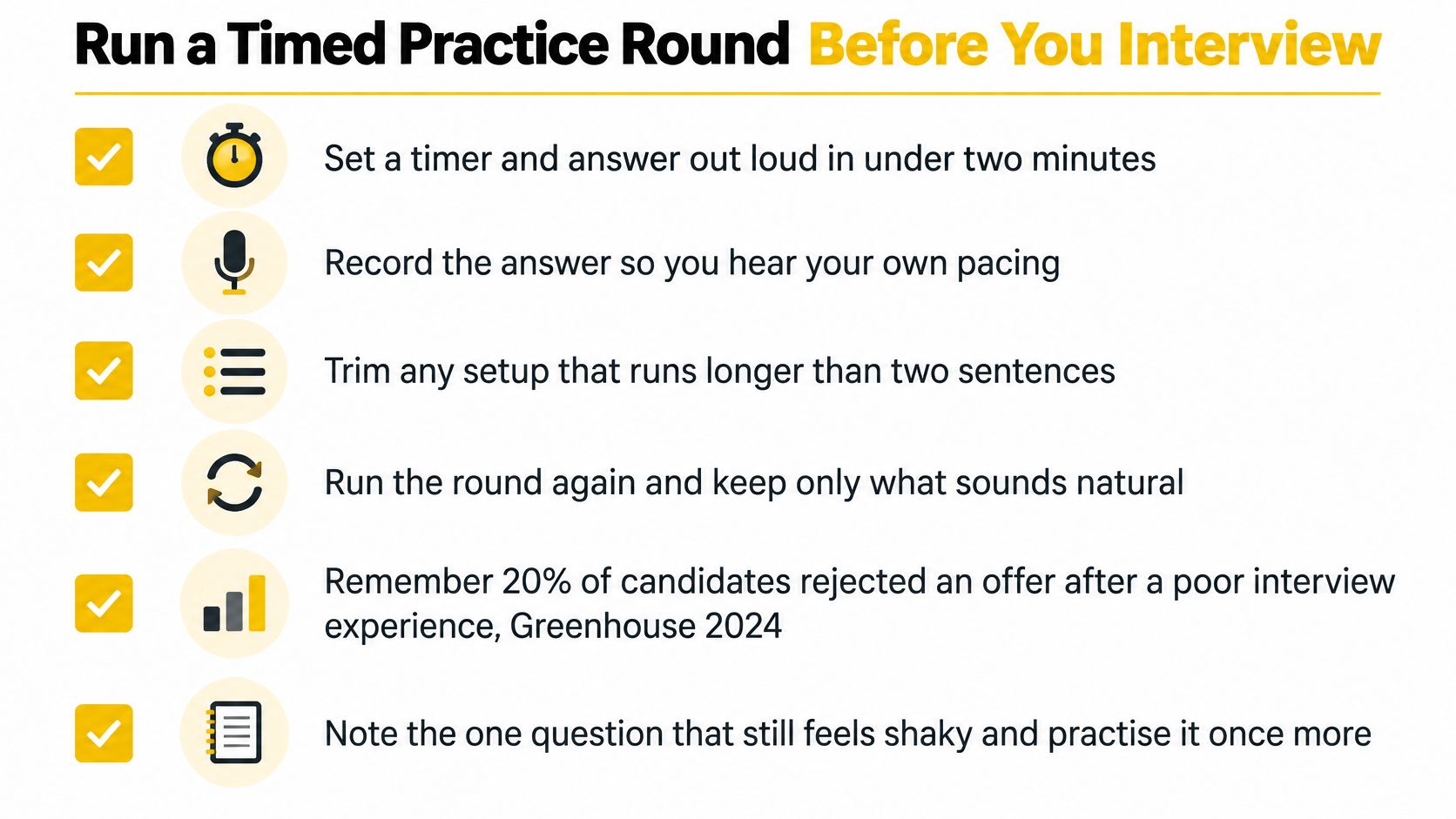
Run a Timed Practice Round Before You Interview
Preparation is what separates a rehearsed answer from a memorised one, and the stakes run both directions. In 2024, 20% of job candidates surveyed by Greenhouse said they had rejected an offer because of a poor interview experience, according to the 2024 Greenhouse candidate experience report. A clumsy process costs employers candidates. A clumsy answer costs you the offer.
Build a routine this week. Pick eight questions from the map that match your target role, write one answer for each using the five steps, then speak each aloud inside 90 seconds. Record at least one round and check two things: is the result in your final sentence, and is the story specific enough that a stranger could picture it?
Practice tools speed this up. Interview Pilot's practice tools include AI mock interviews, a Question Bank and a Playground for trying answers, and before your first interview you add your resume and the job so the answers fit you and the role. If you want a structured session rather than solo repetition, our walkthrough of an online mock interview shows how to run one. Scheduling matters as well when a panel is involved, and tools like SyncThemCalendars for recruiting teams explain why your interview slot sometimes moves at short notice, so keep a rehearsed answer ready rather than cramming the night before.
Finish with a checklist: three rehearsed failure stories, one AI-use answer if your field uses AI, one accommodation script if you need one, and a recovery phrase for freezing. Decide today which eight questions you'll rehearse this week.
Interview Pilot gives you AI mock interviews, a Question Bank and a Playground for trying answers, plus an Interview Copilot that supports you during live online interviews, so the frameworks here become habits instead of notes you never reopen. Add your resume and the job description, pick the eight questions that match your target role, and run a timed round tonight. Start at Interview Pilot and rehearse the failure question first, because that's the one that stops feeling dangerous once you've said it out loud.



Topics
tough interview questions
behavioral interview
STAR method
interview tips
interview preparation
Continue reading
Interviews
9 Mock Interview Questions for 2026: Sample Answers
Practice 9 mock interview questions with sample answers, STAR-based guidance, and rehearsal prompts for behavioral interviews in 2026.
November 20, 2026
17 min read

Interviews
How to Answer Behavioral Questions (2026 Guide)
Master how to answer behavioral questions using the STAR method, with role-specific examples and practice exercises for software engineering, product
October 9, 2026
12 min read
Interviews
10 Nursing Manager Interview Questions to Expect
Prepare for nursing manager interview questions with 10 real prompts, leadership answer examples, and tips for staffing, budgets, and conflict.
November 25, 2026
19 min read