












Interviews
8 Embedded Systems Interview Questions
Prepare for embedded systems interview questions with sample answers on MCUs, RTOS, interrupts, memory, bootloaders, debugging, and design.
Interview Pilot Editorial Team
Updated September 23, 2026
20 min read
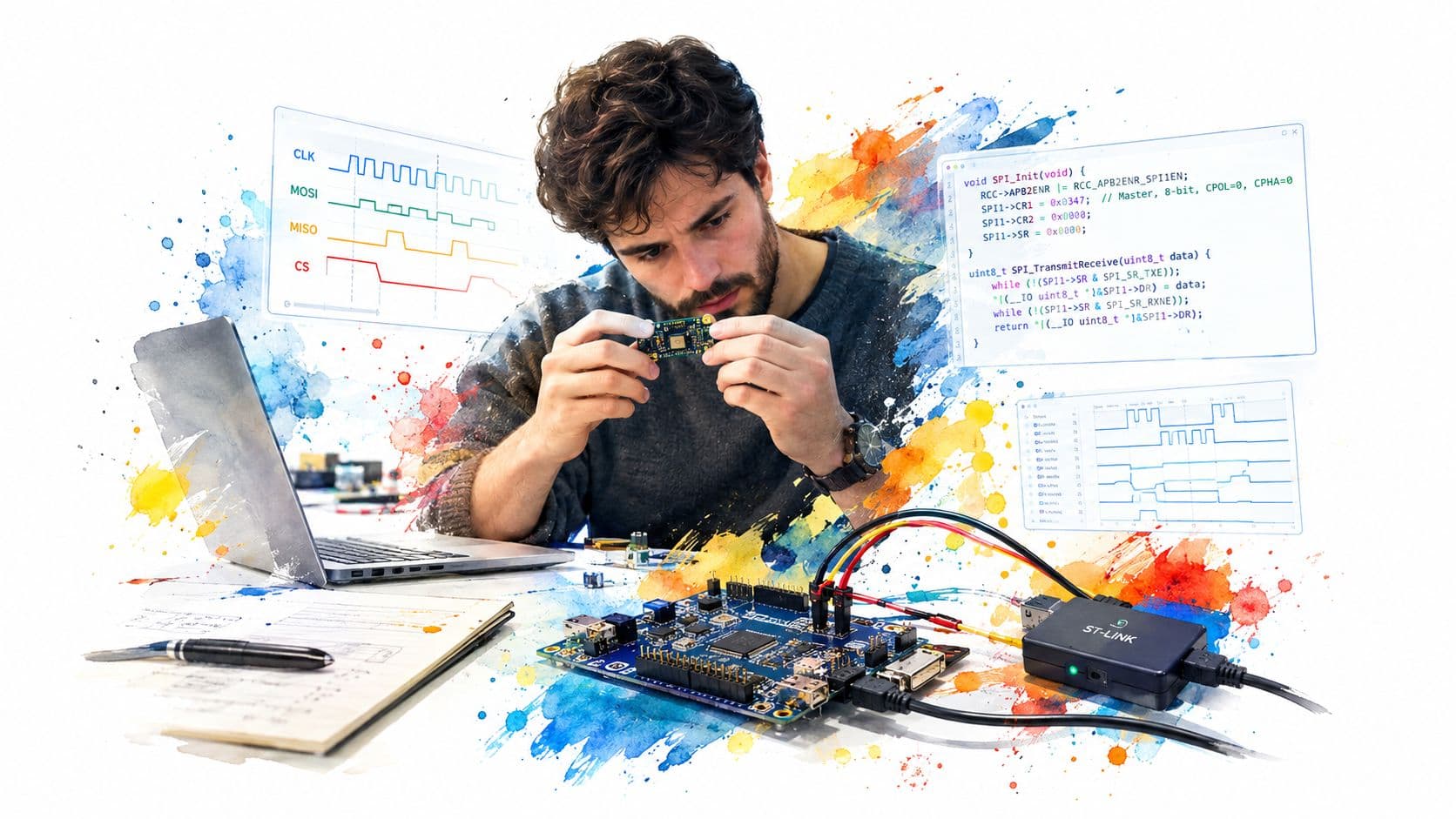
You're in an embedded systems interview, and the interviewer has moved past definitions. They want to know why you chose a microcontroller, how you'd guarantee timing for a sensor task, and what you'd do when the board occasionally resets in the field. Reciting that an interrupt is an asynchronous event won't be enough. You need to connect the concept to a design decision, a failure mode, and a verification method.
The most reliable pattern for answering embedded systems interview questions is simple: define the concept, state the constraint, explain the trade-off, give a concrete implementation scenario, and describe how you'd verify the result. The eight questions below follow that progression, from hardware fundamentals through RTOS behavior, interrupts, power, memory, boot, abstraction, and debugging. They're useful whether you're preparing for embedded software career opportunities or moving from general software into firmware.
1. What is the difference between microcontrollers and microprocessors?
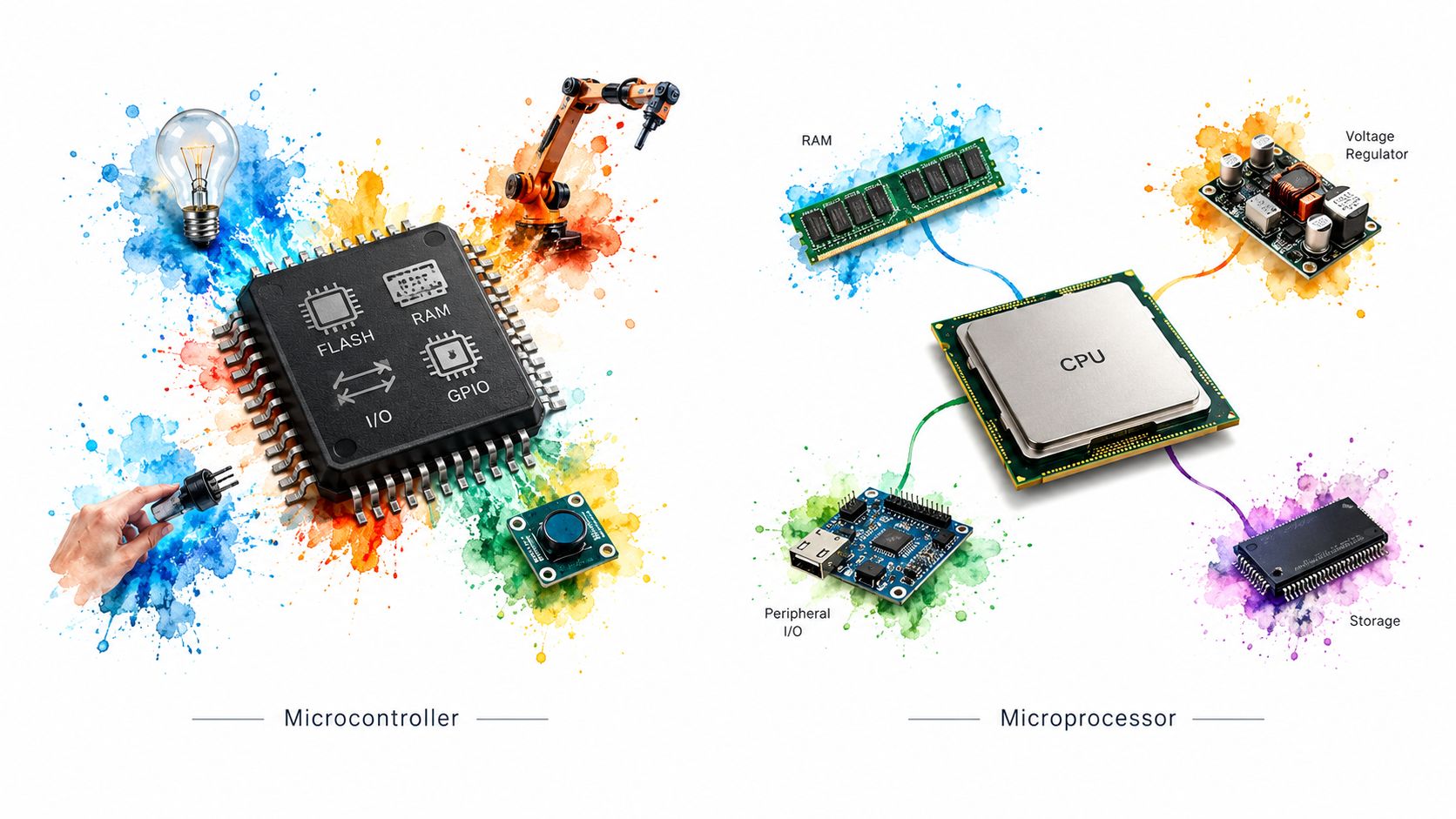
A microcontroller integrates a CPU core, memory, timers, communication peripherals, and GPIO on one chip. A microprocessor usually provides the processing core and relies on external memory and peripherals to form a complete system. The distinction matters because the integration level shapes the board design, power budget, boot process, software architecture, and bill of materials.
An ARM Cortex-M microcontroller is a natural choice for a sensor node that wakes, samples an input, processes a small amount of data, and returns to sleep. An ARM Cortex-A processor is more appropriate when the product needs substantial memory, a complex operating system, graphics, networking, or several applications running at once. An Arduino board typically exposes a microcontroller-oriented design, while a smartphone uses a much more capable processor-based architecture.
How to make the trade-off explicit
Don't present the answer as “microcontrollers are small and microprocessors are powerful.” Explain why the difference affects implementation:
- Integration: A microcontroller can reduce external components because memory and peripherals are on-chip.
- Power: A microcontroller generally suits always-on control and battery-powered designs, while a processor platform can support heavier workloads at a higher system cost.
- Software: A microcontroller may run a bare-metal superloop or an RTOS. A processor-based system may need a boot chain, external memory initialization, and Linux or another rich operating system.
- Application fit: Motor control, appliance logic, and simple connected sensors favor microcontrollers. Multimedia, gateway, and application-processing workloads may favor microprocessors.
A strong answer names hardware you've used and identifies the limiting resource. You might say that an STM32 Cortex-M device was selected because its integrated timers and serial peripherals simplified a control board, while an ARM Cortex-A platform would have added unnecessary memory and power complexity.
For related preparation on hardware-oriented discussions, review these technical interview questions for electrical engineering.
2. Explain real-time operating systems and their importance in embedded systems
An RTOS organizes concurrent work into tasks and schedules them according to priority, readiness, and timing requirements. Its value isn't just that it lets a system run multiple tasks. The important property is predictable behavior. A system needs to respond within an understood timing boundary, not merely respond quickly on average.
Consider a data logger with separate activities for sampling, filtering, storage, communication, and fault monitoring. A timer can release the acquisition task, a queue can transfer samples to processing, and a lower-priority storage task can write batches without blocking the acquisition path. FreeRTOS, VxWorks, QNX, and other RTOS environments provide different APIs and system characteristics, but the design question remains the same: which work has a deadline, and what happens if it misses it?
Explain timing instead of reciting scheduler terminology
Distinguish hard real-time from soft real-time behavior. A missed deadline in a safety-critical control path may be unacceptable, while a delayed user-interface update may degrade experience without creating a dangerous state. Then discuss the mechanisms that protect those deadlines:
- Priorities: Time-sensitive work must outrank background processing, but excessive priority levels can make behavior difficult to reason about.
- Blocking: A high-priority task waiting on a mutex can still miss its deadline if a lower-priority task owns the resource.
- Context switching: Preemption improves responsiveness, but it adds overhead and complicates shared-state reasoning.
- Communication: Queues and event flags often make ownership clearer than having every task access global buffers directly.
A concise sample answer should define deterministic scheduling, identify the task with the strictest deadline, describe the synchronization method, and explain how timing would be measured. Mention trace instrumentation, GPIO timing markers, or an RTOS-aware debugger rather than claiming that the RTOS guarantees every deadline automatically.
Practical rule: An RTOS doesn't make a design real-time by itself. You still need a schedulability argument, bounded critical sections, and measurements on the target hardware.
3. What are interrupts and how do you handle them in embedded systems?
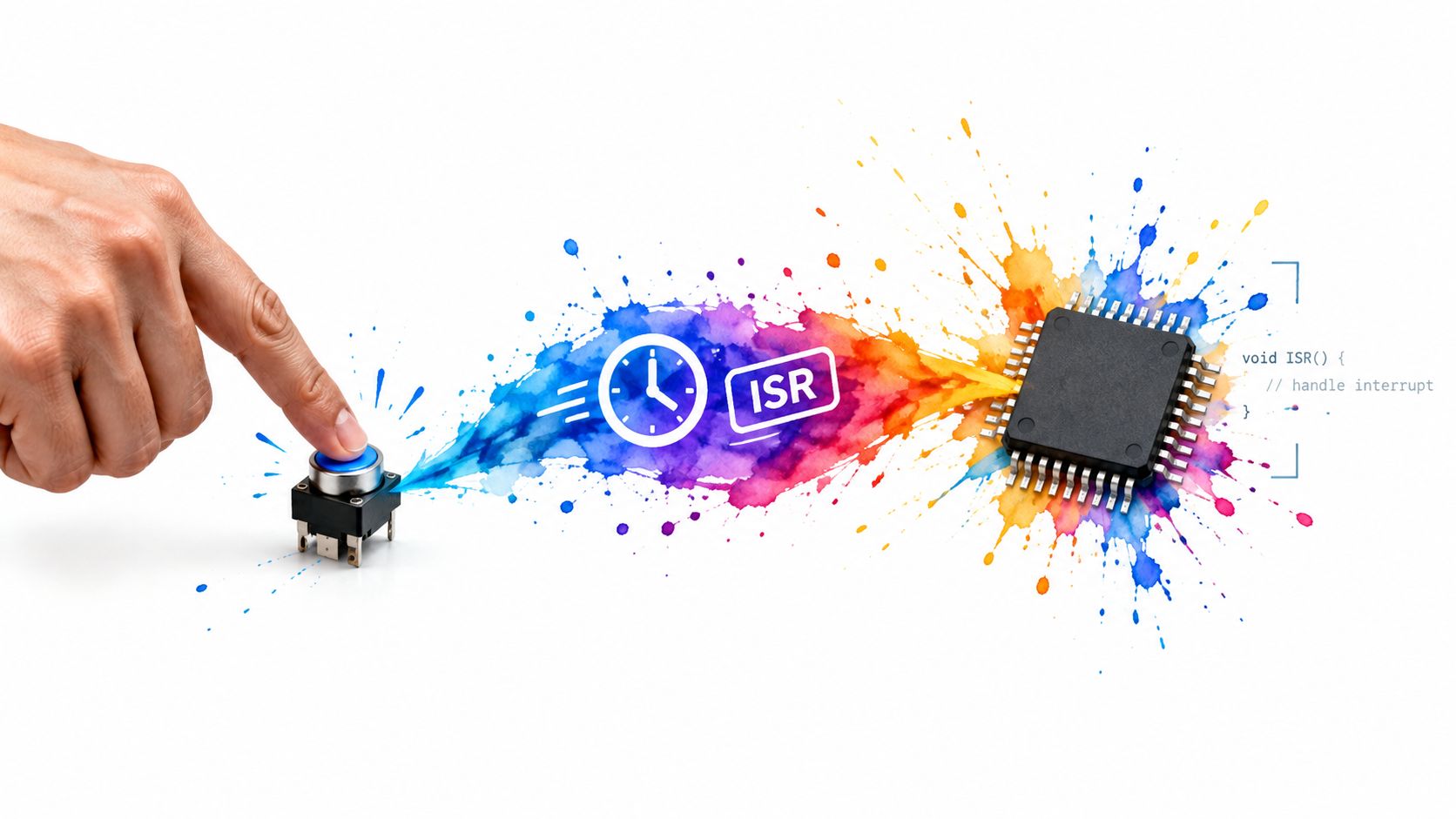
An interrupt lets hardware notify the processor that an event needs attention. The processor saves enough execution context to enter an Interrupt Service Routine, or ISR, handles the urgent portion, and then resumes the interrupted code. Interrupts are useful when waiting continuously would waste CPU time or when the response must begin promptly.
A UART receive interrupt is a practical example. The ISR can read the received byte from the peripheral register, place it into a ring buffer, clear the relevant status condition, and notify a task or main loop. It shouldn't parse a complete protocol packet, allocate memory, or wait for another resource. Those operations belong in deferred processing, where they can be scheduled and tested more safely.
Show that you understand ISR boundaries
Interviewers usually want more than “keep the ISR short.” Explain the consequences of each choice:
- Latency: Long ISRs delay other interrupts and increase response uncertainty.
- Shared state: Data exchanged between an ISR and ordinary code needs a clear ownership and synchronization strategy.
volatilecan prevent inappropriate compiler optimizations, but it doesn't make a multi-step update atomic. - Critical sections: Temporarily masking interrupts can protect a short operation, but excessive masking increases latency.
- Nesting: Nested interrupts can improve responsiveness for urgent events, yet they introduce more complicated priority and reentrancy behavior.
- Polling versus interrupts: Polling can be easier to reason about for a very frequent, predictable event. Interrupts are often better for sparse events or when the processor should sleep between activities.
Suppose a GPIO interrupt reports a sensor threshold crossing. The ISR might capture a timestamp, latch the event, and signal a task. The task then reads the sensor over I2C, validates the measurement, and updates the application state. Verify the design by measuring the ISR pulse on a GPIO, checking missed-event behavior, and testing simultaneous interrupt sources.
4. How do you optimize power consumption in embedded systems?
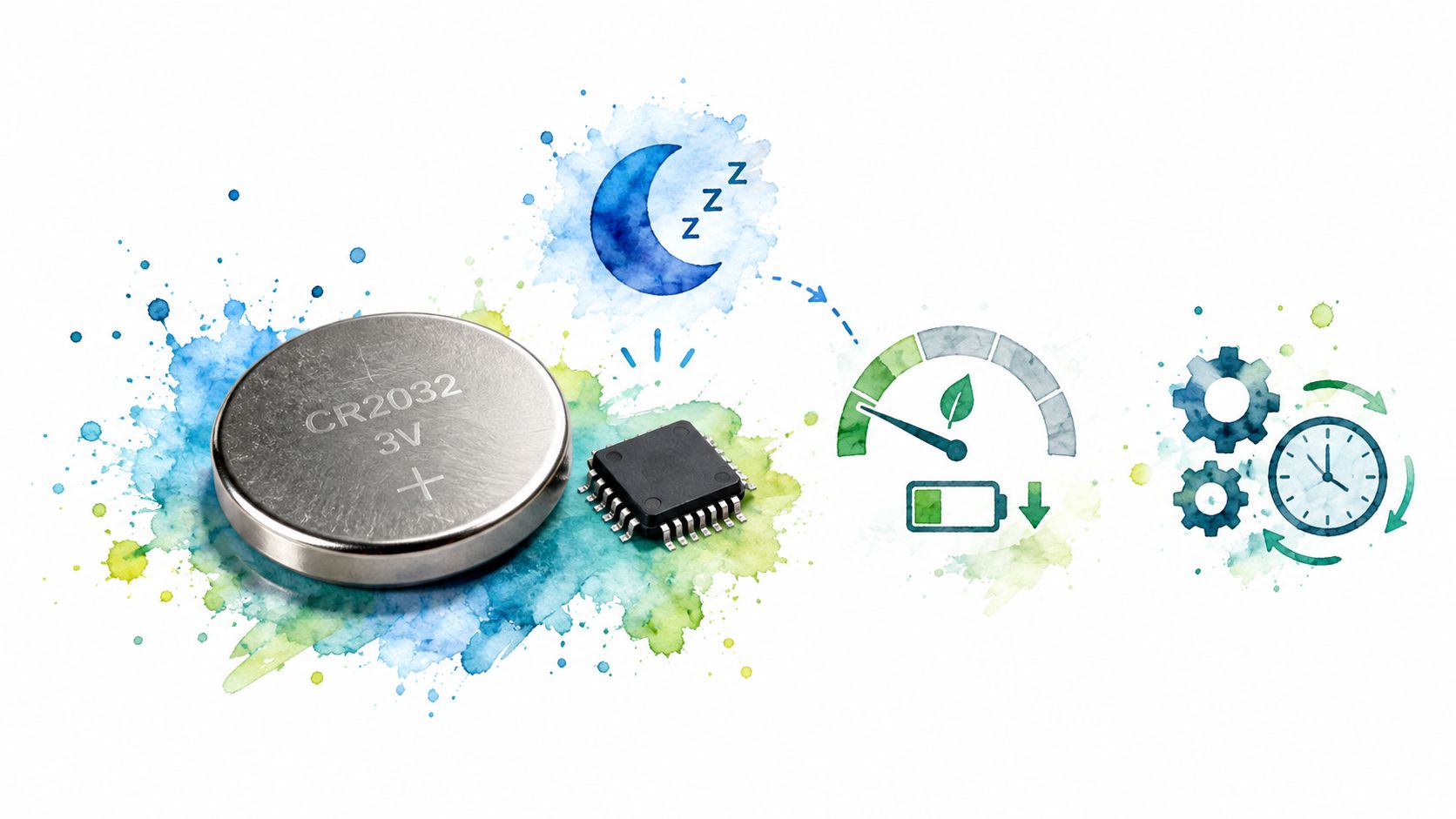
A battery-powered environmental sensor may wake for a real-time-clock alarm, enable its sensor, wait for settling, capture a sample, save the result, transmit only when required, and return to sleep. Explain how you would prove that sequence meets the energy budget, rather than listing low-power modes from memory.
Start with a current trace or oscilloscope measurement. Identify each wake event, the peripheral causing activity, the active duration, and the current drawn in sleep and active states. A debugger can correlate those intervals with firmware execution. For more hardware-side preparation, see these technical interview questions for electrical engineers.
Connect power decisions to system behavior
Build the answer around workload, measurement, and trade-offs:
- Sleep states: Choose sleep or deep sleep according to wake-up latency and the state that must remain retained.
- Clock control: Lower the clock frequency when timing permits, and disable clocks for unused peripherals.
- Peripheral lifecycle: Shut down sensors, radios, converters, and interfaces between operations. Check pin states, pull resistors, pending interrupts, and restart time when doing so.
- Wake sources: Specify which timer, GPIO, comparator, or communication event can resume execution.
- Algorithm choice: An algorithm that uses fewer operations can reduce active time, while a memory-heavy or less predictable method may create different costs.
Consider a sensor that samples periodically but sends data only after a threshold or scheduled interval. Reducing transmissions may save energy, yet it can delay an alert. Turning off a sensor may also require a settling period that changes the energy per measurement. Measure sleep current, active current, wake duration, and energy for a complete operating cycle, then verify that the sampling policy still satisfies detection and response requirements.
A concise sample answer should state the measurement method, identify the main energy contributors, describe the firmware changes, and close with the trade-off. Lower power can mean slower acquisition, less frequent communication, reduced sensor accuracy, or more complicated state retention. Show how the product requirement determines which cost is acceptable.
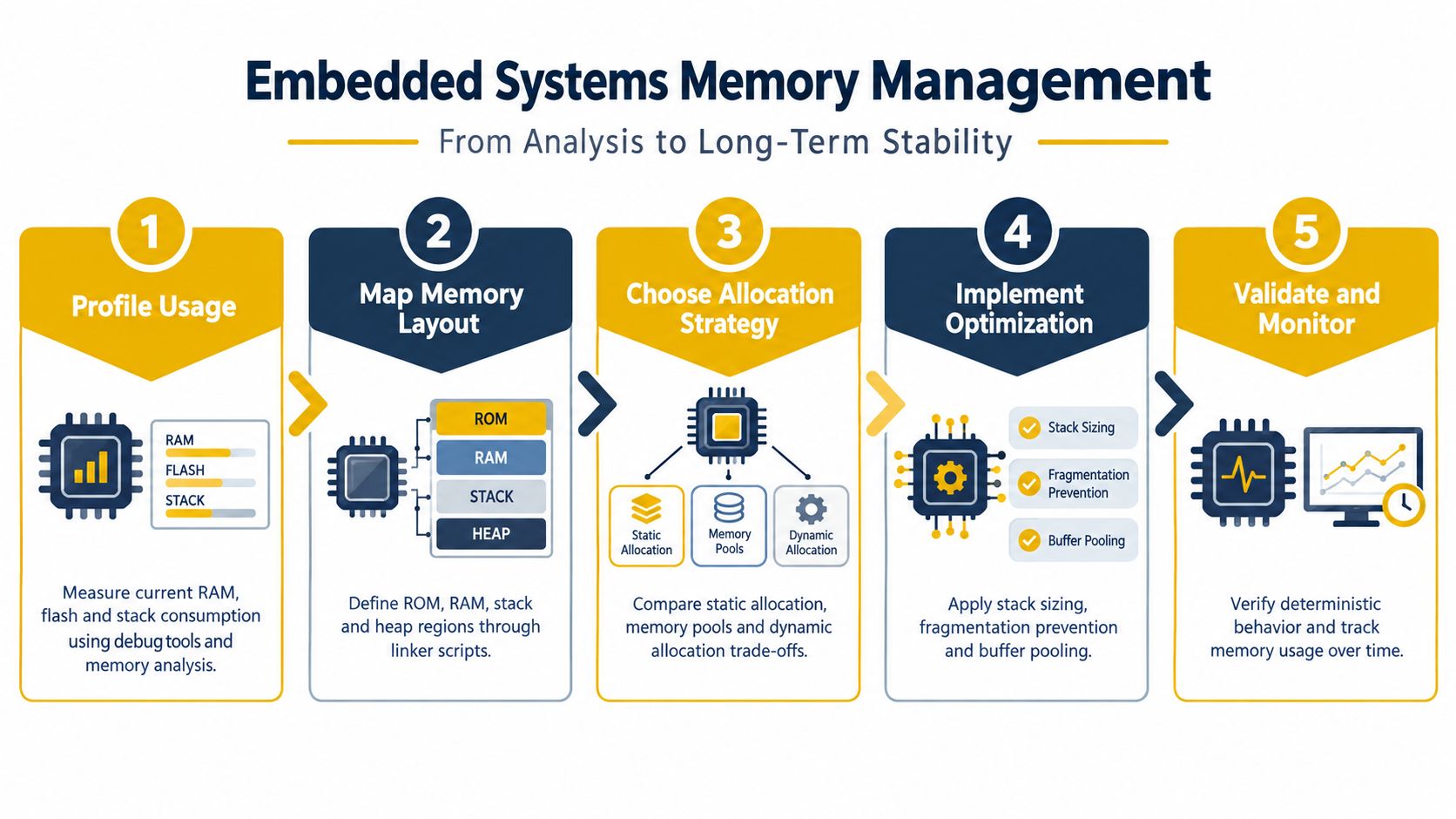
5. Describe memory management and the memory hierarchy in embedded systems
A good answer starts by drawing a memory map. Put the bootloader and application code in non-volatile flash, initialized data in its load location and runtime RAM location, zero-initialized data in the appropriate RAM section, and stack and heap regions where the linker script expects them. Then explain what happens during startup, including copying initialized data into RAM and clearing the uninitialized section.
The hierarchy affects both capacity and behavior. Flash stores firmware but has different write and erase characteristics from RAM. RAM holds live state, buffers, stacks, and possibly a heap. Caches and tightly coupled memory can affect performance on larger processors, while memory-mapped peripheral registers require carefully qualified accesses and hardware-specific ordering.
Explain why allocation strategy matters
Static allocation is often easier to analyze because the size and lifetime of an object are known before execution. A fixed memory pool can provide controlled reuse without the unpredictable fragmentation associated with unrestricted malloc and free. Dynamic allocation isn't automatically wrong, but long-running firmware, safety-related code, and tightly bounded real-time paths need a strong reason to accept its risks.
Consider an RTOS application with tasks for acquisition and communications. Each task needs its own stack, and the acquisition path may need a fixed-size buffer for samples. Oversized local arrays can exhaust a task stack, while undersized stacks can fail only under unusual call paths. Use stack watermarking, canary patterns, map-file inspection, and a debugger to determine actual headroom rather than guessing.
Memory bugs often appear as unrelated peripheral failures. Check the map file, stack boundaries, buffer ownership, and register access before blaming the device driver.
A sample answer should mention linker scripts, section placement, alignment, cache or DMA coherency where relevant, and the verification method. Explain how you'd detect an overflow, how you'd handle a failed allocation, and why the chosen policy fits the product's uptime and timing requirements.
6. What is a bootloader and why is it essential in embedded systems?
A bootloader is the code that runs before the main application. It can initialize enough hardware to select an image, validate firmware, configure memory, support a recovery path, and transfer control to the application. On a small microcontroller, a ROM-resident loader may hand off to a device-specific application bootloader. On a Linux-based board, the boot chain may include an early loader and U-Boot before the operating system starts.
Suppose a field device receives a firmware update over a network. The running application writes the image to an inactive region, verifies its integrity and authenticity, records the intended version, and requests a reboot. The bootloader checks the image before starting it. If the new application fails to confirm healthy startup, the recovery design must prevent the device from becoming permanently unbootable.
Cover reliability and security together
CRC can detect accidental corruption, but it doesn't establish who produced the image. A production design may need digital signature verification, secure key handling, version policy, and protection against replaying an older vulnerable image. Encryption can protect confidentiality during transfer or storage, but it doesn't replace authenticity checks.
Discuss the memory layout clearly:
- Boot region: Reserved for immutable or protected startup code.
- Application region: Holds the normal firmware image.
- Update region: Stores a candidate image when the design uses separate slots.
- Metadata: Records image status, version, confirmation, and recovery state.
A watchdog can help recover from a failed startup, but it must be integrated carefully. If the bootloader blindly jumps to a corrupt image or resets in a loop without recording the reason, the watchdog only hides the failure. Verify boot behavior with interrupted updates, invalid signatures, power loss during writes, downgrade attempts, and application crashes during confirmation.
Your sample answer should define the bootloader, describe the update and validation path, name the recovery strategy, and explain how you'd test every transition.
7. Explain hardware abstraction layers and their role in embedded systems
A Hardware Abstraction Layer, or HAL, presents a stable software interface over hardware-specific registers and drivers. It can let application code call sensor_read() or pwm_set_duty() without knowing the exact register sequence for a particular microcontroller. The abstraction is valuable only when it preserves the behavior the application needs and makes hardware differences visible where they matter.
A useful HAL for a motor controller might separate GPIO, timer, ADC, and fault-input interfaces. The application can depend on those interfaces, while one implementation targets an STM32 device and another targets a different board. A poor HAL hides timing, error states, buffer ownership, and initialization order behind vague functions, making failures harder to diagnose.
Keep the interface narrow and testable
Design the API around capabilities rather than every vendor register. A function should communicate whether it blocks, whether it is safe from an ISR, what units it uses, and how it reports hardware faults. Keep platform-specific headers and conditional compilation near the implementation, not scattered through application logic.
Static inline wrappers can remove overhead for simple operations, but they don't solve an overly broad interface. Vendor libraries such as STM32 HAL or NXP SDKs may accelerate development, yet their behavior and naming conventions become part of your dependency surface. A custom wrapper can improve portability, but it also creates maintenance work and must be tested against each supported target.
Architecture test: If you can't implement the same interface for two hardware variants without changing application code, the abstraction may be exposing the wrong details.
Use a concrete example in the interview. Explain how you isolated an SPI transaction behind an interface, injected a fake driver for unit tests, and retained access to raw status information for diagnostics. Verify the abstraction through host-side tests, target integration tests, timing measurements, and fault injection. The strongest answer admits that portability, performance, and transparency can conflict.
8. How do you debug embedded systems and what tools do you use?
Debugging starts with containment. Reproduce the fault, record the exact hardware and firmware revision, identify whether the failure is deterministic, and separate power, clock, communication, memory, and application hypotheses. An embedded system may offer no display and limited logging, so useful evidence often comes from SWD or JTAG, GPIO timing markers, register captures, UART traces, logic analyzers, and crash-state storage.
For a board that resets during SPI transfers, begin by checking reset-cause registers and the watchdog state. Use a debugger to stop at the fault handler, inspect the stacked program counter and general registers, and compare the address with the map file and disassembly. Then probe the SPI clock, chip-select timing, and data lines. If the bus is correct but the firmware corrupts a buffer, the logic analyzer has ruled out one class of causes without proving the remaining one.
Build a layered investigation
- Hardware evidence: Measure supply rails, reset behavior, clock signals, and bus levels.
- Execution evidence: Inspect registers, stack frames, exception status, and disassembly through J-Link, ST-Link, GDB, or an IDE debugger.
- Protocol evidence: Decode UART, I2C, SPI, or CAN traffic with a logic analyzer.
- Software evidence: Use bounded logging, trace buffers, assertions, and persistent fault records.
- Regression evidence: Use Git history, targeted tests, hardware-in-the-loop stimulation, and automated reproductions.
printf can help, but it can also change timing, consume stack, block on a full output buffer, or mask a race. A circular trace buffer with event IDs and timestamps is often safer. Unit-test hardware-independent logic on the host, then validate register behavior and timing on the target.
For broader preparation around operating systems and low-level troubleshooting, these interview questions on Linux can help you practice adjacent concepts.
A strong sample answer ends with proof. State the hypothesis, the instrument or experiment you used, the observation that confirmed or rejected it, and the regression test that prevents the bug from returning.
Here's a practical demonstration of debugger-driven embedded troubleshooting:
8-Point Embedded Systems Interview Comparison
| 🔄 Implementation complexity | ⚡ Resource requirements | 📊 Expected outcomes | Ideal use cases | ⭐ Key advantages / 💡 Tips |
|---|---|---|---|---|
| Microcontrollers vs Microprocessors, difference | Low–Medium: conceptual but requires hardware-architecture knowledge | Basic hardware labs, datasheets, dev boards | Clear distinction of integration level, power and cost trade-offs | ⭐ Clarifies foundational decisions; 💡 Cite concrete examples (Arduino vs Intel x86) |
| Real-time operating systems (RTOS) | High: scheduling, concurrency, latency analysis | RTOS kernel, testing tools, deterministic hardware | Predictable task timing and latency guarantees | ⭐ Ensures determinism for time-critical tasks; 💡 Explain hard vs soft real-time and name RTOS used |
| Interrupts and handling | Medium–High: low-level, timing-sensitive, race-condition risks | MCU IRQ controllers, logic analyzer/oscilloscope, careful ISR design | Fast asynchronous response with low CPU polling overhead | ⭐ Enables real-time responsiveness; 💡 Keep ISRs short, use volatile and safe sync primitives |
| Power consumption optimization | Medium: hardware + software trade-offs, measurement needed | Power meter/oscilloscope, low-power MCUs, DVFS and clock control | Reduced energy use, longer battery life, duty-cycled operation | ⭐ Directly improves product competitiveness; 💡 Start with measurements and quantify savings |
| Memory management & hierarchy | High: platform-specific, linker and allocation complexities | Linker scripts, debuggers, memory analysis tools | Deterministic memory use, fewer runtime crashes, improved performance | ⭐ Prevents fragmentation and failures; 💡 Sketch memory map and prefer static or pooled allocations |
| Bootloader design & role | High: low-level init, security and recovery complexity | Flash-layout planning, crypto libs, OTA infrastructure, watchdog | Reliable boot sequence, secure and recoverable firmware updates | ⭐ Enables safe in-field updates; 💡 Use A/B images, signatures, and rollback protection |
| Hardware Abstraction Layer (HAL) | Medium: API design trade-offs between portability and overhead | Platform SDKs, multiple hardware implementations, conditional builds | Portable firmware and simplified multi-platform development | ⭐ Reduces duplication and eases testing; 💡 Design minimal APIs and use inline wrappers |
| Debugging embedded systems | Medium: tool familiarity and systematic troubleshooting | JTAG/SWD debuggers, logic analyzer, oscilloscope, serial logs, simulators | Faster root-cause identification and higher firmware quality | ⭐ Directly increases productivity; 💡 Combine hardware breakpoints with strategic logging and reproduce cases when possible |
Make Every Answer Demonstrate Engineering Judgment
Strong answers to embedded systems interview questions don't stop at correct definitions. They show that you can turn a requirement into an implementation, recognize what can fail, and produce evidence that the system behaves as intended. A candidate who explains interrupts clearly but can't discuss latency, shared data, or test instrumentation sounds less prepared than someone who gives a shorter answer with a complete engineering chain.
Use this rehearsal pattern for every question:
- Define the concept. Explain what it is in plain technical language.
- Name the constraint. Identify timing, power, memory, safety, cost, portability, or reliability requirements.
- State the choice. Say which architecture, API, allocation policy, synchronization method, or tool you'd use.
- Explain the trade-off. Name what your decision makes harder, slower, larger, less portable, or more complex.
- Identify the failure mode. Discuss missed deadlines, race conditions, corrupted images, stack exhaustion, bus faults, priority inversion, or another realistic risk.
- Describe verification. Mention measurements, fault injection, trace data, unit tests, hardware-in-the-loop tests, map files, or debugger evidence.
Role context should change the follow-up depth. A junior firmware interview may ask you to explain volatile, memory-mapped registers, or the difference between polling and interrupts. A mid-level role may ask how you designed ownership around DMA buffers, diagnosed a sporadic watchdog reset, or selected a synchronization primitive. A safety-critical or automotive role may require you to reason about deadline guarantees, startup recovery, defensive design, traceability, and proof that a fix handles the relevant failure modes.
The core syllabus is stable across many interview guides. One guide lists 40 questions, while another embedded interview resource discusses a broad set of recurring fundamentals. That repetition is useful, but memorizing a question bank isn't enough. Prepare a small portfolio of projects you can explain from requirement to test result, including one difficult bug and one decision you later changed.
Practice aloud with variations:
- What would change if the device had a smaller RAM budget?
- What happens when the peripheral stops responding?
- How would you prove the ISR can't block?
- What evidence shows the bootloader won't brick the device after power loss?
- Which measurement would distinguish a software timing issue from a hardware signal-integrity issue?
Use precise language about your own experience. If you've only used one RTOS, say what you learned from it and how the concepts transfer. If you haven't worked with secure boot, explain the validation and recovery principles you would investigate rather than pretending to have shipped them. Interviewers can usually distinguish honest reasoning from memorized terminology.
Structured rehearsal can make that practice easier. Interview Pilot offers AI Mock Interview sessions and a searchable Question Bank, and its interview preparation tools can help you rehearse technical answers with role and profile context. Treat it as a preparation aid, not a replacement for reading datasheets, building firmware, probing real buses, and debugging actual hardware.
Finish each answer with the sentence interviewers remember: “I'd verify that by...” Then name the exact experiment. That habit turns theory into engineering judgment.
Interview Pilot offers AI Mock Interview sessions and a searchable Question Bank for practicing technical interview prompts, including the architecture and debugging themes covered here. Use Interview Pilot to rehearse concise answers, challenge yourself with follow-up questions, and arrive better prepared to discuss the firmware you've built.
Topics
embedded systems interview questions
embedded systems
firmware interview
RTOS interview
embedded debugging
Continue reading

Interviews
10 Excel Interview Questions by Skill Level
Prepare with 10 Excel interview questions by skill level, including formulas, tasks, pivot table exercises, and practical answer strategies.
September 22, 2026
23 min read

Interviews
10 Self Descriptive Words for Interviews and Resumes
Explore 10 self descriptive words for interviews and resumes, with examples, trade-offs, and tips for choosing language that sounds credible.
September 22, 2026
19 min read

Interviews
Interview Programming Questions in Java: 2026 Guide
Master interview programming questions in Java with 10 topic-based sets, solution strategies, and tips for algorithms, OOP, concurrency, and JVM.
September 21, 2026
31 min read