












Interviews
18 Hour to Salary: How to Convert Pay Correctly
Understand the 18 hour to salary conversion and how overtime, paid time off, and pay transparency laws change your real annual earnings.
Interview Pilot Editorial Team
Updated October 2, 2026
14 min read

At $18 per hour, a full-time schedule of 40 hours per week produces a base annual salary of $37,440 before taxes, using 2,080 working hours per year. Real pay can change once you account for overtime, unpaid time off, benefits, or a schedule that isn't exactly 40 hours every week.
You may be comparing a job posting that lists an hourly rate with another that gives only an annual salary. Perhaps you're in an interview and the recruiter asks about your compensation expectations, or you're trying to decide whether an $18 hourly offer is enough to replace your current income. The basic conversion is straightforward, but the number on a calculator is only a starting point for understanding the offer.
Understanding the 18 Hour to Salary Conversion
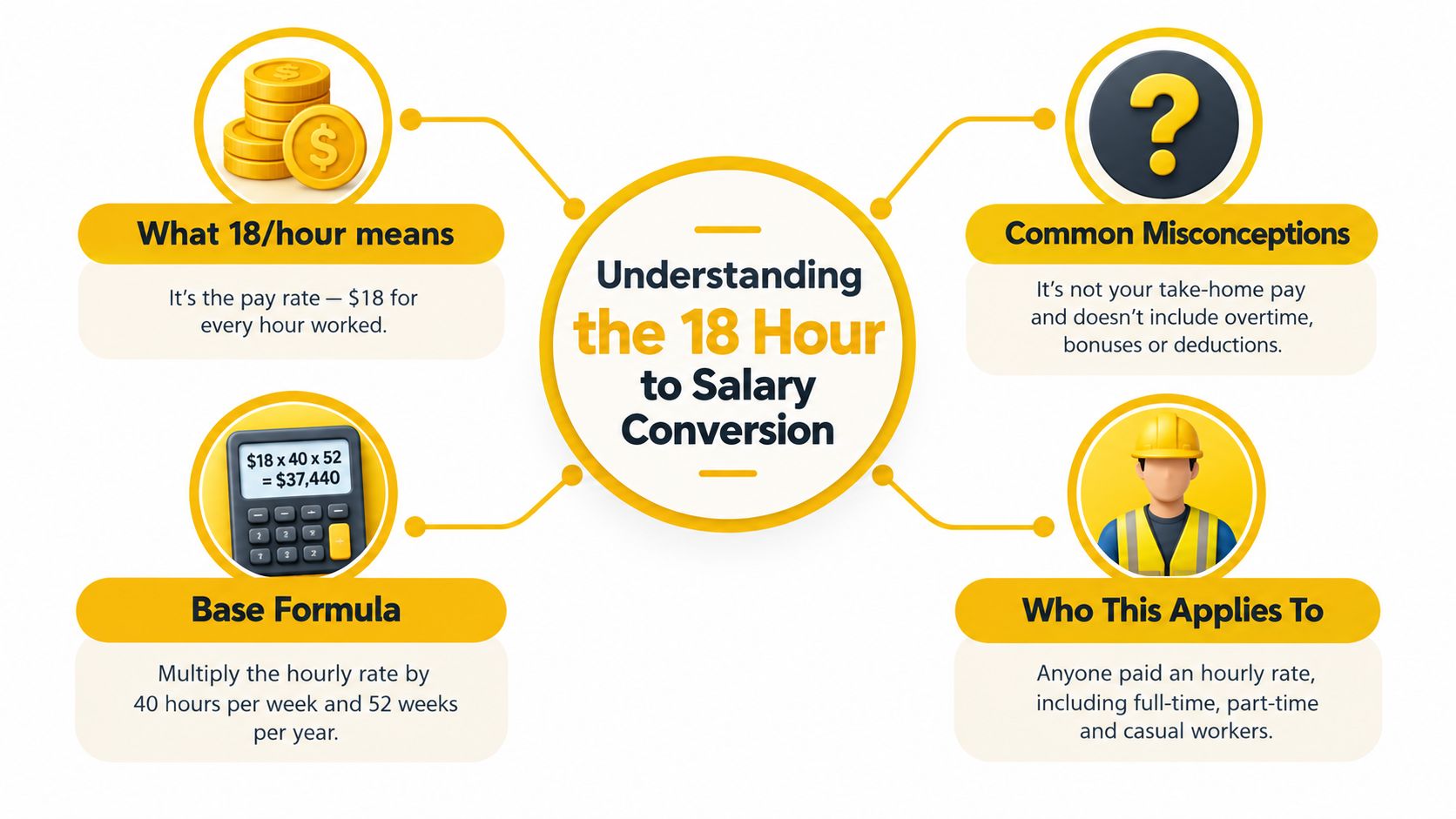
The search phrase 18 hour to salary usually means, “How much would I earn in a year if I made $18 per hour?” For a conventional full-time schedule, the calculation is:
$18 × 40 hours per week × 52 weeks per year = $37,440 per year
That figure is gross pay, meaning it comes before taxes, insurance premiums, retirement contributions, and other deductions. It also assumes that you work the full schedule consistently, receive no overtime premium, and don't lose earnings through unpaid leave.
What the baseline tells you
The annual figure gives you a common comparison point. It lets you place an hourly offer beside a salaried offer without guessing, even though the two compensation structures may work differently in practice.
The phrase can also signal a different question. You might be asking whether overtime raises the annual amount, whether a part-time schedule changes the answer, or whether “salary” means the amount deposited into your bank account. It doesn't. Salary calculations normally describe gross compensation, while take-home pay depends on deductions and tax circumstances.
Practical rule: Treat $37,440 as an annualized base-pay comparison, not as a promise of what you'll receive every year.
Before accepting an offer, identify the schedule attached to the rate. An $18 hourly position with predictable paid hours is materially different from one where the employer schedules fewer hours, expects regular extra work, or provides unpaid time between assignments. The rate stays the same, but the annual result doesn't.
How to Calculate Annual Salary from an Hourly Wage
The general formula is:
Hourly wage × hours worked per week × weeks worked per year = annual gross income
For the standard full-time example, multiply $18 by 40 hours and 52 weeks. That produces $37,440 in gross annual pay, as shown by the annual salary conversion example from HR Cloud.
The same result can be expressed over shorter pay periods. At that full-time schedule, $18 per hour equals $720 per week and about $3,120 in gross monthly income, before deductions, according to the hourly-to-salary calculation from Harvest. Monthly pay is an average, not necessarily the exact amount on every paycheck, because employers may pay weekly, biweekly, semimonthly, or monthly.
Adjusting for a different weekly schedule
The 40-hour assumption matters. If your schedule is 37.5 hours per week, the annual calculation becomes:
$18 × 37.5 × 52 = $35,100
That is $2,340 less per year than the 40-hour baseline, because the weekly schedule is shorter. The difference isn't caused by a lower hourly rate. It comes entirely from the number of paid hours.
You can use the same method for any consistent schedule:
- Part-time work: Multiply $18 by the actual weekly hours and the number of paid weeks.
- Seasonal work: Replace 52 weeks with the weeks you realistically expect to work.
- Variable work: Estimate a typical week, then create a low-hours and high-hours version.
- Unpaid breaks: Remove weeks or hours when you won't receive wages.
Don't multiply an hourly rate by 2,080 automatically if the offer doesn't provide 2,080 paid hours. Start with the schedule in the written offer, then ask how often the employer changes it.
Why the 2,080-Hour Rule Is Only a Starting Point
The 2,080-hour rule comes from 40 hours per week across 52 weeks. It creates a consistent baseline for comparing compensation, which is why payroll teams and salary calculators use it so often. Under that model, annual salary equals the hourly rate multiplied by 2,080, so $18 per hour maps to $37,440 in gross annual pay, as explained in HR Cloud's hourly-pay conversion guidance.
The limitation is hidden in the assumptions. The calculation presumes a steady schedule, no unpaid leave, and no overtime premium. It doesn't tell you whether the employer will offer paid work for every scheduled hour, whether holidays are paid, or whether you qualify for overtime when your hours increase.
Baseline versus realized earnings
A calculator answers a mathematical question. Your paystub answers an employment question. Those answers can differ when your schedule is irregular, when work pauses without pay, or when your employer classifies you as nonexempt and pays a premium for eligible extra hours.
Paid time off also requires careful reading. A job may offer vacation or sick leave, but you need to know whether those hours are paid, how they're earned, and whether the policy applies during your first months of employment. Don't count time away from work as paid just because the employer uses the phrase "full-time."
The same caution applies across countries. If you're comparing an offer under UK rules, a resource on working time regulations in the UK can help you distinguish schedule expectations and working-time protections from the wage conversion itself. Local rules may affect how you assess the offer, but they don't change the arithmetic of an $18 hourly rate.
The useful question isn't only “What does $18 per hour annualize to?” It's “How many hours will I be paid, and under what rules?”
Use 2,080 hours to compare offers on equal terms. Then replace the assumption with the employer's actual schedule, leave policy, and overtime treatment before estimating your likely income.
When Overtime Changes Your Real Annual Pay
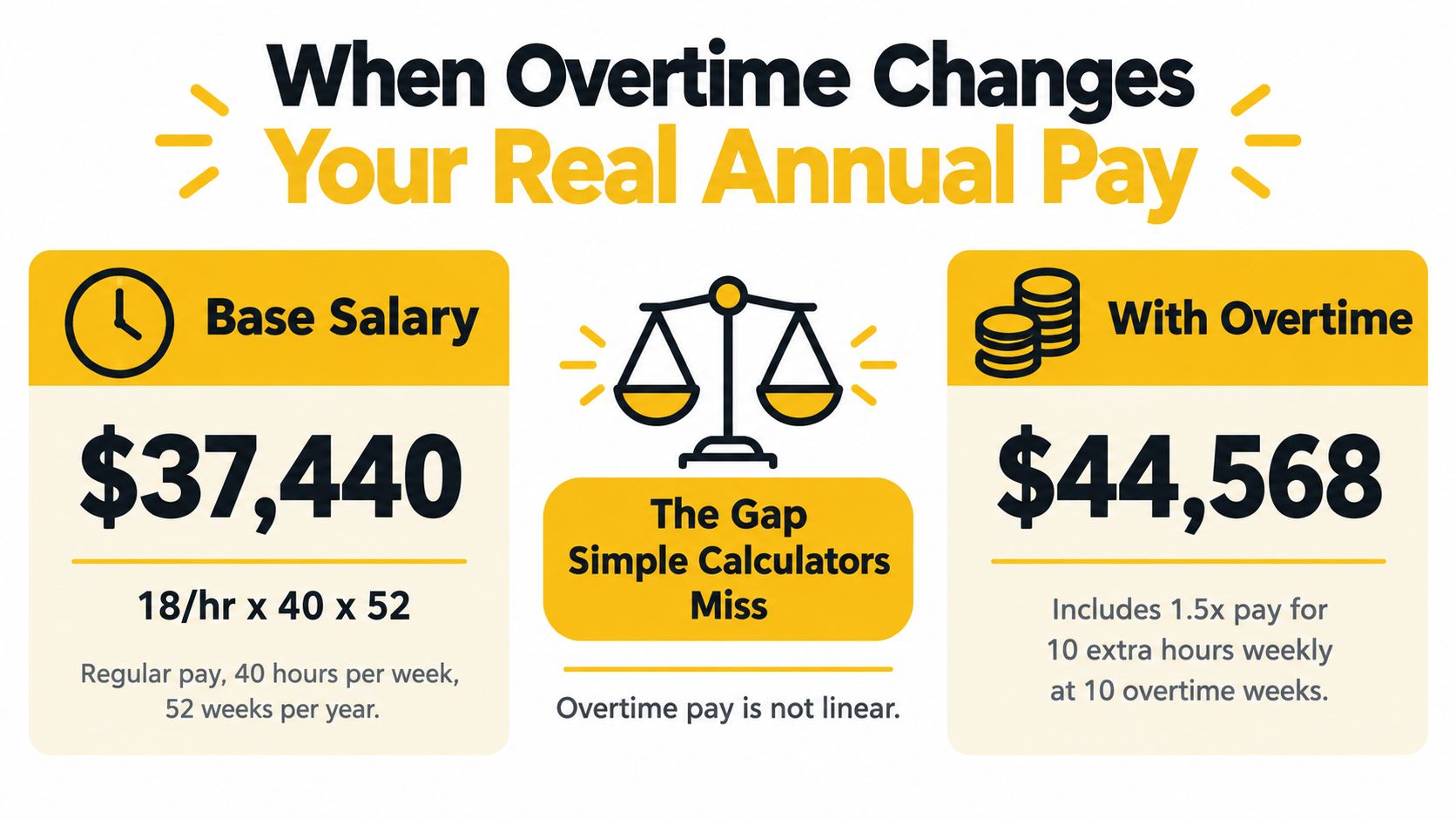
A nonexempt hourly worker may earn more than the base annualized amount when eligible overtime applies. For hours above 40 in a workweek, overtime is generally paid at 1.5 times the regular hourly rate, according to the Oregon Bureau of Labor and Industries overtime guidance.
At an $18 regular rate, the overtime rate under that model is $27 per overtime hour. That extra amount means you can't accurately forecast regular overtime by multiplying $18 by all hours worked. You need to separate ordinary hours from premium hours.
Compare the compensation models
| Pay situation | How to evaluate it | What can change the result |
|---|---|---|
| Straight-hour schedule | Use the hourly rate multiplied by paid hours | Unpaid leave, schedule reductions, and missed shifts |
| Eligible overtime | Calculate regular hours separately, then apply the premium rate to qualifying extra hours | Whether overtime is authorized, available, or legally required |
| Salaried offer | Review the stated annual amount and expected working time | Exempt status, workload, paid leave, and benefits |
A role that regularly requires extra hours deserves its own projection. Ask whether overtime is voluntary, mandatory, approved in advance, or restricted by the manager. Also ask whether the employer tracks all time worked. A promise of “plenty of overtime” isn't the same as guaranteed paid hours.
The reverse problem occurs when a recruiter advertises an annualized figure that assumes overtime but presents it like dependable base pay. Separate base compensation from possible compensation. Your budget should rely on the base amount unless the additional hours and premium terms are documented and consistent.
The video below offers another way to think about hourly compensation and overtime:
Benefits and deductions sit outside this calculation. Overtime can raise gross earnings, but taxes, insurance, retirement contributions, and unpaid gaps can still reduce what reaches your account.
Hourly and Salaried Pay in 2026 Job Postings
The conversion matters most when you're reading a real job posting. In 2026, pay-transparency rules are changing how employers present compensation, and candidates increasingly encounter postings that disclose an hourly rate for hourly work or an annual range for salaried work. Recent guidance states that, as of October 1, 2026, 27 U.S. jurisdictions had enacted pay-transparency laws, according to SixFifty's 2026 pay-transparency posting guidance.
That doesn't mean every posting will use the same format or provide the same detail. It means you should read the compensation field as an employment term, not as an invitation to perform a vague conversion. An hourly range may depend on location, shift, experience, or duties. An annual salary range may come with expected hours and responsibilities that aren't obvious from the headline.
Read the posting in its own format
If the position is hourly, ask:
- Rate: Is $18 the starting rate, the full range, or a shift-specific amount?
- Hours: Are the hours guaranteed, estimated, or dependent on demand?
- Overtime: Is the role nonexempt, and how does the employer handle eligible extra time?
If the position is salaried, ask how the annual amount relates to the expected workload. A higher annual figure isn't automatically better if the role requires substantially more time and doesn't provide an overtime premium. A lower hourly figure may produce stronger actual compensation when the schedule is reliable and overtime is available.
For a plain-language explanation of classification, Benely's nonexempt employee guide is a useful reference. Classification affects how you evaluate extra hours, so don't assume that the word “salary” alone tells you whether overtime protections apply.
Real-World Examples of Hourly-to-Salary Calculations
Consider three candidates who all see an offer advertised at $18 per hour. Their annual outcomes can differ because the rate is only one part of compensation.

Candidate one has a stable full-time schedule
Jordan receives a written offer for 40 paid hours each week throughout the year. There is no expected overtime, and the employer's leave policy is clear. Jordan can use the standard annualized baseline of $37,440 gross pay, because the schedule matches the assumptions behind the calculation.
Jordan still needs to check whether holidays and time off are paid. If the employer closes for unpaid periods, the annual estimate should be reduced to reflect the hours Jordan won't be paid.
Candidate two regularly works beyond the base schedule
Morgan's offer also lists $18 per hour, but the manager says the team regularly needs extra coverage. Morgan should calculate regular wages at the base rate and qualifying overtime at the applicable premium rate, rather than treating every hour as ordinary pay.
The important question is whether those extra hours are dependable. If the employer can't promise them, Morgan should treat overtime as potential income and build a budget around base pay. If the employer expects the hours, Morgan should ask for the overtime policy in writing and confirm how time is recorded.
Candidate three compares hourly and salaried work
Riley is choosing between the $18 hourly role and a salaried role. Riley shouldn't compare the annual figures alone. The comparison should include expected weekly hours, paid leave, health benefits, retirement contributions, commuting costs, schedule predictability, and overtime eligibility.
A structured comparison can prevent a misleading conclusion. Guidance on evaluating a larger annual salary, such as this discussion of a $60,000 annual salary, can also help Riley think in terms of gross pay, work expectations, and overall offer value rather than one headline number.
How to Verify an Offer Beyond the Basic Conversion
Before accepting an hourly or salaried offer, request the details that determine your real annual income.
- Confirm paid hours. Ask how many hours the employer expects, whether the schedule is guaranteed, and how often it changes.
- Clarify overtime. Find out whether you're nonexempt, when premium pay applies, and whether managers must approve extra hours.
- Review paid time off. Check vacation, sick leave, holidays, eligibility dates, and whether time away is paid.
- Check pay frequency. Confirm whether the stated amount is gross pay and how often you'll be paid.
- Compare benefits. Request employee insurance costs, retirement terms, bonuses, and other compensation in writing.
- Read the posting carefully. Identify whether the listed amount is an hourly rate, annual range, starting rate, or estimated total.
Keep your own worksheet with base pay, expected hours, overtime assumptions, unpaid periods, and benefits. The guide to comparing job offers can help you organize those factors before you respond.
Using Salary Literacy to Improve Interview Outcomes
Knowing the annual equivalent of an hourly rate gives you a firmer answer when an interviewer asks about expectations. You can explain that your evaluation depends on the base rate, expected schedule, overtime treatment, paid leave, and benefits. That response sounds more prepared than naming a salary figure without understanding the work attached to it.
Salary literacy also helps you spot unclear language. If a recruiter presents an annualized number that includes assumed overtime, ask for the guaranteed base compensation separately. If a salaried role offers a range but says little about expected hours, ask how the team defines a typical week and how workload is managed.
Turn the calculation into a conversation
Use questions that invite specific answers:
- “How many hours should I expect in a normal week?”
- “Is overtime available, expected, or uncommon?”
- “Would this role be classified as exempt or nonexempt?”
- “Which benefits are included, and when does eligibility begin?”
- “Is the amount in the posting base pay or total estimated compensation?”
You can also benchmark your expectations with an earnings check from The Money Maniac, then connect your target to the responsibilities and schedule of the role. Research gives you a reference point, while the employer's written terms determine whether the offer works for you.
When you reach the offer stage, prepare before negotiating. This guide to negotiating salary after a job offer can help you frame a counteroffer around the full package instead of focusing only on the hourly-to-annual conversion.
The key lesson is simple: $18 per hour has a clear mathematical baseline, but its practical value depends on paid hours, overtime, leave, benefits, and the way the employer defines the role. Bring those questions into the interview, and you'll compare offers with evidence rather than assumptions.
Interview Pilot offers AI-supported mock interviews, a searchable question bank, and real-time suggested answers for online interviews, helping you practice compensation questions and explain your pay expectations clearly. Visit Interview Pilot to prepare for salary discussions with a more structured approach.
Topics
18 hour to salary
hourly to salary
salary conversion
overtime pay
hourly wage
Continue reading

Interviews
8 Interview Questions Event Manager Candidates Should Know
Prepare for interview questions event manager candidates face with sample responses, crisis scenarios, competency markers, and practical answer frameworks.
October 2, 2026
22 min read

Interviews
Behavioral Interview Questions to Ask Candidates
Use behavioral interview questions to ask candidates with competency-based scoring guidance, ideal answer indicators, and practical follow-up tactics.
October 1, 2026
22 min read

Interviews
Interview Questions STAR Method Guide
Master interview questions STAR method with role-specific examples, timing breakdowns, and AI practice tips for technical and behavioral rounds.
September 30, 2026
14 min read