












Interviews
Is 60000 a Year a Good Salary in 2026
Discover what earning 60000 a year actually means for your budget, taxes, and lifestyle. Learn how to evaluate offers and negotiate confidently in interviews.
Interview Pilot Editorial Team
Updated September 25, 2026
11 min read

$60,000 a year is about $28.85 an hour, $1,153.85 a week, and $5,000 a month before taxes. It also sits almost exactly at the U.S. median for full-time wage and salary workers, which is why the usual “good salary or not” debate misses the point.
The question is simpler and more useful: what does $60,000 buy where you live, after taxes, housing, and benefits? Treat it as a starting point, not a verdict.
The Myth of the Universal Salary Benchmark
Most salary advice makes one bad assumption, that a single number can tell you whether an offer is good. It can't. $60,000 a year may look solid on paper, but its real value changes fast once you factor in location, household size, and what the employer is paying for beyond base salary.
A better way to think about it is this, a headline salary is a signal, not a conclusion. The same number can feel tight in one market and workable in another, because rent, commuting, taxes, and everyday expenses don't move in sync with pay. If you're comparing offers, you need a local lens, not a national slogan.
That's why the abstract “is it enough?” question leads people astray. A candidate who sees $60,000 as automatically “good” can under-negotiate in a strong market or overestimate comfort in an expensive one. For a wider career comparison mindset, see how different roles get framed in this salary guide for crime scene investigators.
Practical rule: If a salary number makes sense only when you ignore geography, it's not a strong benchmark.
The right standard is not whether $60,000 sounds respectable. It's whether the offer covers your actual life in your city, with your debt load, your commute, and your savings goals intact.
Calculating Your Actual Take Home Pay
Gross pay is where the negotiation starts, not where your budget should end. A $60,000 annual salary works out to about $5,000 gross per month before deductions, but that is not the amount you can spend freely. Federal taxes, retirement contributions, and other pre-tax deductions change the number that lands in your account.
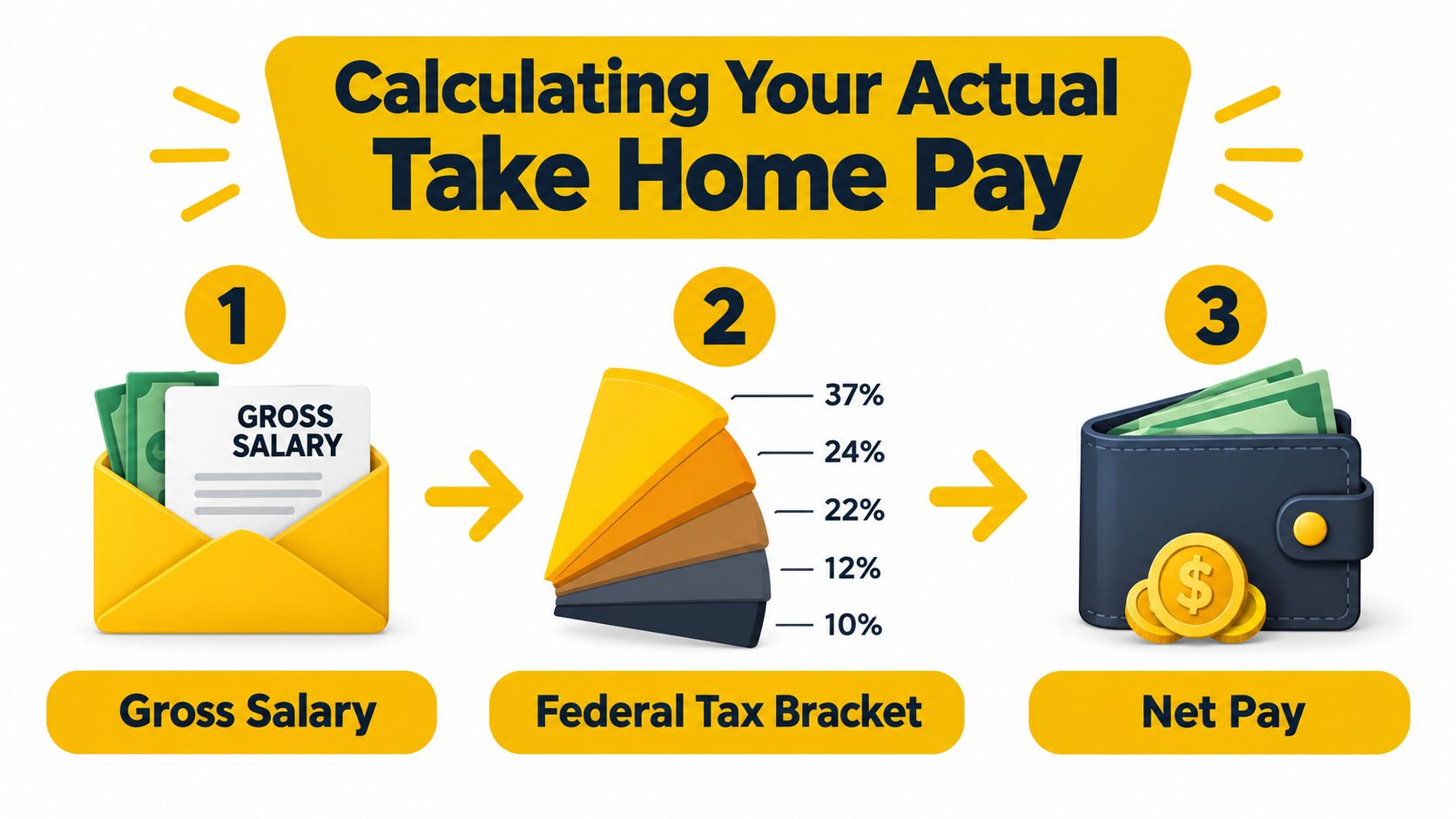
Marginal tax brackets are not flat taxes
A common mistake is assuming that if part of your income falls in the 22% federal income tax bracket, then your whole salary gets taxed at 22%. That's not how it works. Only the income above each bracket threshold gets hit at the higher marginal rate, which means the effective tax burden is lower than the top bracket suggests, and that matters a lot for planning under 2025 tax rules.
That difference is why two people with the same salary can take home different amounts. One maxes out pre-tax retirement savings, another doesn't. One itemizes benefits through a strong employer plan, another pays more out of pocket.
Bottom line: Don't budget from gross pay. Budget from what remains after taxes and pre-tax deductions.
Use pre-tax choices to lower taxable income
The standard deduction and pre-tax retirement contributions can materially reduce taxable income, which boosts take-home pay without changing your salary. That's not a loophole, it's a real part of compensation math. If your employer offers a retirement match, you should treat it as part of the offer, not an optional extra.
When you're comparing roles, put the pay package next to a real-world benchmark. For example, if you want a frame of reference across professions, it helps to understand nursing pay scales before you decide whether a similar base salary is competitive in your market.
The mistake is to ask whether $60,000 is “good” in isolation. The useful question is whether your net pay, after the tax structure and deductions, supports the budget you need.
Geographic Purchasing Power and Cost of Living
A salary isn't powerful because of the number printed on the offer letter. It's powerful because of what that number buys in a specific city. That's where $60,000 a year becomes slippery, because the same income can feel manageable in one market and brutally constrained in another.
The comparison people need is not national averages, it's local survival math. One source notes that $60,000 converts to about $28.85 an hour, $5,000 a month, and roughly $1,500 as a 30% rent target, yet the same lifestyle may require more than $202,000 in New York City because of a 155% higher cost of living than Kalamazoo. Another source says the average annual cost of living for a U.S. household was $77,280 in 2023, which puts $60,000 below average household spend before you even get to city-level pricing or taxes as discussed in this cost-of-living comparison.
What that means in practice
In a lower-cost region, $60,000 can support a steadier monthly budget because housing, parking, and everyday services leave more room. In a high-cost city, the same salary forces trade-offs fast. You start trimming grocery quality, delaying savings, or accepting a longer commute just to make rent work.
The takeaway is blunt. $60,000 is not a universal comfort line. It's a weak proxy unless you adjust for geography and household structure.
If you're evaluating a remote role, don't let the word “remote” hide the underlying issue. Ask whether the company is pricing the offer for your actual location, or for its preferred labor market. That difference can decide whether the offer is competitive or just convenient for the employer.
Useful test: If you moved the same $60,000 offer from a cheap city to a pricey one, would you still call it a strong deal? If the answer changes, the salary isn't the story, the city is.
Housing Affordability and Budgeting Ceilings
Housing is where salary reality becomes impossible to ignore. The cleanest way to judge $60,000 a year is to work backward from a housing ceiling, because rent or mortgage payments usually drive the rest of the budget. Under the 28/36 debt-to-income framework, about $1,400 per month is a practical housing-payment ceiling, and that typically translates to roughly $180,000 to $220,000 in home price depending on down payment, credit score, debt load, taxes, and insurance according to this affordability model.
Use the ceiling before you fall in love with a property
If your housing payment pushes past that ceiling, everything else gets squeezed. That includes emergency savings, retirement contributions, and the flexibility to absorb a car repair or medical bill. Rising mortgage rates, higher property taxes, or existing debt can cut that price range sharply even when income stays fixed at $60,000.
That's why offer evaluation has to happen before signing a lease or chasing a mortgage pre-approval. The salary may look stable. Your monthly obligations may not be.
A simple decision filter
Use this checklist before you accept a role tied to a move or a new lease:
- Housing payment first: If the rent or mortgage makes you stretch beyond a realistic ceiling, the job isn't affordable.
- Debt second: Student loans and card balances reduce the room you have for housing fast.
- Location costs third: Taxes, utilities, and insurance can swing the budget even when the headline salary stays the same.
- Savings last, but never optional: If you can't save on this salary, you're not being paid enough for the market you're entering.
If you want a negotiation framework tied to compensation timing, this salary negotiation guide after an offer is the right companion piece.
Strategic Salary Negotiation in Interviews
Treat $60,000 as your floor. A single number gives the employer too much control over the conversation, and it leaves no room to improve the offer before the role is even defined.
Use a range, but make it protect your minimum. If you want $60,000, do not say $55,000 to $60,000. Say $60,000 to $65,000 so you avoid anchoring yourself below the number you need. That matches current interview coaching from Indeed's salary expectations advice, and the same point is laid out more fully in our guide to salary expectation interviews.
Say the floor, then tie it to scope
Keep your answer calm and specific. A strong version is, “Based on the scope of the role and the market, I'm targeting something in the $60,000 to $65,000 range, depending on total compensation and responsibilities.” That keeps the discussion open and pushes the employer to address the full package.
If you want to rehearse that answer, use Interview Pilot in mock interview drills or live prep. It helps you practice the compensation question until your phrasing sounds natural instead of stiff.
For multilingual candidates, negotiation language matters as much as vocabulary. A resource like learn to conjugate negociar can help if you are preparing for interviews in Spanish-speaking settings where compensation talks still need to sound confident.
Strong rule: Never give a number that leaves no room for the employer to improve it.
The point is control of the conversation. A candidate who frames $60,000 as the minimum acceptable outcome keeps room to negotiate benefits, bonuses, and title. A candidate who gives a tight lower range often leaves money on the table before the offer discussion even starts.
Evaluating Total Compensation Beyond Base Pay
A base salary is only one line item. The rest of the offer can shift the true value of $60,000 a year. Health insurance contributions, retirement matches, paid time off, and remote-work support all alter the amount you keep in the end.
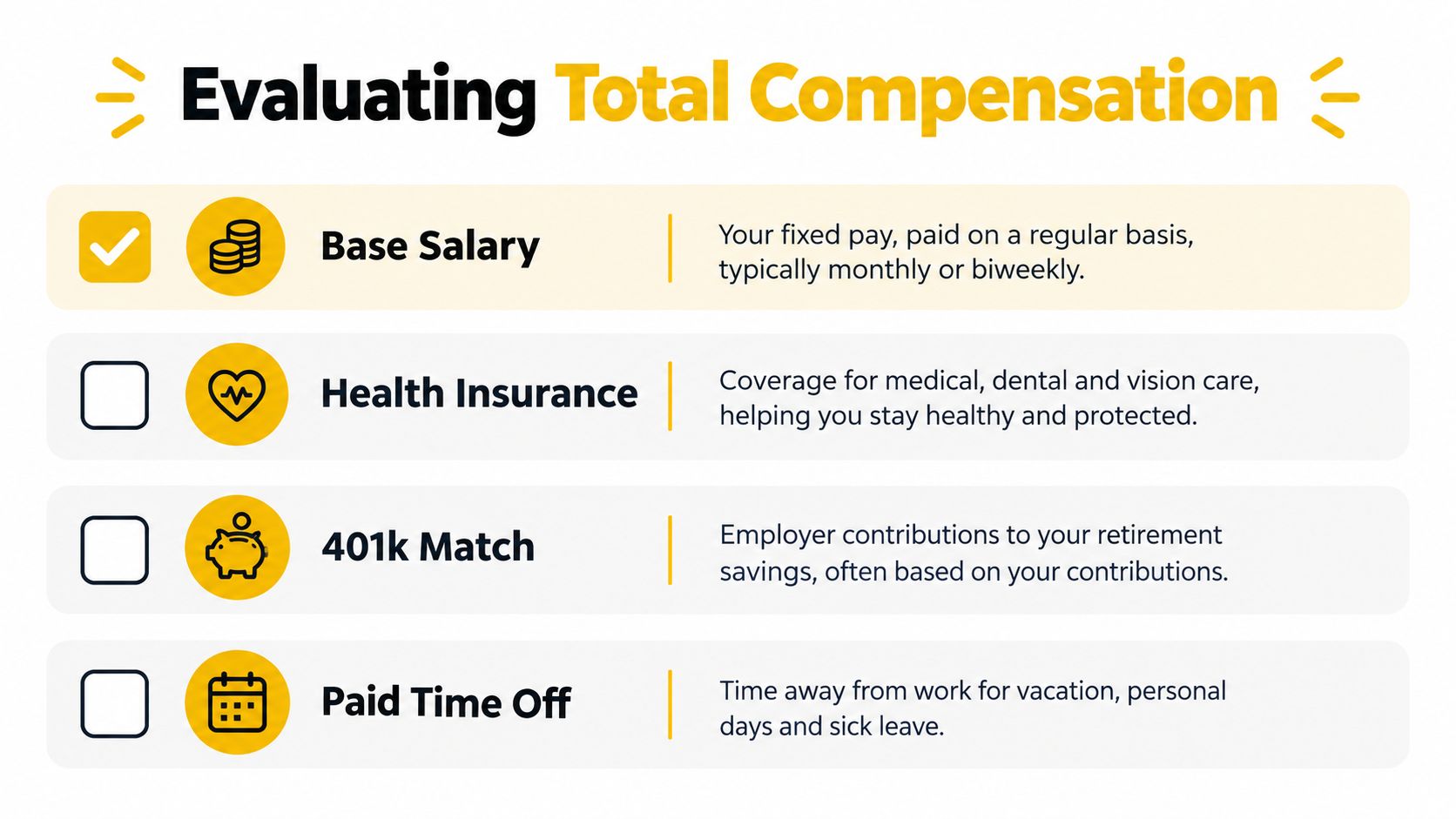
Compare what the employer pays, not just what you see
A lower base salary can be the better offer if the employer covers more of your health costs or offers a meaningful retirement contribution. A higher base salary can be weaker if your out-of-pocket expenses spike. That's especially true for people balancing commuting, family coverage, or relocation.
The smartest candidates compare offers as full packages. In fintech, for example, compensation often mixes salary, bonuses, and benefits in ways that make a simple base number misleading, which is why fintech career advice from Vaira's View can be useful when you're learning how to read the whole offer, not just the headline pay.
Make the final call on total value
Use this order when deciding whether to accept:
- Base salary. Does it clear your minimum cash need?
- Health insurance. Will your monthly costs rise or fall?
- Retirement support. Does the employer add meaningful long-term value?
- Time off and flexibility. Will this job fit your life?
- Remote-work costs. Are you paying for home office equipment, internet, or commuting?
A candidate who evaluates compensation this way makes cleaner decisions and stronger counteroffers. The role is not just to earn a number. It's to improve your financial position without creating a hidden cost burden elsewhere.
If you want a sharper way to judge your next offer, use Interview Pilot to practice salary questions, counteroffers, and interview wording before you get on the call. Visit Interview Pilot to rehearse the exact answers you need for salary expectations, negotiation, and offer evaluation.
Topics
60000 a year
salary expectations
interview negotiation
cost of living
take home pay
Continue reading

Interviews
Interview Questions Problem Solving: Top 10 Examples 2026
Learn to ace interview questions problem solving. Discover proven techniques and example answers that impress hiring managers and land you the job in 2026.
September 25, 2026
18 min read

Interviews
10 Interview Questions on Microservices with Answers
Master interview questions on microservices with model answers, follow-ups, difficulty tags, and practice prompts for architecture and engineering roles.
September 24, 2026
21 min read

Interviews
10 Operating System Interview Questions
Prepare with 10 operating system interview questions covering processes, memory, concurrency, file systems, model answers, and study resources.
September 24, 2026
24 min read