
















Companies
Why This Company? How to Answer in an Interview
Learn why interviewers ask "why this company," how to research in 30 minutes, and how to build a specific 60-90 second answer, with examples for career changers.
Interview Pilot Editorial Team
9 min read

Why This Company? How to Answer in an Interview

“Why do you want to work here?” tests two things: whether you did your homework, and whether your reasons fit the role. A strong answer names one or two specific things about the company, ties them to your own experience, and takes about a minute to say. We built Interview Pilot to help you deliver exactly that answer, in your own words, when the question arrives in a live online interview.
TL;DR
- Interviewers use this question to check your research and your fit, not to hear praise.
- Spend about an hour on research and keep three to five concrete details.
- Build the answer in three parts: a specific reason, a link to your experience, a mutual benefit. Aim for 60 to 90 seconds.
- Career changers and students should lean on transferable skills and what they want to learn.
- Non-native speakers do best with short sentences and a rehearsed structure, not a memorized script.
What the interviewer is really asking
The question looks friendly, but it screens candidates. A University of Minnesota School of Public Health writer describes a search committee in which 60% of finalists failed on two categories: doing their research and explaining why they were interested in the position and how it related to their career goals. They were dropped despite strong résumés.
Employers have practical reasons. Hiring is slow and expensive, so they want people likely to stay, to fit the culture, and to speak well of the company. A Job Skills article lists alignment with culture and values, long-term commitment, performance, brand ambassadorship and genuine interest as the five reasons.
A hiring firm’s tech-hiring guide gives a useful contrast. A weak answer cites only matching technologies. A stronger one adds that you share the company’s purpose and like its culture of collaboration and innovation.
Why this company is not the same as why this job
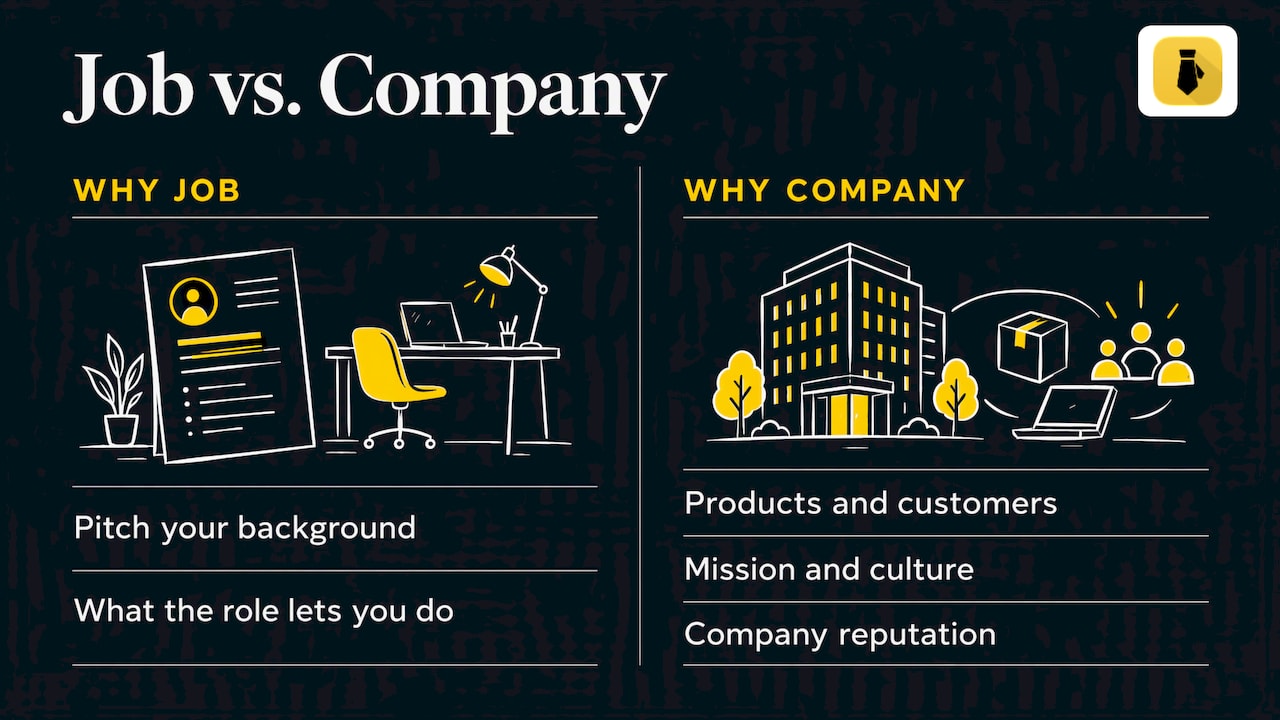
The two questions overlap, but they aim at different things. “Why this job?” is your chance to pitch your background and what the role lets you do. “Why this company?” asks what draws you to the organization itself: its products, customers, mission, culture, reputation. MIT Sloan’s career office suggests the strongest answers combine why the company, why the position and why you will succeed, and narrowing to one only when the question is specifically about the position. If the question is about the role, our guide on answering “Why do you want this job?” covers it.
Research the company in about an hour
Good answers are built from specifics, so research comes first. One staffing firm recommends 60 to 90 minutes of preparation per interview, ending with a short list of three to five concrete details you can use as building blocks.
Work through these layers:
- The job description. Know the requirements, duties and skills section well, because it shapes your answers about fit. The UMass Amherst Isenberg interview guide also warns against asking questions the description already answers.
- The company’s own pages. About, mission, leadership, history and press releases. For public companies, add annual reports and 10-K filings.
- Products, customers and competitors. UMBC’s career center lists products, ownership, size, finances, history, competitors and clients as the things to learn.
- Recent news. Launches, funding, leadership changes, expansion. Search the past few months.
- People and reviews. Look at employees in similar roles on LinkedIn and read employee reviews for patterns, not single complaints.
Brandeis career advisers add that interviewers want research that goes beyond the company website, including history, values and industry competitors. For a longer walkthrough, see our guide to researching a company before an interview.
Turn facts into three lines
Facts alone do not answer anything. Write three lines on one page: what you noticed, what it means for the role, and how your experience helps. Example: “The company moved into larger customer accounts. That likely makes onboarding more complex. I have run onboarding for enterprise clients for three years.” Those lines become your answer.
Build the answer: a three-part structure
Aim for 60 to 90 seconds spoken aloud. The same staffing firm suggests a simple arc:
- Introduction: one specific reason you are drawn to the company.
- Connection: tie your skills to the company’s needs, with one example.
- Conclusion: say how the move benefits both sides.
For the example in step two, the STAR method (Situation, Task, Action, Result) keeps it concrete and short. Choose two or three things about the organization rather than listing everything. Career advice from The Guardian suggests digesting what you found rather than repeating it and avoiding salary, commission or holiday talk in this answer.
A worked example
“I’ve followed your shift from one-off projects to subscription software, and it’s the reason I applied. In my current role I led a renewal program that cut churn by a fifth, so I know how much customer retention matters when revenue is recurring. I’d like to bring that to your customer success team and learn how you handle larger accounts.”
It names a specific business change, links one proven result, and ends on mutual benefit. Swap in your own facts; the numbers above are illustrative.
What to avoid
- Reciting facts. NJIT’s career office says spouting statistics is not the answer. Weave what you know into your reasons or into a question.
- Generic praise. “Great culture, great brand” fits any company.
- Talking only about what you get. Pay, perks and a short commute are real, but they are not your lead.
- Sounding rehearsed. MIT Sloan notes recruiters can smell a stuffy answer. Be honest.
If you are changing careers or have little experience
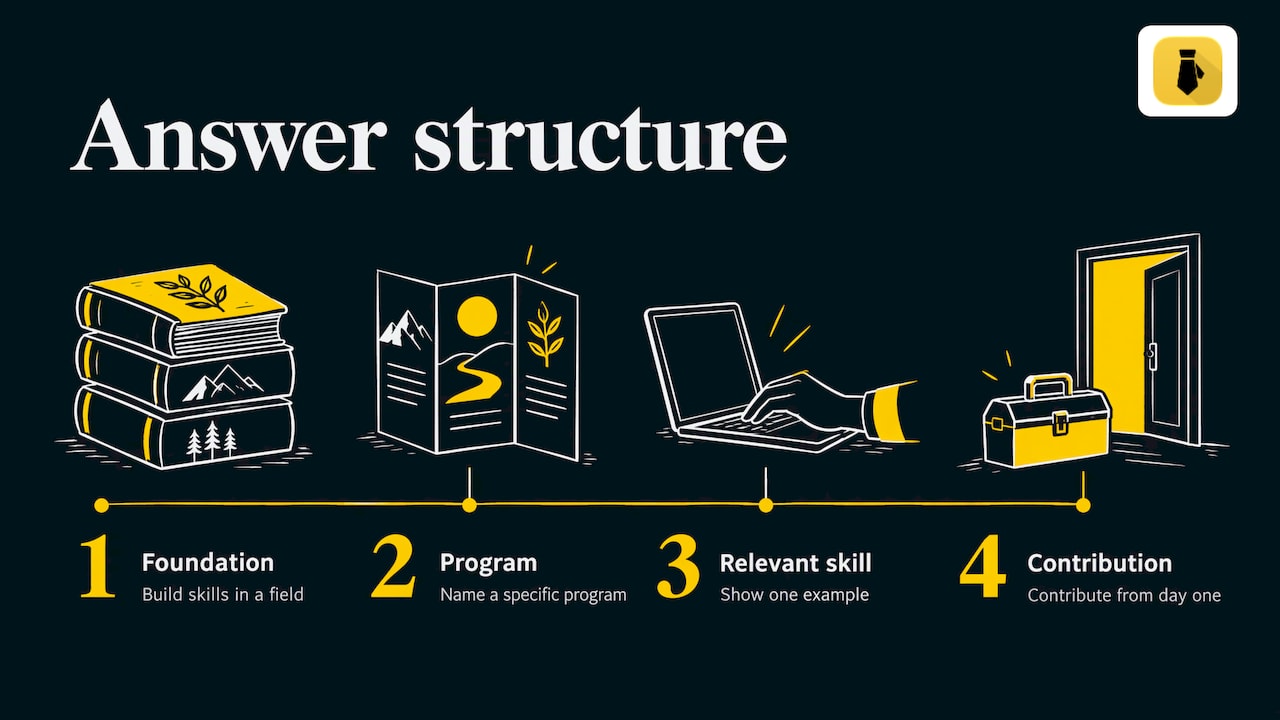
You may not have direct experience, so your reasons and transferable skills carry the answer. Name the training, mentorship or team structure that attracts you, give one example from school, a past job or volunteering, and say where you want to grow. A staffing firm’s sample follows that pattern: build a foundation in a field, cite a specific program, show one relevant skill, and promise to contribute from day one.
For career changers, the bridge matters most. The Minnesota article advises identifying three main bridges between you and the employer. Pick three things you did before that the new role needs, such as handling clients, analyzing data or leading projects. If you are moving into tech, it also helps to read how teams in tech roles describe their work so you can borrow their vocabulary honestly.
Students can use coursework, projects and internships the same way. The structure does not change.
Making it natural in a second language
If English is not your first language, clarity beats polish. Use short sentences, one idea each. Practice the three-part structure out loud until the order is automatic, then speak it in your own words each time instead of memorizing a script. Keep two or three company details you can pronounce comfortably. If you are building business English more broadly, learning a second language for work shows how employers value language skills.
Pause briefly before answering. A two-second pause reads as thoughtful, and it gives you time to pick your first sentence.
When you are not excited about the company
Many candidates apply because they need a job, and that is fine. Find what is honestly appealing: the product, the skills you will build, the industry, the team’s work. Everyone has something. Lead with that, connect it to your strengths, and keep the answer truthful. Hollow enthusiasm is easy to spot; specific interest is not.
Practice with a tool built for live interviews
Interview Pilot is an AI interview assistant that gives real-time support during live online interviews. It uses speech recognition to help you answer questions instantly in a tailored way, supports more than 99 languages and accents, and runs on Mac, Windows, iOS and Android. It uses industry-standard encryption for privacy. There is a free plan at $0 per month and an Unlimited plan at $49.99 per month on the pricing page. You can also read how an AI interview assistant works or rehearse first with an AI mock interview.

For more samples, see our guides on answering “Why do you want to work here?” and “Why do you want to work for our company?”.
Our perspective
Most candidates know the question is coming and still freeze, because pressure scrambles good preparation. Your research is only useful if you can reach it while someone is watching you.
That is why we built Interview Pilot for the live moment. It listens, understands many accents and languages, and helps you respond instantly in a way that fits the question. For non-native speakers especially, the goal is to let your real experience come through in clear, professional English.
Do the research, write your three lines, and bring them into the interview with support behind you.
Kingsley
FAQ
How long should my answer be?
Aim for 60 to 90 seconds. That is enough for a specific reason, one example and a closing line. Practice aloud with a timer.
What if the company has little public information?
Use the job description, the founders’ or leaders’ public posts, and the product itself. Employees in similar roles on LinkedIn can show what the work involves. Then ask the interviewer a question that shows your thinking.
Should I mention salary or benefits?
Not in this answer. Focus on the work, the company’s goals and your growth. Pay is better discussed when the employer raises it or at the offer stage.
Can I use the same answer for every company?
Keep your skills example the same, but change the opening reason and the company details each time. A generic answer is the one most likely to fail.
Sources
- University of Minnesota School of Public Health
- Job Skills
- Hays
- MIT Sloan Career Development Office
- Frontline Source Group
- UMass Amherst Isenberg interview guide
- UMBC Career Center
- Brandeis International Business School
- The Guardian Careers
- NJIT Career Development Services
Recommended



Topics
why this company interview
how to answer why do you want to work here
answer why do you want to work for this company
Continue reading

Companies
Company Interview Guides: How to Prepare Without Guessing
Research an employer, verify its current hiring process, map role requirements to evidence, and prepare for company-specific interviews without relying on leaked questions.
October 26, 2026
2 min read

Companies
Amazon Interview Questions and Answers (2026)
A practical guide to Amazon interview questions and answers, including behavioral examples, Leadership Principles, loop expectations, and sample responses.
August 16, 2026
10 min read
Interviews
How to Stop Rambling in Interviews: Answers That Land
Learn how to stop rambling in interviews with a four-part answer structure, length targets and recovery moves that keep you on point.
November 28, 2026
14 min read