
















Interviews
Teaching Assistant Skills: A Practical Guide for 2026
Discover the essential teaching assistant skills schools expect, with classroom examples and CV phrasing for 2026.
Interview Pilot Editorial Team
Updated November 6, 2026
16 min read
Only 54% of secondary-school teachers and 53% of primary-school teachers said their career training included working effectively with teaching assistants, according to the Department for Education's May 2024 survey. That's a useful warning for applicants: a productive classroom partnership needs deliberate communication, not assumptions about who does what.
Strong teaching assistant skills combine instructional judgement, calm routines and clear professional boundaries. Being helpful matters, but knowing when to prompt, when to observe and when to involve the teacher matters more.
Why Teaching Assistant Skills Matter More Than Ever
Schools need teaching assistants who can explain concepts, guide small groups, organise resources, observe pupils closely and coordinate with teachers. Government figures cited by The Open University show that full-time-equivalent teaching-assistant posts in England's mainstream schools increased threefold between 1997 and 2010, reaching approximately 170,000 positions.
Consider a typical mathematics lesson. While the teacher introduces subtraction, the assistant notices a pupil counting backwards incorrectly, checks whether the problem concerns number order or the method, and shares that observation before the next task. That's instructional support, not just keeping someone occupied.
Professional standard: Your contribution should help the teacher understand learning, not just confirm that pupils completed the worksheet.
This distinction matters when applying. A statement such as patient and helpful tells an interviewer little about what you'll do when a group struggles.
Prepare examples that demonstrate judgement: adapting an explanation, noticing a barrier or following an agreed behaviour plan. Include the less visible skills too, such as facilitating online participation and prioritising conflicting requests.
Before applying, rate your current skills as strong, developing or missing. Be honest: identifying a training need is more useful than claiming confidence across every part of the role.
The Core Skill Set Every Teaching Assistant Needs
Teaching assistant skills by category and priority
| Category | Skill | What It Looks Like in a Lesson | Priority |
|---|---|---|---|
| Instructional | Questioning | Asks open questions and waits for reasoning | Essential |
| Instructional | Explaining concepts | Re-explains a task using a second example | Essential |
| Instructional | Formative feedback | Gives a hint, then checks with a new example | Essential |
| Classroom management | Behavior routines | Sets and reinforces consistent transitions | Essential |
| Classroom management | Observation and recording | Notes which pupils stall and reports to the teacher | Essential |
| Classroom management | Relationship building | Greets pupils by name and follows through on promises | Essential |
| Subject and technical | Subject knowledge | Knows the year group's common misconceptions | Essential |
| Subject and technical | Safeguarding awareness | Knows reporting steps and logs concerns promptly | Essential |
| Subject and technical | SEND inclusion | Adapts a task for a pupil with a learning need and logs progress | Essential |
| Subject and technical | Digital tools | Runs a shared document or video session smoothly | Desirable |
| Subject and technical | Language support | Supports pupils with EAL using visuals and key vocabulary | Desirable |
| Subject and technical | First aid | Holds current certification and knows the procedure | Desirable |
Treat essential as the foundation for dependable classroom support. Desirable skills widen the roles you can take on, but the job description takes precedence: digital competence, language support or first aid may be essential for a particular post.
Understand what competence looks like
Subject knowledge means more than getting the answer right yourself. Before supporting fractions, for example, check whether you can explain why a larger denominator doesn't automatically mean a larger fraction. Ask the teacher which representations and vocabulary pupils already use.
SEND means special educational needs and disabilities. Inclusion involves following agreed adaptations, preserving the learning goal and noticing whether the pupil can participate more independently. It doesn't mean diagnosing a need or inventing a separate programme without guidance.
Similarly, supporting English as an additional language, or EAL, requires care. A pupil who needs help understanding instructions may still have strong subject knowledge; don't confuse unfamiliar vocabulary with inability.
Turn the checklist into preparation
For each row, identify something another adult could observe. Rather than rating yourself highly for communication, ask whether you can give a clear instruction, listen without interrupting and report a concern accurately.
Use these prompts to organise your preparation:
- Strong: Identify a classroom example and someone who could verify it.
- Developing: Name the specific behaviour you need to practise.
- Missing: Request training, observation or supervised experience before claiming competence.
Reviewing interview questions for teachers can also help you understand the classroom decisions your support needs to align with. Use the questions to practise explaining your contribution without implying that you replace the teacher.
How to Question and Give Feedback That Builds Learning
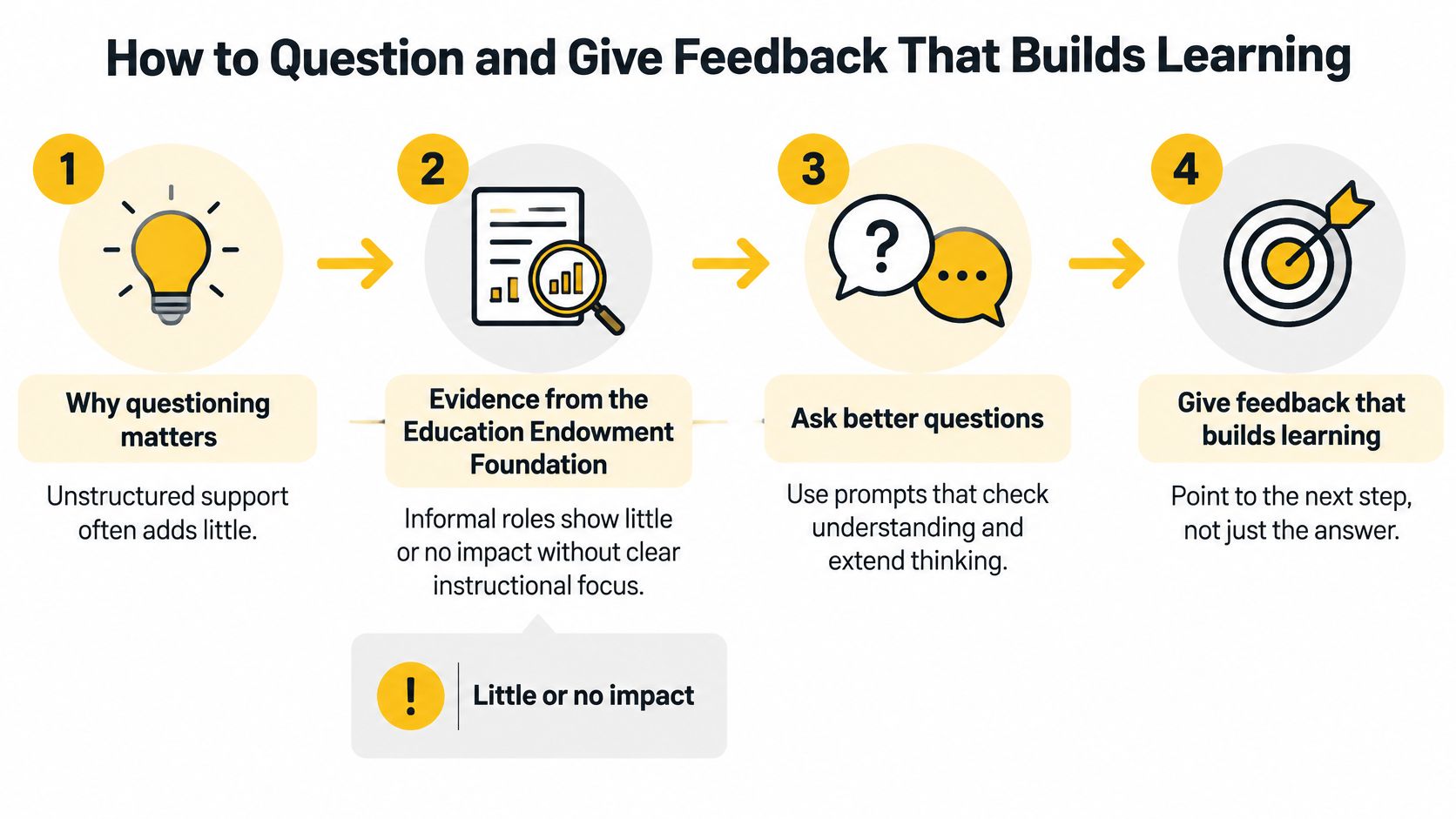
Good support helps pupils think, rather than just finish. The Education Endowment Foundation guidance reports little or no impact on pupil outcomes when teaching assistants work in informal, unsupported instructional roles, making a clear instructional purpose essential.
A useful starting question is: what should this pupil understand after our conversation? If you can't answer that, it's easy to drift into reading instructions aloud, correcting answers or completing the difficult parts yourself.
The visual below summarises the shift from unsupported help to purposeful questioning and feedback.
Use a diagnostic sequence
Ask the learner to explain their reasoning aloud. Invite them to show where they started and why, using speech, drawing or practical materials as appropriate. Don't interrupt at the first error, because their explanation may reveal a different difficulty from the one you expected.
Pinpoint the bottleneck. Decide whether the pupil misunderstands the concept, the vocabulary or the procedure. A common slip is reteaching the whole task when the pupil only needs help interpreting a particular instruction.
Give the smallest useful hint. Direct attention to a relevant feature, such as the place-value columns, without supplying the completed calculation. If the pupil still can't proceed, increase support deliberately rather than repeating the same prompt more loudly.
Check transfer with a new example. Change the numbers, wording or context and ask the pupil to attempt it independently. Repeating your answer isn't enough to establish understanding.
Say a pupil adds the denominators when adding fractions. You might ask them to build both fractions using equal-sized pieces, then consider what unit they're counting. That exposes the reasoning more clearly than immediately demonstrating the written method.
Prepare prompts before the lesson
Keep a prompt card alongside the activity: What do you notice? What have you tried? How could you check? Discuss likely misconceptions with the teacher so your hints match the lesson's approach.
For practical ways to gather evidence during tasks, Kuraplan's formative assessment ideas for responsive teaching offers a useful starting point. Choose a check that reveals understanding, not just willingness to raise a hand.
If the pupil can only succeed while you're talking, reduce your input and check what they can do independently.
Track learner talk, the balance of open questions versus answer-giving questions, and whether the pupil completes a follow-up problem alone. You don't need a complicated spreadsheet; brief observation notes can identify habits worth changing.
Ask a colleague to listen for rushed explanations or questions you answer yourself. A professional communication guide can support your rehearsal of concise explanations, but classroom feedback should focus on what the learner does next.
Managing Behavior and Routines Without Losing Teaching Time
Classroom management is about protecting access to learning, not winning a confrontation. Your response should fit the teacher's expectations, the school's behaviour approach and any individual support plan.
Start by agreeing what you'll handle independently and what requires the teacher. Without that conversation, even a well-meant intervention can create competing instructions.
Build predictable routines
- Transitions: Use the agreed signal, check that pupils are in the right place, then prompt them to stop, organise their materials and begin the displayed task.
- Small-group starts: Have resources ready, identify the learning goal and show pupils what they should attempt while waiting for help.
- Quiet corrections: Move nearby when appropriate, use a brief neutral reminder and allow the pupil an opportunity to respond without an audience.
These routines need to be taught and practised. Don't assume that a pupil who looks towards you has understood what to do.
Respond without derailing the group
Suppose a pupil repeatedly calls out during guided reading. First, use their name and remind them of the agreed way to contribute. Keep your language specific to the action rather than describing their character.
If the calling out continues, offer a choice already permitted by the classroom plan, such as contributing when invited or briefly listening before their next turn. Don't invent a consequence because you feel under pressure.
Use the pre-agreed signal to involve the teacher if the disruption continues or the pupil needs support beyond your remit. Afterwards, record what happened, what preceded it and how the pupil responded.
Practical rule: Agree the routine with the teacher before the lesson starts, including the point at which you'll seek help.
Observation makes these responses more useful. Notice who has stopped writing, who keeps watching the door and who has finished early, but don't treat those observations as explanations. Record observable actions on an approved shared sheet, then let the teacher know what needs attention.
Build trust through ordinary follow-through: greet pupils by name, return when you've said you will and acknowledge a successful restart. Don't promise confidentiality or rewards you can't provide.
For an interview, a strong example describes how you maintained the agreed approach while keeping the group learning. The common mistake is presenting yourself as the person who took over discipline, rather than a colleague who acted consistently and communicated well.
Supporting Online and Hybrid Lessons
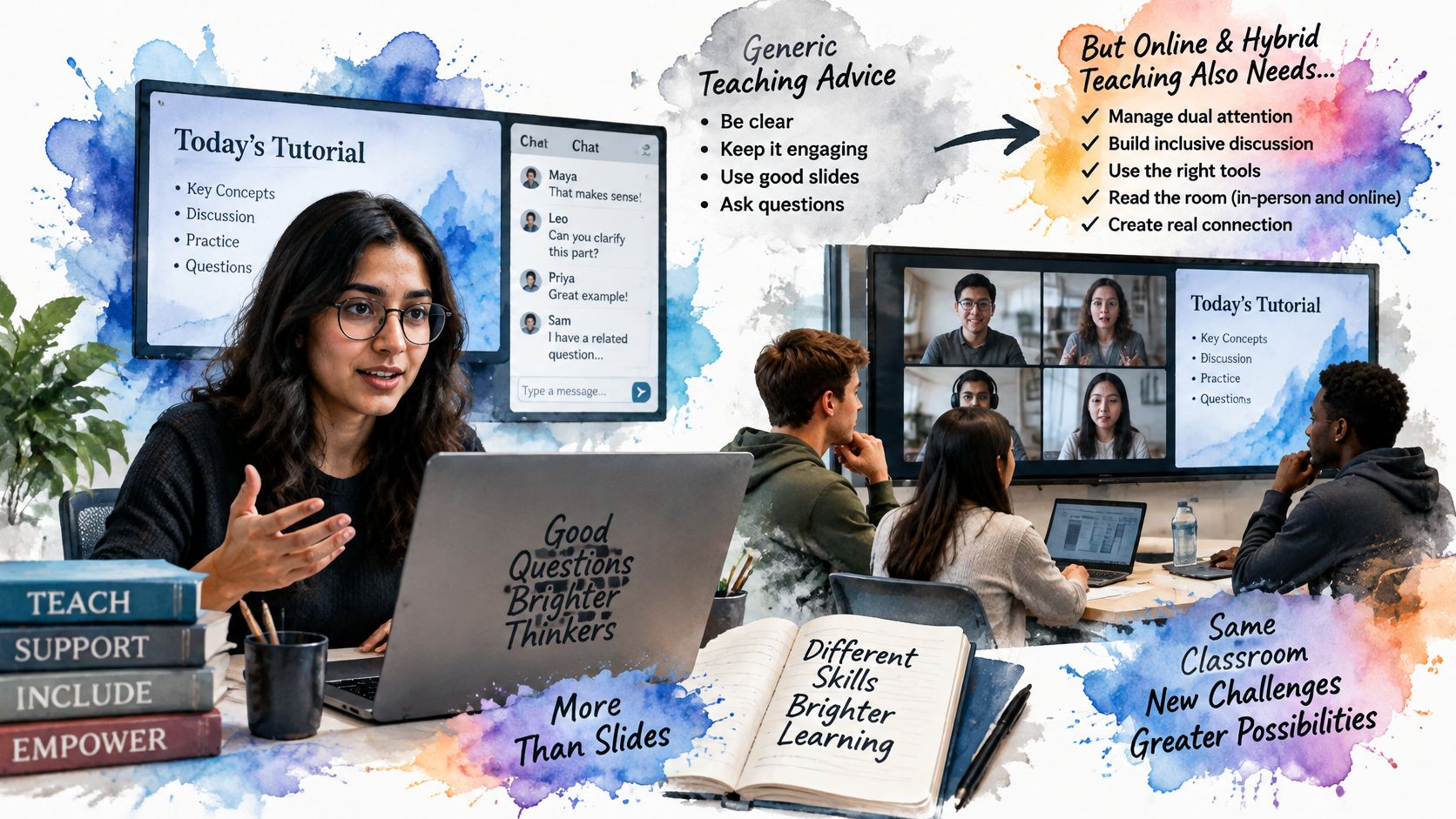
Online facilitation needs more than patience and a working microphone. In a study of teaching assistants at universities, participants described online tutorials as more challenging and less effective than face-to-face sessions, particularly because interaction was difficult. That's university evidence, not a direct measure of school lessons, but it identifies practical issues worth planning for.
In a hybrid room, the assistant needs to attend to pupils who aren't physically beside them.
Online teaching tasks and low-cost fixes
The difficulty descriptions below reflect participants' experiences where applicable. The final row is a planning risk to check locally, not a measured finding.
| Task | Typical Difficulty | Low-Cost Fix |
|---|---|---|
| Marking assessments | Most challenging routine task | Feedback rubric with a reusable comment bank |
| Pacing tutorials | Most challenging routine task | Timed online lesson script with checkpoints |
| Moderating discussion | Interaction is difficult | Turn-taking rules and participation prompts |
| Sustaining participation | Interaction is difficult | Short polls or chat questions every few minutes |
| Answering student questions | Comparatively less difficult | Shared FAQ document |
| Preparing sessions | Comparatively less difficult | Reusable session template and checklist |
| Escalating disengaged students | Unclear unless locally agreed | Written escalation protocol with a set trigger |
Make participation deliberate
Moderate discussion explicitly. In Microsoft Teams or Google Meet, explain how pupils should request a turn and whether chat is open for answers or questions. In a hybrid lesson, bring remote contributions into the room rather than leaving them unread on screen.
Offer accessible ways to respond. Use a short poll, a chat response or a shared-document task at planned checkpoints. For example, ask pupils to identify which worked example contains an error before inviting an explanation; don't rely solely on volunteers speaking into microphones.
Make digital feedback usable. Agree a rubric with the teacher and build a comment bank around the task's criteria. Personalise each selected comment so the pupil knows which part of their work needs attention.
Use the following video as a prompt for discussing your own online-support routines.
Agree a written process for missed sessions, lack of response and technical problems, including who contacts home and when. Don't assume disengagement means unwillingness: check access needs through approved school channels.
Lesson scripts, rubrics and escalation templates are low-cost, transferable systems. Build a draft, test it with the teacher and retain a permission-cleared example as evidence of your online teaching assistant skills.
Setting Boundaries When Workload Pressure Rises
Being endlessly flexible isn't the skill. In an NCFE survey of more than 150 active teaching assistants, nearly three-quarters had considered changing careers, and almost half wouldn't recommend the role as a career.
Accepting every request can mean abandoning planned learning support without anyone explicitly deciding that it should stop. Professional flexibility requires an agreed priority, not silent overextension.
Triage requests openly
- List the requests. Put scheduled interventions, classroom support, preparation and unexpected cover requests in one place.
- Rank them with the teacher. Identify immediate safety concerns, pupil needs and the teacher's stated instructional priority.
- Confirm what you can cover. Record the agreed change through the school's normal communication system, including what will be postponed.
- Log the impact. Note the support delivered, the pupil response and any work that couldn't happen.
Keep records factual. An intervention log should distinguish between a session that took place without progress and a session cancelled because you were reassigned.
Be professionally assertive
Try explaining that a new request conflicts with the planned reading intervention, then ask which task should take priority and who should be told. You're making the trade-off visible, not refusing to cooperate.
If conflicts become routine, raise them with your line manager or the relevant inclusion lead. Ask for a deployment decision rather than attempting to solve staffing shortages through unpaid preparation or improvised cover.
A boundary is useful when it identifies the pupil support at risk and asks the right person to decide.
Safeguarding concerns require the school's reporting route, not a place at the bottom of a task list. Record factual information, report promptly to the designated safeguarding lead or deputy, and follow the school's urgent escalation procedures where necessary.
For SEND support, request preparation time to understand the agreed adaptations and relevant plans. Willingness to help isn't a substitute for knowing how to provide safe, appropriate support.
Write Your Teaching Assistant CV With Evidence
CV phrasing and evidence for each core skill
| Skill | CV Phrase Template | Evidence to Gather |
|---|---|---|
| Questioning and feedback | Used targeted questioning to move [number] pupils from answers to reasoning | Lesson observation notes or a feedback example |
| Behavior routines | Maintained classroom routines for a class of [number] pupils in [subject] | Teacher reference or observation record |
| Observation and recording | Recorded pupil progress and shared concerns with teachers each lesson | Sample observation sheet with personal details removed |
| Online facilitation | Moderated online discussion and set participation prompts for [number] students | Lesson script or screenshot with permission |
| Workload triage | Prioritised interventions across [number] groups during staffing shortages | Intervention log or timetable |
| Safeguarding awareness | Followed safeguarding procedures and logged concerns promptly | Current training certificate |
| Language support | Supported pupils with EAL using visuals and key vocabulary | Resource example or teacher feedback |
Treat these as templates, not ready-made claims. Replace the placeholders with accurate details, and change any wording that goes beyond what you did.
Write an action, context and outcome
Lead with a concrete verb such as adapted, recorded, facilitated or coordinated. Name the year group, subject or setting so the employer can understand your experience, and include a number only when you can verify it.
Then explain the outcome. If you don't have attainment evidence, use a narrower observable result, such as a pupil beginning a task independently or the teacher adjusting the next activity following your notes.
These resume bullet examples can help you tighten the wording. Keep the distinction between your action and the teacher's responsibility clear.
- Get permission: Don't remove school records or share classroom screenshots without authorisation.
- Protect pupils: Remove names, photographs, usernames and other identifying details from permitted examples.
- Match evidence to claims: A certificate supports a training claim; it doesn't prove every aspect of classroom competence.
Rehearse examples with a specific result
Prepare a short situation, action and result example for each essential skill. For a struggling group, establish the learning difficulty, describe your decision and explain what pupils could do afterwards.
For a behaviour question, avoid labelling a pupil difficult. Describe the observable behaviour, the agreed response and how you coordinated with the teacher.
Rehearse aloud and time yourself so the answer stays focused rather than becoming a full account of the lesson. Check whether a listener could identify your contribution without guessing, and acknowledge anything you would change next time.
Choose the skills you can evidence most convincingly, write the corresponding CV lines this week and prepare an interview example for each. Where your evidence is weak, arrange a specific opportunity to practise rather than adding another unsupported adjective.
Our AI mock interviews offer practice alongside an evaluation of your answers. Visit Interview Pilot to rehearse your teaching-assistant examples and check whether you've explained your actions, classroom judgement and results clearly.
Topics
teaching assistant skills
teaching assistant duties
TA skills
classroom support skills
teaching assistant CV
Continue reading

Interviews
Online Interview Dress Code: What to Wear on Camera
What to wear for a video interview: the right outfit, camera-friendly colors, what to wear below the waist, and body language tips that read well on screen.
November 8, 2026

Interviews
Insurance Questions for Interview: 10 Answers That Land
The 10 most common insurance questions for interview panels across underwriting, claims, sales and actuarial roles — with answer guidance for each.
November 8, 2026
19 min read

Interviews
Interview Business Casual: What to Wear and When
Interview business casual explained: industry-by-industry outfits, piece-by-piece checklists and video-call tips so you dress one step smarter.
November 8, 2026
14 min read