



Career
Skills Required for Pharmacist Roles in 2026
See the skills required for pharmacist jobs: clinical checks, counseling, digital safety, resume bullets, and interview lines for 2026.
Interview Pilot Editorial Team
Updated November 5, 2026
18 min read
The most popular advice about pharmacist careers often starts with memorizing medicines, working quickly, and paying attention to detail. Those abilities matter, but they don't tell an employer whether you'll recognize an unsafe prescription, manage a treatment gap, or challenge an automated recommendation that doesn't fit the patient.
The skills required for pharmacist roles are better judged by a harder question: can you explain the patient risk, make a defensible decision, and show what happened afterward? That's the standard to use when choosing what to learn, what to put on your resume, and what to rehearse before an interview.
Skills Required for a Pharmacist at a Glance
A pharmacist's job is to keep treatment safe from the first piece of patient information to the follow-up. The useful hiring standard isn't a personality list. It's a set of observable behaviors, including assessment, verification, communication, management, and professional accountability.
Pharmacist skill clusters and the proof they require
| Skill cluster | What competent practice looks like | Proof to show |
|---|---|---|
| Pharmaceutical care | Collect indication, effectiveness, safety, adherence, comorbidities, other medicines, and preferences; choose medicine, formulation, dose, route, schedule, and monitoring | Reasoning chain from patient problem to follow-up metric |
| Medicine supply and dispensing | Validate legality, recalculate, label, package, store, secure, compound with controls, and dispose safely | Named verification step and a near-miss outcome |
| Patient and team communication | Explain use, contraindications, storage, and adverse effects in lay language; use teach-back; hand off to the prescriber | Counseling or escalation example showing what the patient understood |
| Organisation and management | Prioritize under shortage or workload pressure, document decisions, substitute within scope, and stop an unsafe check | Scenario showing when you refused unsafe throughput |
| Professional and personal competence | Maintain continuing professional development, ethics, emergency readiness, and digital literacy; challenge decision support before acting | Learning example or an alert you verified or overrode |
| Pharmaceutical public health | Support prevention, safe disposal, emergency response, and population-level medicine use | Public-health action tied to a patient or community outcome; add your actual national licence or registration name |
These are FIP-aligned skill clusters, not separate job descriptions. A single prescription may require several at once. Finding an interaction is pharmaceutical care; contacting the prescriber is team communication; arranging a safe supply and documenting the decision involve management and professional accountability.
Turn knowledge into evidence
Clinical proof is a reasoning chain, not a catalogue of medicines you recognize. Operational proof might be a recalculation that caught a strength mismatch. Communication proof might be a patient correctly demonstrating an inhaler after you changed your explanation.
For readers still exploring how pharmacy work extends beyond dispensing, Healtsy's 10 pharmacy facts explained offers an accessible companion resource. Use that broader orientation to identify interests, then use the table to identify evidence.
Evidence test: Could a preceptor tell what you checked, why it mattered, and what you did next?
Your evidence should also match your level of responsibility. A supervised trainee can describe identifying a concern and escalating it correctly. They shouldn't present the supervising pharmacist's final decision as their own independent intervention.
Separate competence from permission to practise
Licensing gates commonly include an accredited pharmacy degree, a national or board registration examination, and supervised intern or pre-registration experience. Check your regulator's exact requirements, including any law examination and jurisdiction-specific prescribing or substitution rights.
Those gates don't have identical names or structures across countries. Write the actual licence or registration name for your country in the final row's proof column, rather than treating a degree as universal permission to practise.
Mark the row you can't yet support with a real example. That's your next supervised learning objective.
How Pharmacists Judge a Medicine Before It Leaves
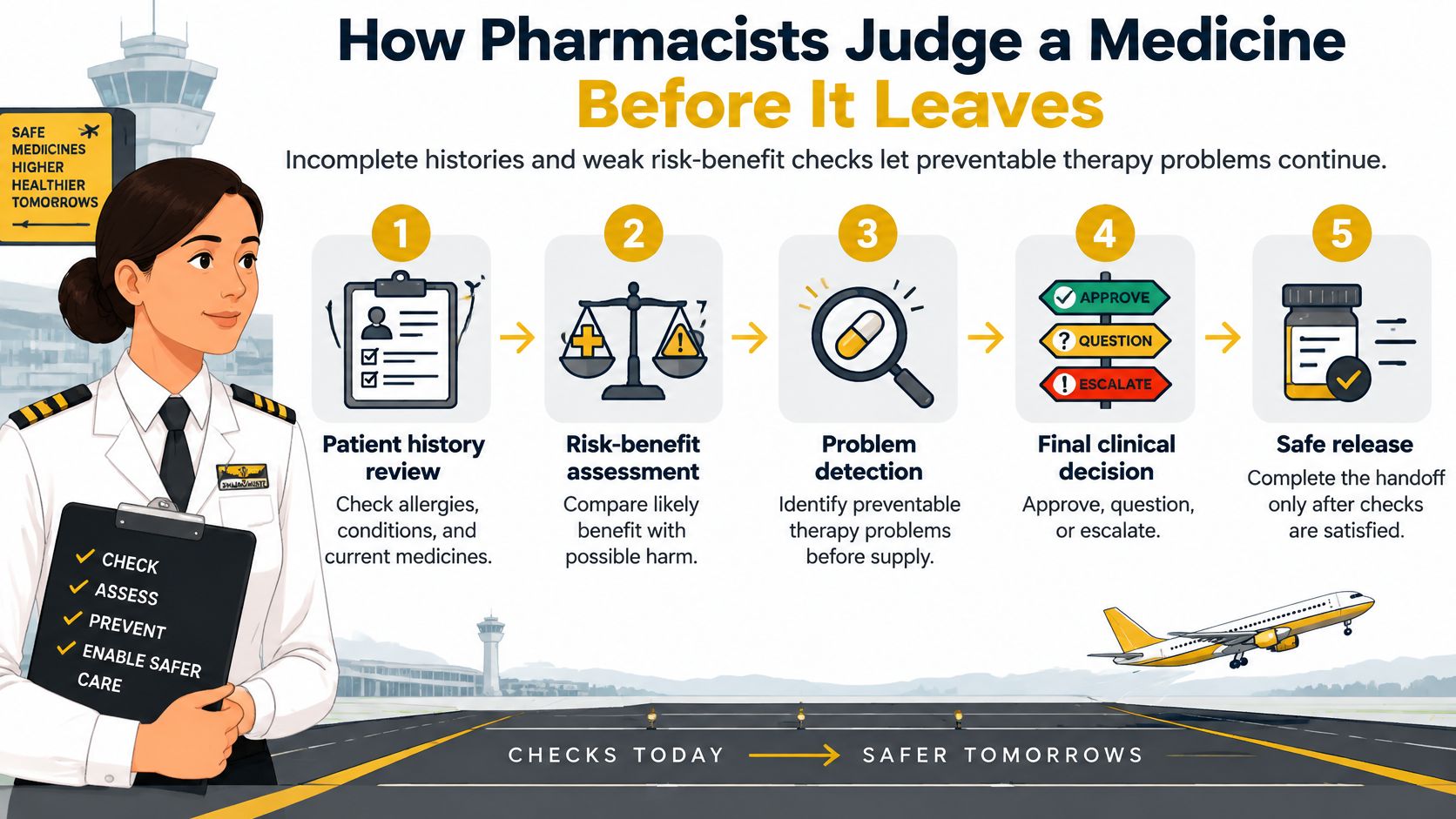
Clinical checking resembles a pilot's preflight more than reading a label aloud. You're checking whether the proposed treatment fits the conditions in front of you, not merely whether the prescription looks complete.
The FIP Global Competency Framework identifies 23 competency domains and 124 behavioral statements across pharmaceutical public health, pharmaceutical care, organisation and management, and professional and personal competencies. Its medication-assessment expectations require patient-specific reasoning, not dispensing accuracy alone.
Narrate the clinical decision
- Define the problem and indication. Establish what the medicine is intended to treat or prevent. If the indication isn't clear, don't infer it solely from the product name.
- Collect the patient context. Assess effectiveness, safety risks, adherence, comorbidities, concurrent medicines, and preferences. Ask about nonprescription products and what the patient takes, not just what appears on the record.
- Validate legality and clinical appropriateness. Check prescription requirements alongside contraindications, interactions, allergies, and duplication. These are separate questions: a legally valid prescription can still be clinically unsuitable.
- Evaluate the treatment details. Consider the medicine, formulation, dose, route, and administration schedule together. A suitable active ingredient doesn't make every formulation or regimen suitable.
- Define monitoring. Identify both an objective outcome, such as a relevant laboratory result, and patient-reported effects, such as symptom improvement or troublesome adverse effects.
- Communicate and close the loop. Explain the concern and proposed intervention to the prescriber or care team. Name who will review the patient and what finding will trigger reassessment.
An incomplete history can make an apparently reasonable decision unsafe. For example, a prescription may be valid but require review because the patient's kidney function has changed, pregnancy changes the risk-benefit assessment, or another clinician has prescribed duplicate therapy.
Explain the trade-off, not just the rule
Say a patient's record contains an old renal result and a newly prescribed medicine requiring renal assessment. The competent response isn't to announce that the dose is wrong. Establish whether the information is current, consult the relevant dosing guidance, and communicate the uncertainty before recommending a change.
Household circumstances also belong in the history when relevant. If a patient describes confusion between human and veterinary medicines, Bandana Rx's guide to safe storage for pet medications can support a separate discussion about keeping those products clearly distinguished.
For an interview, organize your explanation as problem, medicine-related risk, evidence or guideline, intervention, communication, and follow-up metric. Knowing the drug name starts the discussion. Explaining why treatment should proceed, change, or pause demonstrates judgment.
Dispensing Controls and Counseling That Prevent Harm
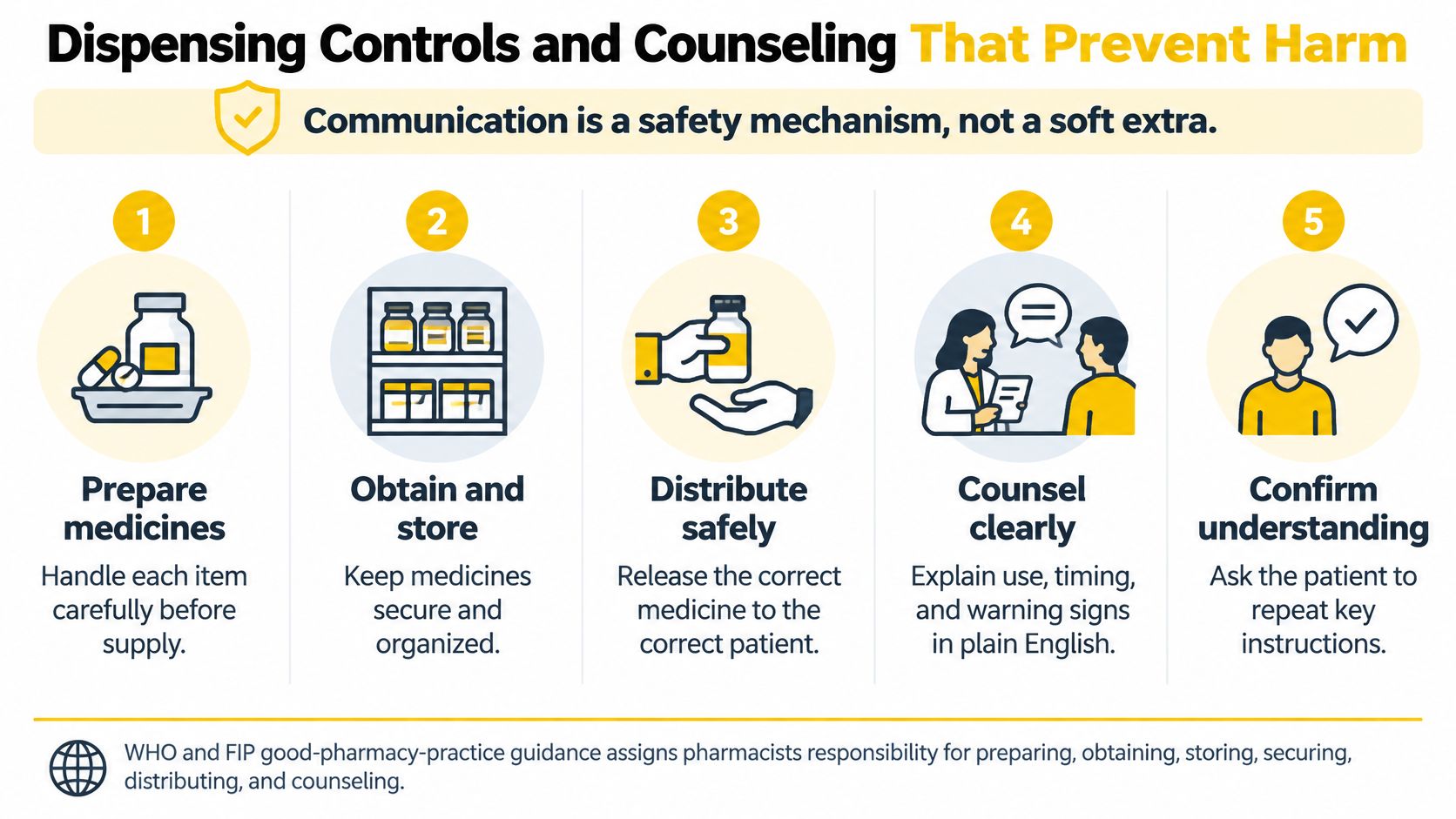
A patient can leave with the correct medicine and still use it unsafely. If they misunderstand the timing, can't operate the device, or don't recognize a warning symptom, a technically correct supply hasn't completed the safety task.
The WHO/FIP good-pharmacy-practice guidance assigns pharmacists responsibilities across preparing, obtaining, storing, securing, distributing, administering, dispensing, and disposing of medicines, alongside medication-therapy management, continuing professional development, and public health. Communication is a safety mechanism, not a soft extra.
Make verification visible
A reliable dispensing process includes concrete controls:
- Prescription re-check: Compare the prepared item against the original prescription, using an independent check where the procedure requires one.
- Accurate calculations: Recalculate using the prescribed dose, available concentration, and correct units. Don't copy a previous calculation without verifying its inputs.
- Labeling and packaging: Confirm that directions, warnings, container, and supplied product agree.
- Validated compounding: Follow the approved formula and procedure, documenting ingredients and required checks.
- Environmental controls: Maintain the required preparation conditions, storage conditions, cleanliness, and separation of products.
Consider a liquid medicine prepared in the correct concentration, but with directions that confuse milligrams and millilitres. The verification step is a comparison of the prescription, concentration, calculated volume, and label. The escalation decision is to hold release until the discrepancy is resolved, not ask the patient to interpret it.
The outcome you can establish immediately is that the corrected directions match the intended dose. Don't claim that you prevented a specific injury unless you have evidence for that conclusion.
Check what the patient can do
Teach-back should test your explanation, not the patient's confidence. Ask them to show how they'll measure the dose or describe when they'll take it, rather than asking whether everything makes sense.
Explain why the medicine was selected, how to use it, relevant contraindications, storage, and adverse effects in everyday language. For devices, demonstration is more useful than a fluent description. Document unresolved concerns and arrange follow-up when the patient still needs support.
A correct box isn't the endpoint. The patient needs a usable treatment plan.
Patients navigating pharmacy services may also benefit from reviewing a provider's pharmacy information, such as XO's Registered pharmacy page. That orientation doesn't replace individualized counseling or confirmation that the patient understands their own treatment.
Maintaining these abilities requires continuing professional development, meaning systematic maintenance and broadening of knowledge, skills, and attitudes throughout a career. Identify a gap, complete relevant learning, and show how you changed your practice afterward.
Judgment When Shortages and Workload Collide
Knowing which medicine would be ideal isn't the same as getting a patient safely through a supply failure. This distinction between technical competence and system-navigation skills is missing from many pharmacist skills lists.
In Ireland's 2025 Pharmacy Workforce Survey analysis, 59% of respondents identified medication shortages as a major obstacle; respondents also called for protected breaks, clearer career progression, improved clinical training, prescribing rights, and stronger digital integration. These findings describe an Irish workforce, not a universal prevalence estimate, but they make the practical challenge clear.

Judge the decision, not the queue speed
An employer who measures only throughput may miss the pharmacist who recognized that a check could no longer be completed safely. Speed can describe activity. It doesn't establish that the patient received appropriate treatment.
The employable skill is controlled prioritization: recognizing urgency, understanding substitution authority, involving the right clinician, and leaving a record another professional can act on. Assertive communication matters because a safety concern that remains unspoken can't guide the team's response.
Resilience doesn't mean accepting an indefinitely unsafe workload. It includes recognizing your limits, requesting support, and making the risk explicit without blaming colleagues.
Use constraints to test judgment
Consider these interview prompts without jumping straight to a solution:
| Scenario prompt | Judgment criteria |
|---|---|
| A critical medicine is unavailable and the prescriber is unreachable | Risk from interruption; local substitution authority; available escalation routes; documentation; whether an authorized interim supply or monitoring plan is possible |
| Workload pressure would make a final dispensing check unsafe | Risk to the patient already in process; the check that can't be completed; responsible escalation contact; documentation; continuity arrangements within local scope |
The details matter. An alternative strength, formulation, or medicine may introduce a new administration problem, require authorization, or be unsuitable for the patient. Likewise, a queue-management decision must account for patients whose treatment is time-sensitive, not just those waiting longest.
For either prompt, ask what information would change your decision. A good candidate distinguishes a missing fact from a fact they're entitled to assume.
Community, hospital, and health-system pharmacists can all encounter these pressures, although their authority and escalation routes differ. Use problem-solving interview questions to practise making your decision criteria explicit, rather than memorizing a universal response.
The strongest evidence isn't that you remained busy. It's that you recognized the constraint, understood its clinical significance, and kept responsibility for the patient visible.
Digital and AI Checks That Stay Under Human Control
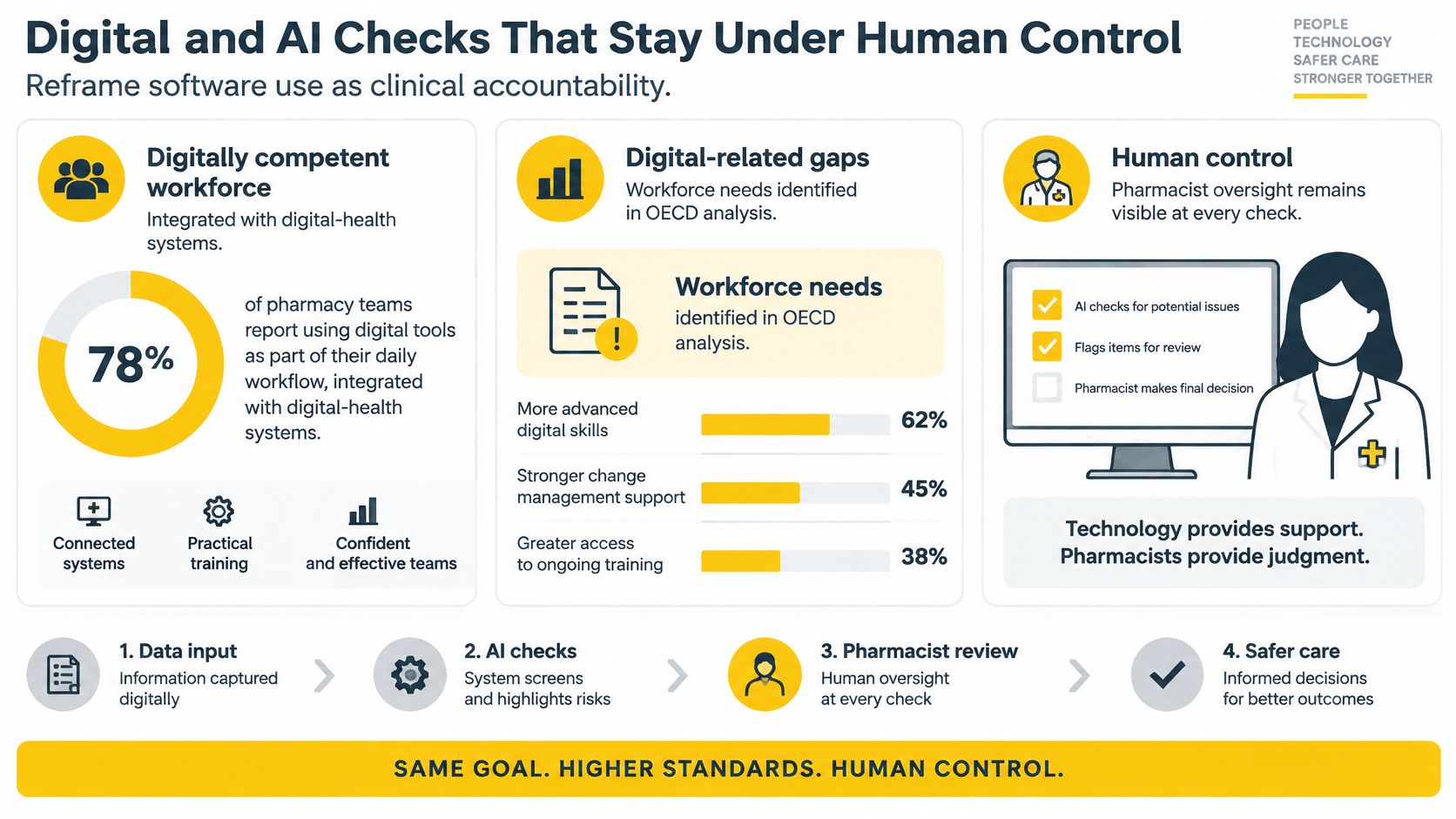
Verify, challenge, document, and explain any algorithm-generated recommendation before it influences treatment. Start by checking the patient information behind it, then assess whether the recommendation fits the clinical situation.
The important skill isn't clicking through pharmacy software quickly. It's preserving clinical accountability when a screen presents an answer that looks authoritative.
Test the recommendation against the patient
Use these case stems to identify what competent digital practice looks like:
- An incorrect alert: Don't accept or dismiss it automatically. Check the medicine, dose, timing, and relevant patient factors against an appropriate clinical reference.
- An incomplete electronic record: Name the missing information, such as a current medicine list or relevant laboratory result, and explain how you'd obtain it.
- Biased input data: State which patient characteristics or circumstances may be poorly represented and how that limits confidence in the output.
- A conflicting digital therapeutic: Reconcile the tool's instructions with the patient's treatment plan before counseling them about its use.
An alert override needs a clinical reason, not irritation at repeated notifications. Equally, accepting an alert doesn't remove your responsibility to check that the resulting change is appropriate.
Automation bias means giving an automated output more trust than its evidence deserves. A practical defense is to identify what would make the recommendation wrong before acting on it.
Keep the record and the explanation usable
Document the relevant inputs, the recommendation reviewed, your decision, and any escalation. Another clinician should be able to understand why you accepted or rejected the suggestion without reconstructing your entire screen session.
Privacy awareness is part of this skill. Don't enter identifiable patient information into an unapproved tool just because it can generate a plausible treatment summary.
For a patient using a digital therapeutic, explain its intended role, how it fits with prescribed treatment, and whom to contact if its advice conflicts with the agreed plan. Don't assume confidence with a smartphone means understanding of the therapy.
Accountability rule: Software can generate a recommendation. A responsible professional must decide whether it belongs in this patient's care.
Workforce guidance emphasizes digital-health integration and evaluating AI outputs before therapeutic use. Hiring language may understate that need: OECD analysis summarized in FIP's new practice environment guidance found digital-related postings represented roughly 2% to 6% of vacancies across the health occupations examined, while explicit AI requirements remained relatively sparse.
Resume Bullets That Prove Pharmacist Skills
A resume bullet is evidence, not a synonym list. Medication therapy management, drug utilization review, and patient counseling are useful terms only when the reader can see what you did.
Build each bullet around a risk, an action, and a defensible result. Add volume or frequency when your records support it, but don't let a large prescription count replace evidence of clinical responsibility.
Adapt these evidence patterns
Replace the bracketed fields with your own information. Remove any activity you didn't perform, and distinguish supervised work from independent practice.
- Clinical assessment: Completed [documented weekly review volume] structured medication reviews, identified [renal-dose or interaction concern], and documented [prescriber decision] with [follow-up finding].
- Medication safety: Performed [documented check volume] final verifications and relevant calculations for [medicine group], detecting [strength, concentration, or directions mismatch] before release and recording [resolution].
- Counseling: Used teach-back during [documented counseling volume] consultations on [inhaler technique, anticoagulant use, or antibiotic timing], recording [demonstration, callback finding, or adherence concern].
- Shortage management: Coordinated [documented shortage cases] involving [unavailable product], arranged [authorized alternative or referral], explained the treatment gap, and recorded [prescriber contact and outcome].
- Digital judgment: Reviewed [documented alert volume] decision-support notifications, verified [patient information], and documented [confirmation or override rationale] with [clinical follow-up].
- Public health or access: Delivered [documented service count] authorized immunizations, disposal consultations, or access-support interventions, recording [completion, referral resolution, or other observable outcome].
A result doesn't have to be a percentage. Prescriber acceptance, a corrected label, successful technique demonstration, or a completed referral can be credible evidence when that's what you know.
Match the setting without borrowing experience
Community and hospital applications shouldn't blur different responsibilities. Compare these adaptable examples:
| Target setting | Evidence-focused wording |
|---|---|
| Community pharmacy | Resolved [directions discrepancy] during prescription verification and confirmed the patient could explain the corrected schedule |
| Hospital pharmacy | Reconciled discharge medicines against [relevant records], escalated [omission or duplication], and documented the agreed list |
Sterile compounding belongs on your application only if you have relevant training and experience. Name the preparation controls you performed instead of adding the term because it appears in a vacancy.
The same evidence-first approach used in an experienced nurse resume is useful for structuring healthcare achievements, but pharmacist scope and credentials must remain explicit.
Avoid invented accuracy rates, unsupported claims of harm reduction, and keyword stuffing. If your evidence ends at identifying and escalating a discrepancy, say that rather than claiming a later clinical outcome.
Final test: A stranger should be able to identify the risk, your action, and the result, and you should be able to defend every word.
Rehearse Judgment Answers Before the Interview
Weak versus strong pharmacist interview answers
| Prompt | Weak answer | Strong answer |
|---|---|---|
| Is this medicine appropriate? | Lists drug classes or claims guideline knowledge | Names the problem, patient-specific risk, relevant guideline, product choice, prescriber contact, and monitoring metric |
| Tell me about a near miss | Claims carefulness and double-checking | Names the verification step, discrepancy, escalation, correction, and outcome watched |
| A critical medicine is unavailable and the prescriber is unreachable | Keeps calling indefinitely or switches without checking authority | Establishes interruption risk and substitution limits, explores authorized interim supply and escalation, documents contacts, and gives patient advice |
| The workload makes a final check unsafe | Works faster to clear the queue | Pauses the unsafe release, informs the responsible lead, arranges a safe check, and protects continuity for the patient already in process |
| An alert or digital tool conflicts with the plan | Accepts the alert automatically or ignores the tool | Checks data quality and clinical relevance, documents the human decision, communicates with the team, and explains any treatment implications to the patient |
Practise a short answer with a clear endpoint
For practice, aim to tell each story in about a minute, extending it only when the clinical reasoning needs more explanation. Lead with the patient risk, not a long description of the pharmacy or a tour of drug names.
Use the sequence problem, risk, evidence, intervention, communication, and outcome. If the story has no outcome, identify what you observed and what remained unknown. A documented handoff is more credible than an invented recovery.
Record a timed rehearsal for each table row. On another pass, shorten the setup and make your own responsibility unmistakable: what you checked, what you recommended, and who authorized the final action.
Use healthcare interview questions to practise patient-facing explanations alongside clinical reasoning. Your answer should make sense to a hiring manager without losing the detail a pharmacist interviewer needs.
Bring pharmacy-specific prompts to practice
At Interview Pilot, our practice tools include a Question Bank and a Playground for trying answers. Our published role lists cover fields such as business analysis and project management rather than a dedicated pharmacist pack, so paste the pharmacy prompts above into practice instead of expecting a pharmacy-specific set.
Keep patient details anonymous and use genuine examples whenever the interviewer asks about your experience. If you're answering a hypothetical scenario, make that explicit and state which missing facts you'd establish before acting.
Choose your weakest row, write the six-part reasoning chain, and rehearse it aloud before applying. You're ready when the listener can follow the safety decision without having to guess why you made it.
Interview Pilot offers a Question Bank and a Playground for trying interview answers, which you can use to rehearse pharmacist judgment scenarios. Visit Interview Pilot, bring the prompt you find hardest, and practise explaining the patient risk, your decision, and the follow-up clearly.
Topics
skills required for pharmacist
pharmacist skills
pharmacy resume
pharmacist interview
clinical competencies
Continue reading
Career
Synonym for Cashier: Alternatives by Job Setting
Find the right synonym for cashier by setting: checkout operator, cash clerk, teller and more, with job-posting and resume wording tips.
November 5, 2026
14 min read

Career
Teamwork Example for Interviews: Sample Answers and a Simple Structure
Need a teamwork example for your interview? See how to pick a story, structure it with STAR, and use sample answers for students, career changers and pros.
November 4, 2026

Career
8 Special Skills for Acting Resume: How to Prove Them
Discover 8 special skills for acting resume listings, from dialects and stage combat to singing and improv, plus tips on how to prove each one to casting teams.
November 4, 2026
17 min read