
















Interviews
Professional Summary in a CV: How to Write One That Gets Read
Learn how to write a professional summary for your CV: what to include, how long it should be, how to tailor it, with formulas and examples you can adapt.
Interview Pilot Editorial Team
Updated November 25, 2026
14 min read

Professional Summary in a CV: How to Write One That Gets Read
A professional summary is two to four lines at the top of your CV that say who you are, what you have achieved and what you can do for this employer. Write it last, build it from facts instead of adjectives, and tailor it to each job ad. There is one more reason to get it right: the same lines become your answer to “Tell me about yourself” in the interview. We built Interview Pilot for that live moment, so we look at the summary as both a document and a spoken pitch.
TL;DR
- A professional summary is a short overview of your experience, skills and results that shows you fit the role, placed directly under your name and contact details.
- Keep it to roughly 2 to 4 lines or sentences, and open with your title and a concrete strength, not an adjective.
- Use one or two numbers that prove a result, and borrow wording from the job ad only where it truly describes you.
- Students and career changers should name the target role and lead with transferable skills and projects.
- Rehearse the summary out loud: it is the backbone of your interview introduction.
What a professional summary does for your CV
A professional summary (also called a profile, resume summary or summary statement) is a short overview of your experience, qualifications, achievements and skills. TopCV describes it as your first introduction to the hiring manager, meant to give a reason to read the rest of the CV and invite you to interview. ICAEW Jobs calls it an elevator pitch that captures the employer’s interest so they read the CV in full.
The pressure is time. Bentley University’s guide cites eye-tracking research showing recruiters spend only about six seconds on an initial fit or no-fit review. So the summary has to carry its weight on its own, with facts that a skimming reader can grasp at once.
It also does a job the rest of the CV cannot. UCLA’s graduate career services notes that a summary can act as a short cover letter when the employer does not ask for one. It is especially useful when your degree does not obviously point to the role you want. That makes it the right tool for career changers, which we come back to below.
Summary or objective?
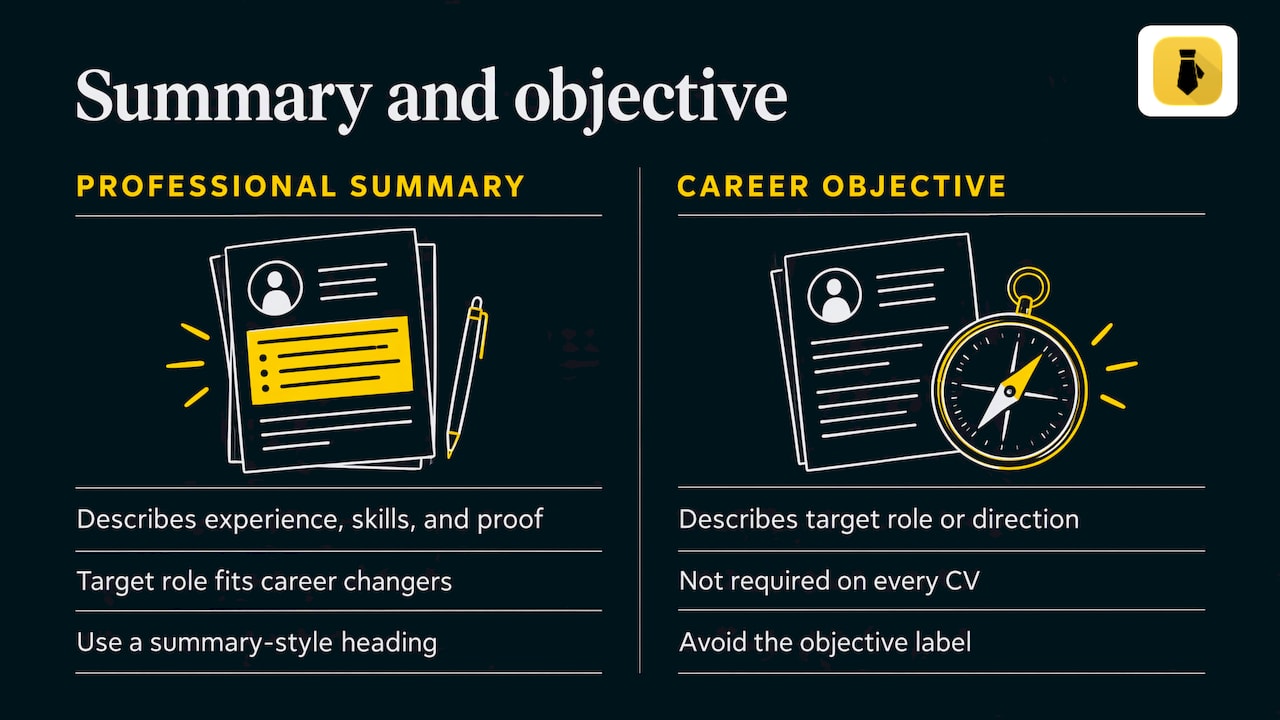
A summary is built on what you already have: experience, skills and proof. A career objective describes the role or direction you are working toward. SEEK explains the difference and notes that an objective is not required on every CV. Duke’s Career Hub advises against the label “objective” and suggests headings such as Professional Summary, Summary of Qualifications or Key Skills. If you are changing fields, you can still state your target role inside the summary, as shown further down.
What to put in it
Think of the summary as four building blocks. TopCV lists your job title (if it aligns with the role), sector, specialization, recent achievements, relevant skills and the value you can offer. Indeed suggests starting with your title and years of experience, adding two or three core strengths that match the job description, quantifying achievements, and closing with the value you bring.
Turned into a working formula:
- Identity: your title and years of experience, or your degree and field if you are early in your career.
- Focus: your specialty or industry, in the words the job ad uses.
- Proof: one or two achievements with a number.
- Fit: two or three skills, plus what you will deliver for this employer.
Career coach Heather Krasna’s template, shared by Idealist, follows the same logic: an adjective and a noun, years of experience in specific skills, a proven ability to do something measurable, and the role you are seeking.
Facts beat adjectives
Bentley’s guide explains that most summaries fail because they contain adjectives and opinions such as “results-oriented” or “hard working” instead of facts and results. It also warns that opening with only a tenure statement like “13 years accounting experience” says how long you were in the role, not what you achieved.
Compare:
- Weak: Hardworking professional with excellent communication skills seeking a challenging role.
- Stronger: Customer success manager with 6 years in B2B software. Reduced churn from 14% to 9% across a 120-account portfolio and trained a team of five new hires. Skilled in onboarding, renewals and Salesforce reporting.
The second version is an illustrative example, so swap in your own figures. The point is that every phrase can be checked and none could be pasted onto someone else’s CV.
Use numbers, but not too many
Indeed recommends quantifying impact with numbers, percentages and metrics instead of vague phrasing like “responsible for increasing sales.” One strong result usually beats a pile of statistics: the reader remembers it, and you can explain it in an interview. Choose the number you would be happy to be asked about.
How long it should be and where it goes
Guidance varies slightly, but it clusters tightly:
| Source | Suggested length |
|---|---|
| Duke Career Hub | 2 to 3 sentences |
| UCLA Graduate Career Services | 2 to 4 lines |
| Indeed | 3 to 4 sentences or lines |
| Columbia Career Education | 2 to 5 phrases, bulleted or a brief paragraph |
| TopCV | No more than about 100 words |
A safe target is three or four lines and under 80 words. Place it at the top of the CV, directly under your name and contact details, so the key information sits in the top third of the first page. TopCV also suggests a clear header such as “Professional Summary” or “Professional Profile” so applicant tracking software can categorize the content.
On voice, UCLA’s guide says to avoid “I” and to use fragments rather than full sentences. Indeed recommends the same implied first person with strong action verbs. Write “Led a team of eight” rather than “I led a team of eight.”
How to write and tailor it, step by step
A generic summary reused for every application is one of the most common mistakes. Here is a routine that takes about 20 minutes per application.
1. Finish the rest of the CV first
Indeed notes that the best summaries are written after the body of the resume is complete. You then pull your strongest material up from the bullets instead of inventing it from scratch.
2. Read the job ad and list the requirements
Columbia’s career office recommends researching positions of interest and listing common requirements, then selecting the skills, experiences and accomplishments that match. Underline the three things the ad repeats most. Those are the strengths your summary must show.
3. Name your professional focus
SEEK’s five-step approach starts with naming your professional focus, then choosing your strongest matches, showing evidence with a result or project, explaining the value you bring, and tailoring for each application. Use the ad’s own language only where it accurately describes you.
4. Pick evidence, not a skill list
Technical roles tempt people to dump tools into the summary. Choose the two or three that the job needs and that you can back with a project or result. If your field is design or BIM, looking at Revit portfolio examples shows what kinds of projects make good proof. Our guide to listing skills on a resume with clear evidence walks through matching skills to the actual role.
5. Write, cut, then read it aloud
Draft four sentences, then cut every phrase that could appear on any other CV. Read it aloud. If you stumble, the reader will too.
6. Put the strongest point first
Someone skimming for six seconds may read only the first line. Lead with your best credential or result, not with a generic opener. Recruiters, as an ex-Disney recruiter told CNBC, behave like trained keyword spotters who look for the words signaling the expertise the team needs. Her format is one sentence on who you are and why you fit, followed by six short bullets on skills, knowledge and experience.
A note on keywords
Indeed advises tailoring keywords to the job posting to help with applicant tracking systems. Use them naturally, inside real sentences about real work. A list of buzzwords reads badly to the person who eventually opens the file.
Summaries for students and career changers
With limited direct experience, the summary has a different job: show the bridge between what you have done and what you want to do.
Students and recent graduates
Brooklyn College’s guidebook notes that a summary may not be necessary for a recent graduate whose background already matches the target industry. It is particularly helpful for eclectic backgrounds, several years of experience or career changes. If you do write one as a student, name the target role, then your relevant degree, projects, internships or volunteer work, and one or two skills you can demonstrate.
Illustrative example: Computer science graduate targeting junior data analyst roles. Built a course project that cleaned and analyzed 50,000 rows of public transit data in Python and SQL. Completed a 10-week internship producing weekly dashboards for a campus department.
Career changers
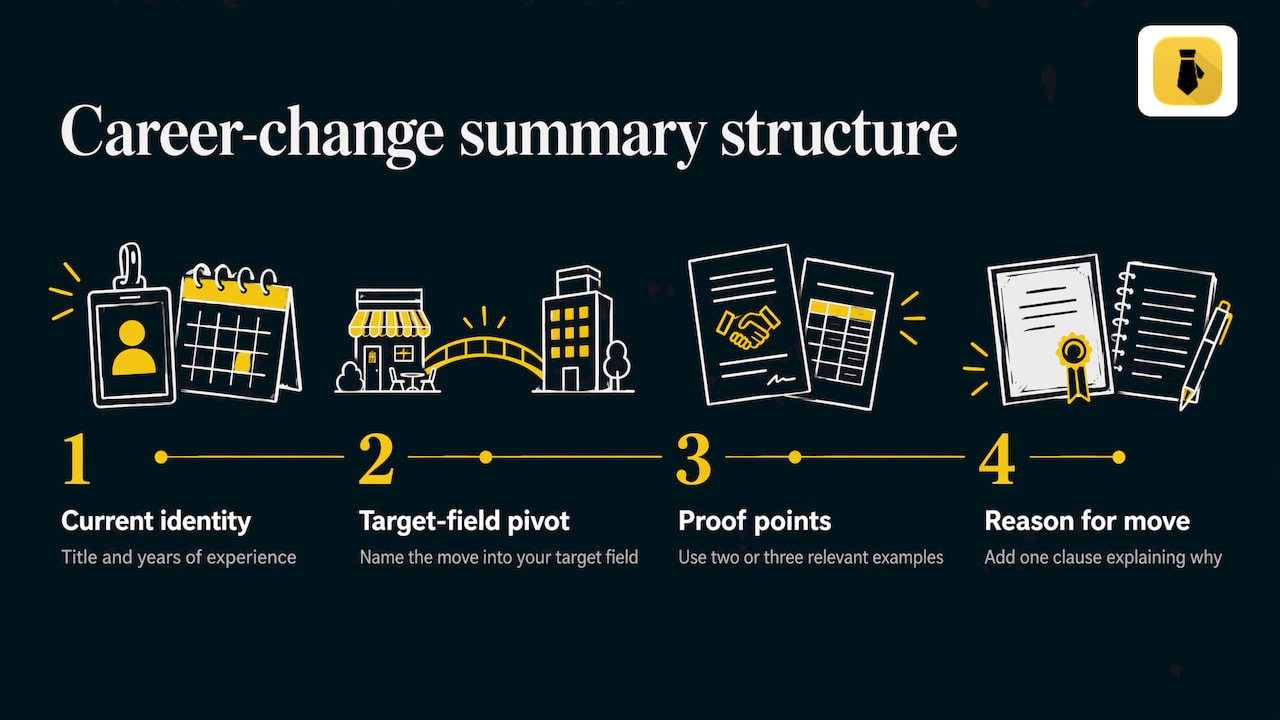
Name the move directly. A workable pattern is your current identity and years, pivoting into the target field, followed by two or three proof points in that field’s vocabulary and one clause on why. TopCV’s career-changer guidance stresses focusing on transferable skills and avoiding jargon from your old industry that could alienate the reader. The structure also fits Duke’s advice of stating who you are professionally and what makes you unique.
Illustrative example: Restaurant general manager with 9 years running high-volume locations, moving into operations management. Cut food costs 12% by renegotiating supplier contracts and led teams of 40 or more. Completed a project management certificate.
For more depth, see our guides on resume summaries for career changers and writing a resume for a career change. Mid-career readers can compare ideas in our mid-career summary examples, and our summary examples built from real evidence show how to turn raw experience into lines like the ones above.
Mistakes that weaken a summary
- Adjectives instead of facts. “Dynamic, results-oriented team player” tells the reader nothing they can verify.
- Too long. Past about 80 to 100 words it stops being a summary and starts being a second CV.
- First person throughout. “I am a motivated…” wastes words and reads as less confident.
- Numbers without context. “Increased sales 300%” invites the question: from what, over how long?
- One version for every job. Swap in the title, keywords and strongest proof each time.
- Burying the best point. If your key result sits in sentence four, move it to sentence one.
- Hiding behind “objective.” Say what you offer, not what you hope to receive.
Your summary is also your interview opening
Most interviews open with “Tell me about yourself” or “Walk me through your background.” A good summary already contains the answer: who you are, your strongest proof and why you fit. Stretch each line into one or two spoken sentences and you have a 60-second introduction that matches your CV, so the interviewer hears the story they just read.
That consistency is where many candidates slip. Under pressure on a live video call, it is easy to forget the number you wrote down, or to hunt for the right English phrase for a skill you know well. That gap between a polished document and a fluent spoken answer is what we designed our app to close.
Our view
A CV summary is the first draft of your interview answer. We hear the same problem from job seekers again and again: the experience is real, but under pressure the words do not come out as clearly as they read on paper. That is especially true for non-native speakers, career changers explaining a pivot, and students who have never had to pitch themselves aloud.
Interview Pilot is an AI interview assistant that provides real-time support during live online interviews. It uses speech recognition to respond to questions instantly in a tailored way, and it understands more than 99 languages and accents, so that everyone can sound professional. More than 450,000 job seekers use it.
Our advice is to write the summary with evidence, say it aloud until it sounds like you, and walk into the call with the support to express it clearly.
Kingsley
Get ready for the live conversation
Once your summary gets you the interview, the next test is saying it well. Interview Pilot gives real-time response support during live online interviews, works with 99+ languages and accents, and runs on Mac, Windows, iOS and Android. You can start on the Free plan at $0 per month, or choose Unlimited at $49.99 per month. See the plans on our pricing page, or read how an AI interview assistant works.

FAQ
How long should a professional summary be?
Aim for two to four sentences or lines, ideally under 80 words. Sources differ a little, with some allowing up to about 100 words, but all agree it should be short enough to read in a few seconds. Senior candidates can use the upper end, while students and career changers usually need less.
Should I write the summary in first person?
Use the implied first person: drop “I” and start with your title or a strong verb, as UCLA’s career services and Indeed both advise. “Operations manager with 7 years of experience” is clearer and shorter than “I am an operations manager with 7 years of experience.”
Do I need a summary if I am a student or recent graduate?
Not always. Brooklyn College notes it may be unnecessary when your background directly matches the target industry. It becomes valuable when your degree, projects or part-time work need framing for a particular role. If you include one, name the role, your relevant skills and one project or result.
Is a professional summary the same as a career objective?
No. A summary shows the experience, skills and evidence you already have, while an objective describes the role or direction you want. If you are changing careers, you can name your target role inside the summary and support it with transferable proof.
Should I change the summary for every application?
Yes. Reuse the structure, but swap in the title, keywords and the achievement that best matches each job ad. It takes a few minutes and keeps the summary relevant to the reader.
Sources
- TopCV: How to write a professional summary for your CV
- ICAEW Jobs: How to write a professional profile
- Bentley University: Resume and Cover Letter Guide
- UCLA Graduate Career Services: Master’s Resume Book
- SEEK: How to write a resume summary
- Duke Career Hub: Summary Statements
- Indeed: Writing a winning resume summary
- Idealist: A formula for the perfect resume summary
- Columbia Career Education: Resume profile or summary statement
- CNBC: Ex-Disney recruiter on writing a resume summary
- Brooklyn College Resume Guidebook
- Revit portfolio examples
Recommended



Topics
professional summary in cv
Continue reading
Interviews
10 Nursing Manager Interview Questions to Expect
Prepare for nursing manager interview questions with 10 real prompts, leadership answer examples, and tips for staffing, budgets, and conflict.
November 25, 2026
19 min read
Interviews
8 Job Interview Questions Bank Teller Candidates Face
Ace the job interview questions bank teller candidates face: 8 topic-grouped questions with sample answers and practical tips for each.
November 25, 2026
20 min read

Interviews
8 IBEW Apprenticeship Interview Questions and Answers
Ace your IBEW apprenticeship interview questions with 8 real questions, strong sample answers, and safety, math, and teamwork prep tips.
November 25, 2026
16 min read