










Interviews
Product Sense Interview Framework Explained
Pick a product sense interview framework, run goal-to-guardrail steps, score the answer, and see a worked design example.
Interview Pilot Editorial Team
Updated November 10, 2026
18 min read
Product-manager roles grew 32% between 2019 and 2024, according to a 2024 LinkedIn Talent Insights figure cited by When Notes Fly. A bigger hiring market means more interview loops to clear, and more chances to be filtered out by the one round that doesn't reward anything you can memorize.
The product sense interview gives you an ambiguous product and observes how you think. Who would you serve? What is broken for them? What would you ship first, what would you refuse to ship, and how would anyone know it worked? There's no correct feature list. There is a correct shape of reasoning, and a trained interviewer detects that shape within about two minutes.
What follows is the working version of that shape: how to choose a framework before you begin, the one sequence worth saying aloud, the six things you're being scored on, a full worked answer, the two twists that change everything (who's asking, and who gets hurt), and a week of practice that turns it into a habit.
Why a Framework Beats Company Trivia
A company teardown feels like studying the textbook. You memorize the last two launches, the pricing page, and a founder quote. Then the interviewer names a user segment that does not exist yet, and the notes go quiet.
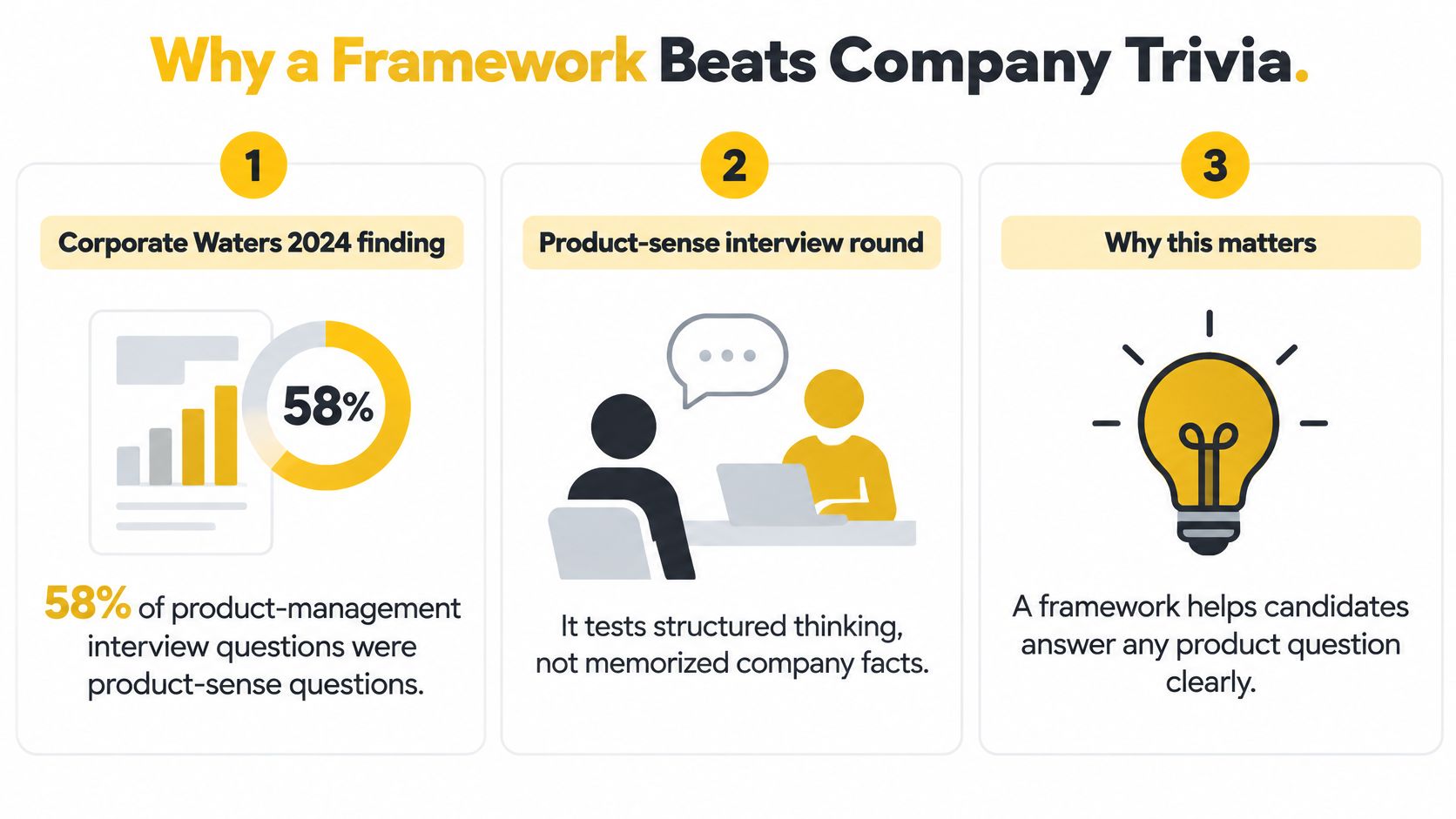
In 2024, product-sense questions accounted for 58% of the product-management interview questions analyzed by Corporate Waters, the most frequent type in that set. That share is why candidates panic, and why a stack of launch notes still fails the round.
The round tests judgment under incomplete information. Four decisions sit inside the prompt: who the user is, which problem is worth solving, which option you would choose, and how anyone would know it worked.
Product sense entered PM recruiting once companies started testing broader product judgment, not only whether a candidate could describe how a feature works. The questions still ask whether you can reason about users, market context, business constraints, and the wider ecosystem.
A framework is a decision tool. You choose the method before any step begins, the way a cook picks the pan before the oil is hot. The same prompt shifts if the asker is a CEO rather than an engineer, and it shifts again if the fix you like would harm a headline metric such as retention or trust. Skip that choice and every later sentence is a feature list with no owner.
A strong answer contains at least these pieces:
- One named target user, not "everyone who uses the app".
- A problem worth solving, tied to a journey and a cost.
- More than one solution mechanism, generated before you pick.
- A prioritized choice, with the trade-off said out loud.
- A success measure, plus what would make you reverse the call.
A weak answer sounds like a tour: "I'd add notifications, then a dashboard." Knowing the product well still does not show how you would cut scope under a deadline. A repeatable framework does, in any company's room, because it forces the cut, the person left out, and the metric you refuse to damage.
Job postings describe the role, not the loop. Guessing one company's preferred answer buys very little. The choice of tool is where a strong answer starts.
Which Product Sense Framework Fits the Prompt
Most candidates treat framework choice as a personality trait. They picked CIRCLES in month one and carry it everywhere, like a student who learned one integration rule. Strong candidates treat it as a decision. The prompt type, the clock, and the person asking all narrow the choice before a single step gets spoken.
| Framework | Best prompt | Core sequence | Time fit | Main risk |
|---|---|---|---|---|
| CIRCLES | Open design or improve-a-product prompt | Comprehend, identify customer, report needs, cut and prioritize, list solutions, evaluate trade-offs, summarize | A full case slot, around 35 to 45 minutes | Completeness without a decision |
| AARM | Short product-sense or improvement follow-up | Ask, analyze one segment and its pain, recommend one option, measure | About 20 to 30 minutes | Too thin on who is excluded |
| Goal to guardrail | Goal already named as growth, engagement, revenue, or trust | Goal, one segment, ranked pains, solutions, impact/effort/risk, primary metric plus guardrail | Any length, as long as the goal is explicit | Trying to serve every user |
| Decision-maker shift | Asker is a CEO, an engineer, or an analytics partner | State the decision and the cost of being wrong, then scope the evidence to that asker | Ambiguous stakeholder prompts | One rehearsed template for every asker |
Where each one breaks
CIRCLES is the wide canvas. Comprehend the situation, identify the customer, report needs, cut through prioritization, list solutions, evaluate trade-offs, then summarize a recommendation. It earns its keep on an open design prompt where you need a place for every part of the arc. The failure mode is narration: seven letters recited like a shopping list, none of them producing a decision. If you're still listing solutions eight minutes in and you haven't said "I'd build this one first because...", the framework has cost you the answer.
AARM is the short slot. Ask clarifying questions, analyze one segment and its pain, recommend one option, measure. It gets you to a recommendation with room left for metrics. Candidates who misuse it recommend confidently and never say who they've left out, which makes the segment choice look arbitrary rather than argued.
The goal-to-guardrail sequence fits when the prompt already names the objective. You're not discovering what the company cares about, you're proving you can move a number without wrecking a neighbor. It's the most testable of the three because every sentence can be checked against a measurable outcome. Its misuse is the opposite of AARM's: drafting an answer for "all users" and diluting every trade-off.
The decision-maker shift isn't an acronym at all. When the asker is named, your first move changes. A CEO wants the strategic bet and the downside. An engineer wants dependencies and what gets cut. An analytics partner wants a falsifiable hypothesis and a reason to trust the instrumentation.
The rule that settles it: CIRCLES for a full design case, AARM when the clock is short, the metric sequence when the goal is explicit, and the stakeholder shift whenever the asker is named.
If you want the prompts to practice against, Interview Pilot's product manager interview guide organizes product-sense questions by the constraint each one puts on your answer.
How to Walk an Answer from Goal to Guardrail
A product sense interview is typically evaluated as a structured reasoning exercise that runs from problem definition to solution choice to measurement. A documented framework recommends clarifying the product goal first, such as growth, engagement, revenue or trust, then selecting one user segment, identifying and ranking pain points, generating several solutions, comparing them on impact, effort and risk, and closing with one primary metric, supporting metrics and a guardrail, as DataInterview's product manager interview prep guide sets out. The same guide's analysis of 1,765 job descriptions found only about 80, roughly 4.5%, that explicitly described a structured interview process across 51 companies, and the median reported process contained four steps. Employers tell you very little about the loop, which is exactly why a spine you can repeat beats a guess you can't defend.
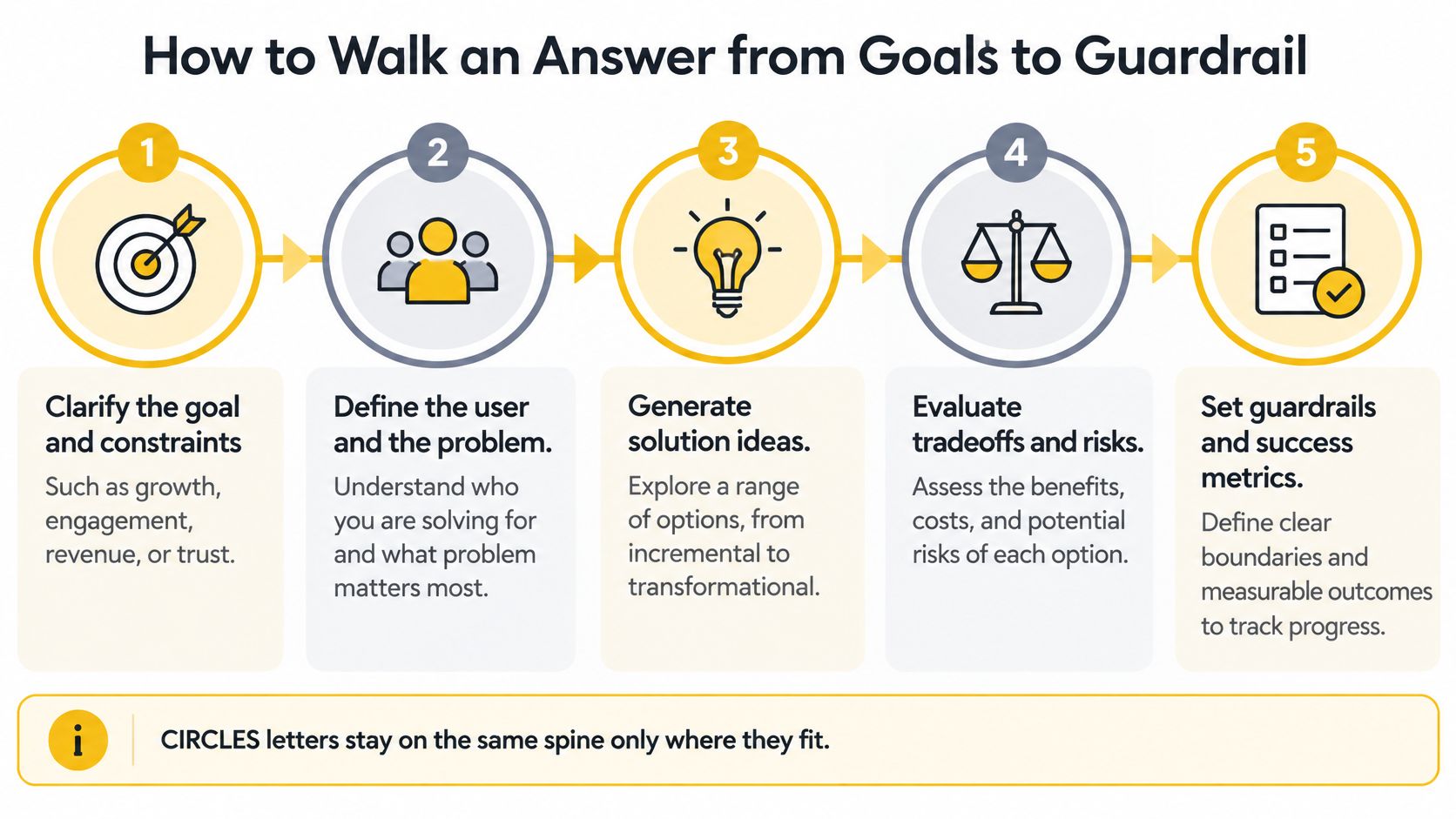
Here is the sequence to rehearse, one step at a time.
Clarify the goal and the constraints. Name the objective (growth, engagement, revenue, trust) and the box you're working inside: one quarter, no new headcount, no pricing change. State your assumptions and start moving. Why: every later choice is judged against this line. The slip: six clarifying questions and no beginning, or no goal at all, so you optimize for engagement in a revenue question.
Name two or three segments by need or behavior. Not "millennials" or "high-income users". Behavior: daily commuters, one-time gift buyers, people who abandoned setup twice. Then pick one and tie it to the goal. Why: the choice only becomes visible when there's something to reject. Designing for everyone at once is the most common way an answer loses its shape.
Map the journey and rank the pain. Walk the chosen segment through the steps, then separate symptoms from root causes. "They churn at checkout" is a symptom. "They can't tell whether the delivery fee applies before entering an address" is a cause. Pick the costliest cause and say why it beats the runner-up.
Generate several mechanisms. Not three shades of the same button. Give yourself different levers: an information fix, an incentive change, a workflow change, a policy change. Breadth is cheap here, and saying "there was also a much simpler option, but it doesn't move trust" is evidence of judgment.
Choose one and price the alternatives. Compare expected reach, impact, confidence, effort, strategic fit and risk, then name the opportunity cost of what you rejected. A prioritization score is a conversation aid, not a verdict. Presenting a RICE number as though it settled the question sounds like process worship rather than product sense.
Close with a measurement contract. Hypothesis, target population, intervention, comparison method (randomized test, holdout, staged rollout), observation window, one primary metric, one diagnostic metric, a guardrail, and a ship, iterate or stop rule. Then name what new information would change your mind.
Say the choice early
Most candidates save the recommendation for the final minute, then run out of time. State the decision in the first third of the answer and spend the rest of it supplying evidence. The interviewer isn't grading suspense.
The 45-second skeleton to rehearse aloud: goal, segment, pain, choice, metric, guardrail. If you can say those six things in that order without notes, the full eight-minute answer is mostly elaboration.
What Interviewers Score in a Product Sense Answer
A strong response works as a decision system rather than a list of ideas: clarify the objective and constraints, segment users by need or behavior, select one segment explicitly, map its journey to the costliest pain, generate multiple mechanisms, choose one while stating trade-offs, and finish with a testable success criterion. That sequence tracks the major phases identified in product-discovery research, alignment, research, ideation, creation or prototyping, validation and refinement, as described in a product-discovery framework in the Journal of Innovation and Entrepreneurship. Practically, it converts into six criteria any interviewer can mark.
| Criterion | Strong signal | Weak signal |
|---|---|---|
| Goal clarity | Names growth, engagement, revenue, or trust plus a constraint before features | Jumps straight to a feature list |
| Segment specificity | Names multiple segments and picks one for the goal | Designs for all users |
| Pain severity | Journey pain is costly and separated from a symptom | A wishlist of feature requests |
| Solution breadth | Several mechanisms, then one choice | A single idea with no alternatives |
| Trade-off quality | Compares impact, effort, and risk, including who may be harmed | A score presented as unquestionable |
| Validation logic | Primary metric, diagnostic, guardrail, and ship, iterate, or stop rule | A vanity metric with no falsification |
Now the same six as sentences you can hear in a recording of yourself.
Goal clarity sounds like "the goal here is trust, because a family that has one bad school run doesn't come back" and fails as "so first I'd add a filter for car seats, and then maybe a loyalty badge". Segment specificity sounds like "three groups could matter, and I'd start with daily school-run parents because frequency makes a trust failure expensive"; it fails as "this would be useful for families". Pain severity sounds like "the main blocker isn't price, it's not knowing whether the arriving car can take a six-year-old". A feature wishlist in place of a cause is the giveaway.
The honest test of trade-off quality: can you name one person or one business outcome that gets worse because of your choice? If not, you haven't made a trade-off, you've made a preference.
Solution breadth sounds like "three mechanisms were available: guarantee the seat, save the child profile, or rate drivers on child safety". Validation logic sounds like "repeat family trips within 28 days is the primary, driver acceptance rate is the guardrail, and we pause if acceptance drops past the agreed threshold". More clicks with worse task completion, retention or trust is the pattern that exposes a vanity metric.
Because these criteria score reasoning mechanics rather than familiarity with a market or product category, they hold up across countries and industries. Score a practice answer 0 to 2 on each row, and redo every zero before you polish your wording.
A Worked Answer for Riders with Children
Take one prompt and run the full spine on it: "How would you improve a ride-hailing app for riders who travel with young children?" Here, the framework stops being theory.
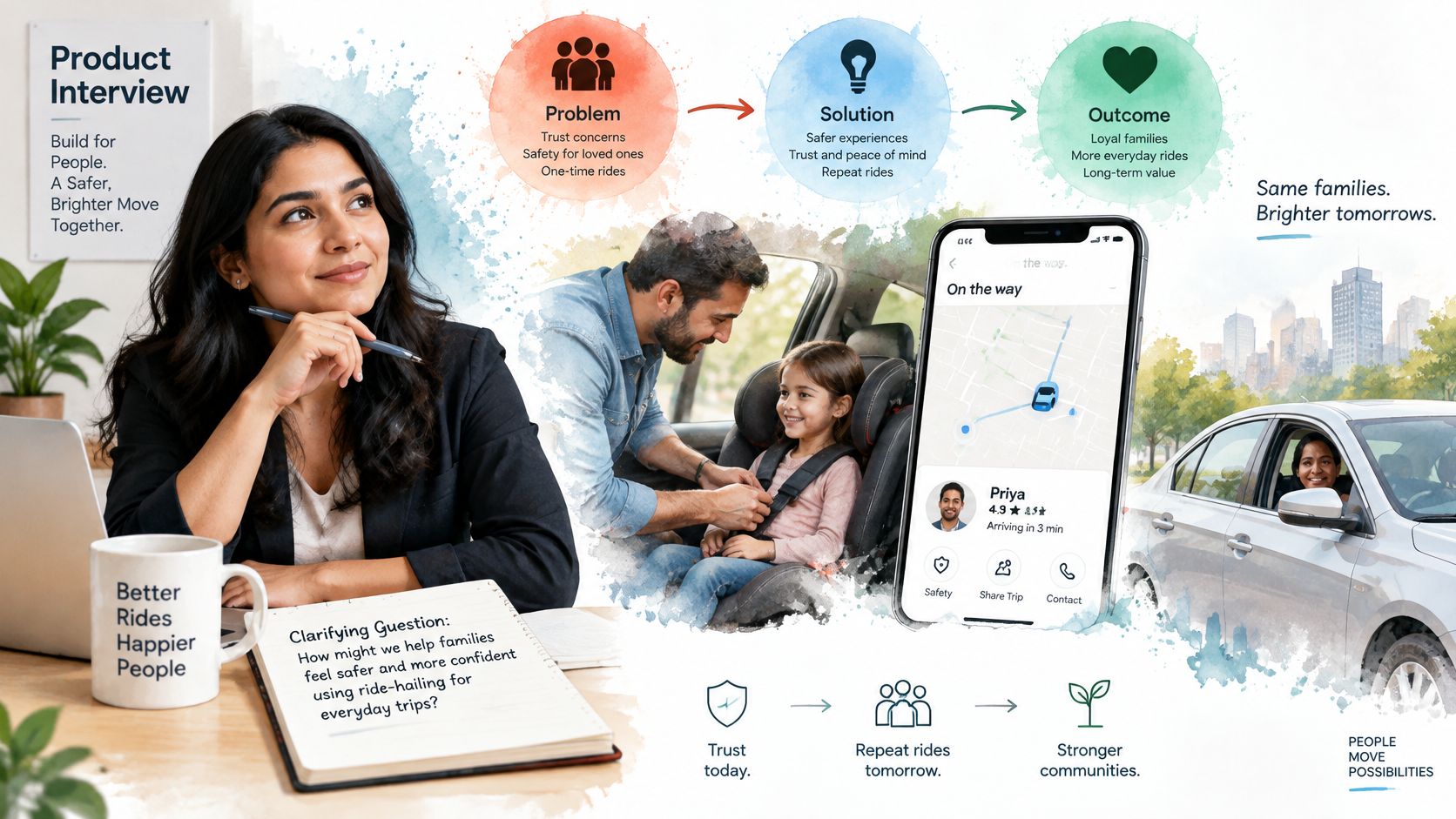
The clarifying question, then the goal. "Before I design, is the priority trip volume or repeat usage?" Assume the answer is repeat usage, so the goal is trust and repeat rides, not raw trips. That single sentence rules out a discount-led answer.
The segments. Three plausible groups: occasional family travelers on holiday, daily school-run parents, and caregivers without a car. Pick daily school-run parents, because frequency makes a trust failure expensive and the behavior repeats within a week.
The pain. Walk the journey: open the app, enter the destination, wait, watch the car approach, install a seat, ride, pay. The costliest pain sits at the waiting stage, where the parent doesn't know whether the arriving car can legally and physically take a child. The root cause is uncertainty before pickup, not price and not a lack of promotions.
Three mechanisms. A guaranteed car-seat toggle that lengthens the ETA, a saved child profile the driver sees before accepting the trip, and a post-trip rating that covers child safety only. Then choose: the saved profile plus an accept signal, because it's reversible, it doesn't require a fleet of seats, and it puts the information in front of the person who can act on it.
The measurement contract. State the hypothesis first: if drivers see the child profile before accepting, repeat family trips rise because the pickup stops being a gamble. Then follow the structure a good experiment plan uses, hypothesis, target population, intervention, randomization or comparison method, observation duration, primary metric, guardrails, and a ship, iterate or stop rule, as Coursera's product management interview prep guide lays out. The primary metric is repeat family trips within 28 days. A leading indicator is successful activation of the child profile; a lagging check is week-four retention rather than a click. Guardrails are driver acceptance rate and pickup ETA, so the fix doesn't dump extra waiting time on every other rider. Stop rule: if acceptance falls past the agreed threshold, pause and redesign.
Name the risks out loud, briefly: selection bias among early adopters, a novelty effect in the first two weeks, spillover into other trip types, and a sample too small to call. That list is the difference between confidence and false precision.
Here's the reasoning in motion, including the follow-up pressure an interviewer will apply.
The same prompt under a different framework would look different, and only slightly. CIRCLES would have spent longer in the customer-needs report before recommending anything, and AARM would have cut to fewer mechanisms and moved straight to the metric. If you want a wider set of prompts to run this spine against, product manager interview questions groups them by the type of decision each one forces.
When the Asker or the Harm Changes the Answer
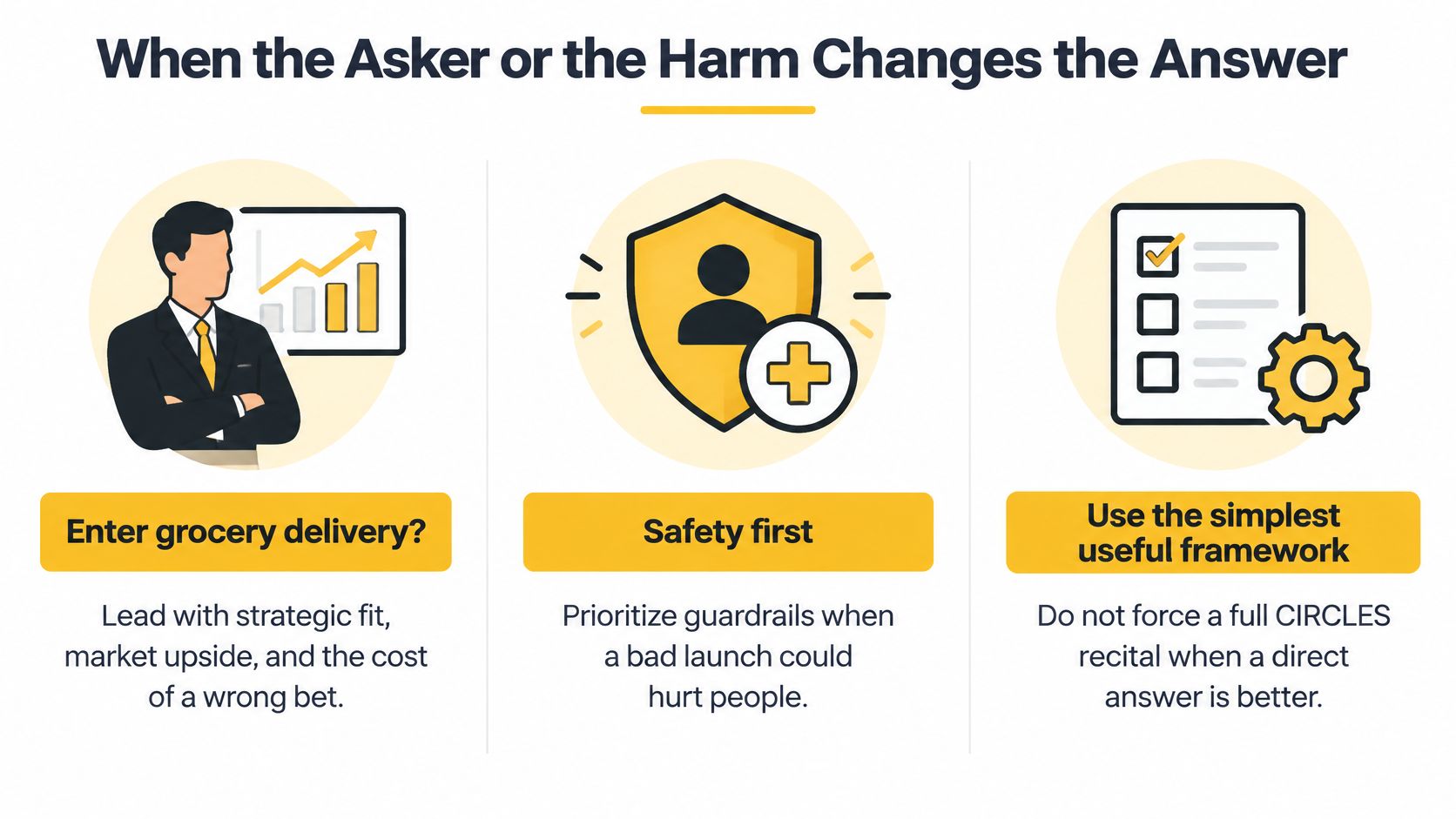
The memorized template fails in two specific places, and both are common in real interviews. The first is who is asking. One practitioner argument holds that the same analysis should change depending on who wants it, why they need it, and what action follows, because those factors set the relevant scope, evidence and detail, as Yuzheng's note on acing the product sense interview argues. Rigid recitation pushes candidates toward completeness instead of decision quality.
Three askers, three first moves
A CEO asking whether to enter grocery delivery doesn't want a feature tour. Lead with strategic fit, market upside and the cost of a wrong bet, then keep the solution detail short. An engineer asking whether saved places can ship this quarter wants feasibility, dependencies and technical risk, plus a plain statement of what gets cut to hit the date. An analytics partner asking whether the new onboarding worked wants a falsifiable hypothesis, a comparison method, an observation window, a primary metric and guardrails on latency, trust and revenue. Three answers, one spine, three different first sentences.
The four lines before you scale
The second failure is harm. The best product decision sometimes lowers a headline metric, burdens another segment, or creates long-term risk. Interview guides tend to mention ethics, accessibility, privacy and platform effects near the end, which implies they're optional add-ons rather than part of product sense, a gap visible in Prachub's product manager interview question collection. Say four things before you scale anything:
- The intended beneficiary, named specifically enough that the interviewer could go find them.
- Who you're excluding or putting at risk, going beyond demographics to language, disability, connectivity, regulation and unequal ability to benefit.
- One measurable guardrail, not a promise to be careful.
- A follow-up test, before the change becomes permanent.
Then separate a reversible MVP from a decision that locks in reputational damage or an unsafe incentive. A smaller underserved segment is often the correct pick when severity and learning value beat raw size, because caring about customers is not the same as maximizing the biggest group.
The self-check to run mid-answer: what decision am I supporting, and what does it cost if I'm wrong? If those two aren't clear, no framework will rescue the response.
Practice the Framework in One Week
No new framework here, just a build order you can finish before your next loop.
- Day one, choose six prompts. Two open design prompts, two metric prompts, and two where the asker is a CEO, an engineer or an analytics partner. Write them on separate lines.
- Days two to four, answer aloud. Use the 45-second skeleton first, then expand to about eight minutes. Record one answer per day, even the bad ones, especially the bad ones.
- Day five, score the recordings. Take the six rubric rows and mark each 0 to 2. Redo every zero before you touch a single word of phrasing.
- Day six, run a hostile mock. Have someone interrupt with "who is this for?" and "what would you not ship?" Answer without notes, because that's what the actual round feels like.
- Day seven, re-answer the weakest prompt. Keep only the version that states a decision, names a user left out, and sets a guardrail.
Interview Pilot's Product Manager Interview Guide contains 20 questions, and the wider question list covers product judgment, execution, metrics, analytics, experimentation, strategy, technical collaboration and leadership, so you can run the week against prompts that exercise different muscles. The AI mock interview then evaluates your answers, which is the fastest way to find the rubric row that keeps slipping. If you want a coach's eye on the trade-offs rather than a transcript, product manager interview coaching shows what targeted feedback looks like on a spoken answer. And if your search spans borders, product management roles for international job seekers is a useful place to see how the same interview is described across markets.
If you want to rehearse this instead of reading about it, Interview Pilot runs AI mock interviews that evaluate your product-sense answers and tell you which part of the spine gave way, whether that's the goal, the segment, the trade-off or the guardrail. Load one of the product manager prompts, answer it aloud, and read the evaluation before your next real loop.
Topics
product sense
interview framework
CIRCLES method
PM interview
AARM framework
Continue reading
Interviews
10 Questions to Ask on 2nd Interview: Smart Picks for 2026
Learn the best questions to ask on 2nd interview, from 90-day goals to team challenges, with tactics that show fit and strengthen your offer.
November 10, 2026
17 min read

Interviews
Phone Interview Answers: What to Say to the 8 Most Common Questions
Sample phone interview answers for the questions you will almost certainly hear, from “Tell me about yourself” to salary, plus tips for sounding clear and calm.
November 10, 2026

Interviews
Real-Time Interview Answers: How Live AI Help Works
What real-time interview answers are, how live AI support listens and responds, where it helps most, and how to use it within employer rules.
November 9, 2026