
















Technical Interviews
Network Engineer Interview Questions: Diagnose Before You Change
Practice network engineer interview scenarios that separate DNS, connectivity, transport, and application problems with controlled diagnostic reasoning.
Interview Pilot Editorial Team
4 min read
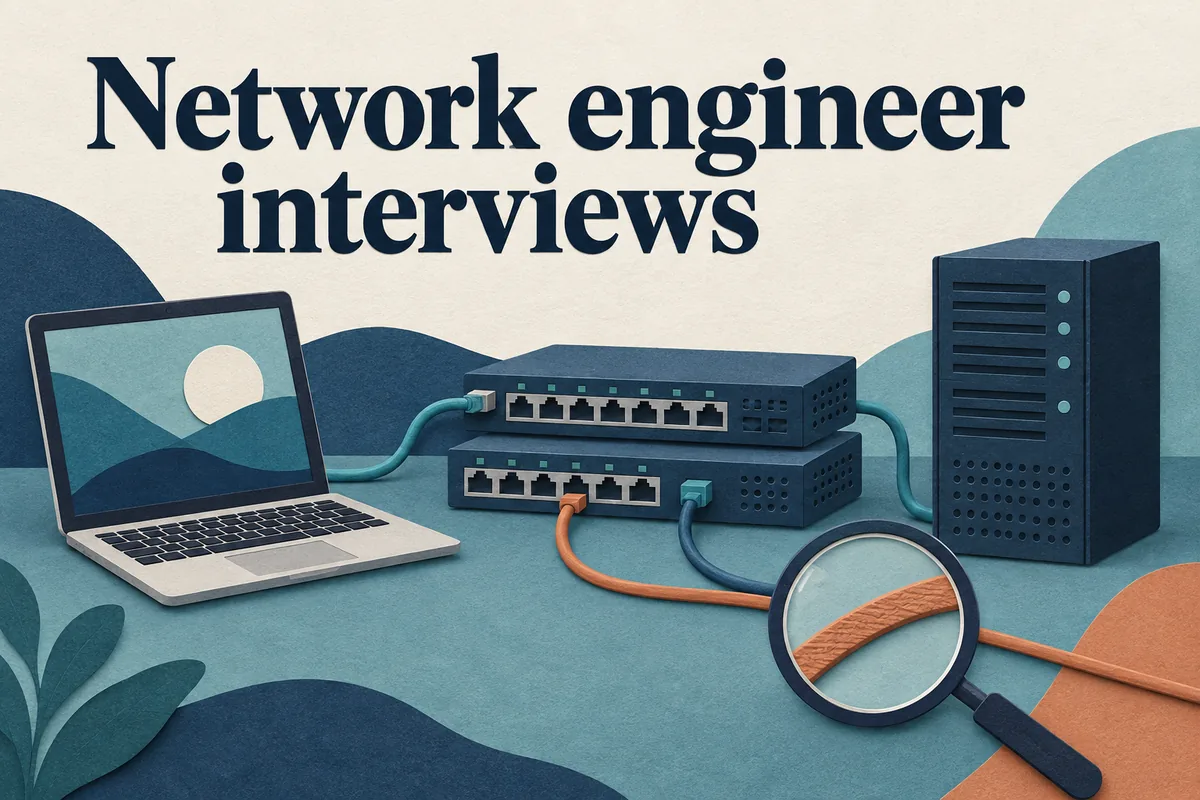
Network interview answers are stronger when they show how you narrow a fault, not how many commands you remember. Start by defining who is affected, what fails, and when it began. A change that restores one test without explaining the failure may create a second problem elsewhere.
These original scenarios focus on reasoning. Any live tests or configuration changes require authorization and the organization's change procedures.
1. One employee cannot open an internal website. Where do you start?
Clarify whether the failure affects one browser, one device, one network, or all users. Ask for the actual error and compare against a known-working client with appropriate access. Check whether the user is on the expected connection and whether a proxy or VPN is part of the intended path.
Avoid changing DNS, firewall rules, or routing immediately. First gather enough evidence to choose a boundary to test.
2. How do you separate name resolution from reachability?
Cloudflare's DNS explanation describes how domain names are resolved to IP addresses. In diagnosis, inspect the returned records and resolver context before assuming that a familiar name points to the intended destination.
Successful name resolution is only one observation. It does not prove that the client can establish a connection or that the application is healthy. Different clients may intentionally receive different answers because of internal DNS, location, caching, or service configuration.
Likewise, typing an IP address into a browser is not a complete HTTPS test. The hostname can matter to TLS and application routing; Cloudflare explains its role in Server Name Indication. Explain what your chosen test isolates and what it changes.
3. Ping succeeds. Why might the website still fail?
An ICMP response does not establish that the required transport connection, TLS exchange, or HTTP request succeeds. Some systems also deliberately do not answer ping even when their application works.
A disciplined answer works through the relevant layers: destination and route, permitted transport connection, certificate and hostname behavior, then the application response. Do not infer that an entire layer is healthy from one weak signal.
4. The problem began after a network change. Would you roll it back?
Review the actual change, affected scope, timing, and available rollback plan. Correlation makes the change a useful hypothesis, not a proven cause. A reversible rollback may be an appropriate mitigation under the team's procedure, especially during user impact, but it still needs an owner and validation.
State how you would check both restored access and unintended effects. A successful test from your laptop is insufficient if only a remote office was affected.
5. How would you explain a subnetting answer?
For a conventional IPv4 /27 subnet, five bits remain for addresses, giving 32 total addresses. In the usual network-and-broadcast arrangement, that leaves 30 host addresses, as illustrated in Cisco's subnetting guide. Show the arithmetic and address boundaries rather than reciting "30."
Ask about the environment before applying that number to capacity planning. A cloud platform may reserve additional addresses; check the platform's rules, such as AWS VPC subnet sizing. Other subnet types also have different rules. The interview is testing whether you understand the model's assumptions.
6. What evidence belongs in an escalation?
Include affected users or locations, timestamps with timezone, expected versus observed behavior, relevant recent changes, and the exact tests already performed. Share sanitized outputs through approved channels. Avoid collecting packet data or identifiers beyond what the investigation permits.
Make the remaining question explicit: for example, whether the destination accepted the connection during the failing attempt. "Network is broken" gives the next team very little to investigate.
Prepare one real troubleshooting story in which your first hypothesis was wrong. Use technical interview preparation to structure practice and technical questions and answers for broader preparation beyond networking.


Topics
Technical Interviews
network engineer interview questions
Continue reading

Technical Interviews
Site Reliability Engineer Interview Questions: Reason About Reliability
Practice SRE interview questions about user-facing indicators, error budgets, actionable alerts, incidents, and reducing recurring operational work.
November 4, 2026
3 min read

Technical Interviews
Mobile Developer Interview Questions: State, Failure, and Performance
Practice mobile developer interview scenarios about offline edits, interrupted requests, UI state, performance investigation, and safe release decisions.
November 3, 2026
4 min read
Technical Interviews
Full-Stack Developer Interview Questions: Follow One Feature End to End
Practice full-stack interview questions through a booking feature, covering UI state, authorization, duplicate requests, data integrity, and debugging.
November 2, 2026
3 min read