









Technical Interviews
Full-Stack Developer Interview Questions: Follow One Feature End to End
Practice full-stack interview questions through a booking feature, covering UI state, authorization, duplicate requests, data integrity, and debugging.
Interview Pilot Editorial Team
3 min read
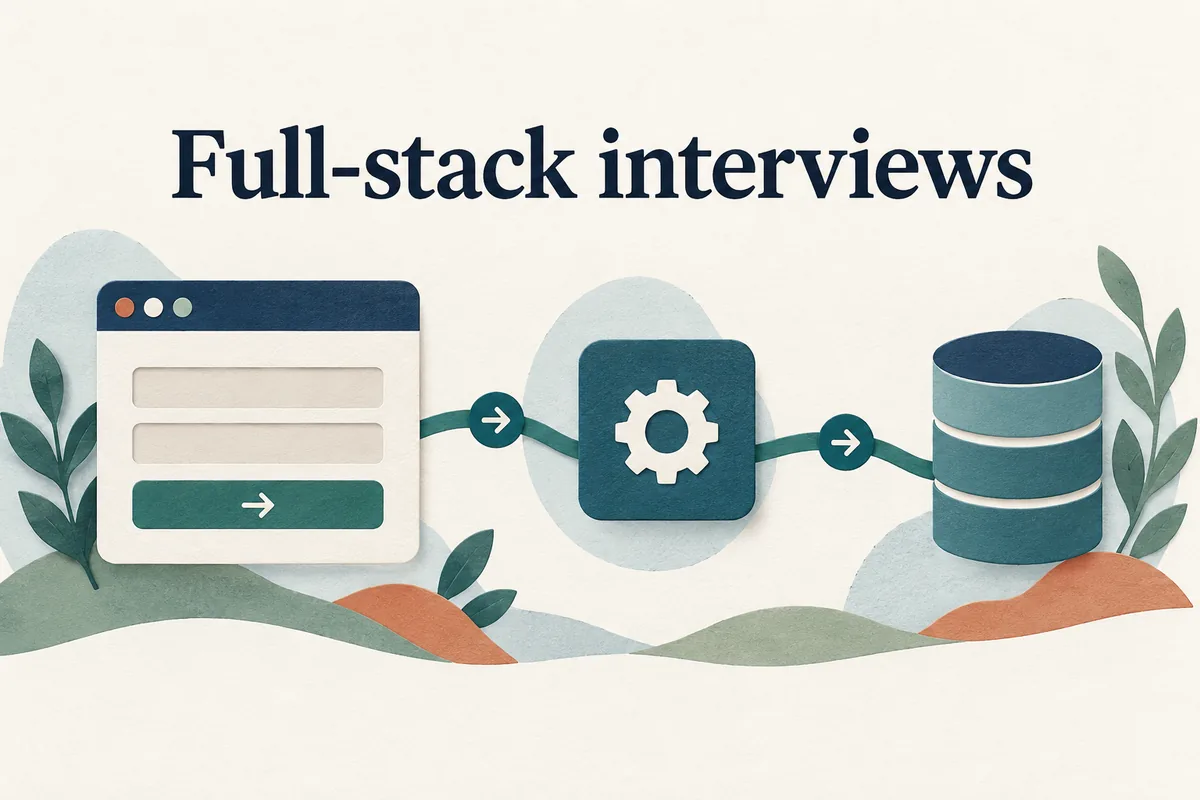
Full-stack developer interview questions become easier to reason through when you can follow one user action across the entire application. Knowing a frontend framework and a database is not the same as explaining what happens between them.
Use this original practice scenario: a signed-in customer reserves the last available appointment. The browser sends a request, the server checks it, and the database records the booking. Describe the contract at each boundary before choosing a stack.
What should the browser do while the booking is pending?
Explain the visible states: ready, submitting, confirmed, and unsuccessful or uncertain. Preserve useful input when an error occurs. Disabling a button can reduce accidental clicks, but it does not establish that only one request can reach the server.
A useful follow-up is: What if the user refreshes after submitting? Ask how the user can discover whether the reservation exists. A lost response and a rejected booking require different messages. Do not confidently display "failed" when the server may already have committed the operation.
Where do you enforce permissions?
The server must decide whether this caller may perform this action on this resource. A hidden button is an interface choice, not an access-control boundary.
OWASP's authorization guidance recommends checking permissions on every request and distinguishes authorization from proving a user's identity. In this scenario, signing in does not automatically authorize someone to cancel another customer's booking.
Propose tests for an allowed user, a different user's reservation, an expired session, and a caller bypassing the normal UI. Keep tests within an authorized test environment.
Two customers request the last slot. What prevents a double booking?
State the invariant first: at most one active reservation may occupy that slot under the assumed product rules. Then discuss a storage-level mechanism appropriate to the database and booking model, including how conflicts are returned to the losing request.
An illustrative answer:
I would not rely on two separate availability reads to establish exclusivity. Both callers might see the same free slot. I would make the reservation operation enforce the invariant atomically, then translate a conflict into a clear unavailable response. I would test genuinely concurrent requests and inspect the stored result, not just whether both screens displayed different messages.
Do not propose a universal schema without clarifying cancellation, temporary holds, and rescheduling. Those rules change what uniqueness means.
The response is lost. Is retrying safe?
Separate duplicate transport attempts from a new booking intention. If the API supports a stable operation identifier, explain its lifetime, scope, and behavior when the same identifier arrives with different input. Simply adding a random identifier to every retry would not link those attempts.
For the exercise, ask the interviewer to choose the expected contract. Should a repeat of an already completed operation return the original booking? What should happen while the first attempt is still processing? Explain how you would test both conditions.
Where would you start debugging a slow confirmation?
Follow the same request through the client, API, database, and any external dependency. Compare timestamps and separate network wait from server work. Do not add caching before knowing which delay matters and whether stale availability is acceptable.
Conclude with the evidence you expect after a change: the same booking rules hold, duplicate attempts remain safe, and the measured delay improves under comparable conditions.
Practice the explanation with technical interview preparation. If a detail is outside your experience, use an honest technical-interview response rather than inventing guarantees about an unfamiliar database.
Topics
Technical Interviews
full-stack developer interview questions
Continue reading

Technical Interviews
Machine Learning Engineer Interview Questions: From Model to Reliable Service
Practice ML engineering scenarios about feature availability, training-serving mismatches, deployment evidence, latency, and delayed feedback.
November 2, 2026
4 min read

Technical Interviews
Data Scientist Interview Questions: Test the Conclusion, Not Just the Model
Practice data science questions on leakage, class imbalance, missing data, experiments, and explaining findings without overstating the evidence.
November 1, 2026
3 min read

Technical Interviews
Frontend Developer Interview Questions With Worked Reasoning
Practice frontend interview questions about accessible controls, stale requests, responsive layouts, performance diagnosis, and testing user-visible behavior.
November 1, 2026
4 min read