
















Interviews
How to Negotiate Salary in an Interview: Scripts and Timing
Learn when to bring up pay, how to answer salary expectations, and what to say to a low offer, with scripts and U.S. sources you can use in your next interview.
Interview Pilot Editorial Team
Updated November 26, 2026
13 min read

How to Negotiate Salary in an Interview: Scripts and Timing

You can negotiate salary in an interview, and the people who do it well follow the same order: learn the range, state a researched number only when you must, and make your real counter once the employer clearly wants you. The hard part is not the theory. It is finding the right words live, with a recruiter waiting, in a second language or on a career change. That is where Interview Pilot helps: it generates tailored answers in real time during live online interviews, in over 99 languages and accents.
This guide gives you the timing, the research, the exact phrasing for the three moments that matter (the range question, the expectations question, the offer), and how to adapt if you are early in your career or changing fields.
TL;DR
- It is fine to ask about the pay range in an early interview. The New York State Department of Labor suggests asking for the range for the position.
- Your real leverage peaks once the employer is convinced you are the right person, so save the hard counter for the offer stage.
- Know three private numbers before you talk: a minimum, a target and an ideal. Never reveal your minimum.
- If you must name a figure, give a range whose bottom is a number you would happily accept.
- If base pay cannot move, negotiate bonus, time off, schedule, development budget or start date.
Is it okay to negotiate salary in an interview?
Yes. The New York State Department of Labor says it is acceptable to begin the salary conversation during the first interview, though not when a hiring manager phones to schedule it. A ResumeBuilder career advisor told CNBC that it is fine to raise compensation in a screener, and that asking early can save both sides wasted time.
There is a distinction worth keeping straight, because it is where most people get confused:
- Asking about the range is a question. It is welcome early.
- Negotiating the number is a trade. It works best when the employer already wants you.
Harvard’s career services office recommends waiting until an offer or a likely offer where possible, because by then the employer is persuaded and you have more leverage. Robert Half suggests keeping the first interview on role fit and, if pay has not come up, raising it carefully by the second interview.
A simple timing map
| Stage | What to do |
|---|---|
| Application or recruiter screen | Ask for the budgeted range. Avoid naming your own number first if you can. |
| First or second interview | Show fit and results. If pay has not come up, ask about the range politely. |
| Final rounds | Answer expectations with a researched range if pressed. |
| Offer | Thank them, show enthusiasm, then make your counter. |
Do your homework before you say a number
A number you cannot defend is a guess, and a guess tends to land low. The New York State Department of Labor lists the steps: research the employer, research salary trends, know your worth, set a realistic range and know your minimum.
Build the benchmark
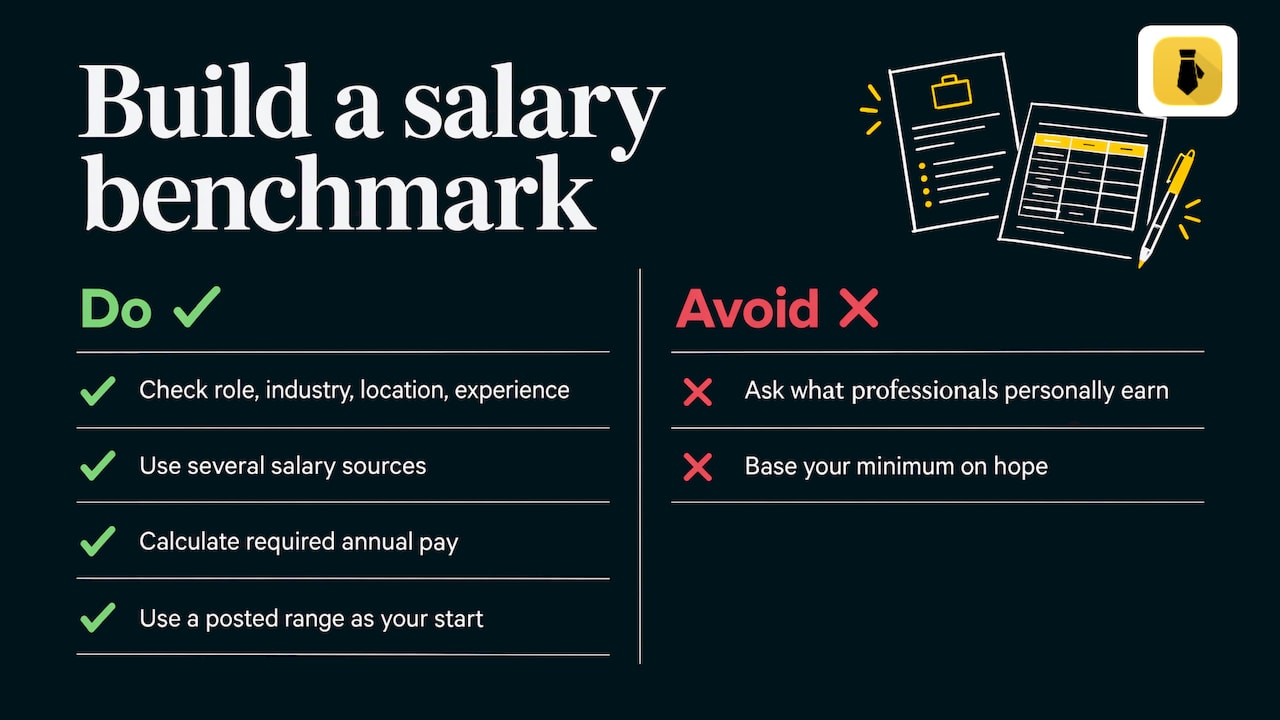
Harvard says a good benchmark reflects the role, industry, location, your experience and the employer’s size or financial condition. It also advises using several salary sources and asking professionals what range is acceptable in the field, not what they personally earn. Yale Law School’s guidance adds a budget step: work out the annual pay you actually require, so your minimum is based on your life and not on hope.
Some states make this easier. Many employers must now publish pay ranges in job postings, which is worth understanding when salary transparency in job ads shapes what you can ask. If the posting lists a range, use it as your starting point.
Set three private numbers
Harvard and Stanford’s career center both recommend settling on three figures before you talk:
- Minimum: the lowest offer you would accept. This is for you alone.
- Target: a fair figure for the role and location.
- Ideal: what a great outcome looks like.
The range you say aloud should generally run from your target toward your ideal. Your survival budget is not something to disclose. Stanford also notes that you may defer answering the expectations question until you have done more research or the process is further along.
Gather your proof
The University of Tampa’s career guide tells candidates to list accomplishments, skills, experience, education, certifications, languages and other differentiators, then prepare to explain the value you would bring. Robert Half agrees that requests land better when tied to measurable results that benefit the employer’s business. Write down your five strongest achievements with numbers: revenue, hours saved, errors cut, people managed.
When they ask about your salary expectations
This is the question that trips people up, because both extremes cost you. Name too low and you may anchor the whole negotiation beneath your worth. Refuse to answer and you may seem evasive.
Step 1: turn the question around
If you can, ask for the range first. The New York State Department of Labor’s suggested question is simply: “Can you tell me the salary range for this position?” A softer version in your own words: you are excited about the role, you want to be sure you are aligned, and you would like to hear the range the team has budgeted.
The same state guide offers a tactful full version: thank them for asking, request the range for this or similar positions, and say your requirements are negotiable and you would like to consider their range before giving an exact number.
Step 2: if pressed, defer once
Harvard suggests saying that your expectations depend on the details of the role and that you would be glad to discuss compensation once you both see a fit. If they keep pushing, ask again for the budgeted range.
Step 3: if you must name a number, name a range
The New York State Department of Labor advises giving a researched range, such as $55,000 to $65,000, and making sure the low end is at least your minimum, because employers may treat your range as a ceiling and negotiate down. Forbes reports a similar rule of thumb: if you are targeting $80,000, say $80,000 to $90,000 rather than starting below your target.
The Connecticut Department of Labor adds that pay is fixed in some occupations but negotiable in many others, and that you should avoid locking yourself into one specific dollar amount before you understand the employer’s range.
For more phrasing, see our guides on answering salary expectation questions and salary expectations in interviews and email. If the figure is requested on a form, the desired salary field has its own rules.
When the offer comes: how to counter
This is the real negotiation. The employer has chosen you, and the conversation changes from “do we want you?” to “how do we close the gap?”.
A counter in four moves
- Thank them and show enthusiasm. Say you are excited about the role and the team.
- Anchor to research. Cite the typical range for someone with your qualifications in your location.
- State your number. Choose a figure inside your target-to-ideal band.
- Ask a collaborative question. Korn Ferry’s talent acquisition leader, quoted by Forbes, favors wording along the lines of asking what can be done to close the gap between the offer and your hoped-for number.
The University of Tampa guide follows the same pattern for a below-expectation offer: thank, express enthusiasm, cite researched pay for comparable candidates, and ask whether they can match it.
A worked example. You are offered $70,000 and your research says $76,000 to $84,000 is typical for your level and city. You might say: “Thank you, I’m excited about this role. Based on my research and the results I delivered in my last position, I was hoping for something closer to $80,000. What can we do to get there?” Then stop talking and let them answer.
If base pay will not move
Robert Half recommends looking at other terms: bonus, paid time off, schedule or remote work, professional development, relocation and start date. Harvard’s Program on Negotiation makes a similar argument, that trades across several issues can help both sides reach an agreement they value. Our guide on comparing job offers beyond the salary number shows how to put a value on each of these.
Why asking is worth it
Most people never ask. In a UCLA Anderson Review report on a working paper covering about 3,858 technology job seekers, 61% of encouraged candidates with offers countered, compared with 54% of the control group, and those who countered gained about 12.45% in compensation terms on average, roughly $27,000 a year in that sample. The sample was tech candidates, so treat the size of the gain as an illustration, not a promise.
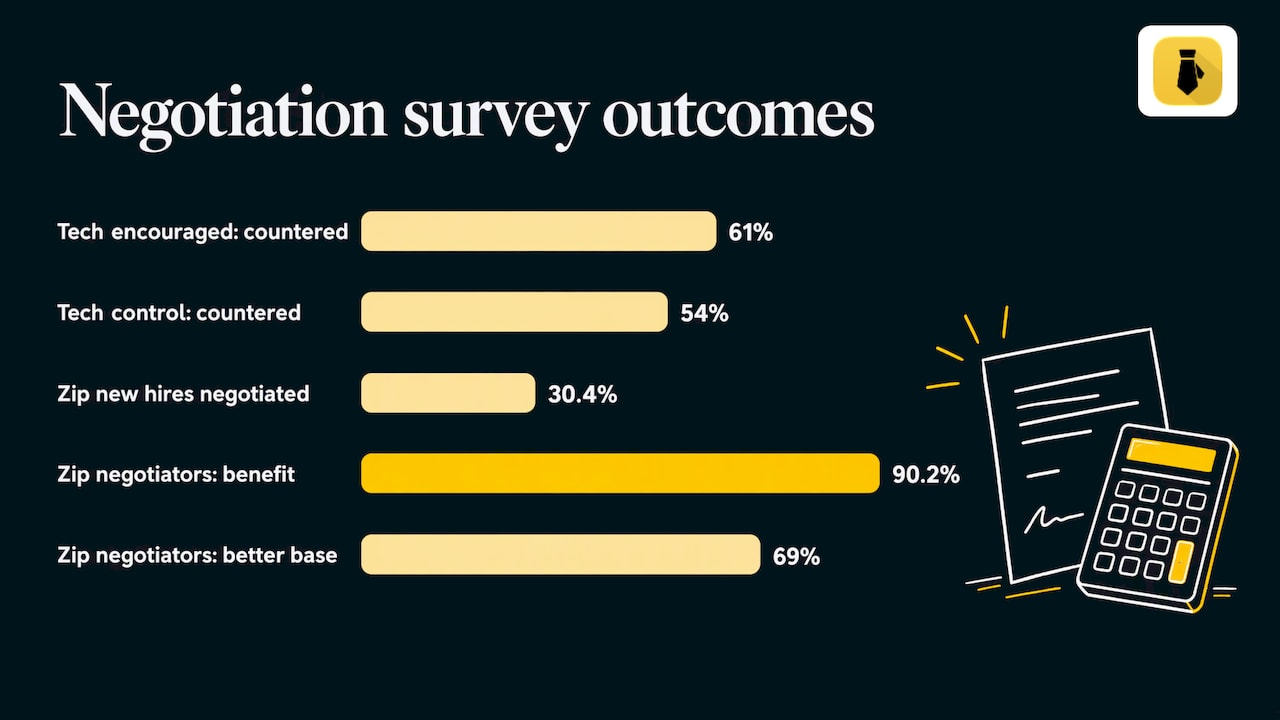
A broader picture comes from ZipRecruiter’s Q4 2025 survey of U.S. new hires: 30.4% negotiated their offer, and among those who did, 90.2% received some additional benefit and 69% obtained better base pay. See the survey results for the full breakdown. The pattern is consistent: asking politely rarely hurts and often helps.
If you are early in your career or changing fields
The same sequence applies, with a few adjustments.
- Early career: you may have fewer job achievements, so lean on internships, projects, coursework, certifications and languages. The University of Tampa guide specifically lists these as differentiators. Benchmark against entry-level pay for your location, not senior averages.
- Career changers: frame your past work as transferable results for the new role. Your earlier salary matters less than what the new position pays at your level. Research the target field’s range and, if the base is lower than you hoped, use the other terms above, such as a faster review cycle or a development budget.
- Non-native speakers: negotiation is a conversation held at speed. Practice the phrases above aloud until they feel like your own, so you can stay calm when the recruiter changes the question.
Where Interview Pilot fits
Salary questions arrive unannounced, usually between a behavioral question and a scheduling question. Interview Pilot is an AI interview assistant that generates tailored responses in real time during live online interviews, using speech recognition that understands accents and supports over 99 languages. It runs on Mac, Windows, iOS and Android, and uses industry-standard encryption for privacy.
There is a Free plan at $0 per month and an Unlimited plan at $49.99 per month, both listed on the pricing page. You can also read how the AI interview assistant works, or rehearse your counter first with an AI mock interview.

You will find more on offers in our job offers and salary library.
Our perspective
Most people lose salary negotiations in the first ten seconds after the question, not in the preparation. They know the research says to ask for the range, and then a recruiter says “what are you looking for?” and the plan disappears.
That is the problem we built Interview Pilot for. Pressure makes it hard to convey your skills and your value, and it is harder still if you are speaking a second language or being understood through an accent. Our app gives you tailored answers in real time, in over 99 languages and accents, so your preparation survives the moment you need it.
Do the homework first: your three numbers, your proof, your range. Then let the app help you say it clearly. Over 450,000 job seekers use Interview Pilot to speak with more confidence in live interviews, and the salary conversation is exactly where that confidence pays off.
Kingsley
FAQ
Is it okay to ask if the salary is negotiable in an interview?
Yes, if you ask about the range first. The New York State Department of Labor suggests asking for the salary range for the position and adding that your requirements are negotiable. Save the actual push for a number until you have an offer or clear signs that one is coming.
What should I say when asked for my salary expectations?
Ask for the budgeted range first. If they insist, say your expectations depend on the role and that you are happy to discuss compensation once you both see a fit. If you still need a figure, give a researched range with your target at the bottom.
Can I negotiate if the first offer is lower than I hoped?
Yes. Thank the employer, show enthusiasm, cite your research on comparable pay and ask whether they can match it. If base pay is fixed, ask about a bonus, extra paid time off, remote work, a development budget or a different start date.
Should I share my current or past salary?
You do not need to lead with it. Your benchmark should come from the market for the role and your location. Rules on asking about pay history vary by state, so check your state’s labor department for what applies where you live.
Sources
- Salary Negotiation Guide, New York State Department of Labor
- When’s the right time to bring up salary during a job interview, CNBC
- Evaluating and Negotiating Job Offers, Harvard FAS Career Services
- Money Talks: When and How to Negotiate Salary, Robert Half
- Salary Negotiation, Yale Law School
- Negotiation Scripts Resource, Stanford Career Education
- Salary Negotiation, University of Tampa Career Services
- 6 Effective Ways To Answer Your Salary Expectations, Forbes
- How do I negotiate my starting pay, Connecticut Department of Labor
- How to Negotiate Pay in an Interview, Harvard Program on Negotiation
- Most Job Seekers Skip Negotiation and Pay a High Price, UCLA Anderson Review
- The ZipRecruiter Survey of New Hires, Q4 2025
Recommended



Topics
negotiate salary interview
Continue reading
Interviews
Interview Questions Librarian: Nine Answers That Impress
Prepare for interview questions librarian candidates face: nine questions, sample answers, and tips on reader services, research, and operations.
November 26, 2026
20 min read
Interviews
How to Answer Tough Interview Questions in 2026
Learn how to answer tough interview questions with clear frameworks, a five-step method, sample answers, and fixes for freezing or rambling.
November 26, 2026
16 min read
Interviews
10 Nursing Manager Interview Questions to Expect
Prepare for nursing manager interview questions with 10 real prompts, leadership answer examples, and tips for staffing, budgets, and conflict.
November 25, 2026
19 min read