









Interviews
Interview and Assessment: How They Differ
See how an interview and assessment differ, which scores predict job performance, and how to prepare for both without chasing the wrong signals.
Interview Pilot Editorial Team
Updated October 29, 2026
15 min read
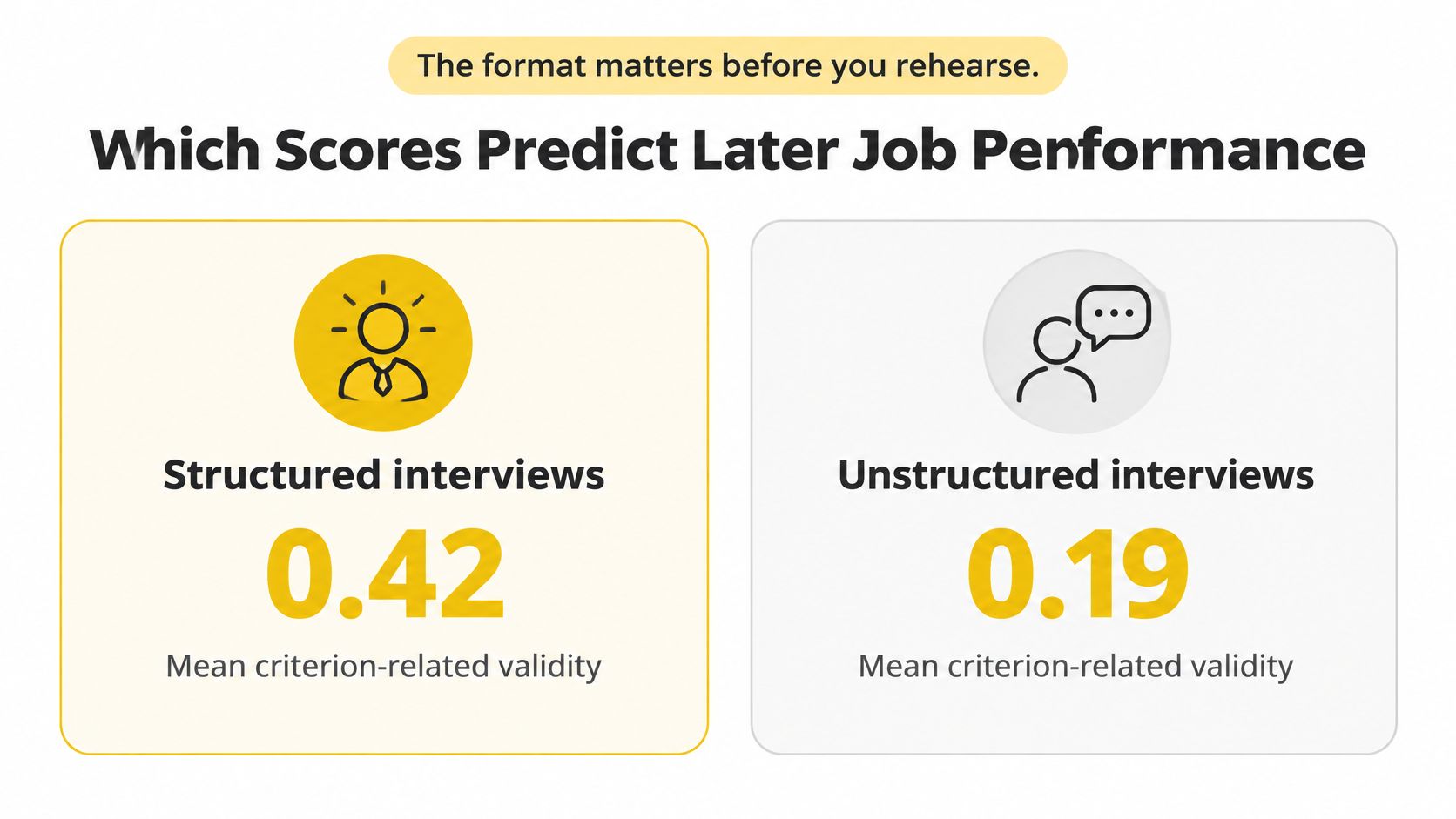
An interview gathers spoken evidence of judgment and past behavior, while an assessment scores a defined task or test, and employers use both because each predicts a different slice of job performance. Structured scores track later performance at about 0.42, while unstructured chats sit near 0.19.
Popular prep still tells you to sound confident, smile on camera, and match the interviewer's energy. That advice trains the wrong target. A careful score looks for evidence tied to the job, not facial expression, vocal emotion, accent, or a generic show of enthusiasm. You can control the examples you bring, the work you finish under a timer, and the questions you ask about how scoring works. You can't control a sloppy process, so part of preparing is learning to read the process itself.
Say your invite lists a "chat with the hiring manager" and a "case exercise." Those aren't the same event. One asks you to explain judgment. The other asks you to produce something that gets graded. Label each stage before you rehearse a single answer.
Interview and Assessment Side by Side
In the first minute of a hiring email, split every stage into talk or task. An interview is a conversation, live or recorded, in which someone asks questions and judges your answers. An assessment is a scored task or instrument: a work sample, case, coding exercise, cognitive test, or written exercise with a rubric. Plenty of current processes mix both, sometimes on the same afternoon, so name each stage before you prepare.
| Method | Main purpose | What gets scored | Typical length | Best candidate evidence |
|---|---|---|---|---|
| Structured interview | Same questions for every candidate | Judgment, communication, past behavior on anchored scales | 30-60 minutes | Specific examples tied to named competencies |
| Unstructured interview | Exploratory conversation | Impression, fit, and follow-up answers | 20-45 minutes | Clear stories, but scoring is inconsistent |
| Work sample or job simulation | Reproduce a real task | Output quality, process, accuracy, time | 60-90 minutes | A finished artifact against the brief |
| Case or live problem | Test reasoning under questions | Structure, assumptions, recommendation | 30-45 minutes | Transparent logic and trade-offs |
| Cognitive or skills test | Measure ability or knowledge | Correct items against a key | 20-45 minutes | Accuracy and pacing, not charm |
| Recorded or one-way video | Standard prompts without a live interviewer | Answer content, sometimes automated signals | 10-30 minutes | Direct, job-relevant answers to each prompt |
Structured interviews give every candidate the same core prompts and score answers on anchored scales. Unstructured interviews drift with rapport. The interviewer follows whatever feels interesting, so two people with the same skill can face different questions and still be compared as if the test were identical.
A work sample scores an output under time and resource rules. You ship a small piece of the job, and the grader looks at what you made. A case scores the recommendation and the assumptions behind it. A cognitive or skills test marks correct items against a key, so charm doesn't move the score. A personality or behavioral questionnaire describes tendencies. It isn't a finished piece of work, and it shouldn't stand in for one.
Practical rule: If you must produce a work product that is graded, treat it as an assessment. If you must explain judgment in answers, treat it as an interview.
Recorded video sits in between. The prompts are standard, which looks like structure, but some systems also read automated signals that have little to do with the job. Your best evidence is still a direct answer to the prompt in front of you.
Which Scores Predict Later Job Performance
A polished conversation is not the same as strong evidence of future performance. Scores are more useful when the assessment measures job-related skills consistently and the scoring rules make those skills visible.
| Method | What the score indicates | When it is strongest |
|---|---|---|
| Structured interview | How answers relate to later job performance | Standardized questions, probes, and anchored scoring |
| Unstructured interview | A less consistent link to later performance | When interviewers have wide discretion and follow-ups vary |
| Interview based on formal job analysis | How well questions reflect analyzed work requirements | Competencies drawn from a formal analysis of the role |
| Interview based on informal job analysis | How well questions reflect assumed or loosely defined requirements | When role requirements are not formally analyzed |
| Work sample | How well a candidate completes a job-related task | A close match to the work, with a clear rubric, time limit, and partial-credit rules |
Structured interviews generally predict later job performance better than unstructured interviews. The difference comes partly from consistency: candidates answer the same core questions, receive comparable follow-ups, and are scored against shared criteria. Job analysis also matters. Questions grounded in a careful analysis of the role are more likely to measure relevant competencies than questions based on loose assumptions.
Why structure changes the score
Structure limits how much interviewer discretion can shape the result. Rapport, conversational style, personal preferences, and uneven follow-ups have less room to affect scores when interviewers use the same prompts and anchored criteria. The goal is to assess judgment, communication, and past behavior against named competencies, not facial expression, vocal emotion, accent, or generic confidence.
A work sample adds a different kind of evidence: the candidate has to produce something, and the evaluator scores the result against stated criteria. That evidence is most useful when the task reflects actual job requirements and the rubric explains how quality is judged. No single score guarantees future performance, so candidates should focus on providing clear, job-relevant evidence in each format.
Consistent scoring also depends on the process. Competency-based questions, shared core prompts, behaviorally anchored rating scales, independent scoring before discussion, and trained interviewers help keep evaluations focused on the work. For preparation, identify the competencies being assessed and practice showing evidence for each one. A fluent answer that could fit any job is less informative than a specific example tied to the role.
Formats You Will Meet in a Hiring Process
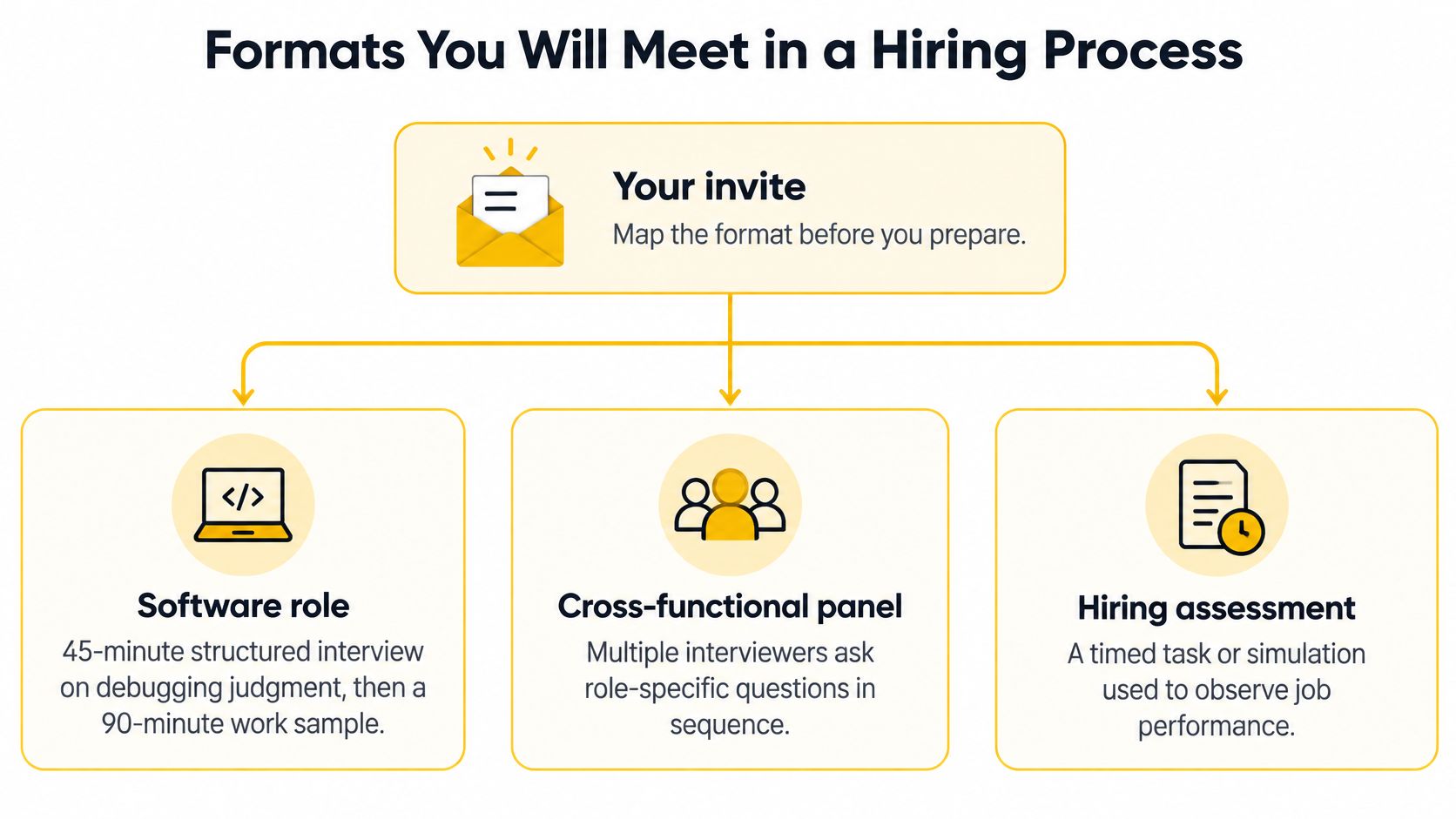
Hiring stages can look different while measuring related skills. A conversation reveals how you explain a decision; a work sample shows what you do with a task. The format matters because it shapes what counts as evidence.
Software role. A structured interview might ask how you would debug a problem, followed by a work sample involving code. The interview surfaces your reasoning and trade-offs. The practical task tests how you apply them. Check which tools and materials are allowed before starting.
Consulting or product. A behavioral interview may ask about a stakeholder conflict, followed by a live case. The conversation elicits evidence from your past; the case tests how you frame a problem and support a recommendation. State your assumptions so the evaluator can assess the reasoning behind your answer.
Campus or operations hire. A short skills test may come before a panel interview. A panel can feel like a group conversation, but your preparation should focus on the role-related evidence you can provide, not on facial expression, accent, or generic confidence.
Five rules before a work sample starts
Check these details before the timer starts. If anything is unclear, ask.
- Environment: Confirm the editor, language, dataset, or whiteboard you will use.
- Resources: Check which documents, notes, or searches are allowed.
- Duration: Confirm the time limit and whether setup time counts.
- Rubric: Ask how output, process, accuracy, and time are assessed.
- Partial credit: Find out whether a sound method can earn points when the final answer is wrong.
A work sample is most useful when the task resembles the job and the scoring criteria match the work. Read the scoring key before drilling, just as candidates understand loan officer test scoring before preparing for a licensing exam. Focus practice on the task and its criteria, rather than trying to imitate a preferred tone.
Group interviews can make individual contributions harder to distinguish, while take-home tasks can leave questions about who completed the work. A personality survey measures something different from a work sample, so check what each stage is intended to assess. If an invitation uses vague labels such as “screen,” “loop,” or “exercise,” this guide to common interview formats can help you interpret them.
How to Prepare for Interviews and Assessments
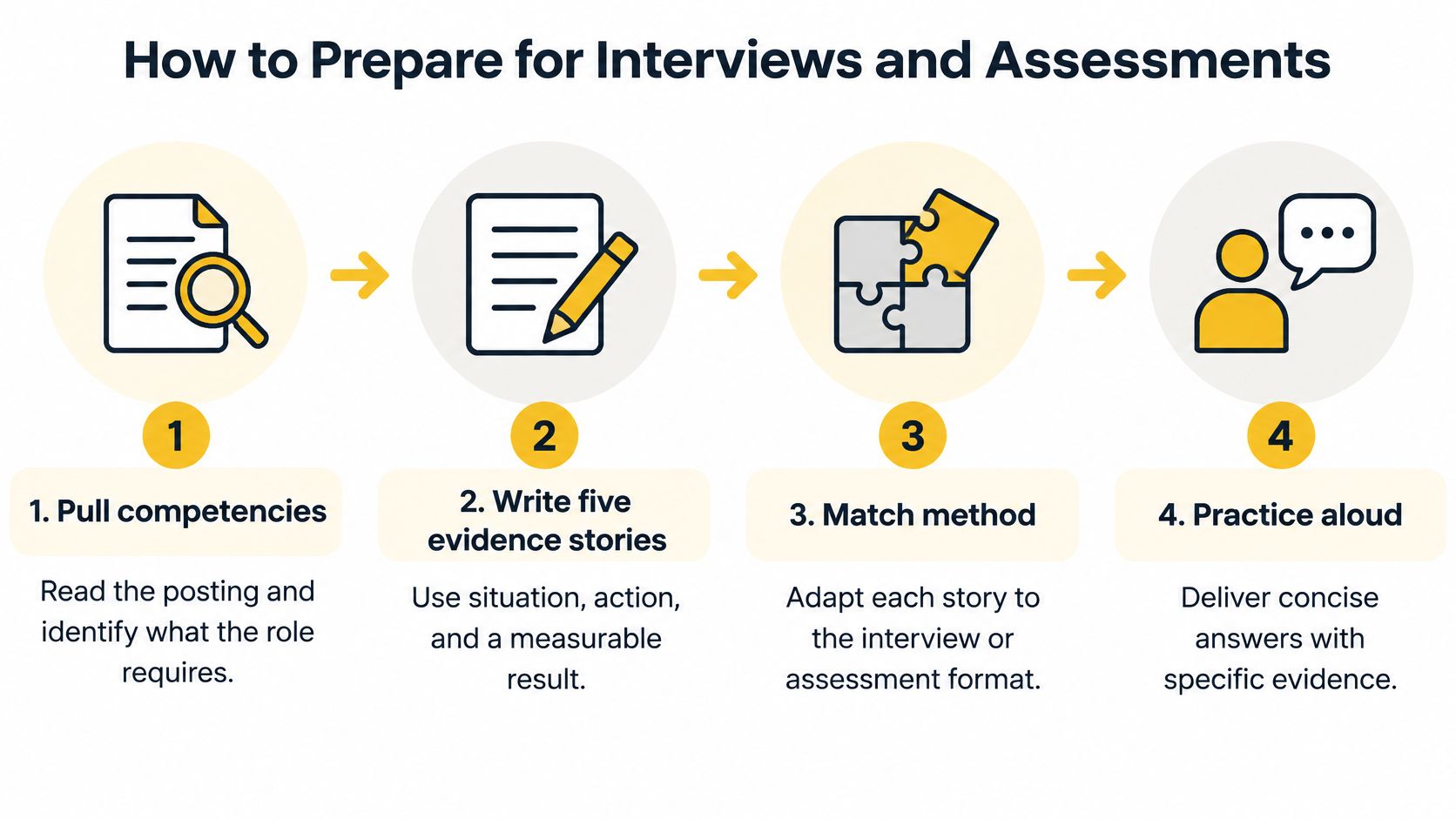
Use one routine and change the drill to match the method. Don't build a second comparison chart.
Pull competencies and write five stories. Read the posting and list what the role requires. For each story, note the situation, your action, and a measurable result. The reason is simple: scorers need evidence they can anchor. The usual slip is collecting impressive anecdotes that don't match any competency on the page.
For the interview, cap the answer. Practice the same competency in under two minutes, then add one probe you might hear, such as "What was your specific role?" Stop polishing tone. Interviewers on a structured loop are listening for the action and the result. Extra warmth doesn't raise an anchored score.
For a work sample or case, rebuild a past task under a timer. State assumptions out loud and score yourself on output, process, accuracy, and time. A generic story fails here because the task wants a calculation, a design, or a recommendation. Say you're asked to cut a support queue by a third. Write the assumption, the steps, and what you'd ship in the time allowed.
Read the rules before the day. Confirm tools, camera, time limit, and whether partial credit exists. Ask if a rule is missing. People who master commercial driving practice tests already know a knowledge exam rewards accuracy and pacing, not presence. The same is true of a skills test.
Run one full mock in the actual format. If the stage is talk, answer questions. If it's a task, produce the artifact. Note where the evidence was thin, not where you "felt off."
On the day, answer the question asked and show the work. Skip stories that don't match a competency. Rehearsing facial energy is the common miss. A second miss is forcing a STAR story onto a prompt that wants a number.
Finish the week with five boxes checked: competencies listed, two stories each, one timed task, rules confirmed, and one question ready about how scoring works.
Job-Relevant Answers When AI Is Scoring
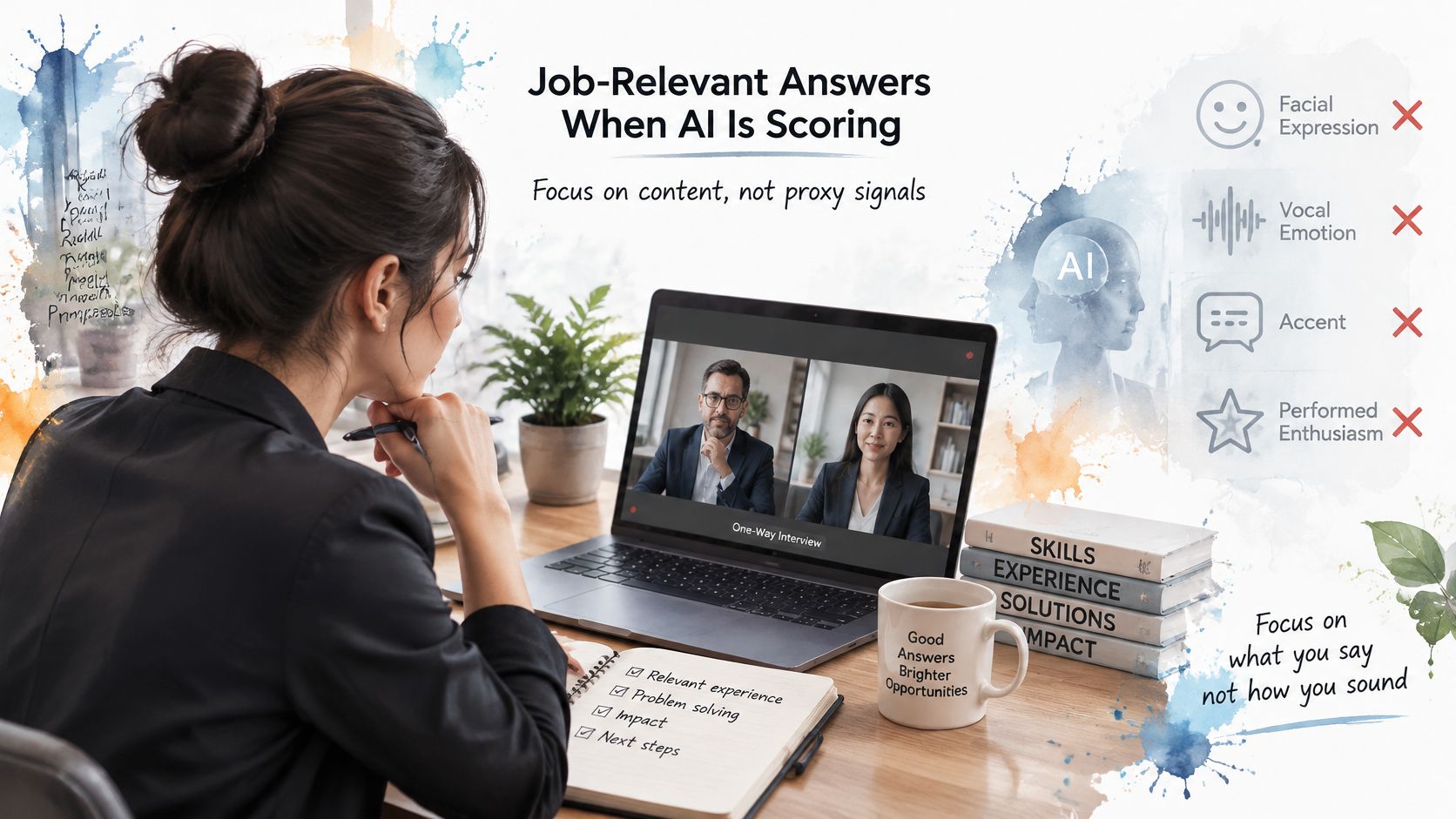
The best way to prepare for an AI-scored interview is to give clear evidence of job-related skills. Facial expression, vocal emotion, accent, and performed enthusiasm are poor substitutes for that evidence.
In a one-way video or automated screen, the lack of visible human feedback can make presentation feel like the main test. Yet a polished interface does not tell you whether the scoring criteria are fair. A 2025 FAccT review of 49 peer-reviewed studies identifies bias in training data as a central risk in AI recruitment, even where automation may improve consistency.
Standardization isn't fairness
Standardization means candidates encounter a more consistent process. It does not guarantee that the questions or scoring criteria measure the right things. Historical hiring data can also carry “similar-to-me” and stereotype biases, so an automated score may reproduce patterns that have little to do with job performance.
For candidates, the practical response is to focus on evidence rather than trying to guess the model's preferences. State your reasoning in order, show the steps behind technical work, and connect examples to competencies named in the job posting. These choices make your answer easier to assess without asking you to perform a particular personality.
Advice that treats eye contact, a lively tone, or a particular accent as a scoring key can disadvantage disabled, neurodivergent, multilingual, or culturally diverse candidates. A quieter delivery does not erase relevant experience, and confidence alone does not demonstrate competence.
Before recording, ask which competency the prompt measures and whether a human reviewer will see the result. This guide to how AI interviews work can help you distinguish the assessment question from the technology presenting it. If the format prevents you from giving a fair answer, request an accommodation or human review.
To close, identify the competency you addressed, the evidence you provided, and whether the format blocked a fair answer.
What to Do After an Opaque Interview
A poor interview process can hide strong candidates behind unclear criteria, inconsistent questions, or personal impressions. More practice cannot correct a score that measures the wrong things. The practical next step is to assess what the process measured and ask for specific feedback.
In the Aptitude Research interviewing report, 82% of recruiters reported losing quality talent because of a poor interview process, while 54% of candidates reported experiencing interview bias. Employer feedback is part of the hiring outcome: it can clarify which evidence the interviewer considered and what the decision was based on.
Same-day diagnostic
Write down what happened while the details are fresh.
- Capture the questions. Record their wording, not just your impression of the interview.
- Separate evidence from rapport. “Walk me through a failed launch” asks for job-related evidence. “You seem like you'd fit the culture” relies more on personal impression.
- Note the structure. Were the questions consistent and tied to a clear rubric, or did the conversation vary without an obvious reason?
- Ask for specific feedback. Request the skill or competency the interviewer wanted to assess, and where your answer fell short.
- Document concerns. Record dates and wording if you believe bias or an accommodation issue affected the process.
- Choose your next step. Continue, request a human review, or decide not to pursue the opportunity.
A clear request can be brief: “Could you share which competencies informed the decision and what evidence was missing from my answers?” You are asking what the score measured, not demanding a different result.
Continue when the task matched the job and feedback identifies a skill you can develop. Pause when the decision appears to rest on likability, accent, or an unexplained automated flag.
A vague “not a culture fit” after inconsistent questions tells you little about your ability. Keep a record, make one specific request, and use the response to judge whether the process gives you meaningful information.
Practice Against the Competencies You Will Be Scored On
Pick the next seven days by the stage in front of you, not by a generic confidence plan.
If the next stage is an interview, rehearse evidence against the posting's competencies and skip smile drills. A behavioral competencies guide keeps each story tied to a skill the rubric can score. If it's an assessment, do one timed work sample and score yourself on output, accuracy, and time. If it's recorded or AI-mediated, keep answers direct and job-related, and keep the human-review sentence ready.
Run one mock in the exact format, then keep only the answers that cite a real result. Interview Pilot can host that session. AI mock interviews are available, along with an evaluation of your answers. The copilot supports technical questions, live coding, behavioral questions, phone interviews, online assessments, recorded interviews, group interviews, and case studies. The question library has sets for 10 roles, including software engineer, product manager, data scientist, consulting, and financial analyst, and you can build a profile from your resume or the job posting. No tool guarantees an offer, or that a listed question will be asked.
Interview Pilot gives you mock interviews with an evaluation of your answers, structured question sets, and a copilot for online assessments, recorded interviews, and case studies, so practice stays tied to the competencies on the posting. Use one matched session this week, keep the answers that cite a real result, and drop the drills that only train a confident tone. Visit Interview Pilot when you're ready to run that session.
Topics
interview and assessment
structured interviews
work samples
hiring tests
candidate preparation
Continue reading

Interviews
Question to Ask Hiring Manager: 10 Smart Picks
Find the best question to ask hiring manager at every stage, with practical follow-ups, role-specific adaptations, and real examples.
October 18, 2026
19 min read
Interviews
Nursing Job Interview Questions: 9 Sample Answers
Prepare for your next role with 9 nursing job interview questions, including clinical scenarios, behavioral prompts, and model answers you can adapt.
October 29, 2026
18 min read

Interviews
Situational Interview Answers: How to Structure Yours
Learn how to answer situational interview questions with a clear, STAR-based structure, worked example answers, common mistakes to avoid and a practice plan.
October 29, 2026