
















Resumes
How Applicant Tracking Systems Work
Understand resume parsing, application records, employer-configured screening, and recruiter review without relying on myths about universal ATS scores.
Interview Pilot Editorial Team
3 min read

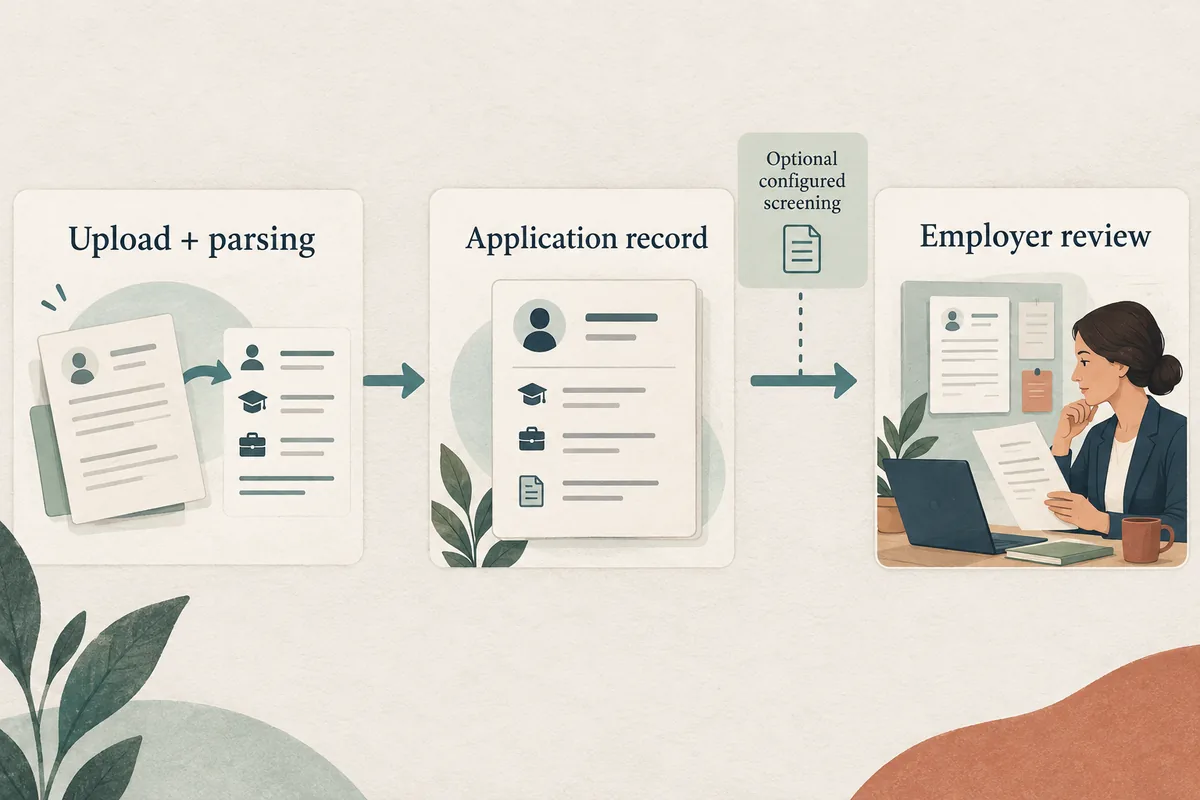
An applicant tracking system, or ATS, helps an employer collect and manage applications through its hiring process. It is not one universal robot with a single scoring formula that every candidate must beat.
Different products and employer configurations do different things. Separate three questions: Can the system read your document? Does your application satisfy the employer's stated requirements? How does the hiring team review candidates?
Parsing is not the same as rejecting
Resume parsing extracts information from a file into fields such as employment history or contact details. A parsing error may put information in the wrong place or fail to populate a field.
Greenhouse's parsing documentation describes problems with complex formatting and image-based resumes. It also explains that an unsuccessful parse can leave the uploaded resume attached for manual handling. That is evidence about Greenhouse, not proof that every ATS treats every file identically.
Follow the employer's file instructions. Use selectable text, recognizable section headings, and a clear reading order. When the application shows extracted fields, inspect them rather than assuming the upload filled everything correctly.
Screening rules are a separate layer
Some systems support employer-configured rules tied to application answers. For example, Greenhouse documents auto-rejection rules that an employer can attach to selected responses to custom questions.
That does not mean every rejection was caused by an algorithm, or that repeating a keyword would override a requirement. Answer application questions truthfully. If a question is ambiguous, seek clarification rather than selecting an inaccurate answer to avoid a suspected filter.
Make relevance visible to people as well as software
Use the job description's terminology when it accurately describes your experience. A recruiter searching for a particular tool may not know that an unfamiliar internal project name involved that tool.
For example, replace an unexplained phrase such as "supported the Atlas initiative" with the actual work: "Maintained the weekly SQL report for the customer-support team's backlog review." This fictional example is more informative without keyword stuffing.
Do not add hidden white text, skills you have never used, or a copied job description. Those tactics make the application less trustworthy and do not establish that it will pass a particular screen.
Check the application before submitting
Confirm your contact information, employer names, dates, and job titles in the form. Check that links open the intended portfolio or profile. If the form separates a resume from a required question, answer the question instead of assuming the file substitutes for it.
A third-party "ATS score" may be a tool's own estimate. Unless the employer documents that exact score and process, do not treat it as the employer's decision threshold.
Use the resume-bullet guide to improve the evidence in the document. The goal is an accurate, readable application, not a promise that formatting alone can secure an interview.
Topics
Resumes
how applicant tracking systems work
Continue reading

Resumes
Business Analyst Resume Guide: Show the Path From Need to Change
Write a business analyst resume that connects stakeholder needs, requirements, analysis, and validation, with clear examples of individual contribution.
September 29, 2026
3 min read

Interviews
8 Situational Interview Questions Examples: Model Answers
Explore 8 situational interview questions examples with model answers, annotated tactics, and variations to practice for any role or industry in 2026.
November 11, 2026
20 min read

AI Tools
AI Interview Coach: How It Works and How to Choose One
Learn what an AI interview coach does, which features matter, where it falls short, and how to use one ethically before your next job interview.
November 11, 2026
17 min read