












Interviews
Definition of Len: Guide to Usage Across Languages
Master the definition of len across Python, JavaScript, and Excel. Learn what length actually means and how to avoid common interview mistakes.
Interview Pilot Editorial Team
Updated October 7, 2026
12 min read

In Python, len() returns an object's number of items, not necessarily its character count. In JavaScript, String.length counts UTF-16 code units, so the result can differ from the number of characters a person sees.
You may be looking at a short interview prompt, a spreadsheet formula, or a line of code that seems too simple to deserve discussion. Then the interviewer asks, “What does len return?” You know the syntax, but a doubt appears: does it count characters, bytes, elements, visible symbols, or something else?
The correct answer depends on the language, data type, and representation. The name looks familiar across Python, JavaScript, and spreadsheet software, but the operation isn't universal. Strong candidates don't just memorize that “length means size.” They identify what the environment considers an item and explain what the result measures.
The Interview Moment When You Freeze on Len
The interviewer writes a short expression on the screen and asks you to define len. You start with the answer most tutorials teach: “It returns the number of characters.” Then you remember that Python uses len() on lists and dictionaries. JavaScript has a length property. Excel has a LEN function. The answer suddenly feels less certain.
That hesitation is understandable because length is a measurement, not a universal concept. A string may be treated as a sequence of Unicode code points, UTF-16 code units, bytes, or user-perceived characters. A collection may be measured by its members. An array may report an index boundary rather than the number of populated entries.

A useful response under pressure is to clarify the context before giving a definition. If you don't know which language the interviewer means, you can say that the result depends on the type system and ask whether they're referring to Python, JavaScript, Excel, or another environment. That isn't evasive. It shows that you understand the ambiguity.
Practical rule: Before defining length, identify the language, the type, and the unit being counted.
If you do blank briefly, a calm explanation is better than a rushed guess. Guidance on what to say when you don't know the answer in a technical interview can help you handle that pause professionally.
The core definition of len, then, is contextual. In one environment it measures collection items. In another, it measures an encoding-level representation. In a spreadsheet, it measures characters in a cell value. The interview skill is recognizing which meaning applies.
Python Len Protocol and What Gets Counted
Python's len() is a protocol-level built-in, not merely a string utility. It asks an object for its number of items, and Python supports that operation across several kinds of sequences and collections. The official Python documentation for len() describes this behavior and the protocol behind it.
For a string, the items are the string's elements. For a list or tuple, they are the stored entries. For a range, they are the values represented by that range. For a dictionary, len() counts key-value pairs, not the characters in the keys, the characters in the values, or the total memory used by the dictionary. Sets and frozen sets are also collections for which Python can report a length.
The protocol behind the call
When you write len(value), Python dispatches the operation to value.__len__(). A custom class can therefore support len() by implementing that method. The method must return a non-negative integer. If it returns a negative value, Python raises an exception instead of treating the result as a meaningful size.
That contract matters in an interview because it separates the public operation from the object's internal storage. A container may maintain its size as state and return it directly. Another type may calculate its length dynamically. You shouldn't assume that every object counts characters or that every implementation must iterate through all of its contents.
__len__() also affects truth-value testing when a class doesn't define __bool__(). An object with a reported length of zero is treated as false in a Boolean context. That means an inaccurate length implementation can affect both explicit calls to len() and conditional logic.
The large-object edge case
Python's semantic rule is clear, but implementations still have limits. In CPython, an object whose length exceeds sys.maxsize can cause OverflowError, including an extremely large range. This is a useful follow-up detail because it distinguishes logical length from what the runtime can represent in the expected integer range.
For an interview answer, start: “In Python, len() returns the number of items in an object through the length protocol.” Then add the type-specific distinction, such as dictionary entries rather than total content. Candidates preparing with technical interview questions for Python should practice explaining the rule and the exception, not only recalling the function name.
JavaScript Length Surprises and Edge Cases
JavaScript's String.length looks like a direct character counter. That description works for simple text, but it becomes unreliable when text contains symbols represented by more than one UTF-16 code unit. JavaScript reports the length of the string's UTF-16 representation, not necessarily the number of Unicode characters or visible symbols.

Some emoji and characters from certain scripts use a surrogate pair, which occupies two UTF-16 code units. A person may perceive that sequence as one symbol, while String.length reports two units. The same mismatch can affect validation rules, truncation, usernames, database limits, and coding exercises involving multilingual text. The MDN reference for JavaScript string length documents this representation-level behavior.
What the string result means
The important distinction is between these possible units:
- UTF-16 code units, which JavaScript's
String.lengthreports. - Unicode code points, which represent encoded characters at a different level.
- Grapheme clusters, which more closely correspond to what users perceive as a single character.
- Bytes, which describe an encoded storage representation rather than visible text.
These aren't interchangeable. If a product requirement says “limit the username to a certain number of characters,” using String.length without deciding what “character” means can produce surprising results. A senior engineer asks whether the requirement concerns storage, encoding, or user perception before selecting an implementation.
Arrays have a different trap
JavaScript arrays introduce another meaning of length. Array.length is an unsigned 32-bit value tied to the highest numeric index, plus the position implied by that index. It isn't always the count of populated elements.
A sparse array can have a large reported length while containing empty slots between its entries. Increasing the length creates empty slots rather than filling them with actual values. Therefore, an interview answer that equates array.length with “how many elements are present” is incomplete for sparse arrays.
JavaScript length often describes the object's representation or boundary, not the amount of meaningful content a user sees.
That distinction explains why a candidate should never answer “length always counts characters” in JavaScript. The property is interpreted by the type, and strings and arrays apply different rules.
Excel Len Function and Spreadsheet Nuances
Spreadsheet users encounter LEN outside a conventional programming language. In Excel, LEN is a text function that returns the number of characters in a supplied text string. Its syntax is =LEN(text), and the single required argument can be typed text, a cell reference, or another expression, as Microsoft explains in its Excel LEN function documentation.
Excel includes letters, digits, punctuation, and spaces in the count. As a result, LEN("Hello World") returns 11, because the phrase contains 10 letters plus one space. An empty cell returns zero, while a cell containing one space returns one.
Comparing Excel with Python
Excel's behavior overlaps with Python when the input is text, but the surrounding model is different. Python's len() is defined for many object types and reports the number of items appropriate to each type. Excel's LEN is specifically concerned with the text representation supplied to the function.
That distinction becomes visible with numeric input. LEN(1234) returns 4 because Excel evaluates the number through its text representation. It isn't performing a mathematical digit analysis. The function receives a value that can be represented as text and counts the characters in that representation.
Why formatting doesn't change the result
LEN measures underlying cell content rather than visual styling. Changing a font, color, or display format doesn't alter the character count. This makes the function useful for validating fixed-length identifiers, checking customer or account codes, finding unexpected spaces, and enforcing data-entry rules.
Microsoft also distinguishes LEN from LENB, a legacy byte-counting function associated with certain character sets. That difference reinforces the broader lesson: even within one spreadsheet product, a “length” function may count characters or bytes depending on the specific function selected.
Building a Unified Mental Model of Length
The safest definition of length begins with a question: what is the object, and what unit does this environment use to measure it? That question prevents the most common interview error, which is importing the rule from one language into another.
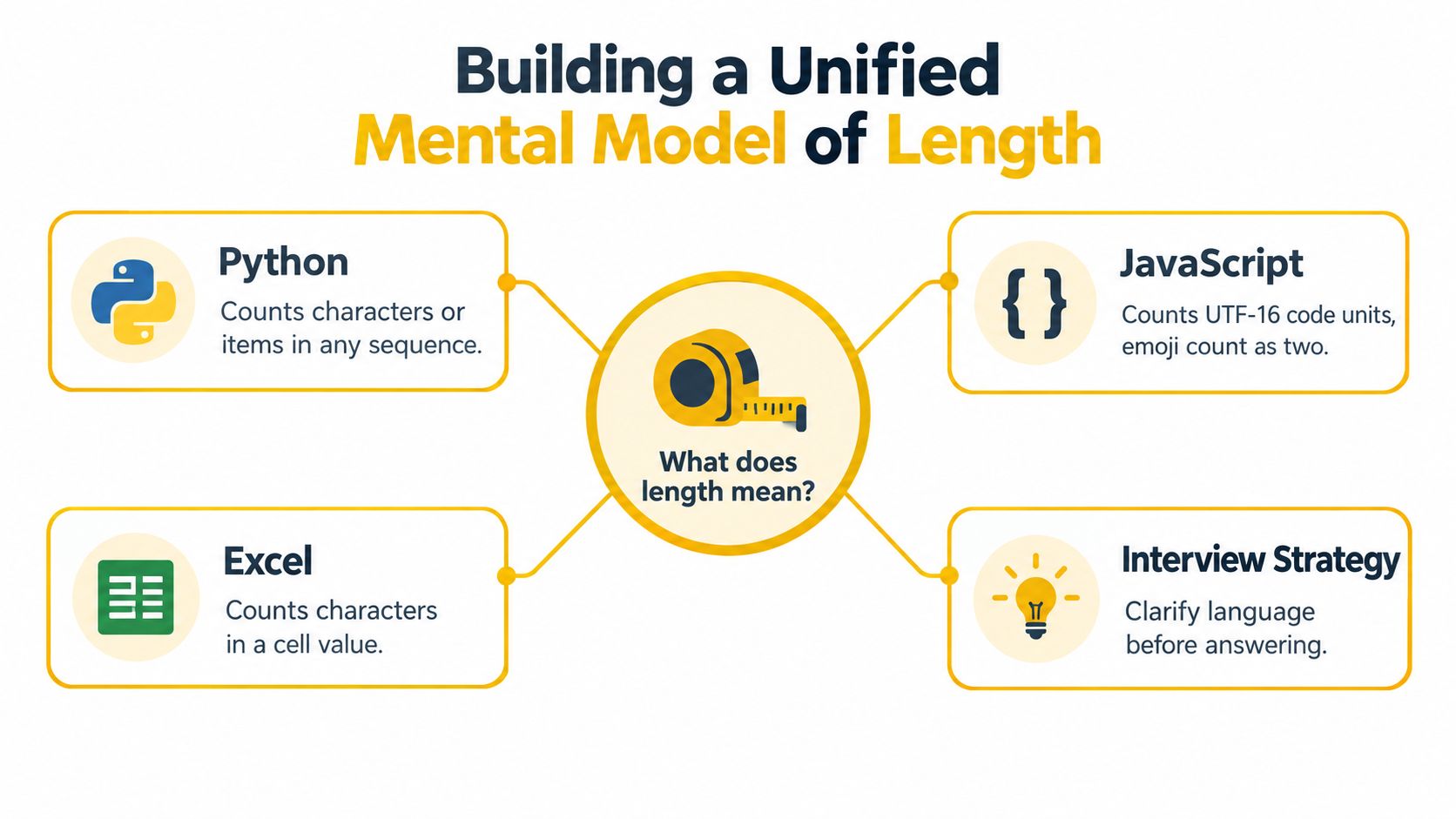
| Environment | What the operation measures | Typical trap |
|---|---|---|
| Python | The number of items exposed by the object's length protocol | A dictionary result counts key-value pairs, not total text or storage |
| JavaScript strings | UTF-16 code units | A visible symbol can occupy more than one code unit |
| JavaScript arrays | An index-based length boundary | Sparse arrays can include empty slots |
| Excel | Characters in the supplied text representation | Spaces count, and numeric input is evaluated as text |
This framework also separates semantic length from physical representation. A Python list's length describes its entries. JavaScript string length describes UTF-16 units. Excel's LEN describes characters in a cell value. None of those results automatically tells you how much memory the object uses or how many visible symbols a reader perceives.
The answer pattern interviewers want
A concise, strong answer usually has three parts:
- Name the environment. Say whether you're discussing Python, JavaScript, or Excel.
- Name the unit. Explain whether the result counts items, code units, characters, or another representation.
- Mention the relevant edge case. For example, dictionaries count pairs, strings can contain surrogate pairs, and sparse arrays can contain empty slots.
The point isn't to recite every encoding standard. It's to show that you won't make a hidden assumption. If the interviewer asks a follow-up about complexity, custom objects, or multilingual text, your definition remains stable because it starts with the type and the protocol.
Interview Checklist for Length Questions
Use these questions before an interview or while solving a coding problem:
- Which language am I using? Don't transfer Python's
len()rules to JavaScript'slengthproperty or Excel'sLENfunction. - What type is the value? A string, list, dictionary, array, range, set, and spreadsheet cell don't necessarily expose length in the same way.
- What exactly is being counted? State whether the answer concerns items, UTF-16 code units, characters in text, or an index boundary.
- Could encoding change the result? In JavaScript, a symbol that uses multiple UTF-16 units can make the reported length differ from what a person sees.
- Could empty positions matter? A sparse JavaScript array may report a boundary that doesn't equal its number of populated entries.
- Is the input numeric? In Excel,
LENevaluates numeric input through its text representation. - Is this a custom Python object? Check whether
__len__()exists and whether it returns a valid non-negative integer. - Am I confusing size with memory? A length result describes the type's measurement rule. It doesn't automatically describe storage usage.
A polished interview response can sound like this: “The definition depends on the environment. Python's len() asks an object for its item count through the length protocol, JavaScript strings report UTF-16 code units, and Excel LEN counts characters in a text value. I'd clarify the language and type before discussing edge cases.”
From Freeze to Confidence in Live Interviews
Return to the candidate at the beginning. This time, they pause before answering. They ask which language the interviewer means, then explain that Python counts items through a protocol, JavaScript strings count UTF-16 code units, and Excel counts characters in a text representation.

The interviewer follows up with a dictionary, an emoji, and a sparse array. None of those questions changes the candidate's method. They identify the type, state the unit, and explain the edge case. That is the true advantage of understanding the definition of len. You aren't memorizing isolated trivia. You're applying a model that survives unfamiliar examples.
Practice saying the answer aloud until the clarification feels natural. A short pause followed by a precise question is stronger than a fast answer based on an unstated assumption.
Interview Pilot offers real-time suggested answers for technical and behavioral interviews, along with guided mock interviews and a searchable question bank for focused practice. Use it to rehearse length questions, explain encoding traps, and build confidence before your next interview with Interview Pilot.
Topics
definition of len
programming length
python len
javascript length
excel len function
Continue reading

Interviews
10 Behavioral Interview Questions Software Engineer
Prepare for behavioral interview questions software engineer candidates face with 10 examples, answer frameworks, and technical-role framing tips.
October 7, 2026
26 min read

Interviews
10 Interview Questions for Teachers to Prepare
Prepare for interview questions for teachers with 10 role-specific examples, suggested responses, classroom scenarios, and practical storytelling tips.
October 7, 2026
25 min read

Interviews
Data Analyst Technical Interview Questions and Answers: 2026
Explore data analyst technical interview questions and answers covering SQL, statistics, Excel, and real-world strategies for 2026.
October 6, 2026
22 min read