









Technical Interviews
Cloud Engineer Interview Questions: Explain Recovery and Tradeoffs
Prepare cloud engineer interview answers about failure isolation, recovery testing, permissions, cost changes, and deployment safety without listing services blindly.
Interview Pilot Editorial Team
4 min read
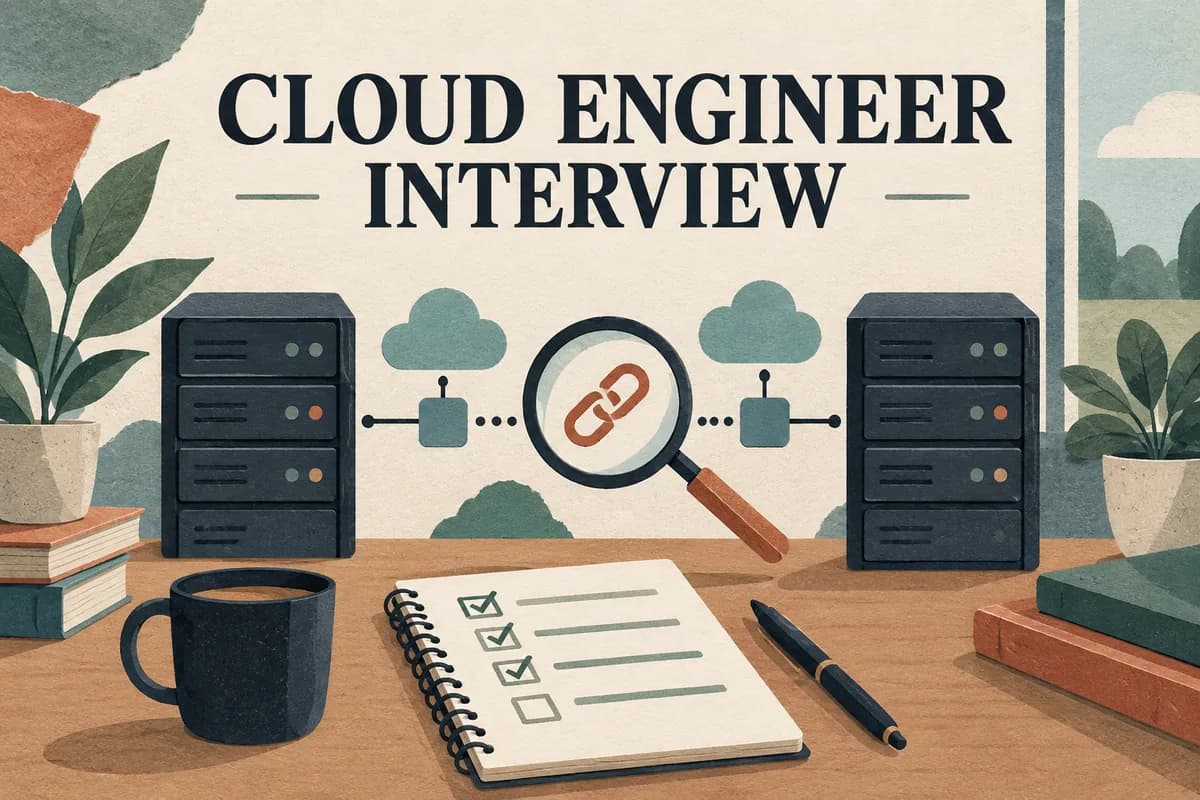
Cloud engineer interview answers should explain a workload's requirements and failure behavior before choosing services. A long list of cloud products does not establish that the design can recover, remain secure, or stay within its operating budget.
The AWS Well-Architected reliability pillar provides reliability context. The original exercises below are vendor-neutral discussion prompts, not a certified design or instructions to change a live environment.
You have backups. How do you know recovery works?
Ask what must be recovered, the acceptable interruption, the acceptable data loss, and the dependencies needed to make the application usable. Then describe a controlled restoration exercise and its success criteria.
In a fictional rehearsal, the database restores successfully but the application cannot start because a required secret is unavailable in the recovery environment. The backup worked; the service recovery did not.
An answer could be:
I would record the failed dependency, assign its recovery owner, and repeat the exercise after correcting the procedure. I would measure from the agreed recovery start point to verified user functionality, not stop the clock when the database process starts. I would keep the test isolated from production and use the approved access controls.
This distinguishes an artifact from a demonstrated capability.
Make the rehearsal evidence specific
For that scenario, sketch a short acceptance record rather than saying "run a disaster-recovery test":
| Check | Evidence you would collect |
|---|---|
| Required data is restored | A defined set of records is present and usable, with the recovery point recorded |
| Dependencies are available | The application can obtain the authorized configuration and credentials it needs |
| A representative user action works | A controlled sign-in, read, or write succeeds as appropriate to the workload |
| Recovery fits the agreed requirement | Start and finish timestamps use the same definition as the requirement |
The exercise may uncover a process failure rather than a broken backup: nobody owns restoring one dependency, or the instructions assume access that the recovery team does not have. Explain how you would assign and retest that gap. Do not claim the whole service is recoverable merely because one representative action passes; the acceptance set must reflect the workload's important functions.
A workload is unavailable in one location. What would you check?
Clarify whether the failure involves the application, data, network, identity, or a shared dependency. Do not assume adding another instance solves every failure mode.
Explain the proposed isolation boundary and the dependency that could still fail both copies. If the design includes failover, discuss how it is triggered, how correctness is checked, and who can authorize it. More regions do not automatically mean a simpler or better system.
Cloud spending rises sharply. What do you investigate?
Compare the billing period, workload volume, resource changes, and usage dimensions. Separate legitimate growth from idle capacity, repeated processing, retention changes, or unexpected traffic.
Avoid recommending deletion from a cost chart alone. Establish ownership and the consequence of changing a resource. A safe answer includes a measured change and verification that the workload still meets its requirements.
For an original practice case, imagine that monthly cost and completed jobs both doubled. Total cost rose, but cost per completed job did not. You would still investigate budget and capacity, while avoiding the unsupported claim that efficiency halved. If completed jobs stayed flat instead, look for work that increased without contributing to that output. Neither pattern identifies the cause on its own.
How would you review a permission request?
Ask which identity needs which action on which resource, for how long, and through what approval process. Explain how you would test the required access without granting broad permissions merely to make an error disappear.
Keep credentials out of interview examples. Describe the authorization model rather than sharing a real policy containing sensitive resource identifiers.
How do you make an infrastructure change safer?
Discuss review, reproducibility, a bounded rollout, and a recovery plan appropriate to the change. A configuration rollback does not necessarily undo a data change, so identify irreversible steps explicitly.
Prepare one incident and one planned improvement using technical interview preparation. Use STAR to describe your own contribution without claiming that a team-wide recovery was entirely your work.
Topics
Technical Interviews
cloud engineer interview questions
Continue reading

Technical Interviews
Business Intelligence Analyst Interview Questions With Examples
Practice BI questions about metric definitions, table grain, duplicate joins, dashboard decisions, and reconciling conflicting reports.
October 31, 2026
3 min read
Technical Interviews
Data Engineer Interview Questions With Pipeline Failure Scenarios
Practice data engineering questions about safe retries, late data, schema changes, quality checks, and backfills using explicit assumptions and validation.
October 31, 2026
3 min read
Technical Interviews
Backend Developer Interview Questions: Reliability and Trade-Offs
Practice backend interview reasoning for transactions, retried requests, authorization, slow endpoints, and background jobs with realistic failure scenarios.
September 29, 2026
3 min read